จำนวน Repository ( 156 )
การผลิตก๊าซชีวภาพจากวัสดุเศษเหลือทางการเกษตร โดยระบบหมักไร้อากาศแบบแห้ง สำหรับครัวเรือนในชุมชนตำบลเกาะขันธ์ จังหวัดนครศรีธรรมราช
This research was studied and transferred the biogas production technology with the community participation using anaerobic dry fermentation system from agricultural residues. The production of renewable energy for replacing LPG in household cooking of Koh Khan Sub-district community Cha-Uat District Nakhon Si Thammarat Province was carried out. The efficiency of the biogas production from different co-digestion material with fresh cow manure was studied for 45 days. The experiment 1 bananas and papaya and the experiment 2 rice straw and coconut meal were used for fermented materials. It was found that the system using rice straw and coconut meal as a fermented material had a higher potential than using bananas and papaya. The system produced averaged biogas of 150 L/d and an average methane content of 67.68% respectively within just 15 days after start-up. While bananas and papaya as fermented materials took more time with more than 30 days after start-up the system. The system produced averaged biogas of 120 L/d and an average methane content of 64.64%. For usability test It was found that 150 L of biogas could continuously cook for 45-60 minutes. The 85% of the technology transfer recipients regarded that the knowledge gained as practical and reduced household expenditures. Additionally the system can produce biogas for a long time without adding new fermented materials. Therefore this biogas system could be applied to local agricultural waste for biogas production which can be expanded to other areas.
อิทธิพลของสภาวะการผลิตและการเก็บรักษาต่อสมบัติทางเคมีกายภาพของพริกป่นและพริกป่นคั่ว
Development of chili powder products through consumer survey to be used as the information for the development of high quality chili powder. The quality and physicochemical properties of chili powder during storage were investigated. The sound and red pods of fresh chili were washed and blanched at 100ºC for 3 min. Blanched chili pods were soaked in 0.25% sodium metabisulfite with 1.0% citric acid for 30 min prior to drying in a tray dryer at 65°C for 14 h to obtain dried chili with a final moisture content of approximately 8%. Dried chili pods without stem were ground to obtain chili powder. Roasting before grinding resulted in the reduction of moisture aw and color values. The results of study on the quality changes of chili powder during storage showed that storage temperature was the important factor affecting the changes in physicochemical properties and percentage of consumer acceptance. Meanwhile aluminum foil packaging slowed the increase of aflatoxin content in chili powder better than polypropylene. However aerobic bacterial count of the developed chili powder product is very low compared to the microbiological specifications while yeast and mold were not detected. The product contains a standard level of aflatoxin content after 12 weeks in all storage conditions which corresponds to the awareness of consumers in terms of quality cleanliness and safety are important factors in deciding to buy chili products.
การเพิ่มประสิทธิภาพการผลิตอิฐช่องลมลวดลายอาหรับ การณีศึกษา : มุสลิมโมเดิร์น์ จังหวัดปัตตานี
The objective of this study is to improve the efficiency in manufacturing process of Arabian-style ventilation bricks with a new production method that uses a machine. The study focuses on all steps of productions in order to increase productivity. After the experiment the study shows that the improvement of ventilation brick manufacturing includes the increase in production volume from 20 pieces per day to 50 pieces per day representing an increase of 76.19 percent; and the decrease in production cycle time originally from 1401 minutes per piece to 97 minutes per piece representing a decrease of 93.07 percent respectively.
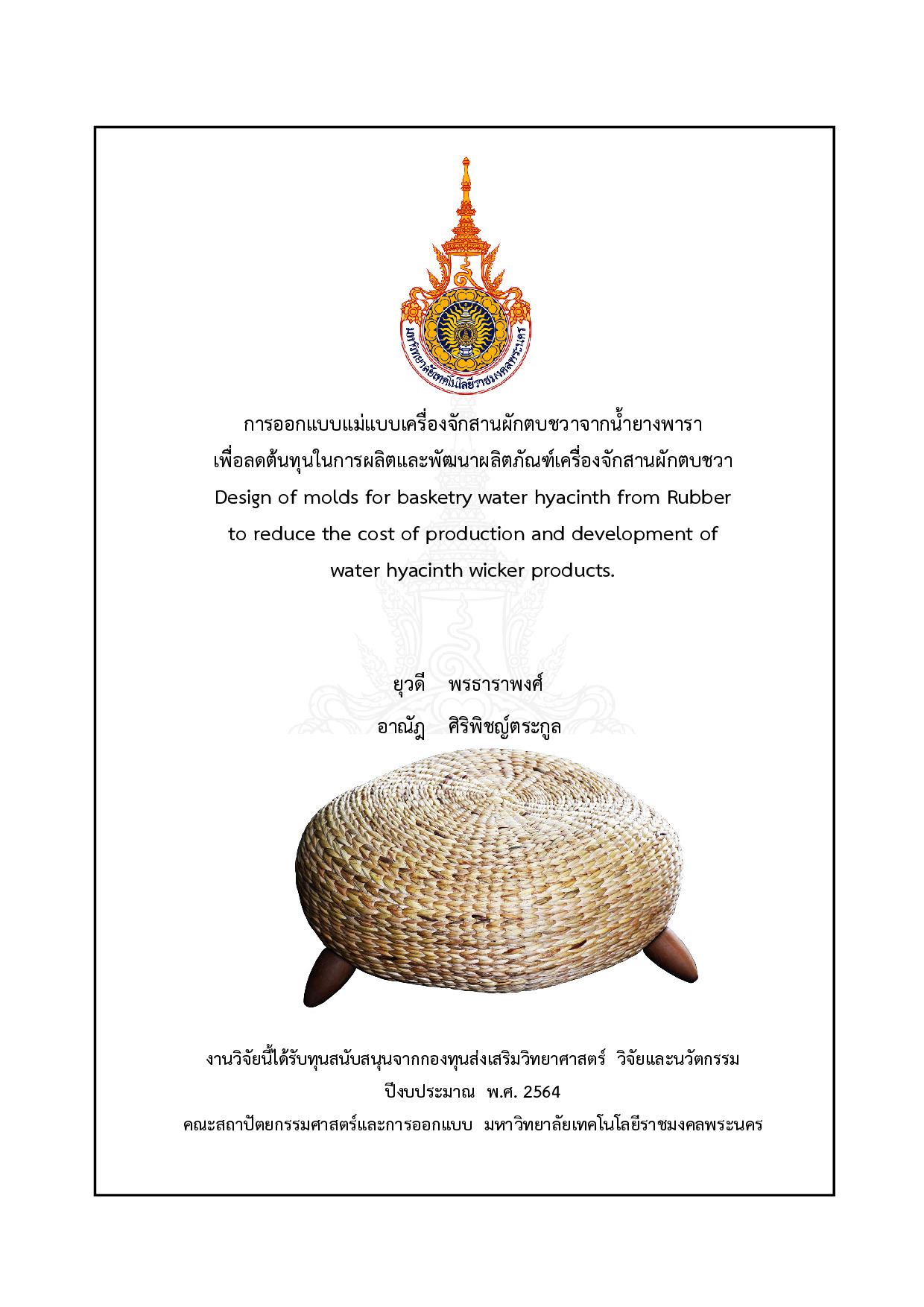
การออกแบบแม่แบบเครื่องจักสานผักตบชวาจากน้ำยางพาราเพื่อลดต้นทุนในการผลิตและพัฒนาผลิตภัณฑ์เครื่องจักสานผักตบชวา
The objectives of this research were 1) to study the design and experiment of materials for producing water hyacinth basketry templates from para rubber 2) to test the water hyacinth basketry templates from para rubber 3) to create a body of knowledge in the development of water hyacinth basketry templates. from rubber latex to the community The process of operation is to design the shape of a water hyacinth basketry to suit the use of the product first after that create a water hyacinth basketry template from para rubber by experimenting with a formula mixed with natural rubber latex and experiment with weaving vegetables. water hyacinths to find the best techniques and styles Results from research on the design of water hyacinth wicker templates from rubber latex and testing of water hyacinth wicker template designs from rubber latex. The aim is to invent materials to solve the problem of replacing the old wicker template. From the research it was found that the water hyacinth basketry model was made from rubber latex. There are two techniques for creating new templates: removable templates and removable templates. and non-removable templates Removable latex coated wicker template can produce many pieces easy to weave The wicker template part is coated with rubber latex. Non-removable or weave cover It can be used to weave as a furniture product with the properties that were discovered that it has a long service life. It is durable strong and durable. Flexibility to reduce shock during weaving. and can be a tool in the profession Can reduce the cost of producing water hyacinth handicrafts Model development part There is a design template for water hyacinth basketry which is a water hyacinth wicker product that has a shape that is exotic modern beautiful and useful according to the products unique characteristics and is a valuable work that can decorate the house beautifully.