จำนวน Repository ( 170 )
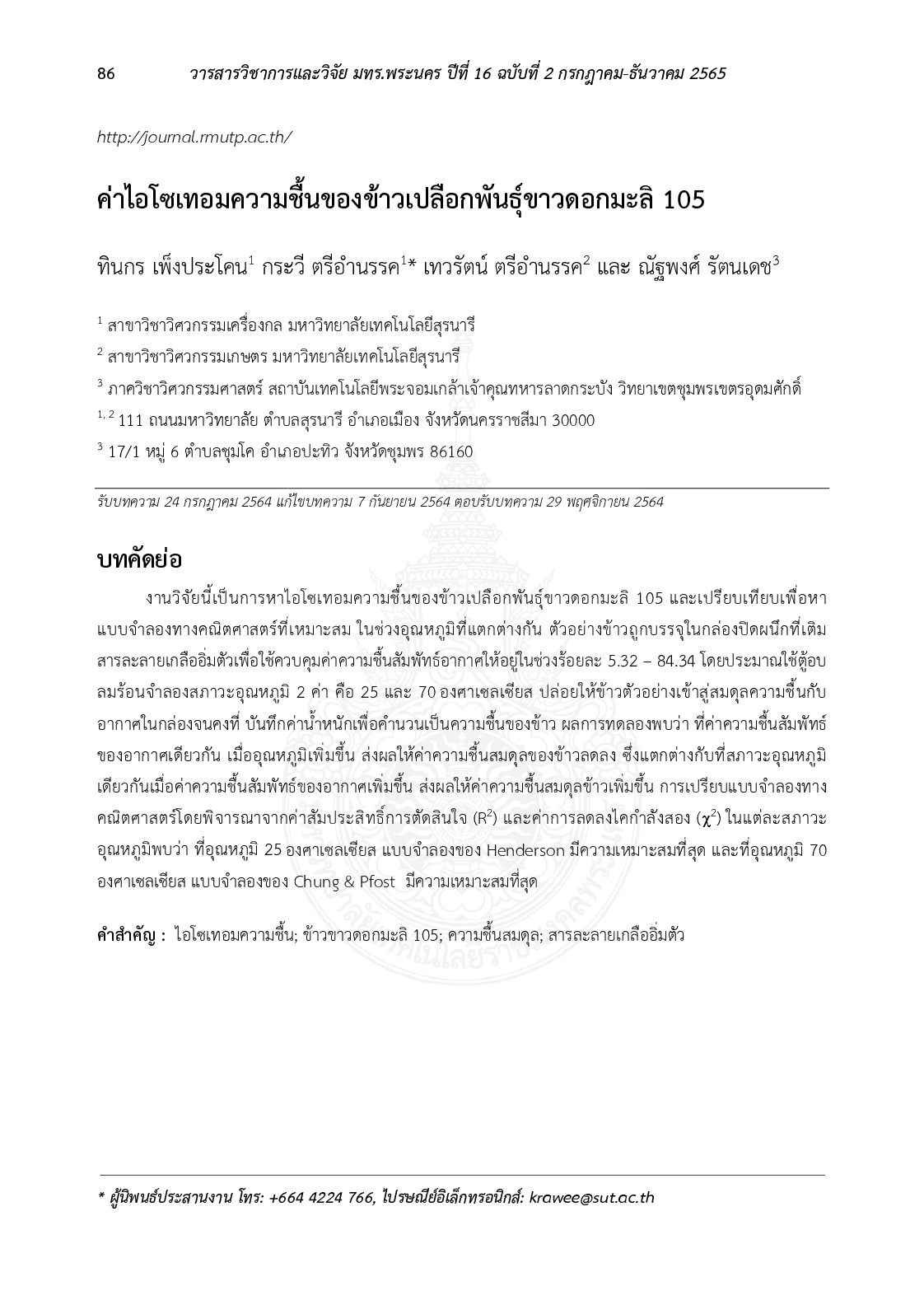
ค่าไอโซเทอมความชื้นของข้าวเปลือกพันธุ์ขาวดอกมะลิ 105
The objectives of this research were the determination of sorption isotherms and the comparison of mathematical models to determine a suitable model in different temperature ranges for Khao Dawk Mali 105. This experiment was made by placing samples in containers which were contained saturated salt solutions to control the humidity in the ranges of 5.32 – 84.34 %RH and the hot air oven was used to provide temperature conditions at 25 and 70 oC. The samples were in containers until the mass of samples was constant so the equilibrium between the samples and the surrounding was reached and then the equilibrium moisture content was determined. The experiment found that for the same relative humidity in the air when the temperature increased the equilibrium moisture content would decrease and for the same temperature in the air when the relative humidity increased the equilibrium moisture content would increase. Furthermore the comparison of models by analysis from R-Squared (R2) and Chi-Square (χ2) in each temperature found that Henderson model was a suitable model at 25 oC and Chung & Pfost was a suitable model at 70 oC.
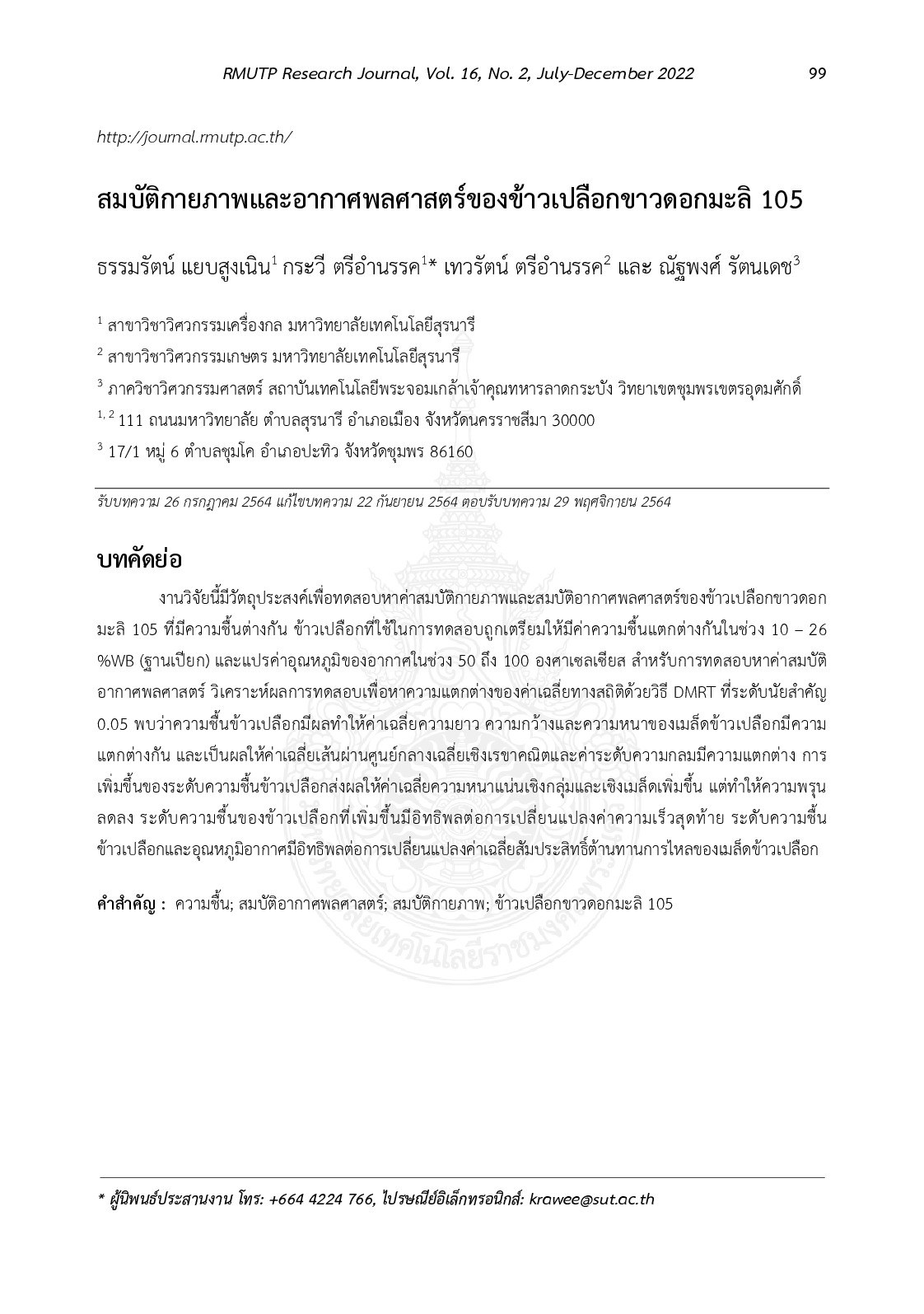
สมบัติกายภาพและอากาศพลศาสตร์ของข้าวเปลือกพันธุ์ขาวดอกมะลิ 105
This research objective was to determine physical and aerodynamics properties of Khao Dawk Mali 105 paddy (Thai Jasmine paddy rice). The paddy sample in this test was prepared with different moisture contents in the range of 10-26%WB and air temperature in aerodynamics properties test was varied in the range of 50–100 OC. Test results were analyzed to determine the statistical mean difference by DMRT method (at P<0.05). It found that moisture content in paddy affects the difference of average length width and thickness of grain and results the difference of geometric mean diameter and degree of sphericity of paddy. An increase in paddy moisture results the increase of average bulk density and kernel density but it reduces the porosity of paddy. Moisture content in paddy affects the difference of terminal velocity. Moisture content in paddy and air temperature influenced the difference of average drag coefficient of paddy.
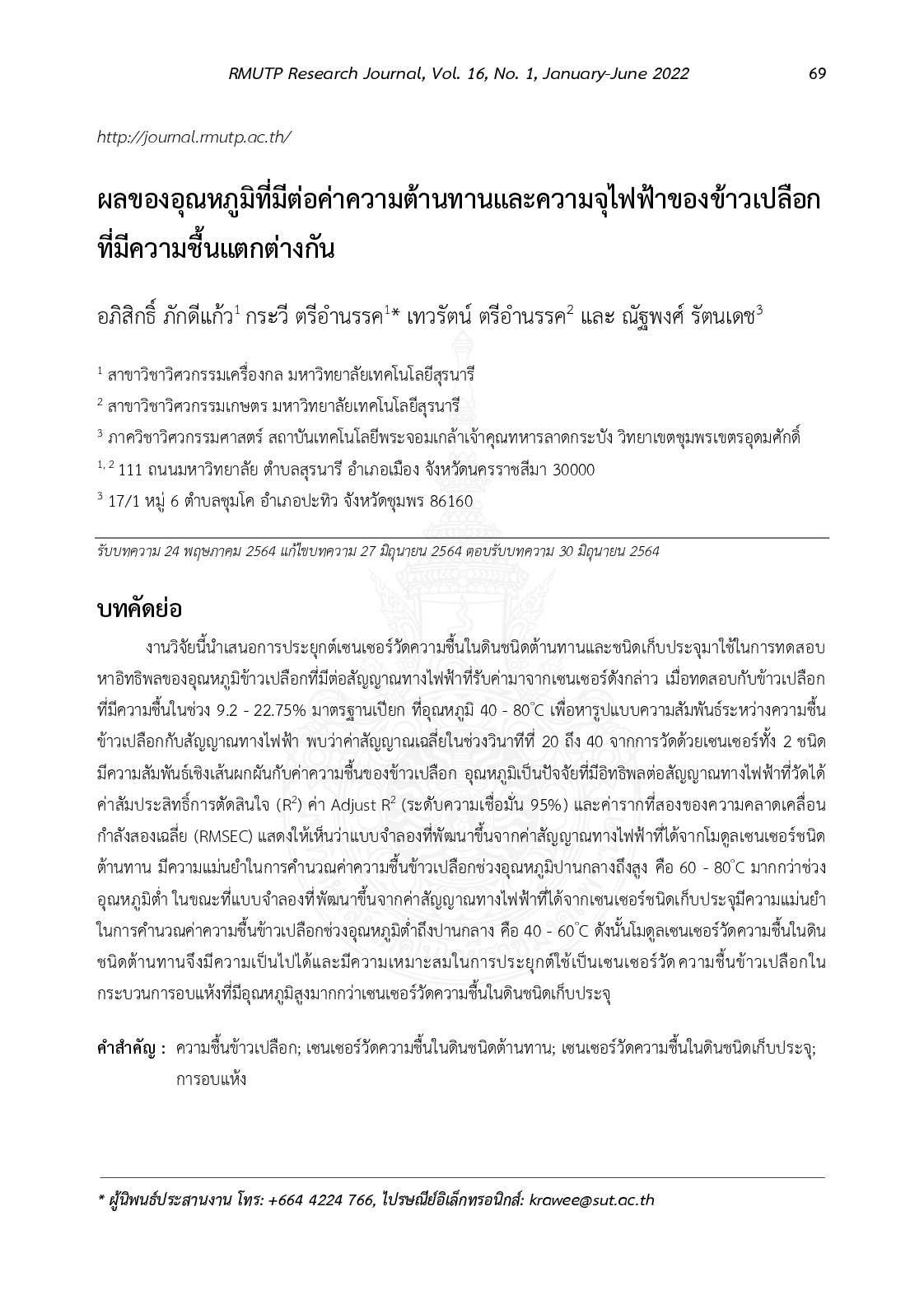
ผลของอุณหภูมิที่มีต่อค่าความต้านทานและความจุไฟฟ้าของข้าวเปลือกที่มีความชื้นแตกต่างกัน
This research proposes an application of resistive and capacitive soil moisture sensors to investigate the influences of paddy temperature on the electrical signal received from sensors when tested with paddy moisture in the range 9.2 - 22.75%wb at 40 - 80ºC to determine the relationship between paddy moisture and electrical signals. It was found that the mean signal values between 20 - 40 seconds from both sensors were inversely linear correlation with the moisture content of the paddy. Temperature is the factors that influence the measured electrical signal. R2 Adjust R2 (95% confidence interval) and RMSEC showed that the model developed from the resistive sensor signals was accurate in calculating the moisture content of paddy between medium to high temperature in range 60 - 80ºC more than the low temperature range. While the capacitive sensor signals model is accurate in calculating paddy moisture between low to medium temperature in range 40 - 60 ºC. Therefore the resistive soil moisture sensor is possible and more suitable for applying as a paddy moisture sensor in the high temperature drying processes than a capacitor soil moisture sensor.
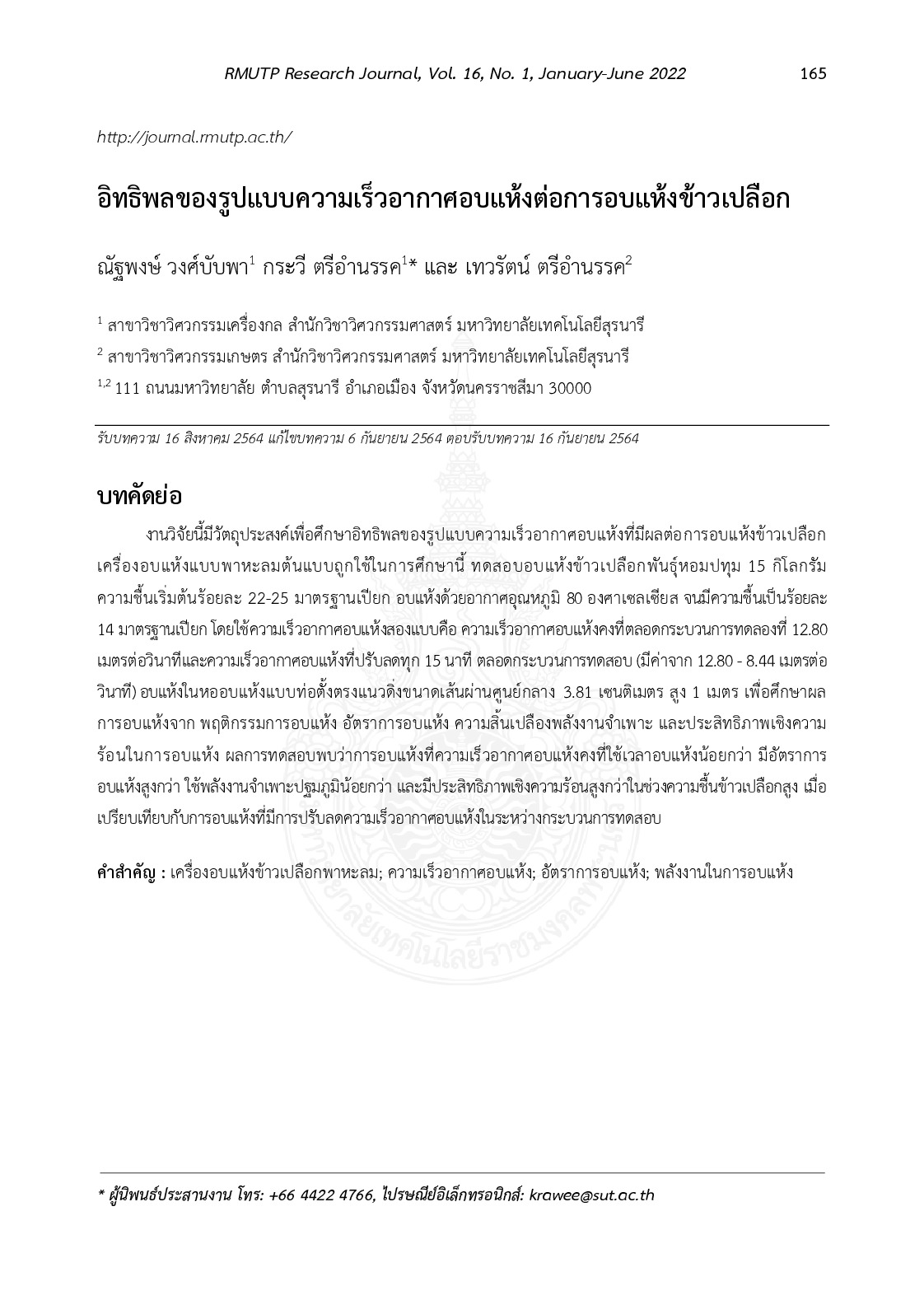
อิทธิพลของรูปแบบความเร็วอากาศอบแห้งต่อการอบแห้งข้าวเปลือก
The objective of this research was to study the influence of drying air velocity characteristics on paddy drying. The pneumatic dryer prototype was used in this study. Test drying 15 kg of Hom Pathum paddy at 22 – 25% initial wet basis moisture content was tested drying under the drying air temperature 80OC until its moisture is 14% wet basis with the two drying air velocity characteristics. The first characteristic of drying air velocity is constant at 12.80 m/s and another is reduced velocity every 15 minutes throughout the test process from 12.80 - 8.44 m/s. Drying in a vertical tube with a diameter of 3.81 cm and height 1 m for study the drying behavior drying rate (DR) specific energy consumption (SEC) and thermal efficiency of drying. The results showed that drying with constant air velocity gives a shorter time higher drying rate lower primary SEC consumption and higher thermal efficiency than drying with reducing air velocity.
การใช้แป้งข้าวกล้องทับทิมชุมแพทดแทนแป้งข้าวเจ้าในขนมเรไร
The objectives of this study were 1) to study the basic recipe of Khanom Raerai and 2) to study the substitute amount of rice flour by using Tubtim Chumphae Brown rice flour in Khanom Raerai at four different levels of 0% 40% 50% and 60% by total rice flour weight. Randomized Complete Block Design (RCBD) to apply the sensory quality in terms of appearance color odor texture and overall preference using a 9-Point Hedonic Scale tasting method tasted by 40 untrained students from Foods and Nutrition Program Faculty of Home Economics Technology Rajamangala University of Technology Phra Nakhon. The data was verified by mean Analysis of Variance (ANOVA) and then compared the mean difference at a 0.05 confidence level by using Duncans New Multiple Range Test (DMRT) method. The results were analyzed by a computer software program. The results found that 1) the basic Khanom Raerai recipe made from rice flour tapioca flour arrowroot flour soybean oil and water was 27.25% 1.63% 1.63% 4.09% and 65.40% by total ingredients weight. The tasters verified the sensory quality in appearance color odor texture and overall preference. The mean values were 7.80 7.40 7.27 7.67 and 7.93 respectively at a moderate level of liking. The results found that almost all sensory aspects were significantly different at the 0.05 level except for color and odor. 2) the amount of Tubtim Chumphae brown rice flour substitutes for rice flour in Khanom Raerai it was found that the tasters accepted 40% by weight of rice flour in terms of appearance color odor texture and overall preferences. The mean values were 8.60 8.20 8.40 8.33 and 8.67 respectively at the level of liking the most. The sensory results found that all sensory characteristics were not different at the 0.05 level. Therefore the Khanom Raerai recipe uses Tubtim Chumphae brown rice flour substitutes for rice flour at the 40% level as the formula accepted in this study.