จำนวน Repository ( 6 )
น้ำพริกผงโรยข้าวเจเสริมเม็ดแปะก๊วย
Vegetarian rice seasoning supplement with ginkgo seeds is an alternative product for health-conscious consumers as well as adds value to ginkgo seeds. In this research the basic formula of rice seasoning was selected and developed into a Vegetarian rice seasoning supplement with ginkgo seeds at 0 25 50 75 and 100 percent of the total amount of ingredients. The 3 basic formulas were prepared and were conducted the sensory evaluation in terms of appearance colour smell taste texture and overall liking. It was found that the panelists gave the highest acceptance score on basic formula No. 1 for all aspects significantly (p<0.05). Therefore this formulation was supplemented with ginkgo seeds at different levels (0-100%). From sensory testing by 50 panelists rice seasoning supplement with ginkgo seeds 50% showed the highest satisfaction score in all aspects (p<0.05). The appearance was included smaller pieces of golden yellow ginkgo seeds with crispy texture. This product still preserved the smell of chili paste mixed with the smell of ginkgo. The taste is mellow and lighter than that of the basic recipe. The nutritional value in terms of total energy carbohydrates fats of rice seasoning supplement with ginkgo were slightly close to that of the basic vegetarian rice seasoning. In addition the color values (L* a* b*) moisture content and water activity (aw) of rice seasoning supplement with ginkgo seeds at 50% were higher than those of the basic formula (p<0.05). From this resulted it may be used as a guideline for the development of other rice seasoning or other foods to enhance nutritional value with ginkgo seeds as well.
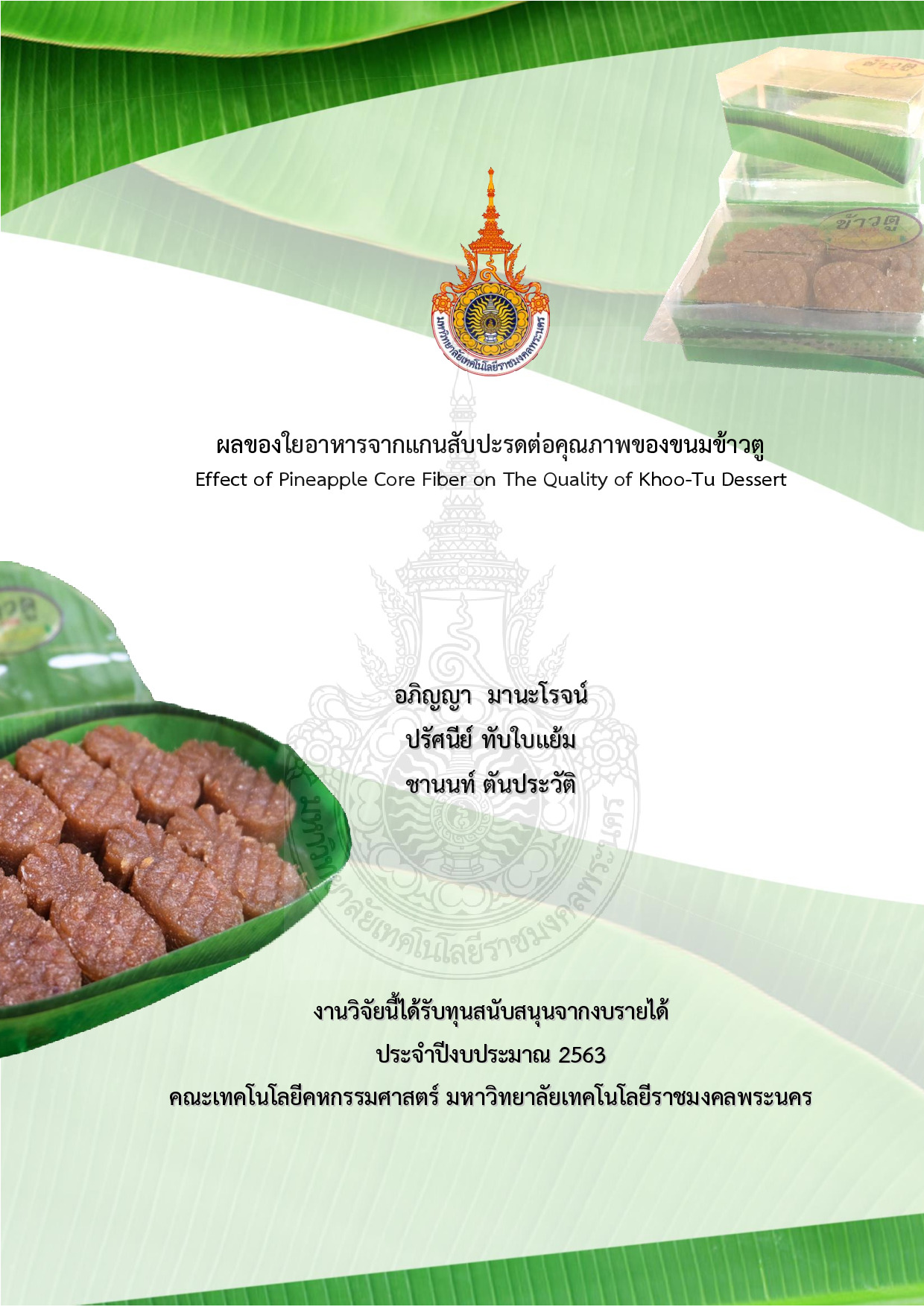
ผลของใยอาหารจากแกนสับปะรดต่อคุณภาพของขนมข้าวตู
These research objectives are to study the basic formulas of Khoo-Tu dessert (dried rice balls made from rice and coconut) and to study the volume of pineapple cores instead of coconut in Khoo-Tu. The test of Khoo-Tu dessert basic formulas by 9 - point hedonic scale method of 50 examiner laboratory the results show acceptance rated on a moderate scale (7). After that substituting coconut with pineapple core the amount of 0 25 50 75 and 100 of the weight coconuts.It was found that at 75% of the substitution level the tasters evaluated the greatest acceptance (p> 0.05). The basic formulas had a pH of 6.24 the Pineapple core formulas 5.94 (p> 0.05). Water Activity (aw)of Khoo-Tu the basic formula was 0.85 and the pineapple core formula was 0.90 (p> 0.05). The color value of the pineapple core Khoo-Tu was L * (brightness value) (37.31) b * (yellowness value) (9.45) rather than the basic formula Khoo-Tu (p> 0.05). The nutritional value of the pineapple core Khoo-Tu was 316 Kcals protein 2.71 % fat 8.86 % ash 0.52 % carbohydrates 56.3 % dietary fiber 3.99 % insoluble fiber 3.60 % and 0.39% of water-soluble dietary fiber that was found in the pineapple core Khoo-Tu to provide lower nutritional value than basic formula Khoo-Tu. The microbiological quality of basic formula and pineapple core formula was found that the total variable count fungi and bacillus serous were less than 10 colonies / 1 g sample and staphylococcus aurias were not found in both samples. The shelf life of rice (Room temperature) found that the basic recipe was 12 days and the pineapple core recipe It has a shelf life of 6 days. At chilled temperature (4 degrees Celsius) it was found that the basic formula and pineapple core formula had a shelf life of 25 days with all microorganisms less than 1 x 10⁴ colonies/sample 1 gram fungus less than 100 colonies /1 gram sample and All microorganisms and fungi exceeded the standard on the 28th day.

การใช้ลูกหนามแดงทดแทนบางส่วนในผลิตภัณฑ์น้ำพริกมะขาม
The objective of this research to study the basic formulas of tamarind paste products. The results of the study were as follows. The evaluated for likeness as 9-point hedonic scale by an untrained 50 member panel. Consumers rate the taste of tamarind paste at a very like level (8). Subsequently Tamarind substitution of 25 50 and 75% by weight of tamarind was found at the level of 75% substitution. Basic tamarind paste has a pH value of 4.20. Tamarind with karanda of 4.49 (p <0.05). Basic tamarind paste has water activity (aw) of 0.81 and tamarind with karanda of 0.83 (p> 0.05). The color of the basic tamarind paste was L * (brightness) (37.0) a * (redness) (5.26) b * (yellow) (12.28) (P> 0.05) The chemical compositions of tamarind with karnda were 237 kilocalories of total energy 10.7 percent of protein 11.5 percent of fat 10.7 percent of ash 4.77 percent of carbohydrates 23.7 percent of dietary fiber 5.20 percent of moisture 49.3 percent Iron content 1.71% total phenolic compounds 1.49 mg / g gallic acid and antioxidant activity 4.6
การใช้แป้งกล้วยทดแทนแป้งสาลีบางส่วนในผลิตภัณฑ์ขนมสาลี่กรอบ
This research aimed to investigate the basic recipe product the quantity of banana flour that used instead wheat flour in Thai crispy sponge cake (Sa Lee Krob) and the nutrition value of Sa Lee Krob. 50 samples were expert lecturers from the department of food and nutrition the department of food science and nutrition and the department of industrial food service the faculty of Home Economics Technology Rajamangala University of Technology Phra Nakhon. 9- point hedonic scale was used in this study. The result found that the basic of 3th recipe (Bloggang 2018) was acceptable as the standard recipe. There were 4 levels of the substitution of banana flour for wheat flour; 0% 10% 20 % and 30%. 10% was acceptable for the appearance color flavor taste texture and overall liking. The average scores were 7.94 7.92 8.22ม 7.90 and 8.08 respectively. For the color of the basic Sa Lee Krob L* (brightness value) a* (redness value) and b* (yellow value) were different from Sa Lee Krob which is substituted with banana flour (p≤0.05) For the texture of basic recipe of Sa Lee Krob the hardness value was harder than Sa Lee Krob which was substituted with banana flour. The flexibility value ability to combine stickiness value and Chewing resistance value were not significantly different (p>0.05). The nutritional aspects of the basic Sa Lee Krob and the quantity of banana flour substituted wheat flour found that provided less energy but more fiber. The more ash showed that banana flour provided more quantity minerals. Minerals found in banana include potassium magnesium phosphorus and calcium.
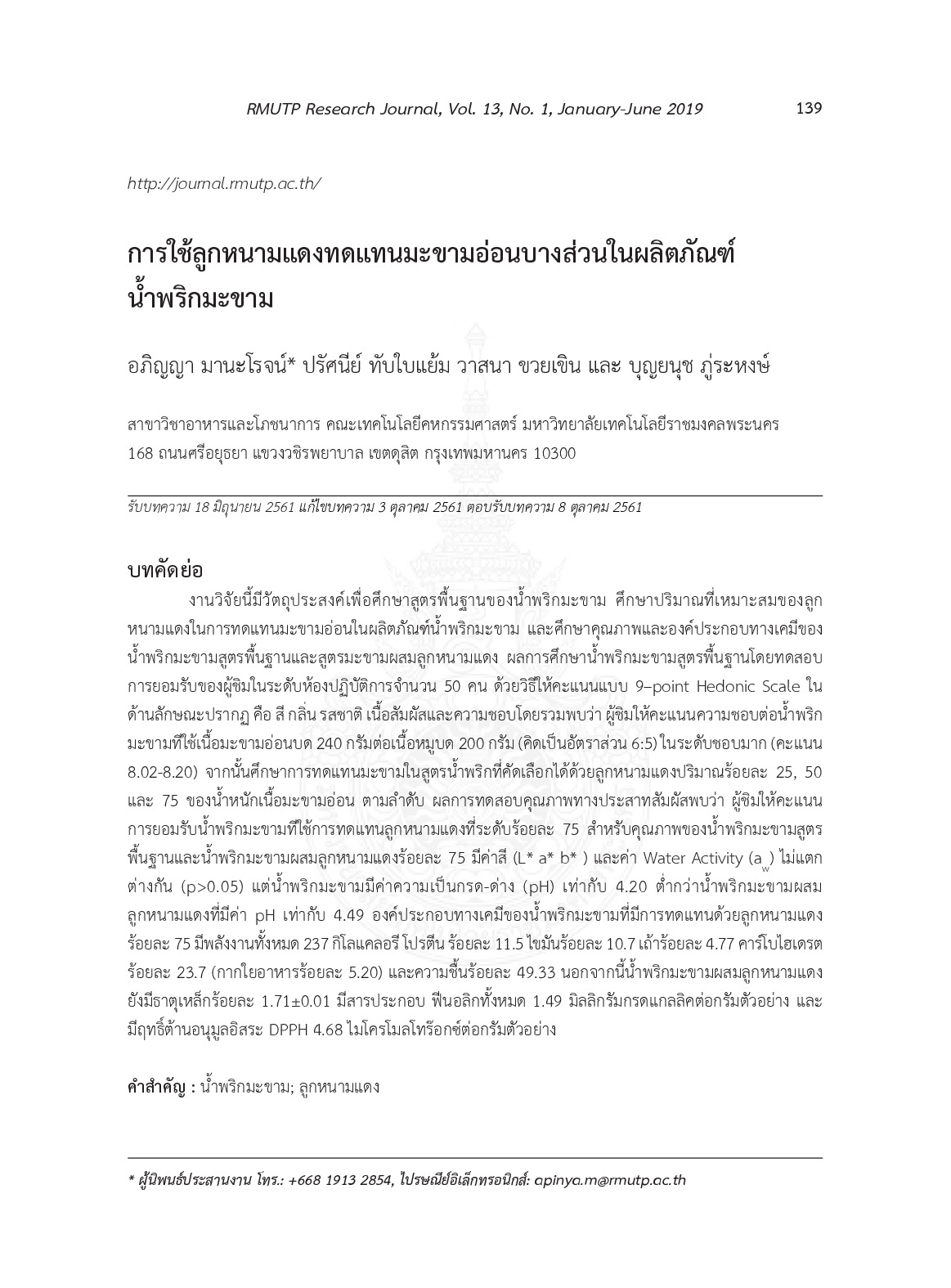
การใช้ลูกหนามแดงทดแทนมะขามอ่อนบางส่วนในผลิตภัณฑ์น้ำพริกมะขาม
This study was to investigate: the basic recipe of tamarind chili paste the suitable proportion of karonda fruit that used instead of young tamarind in the product of tamarind chili paste the quality and the chemical properties of tamarind chili paste and the basic recipe and recipe of tamarind mixed with karonda fruit. The result of the basic recipe of tamarind chili paste was acceptable by 50 samples and the 9-point hedonic scale was used in this study. For the appearance color smell flavor texture and overall taste the respondents rated the taste for tamarind chili paste that 240 gram of young tamarind ground per 200 gram pork ground (6:5 ratio) with the very high level score (8.02-8.20). Then study the substitutions of tamarind with karonda fruit that used 25% 50% and 75% of the young tamarind weight respectively. The result of sensory test found that respondents acceptably rate was 75% of using karonda fruit instead of tamarind in tamarind chili paste. For the quality of the basic tamarind chili paste recipe and the use karonda fruit instead of tamarind chili paste 75% color values (L * a * b *) and water activity (aw) were not significantly different (p>0.05). But tamarind chili paste shows that pH 4.20 that is lower than tamarind chili paste mixed with karonda fruit pH 4.49. The chemical composition of tamarind chili paste that substituted with karonda fruit 75% provides energy 237 kcal protein 11.5% fat 10.5% ash 4.47% carbohydrate 23.7% (fiber 5.20%) and moisture content 49.33%. Moreover tamarind chili paste mixed with karonda fruit contents iron 1.71±0.01% Phenolic content 1.49 mg GAE/g extract and it has antioxidant activity DPPH 4.68 umole Trolox/g extract.