จำนวน Repository ( 49 )
การพัฒนาของที่ระลึกด้วยการแกะสลักสบู่ในรูปแบบผักเครื่องจิ้ม
The objectives of this research are to study the Development of Souvenirs from Soap Carving as Dipping Vegetables. the researcher aimed to investigate the target group’s satisfaction on Souvenirs from Soap Carving as Dipping Vegetables. The researcher examined five methods of soap making from plentiful soaps and then the researcher designed one drafting of soap carving method and determined the size of container for containing carved soap types of vegetable patterns of leaf patterns of flower dipping sauce container and dyeing colors. Then these aforementioned details of soap carving were considered by five experts and they chose the method of soap making and overall patterns for developing of a carved soap product as a souvenir adapting the technique of dipped vegetable carving. After that the products were the instrument for observing target’s group satisfaction amount 100 participants. The data were analyzed as means percentage and standard deviation. The results revealed that. Most experts have chosen the soap type no.5 given that soap texture is fine smooth sticky. The Almost of experts chose the 8 inches diameter of sphere containers. The vegetables that were chosen for carving were long cucumbers cucumbers carrots eggplants Thai eggplants white eggplants white turmeric and long beans. For the leaves carving the patterns of leaves were grooving and stencil. The patterns of flowers carving were single layer flower pattern alternating flower pattern and long shaped flower pattern. Along with the pattern of container carving for chilling paste was the container with lid pattern and the colors for soap painting was batik dyeing color. The satisfaction level of the target group toward the product The highest level of an average of 4.82 for the elegance of the product. The creativity of the materials is at the highest level of an average of 4.74. The value and utility of the product for a souvenir are at the highest level with an average of 4.90.
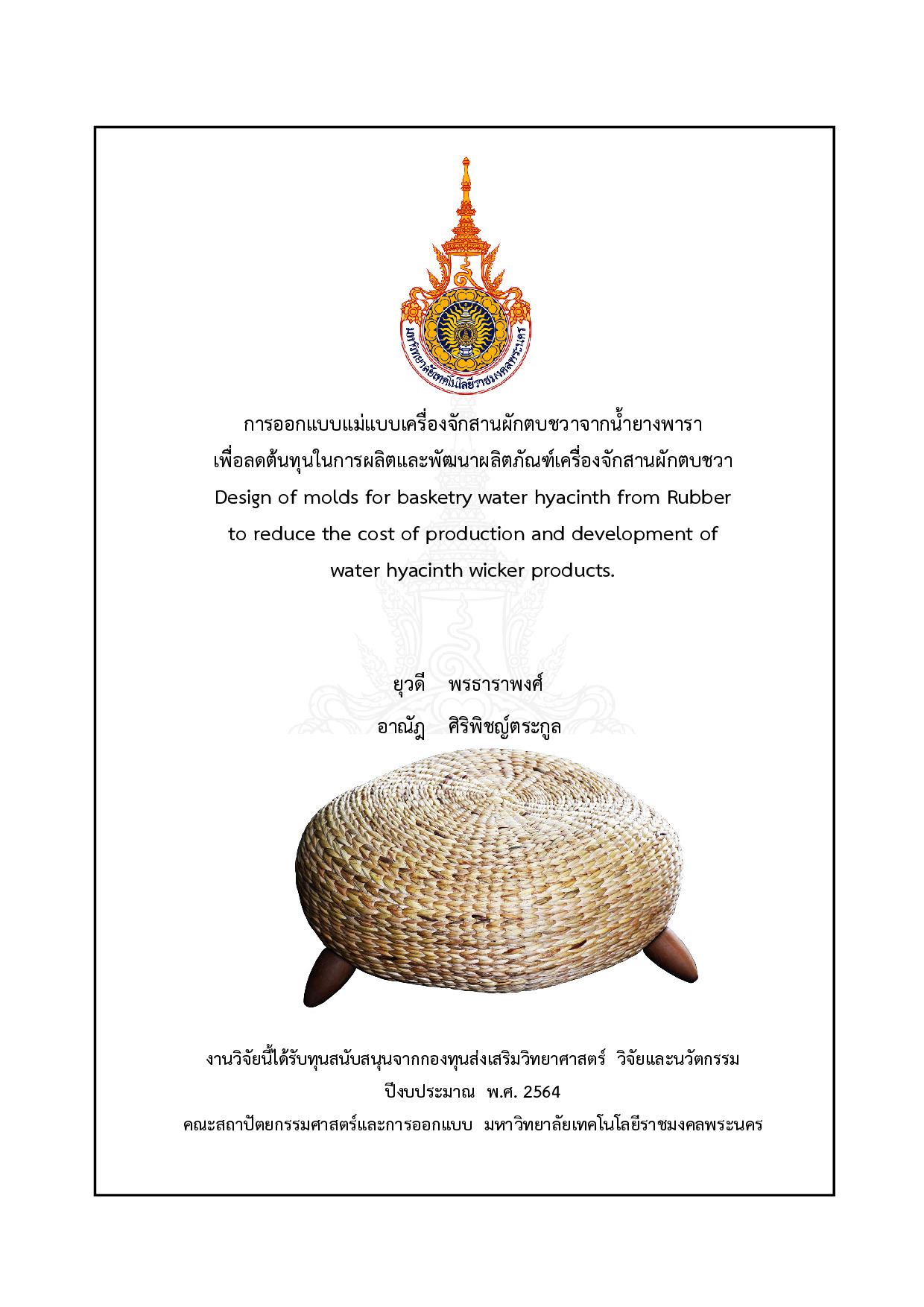
การออกแบบแม่แบบเครื่องจักสานผักตบชวาจากน้ำยางพาราเพื่อลดต้นทุนในการผลิตและพัฒนาผลิตภัณฑ์เครื่องจักสานผักตบชวา
The objectives of this research were 1) to study the design and experiment of materials for producing water hyacinth basketry templates from para rubber 2) to test the water hyacinth basketry templates from para rubber 3) to create a body of knowledge in the development of water hyacinth basketry templates. from rubber latex to the community The process of operation is to design the shape of a water hyacinth basketry to suit the use of the product first after that create a water hyacinth basketry template from para rubber by experimenting with a formula mixed with natural rubber latex and experiment with weaving vegetables. water hyacinths to find the best techniques and styles Results from research on the design of water hyacinth wicker templates from rubber latex and testing of water hyacinth wicker template designs from rubber latex. The aim is to invent materials to solve the problem of replacing the old wicker template. From the research it was found that the water hyacinth basketry model was made from rubber latex. There are two techniques for creating new templates: removable templates and removable templates. and non-removable templates Removable latex coated wicker template can produce many pieces easy to weave The wicker template part is coated with rubber latex. Non-removable or weave cover It can be used to weave as a furniture product with the properties that were discovered that it has a long service life. It is durable strong and durable. Flexibility to reduce shock during weaving. and can be a tool in the profession Can reduce the cost of producing water hyacinth handicrafts Model development part There is a design template for water hyacinth basketry which is a water hyacinth wicker product that has a shape that is exotic modern beautiful and useful according to the products unique characteristics and is a valuable work that can decorate the house beautifully.
การผลิตวัสดุปรับปรุงดินจากเศษอาหารและผักตบชวาด้วยกรรมวิธีดีไฮเดรชั่น
The purpose of this study is to produce the soil improvement materials from food waste and water hyacinth by using a dehydration process. The experiments were divided into two parts : 1) the study of the optimum temperature and time for converting food waste and water hyacinths to soil improvement materials by determining the temperatures of 100 °C 150 °C and 200°C in the periods of 1 hour 2 hours and 3 hours respectively 2) the study of nutrient content in the materials before and after mixing into the soil for 5 days. The soil used in the experiment was sampled from Sai Ma Subdistrict Nonthaburi Province. The parameters used to evaluate the ability to improve the soil quality were soil moisture pH electro conductivity total nitrogen total phosphorus total potassium and organic matter. The results showed that the optimum temperature for drying the food waste was 150°C for 2 hours and the optimum temperature for drying the water hyacinth was 200°C for 3 hours. When the materials were mixed into soil it found that the soil drainage was improved. Mixing the materials into soil could increase the pH value from 5.2 to 5.4 and increase the electrical conductivity from 0.72 mS/cm to 14.78 mS/cm. Besides the plant nutrients including Nitrogen phosphorus and potassium also increased after adding soil improvement materials.
ผลิตภัณฑ์นมเปรี้ยวจากผักผลไม้สูตรลดน้ำตาล
The objective of this research was to develop ready- to- drink yogurt products from mixed fruits and vegetables. By starting with studying the stability level of basic yogurt formula In gelatin is added in 3 levels of basic yogurt products to be used as ingredients in fixed basic yogurts 2 4 and 6 percent with other components in the formula: Pasteurized milk natural flavored yogurt granulated sugar and gelatine Studies have shown that using basic formula yogurt with 4 percent stability is the right amount for making basic stable yogurt. Which the yogurt has 21 solids soluble in water white light yellow The texture of the yogurt is stable. After that mix yoghurt and fruit and vegetable juice to produce curdled milk. By studying the ratio of basic formula yogurt and fruit and vegetable juices in 3 different ratios namely 30:70 50:50 and 70: 30 percent. The quality test results showed that 50: 50 percent formulas had the pH 4. 37 the amount of solids that Soluble in 15 ◦Brix water and are the most accepted formulas. Analyzing the chemical composition thisreducedsugar drinking yoghurt from fruits and vegetables had moisture ash fat protein fiber protein and carbohydrate was found to be 86.81 ± 2.83 0.40 ± 0.32 0.37 ± 0.23 3.02 ± 0.77 0.14 ± 0. 26 and 9. 25 ± 0. 41. Stored at 4 ± 1 ° C for 15 days found that total microbial count yeast mold And coliforms do not exceed the standards set (Notification of the Ministry of Public Health 353/2013)
การตรึงอะโซโตแบคเตอร์แบคทีเรียตรึงไนโตรเจนในอากาศด้วยวัสดุธรรมชาติและผลต่อการเจริญเติบโตของผักกวางตุ้งในดิน
Nitrogen is an essential nutrient for plant growth. When the plants have been grown for a long-term effect to decreased nitrogen in soil and insufficiency of the plant growth. One biological method for increasing the nitrogen content in soil is utilize of free nitrogen-fixing bacteria Azotobacter. Therefore the objective of this research was to search natural material suitable for Azotobacter fixation. The 10 natural materials were observed physical structure and investigated the ability of natural materials for Azotobacter fixation. The results showed that water hyacinth and bagasse stalks were fixed the Azotobacter of 2.43x10⁸ and 1.94 x10⁸ CFU per gram of each natural material respectively. After that the selected fixed Azotobacter of water hyacinth and bagasse stalks were studied the growth of Brassica Chinensis. This experiment was designed to 4 treatments. The first treatment was mixed of water hyacinth stalks and the Azotobacter. Second treatment was mixed of bagasse stalks and the Azotobacter. The third treatment was the Azotobacter only. The last treatment was soil only. The results indicated that the average of plant growth include height leaf number root length fresh weight and dry weight of the mixed of water hyacinth stalks and the Azotobacter had significantly higher growth rates than other treatments. The total nitrogen was also increased 1.4 fold in the soil. All results suggest that the water hyacinth stalk is alternative for the fixation of the free nitrogen-fixing bacteria Azotobacter as induce nitrogen in the soil and plant growth promotion.