จำนวน Repository ( 268 )
การเปรียบเทียบภาระขาดของรอยเชื่อมผ้าทอทางสถาปัตยกรรมจากการเชื่อมลมร้อนและเหนี่ยวนำ
Architectural fabrics were continuously developed on their unique performance. Architects and Engineers designed them for the application of important buildings around the world despite the symptom that Architectural fabric sizes from manufactures are smaller than the application sizes. Recently although the well-known method used to weld Architectural fabrics to enlarge their size is the high frequency welding there were some application issues. To mitigate those issues the researcher created the hot air welding to replace the high frequency welding in consideration on the failing loads of welded seams which are variable factors of the failing loads to indicate the weld strength and it is crucial for the Architectural fabric application. This research presents the comparison of failing load of weld seams between the hot air welding and high frequency welding by the test of Taguchis Orthogonal arrays L25 method. The test results demonstrated that Architectural fabrics welded by the hot air welding has the highest failing loads of wrap equal to 95.38 kN/m and the highest failing loads of weft at 86.17 kN/m. Conversely Architectural fabrics welded by the high frequency welding has the highest failing loads of wrap equal to 101.37 kN/m and the highest failing loads of weft at 97.78 kN/m. Based on a forementioned results there is no significant difference from both welding methods and thus concluded that the hot air welding could be used to replace the high frequency welding method.
การพัฒนาผลิตภัณฑ์กระเป๋าสตรีผ้าไทยทรงดำ
The objectives of this study and product development of Thai Song Dam fabric womens bags were to study the cultural identity of the Thai Song Dam people to develop womens bags made from Thai Song Dam fabric and to study the satisfaction with the development of Thai Song Dam women bags products. The research instruments were an interview and a questionnaire for 80 women who were interested in Thai Song Dam fabric bags. The data were analyzed using a statistical package program such as frequency percentage mean and standard deviation. The results of the study on cultural identity of the Thai Song Dam people found that the dresses and souvenir products of the Thai Song Dam people have the most unique patterns to decorate the fabric which is embroidered with Piao flowers pattern. As for the development of bags made from Thai Song Dam fabric it was found that Thai Song Dam women’s bag are not produced. The researcher therefore studied by applying the patterns of womens bags that are popular today and applying the embroidered with Piao flowers patterns that are the identity of the Thai Song Dam people. As for the satisfaction towards the product development of Thai Song Dam womens bags it was found that overall product development satisfaction was at the highest level (x = 4.75 S.D. = 0.90). The overall satisfaction in sewing products was at the highest level (x = 4.64 S.D. = 0.39) and the overall bag product satisfaction was also at the highest level (x = 4.88 S.D. =0.32).
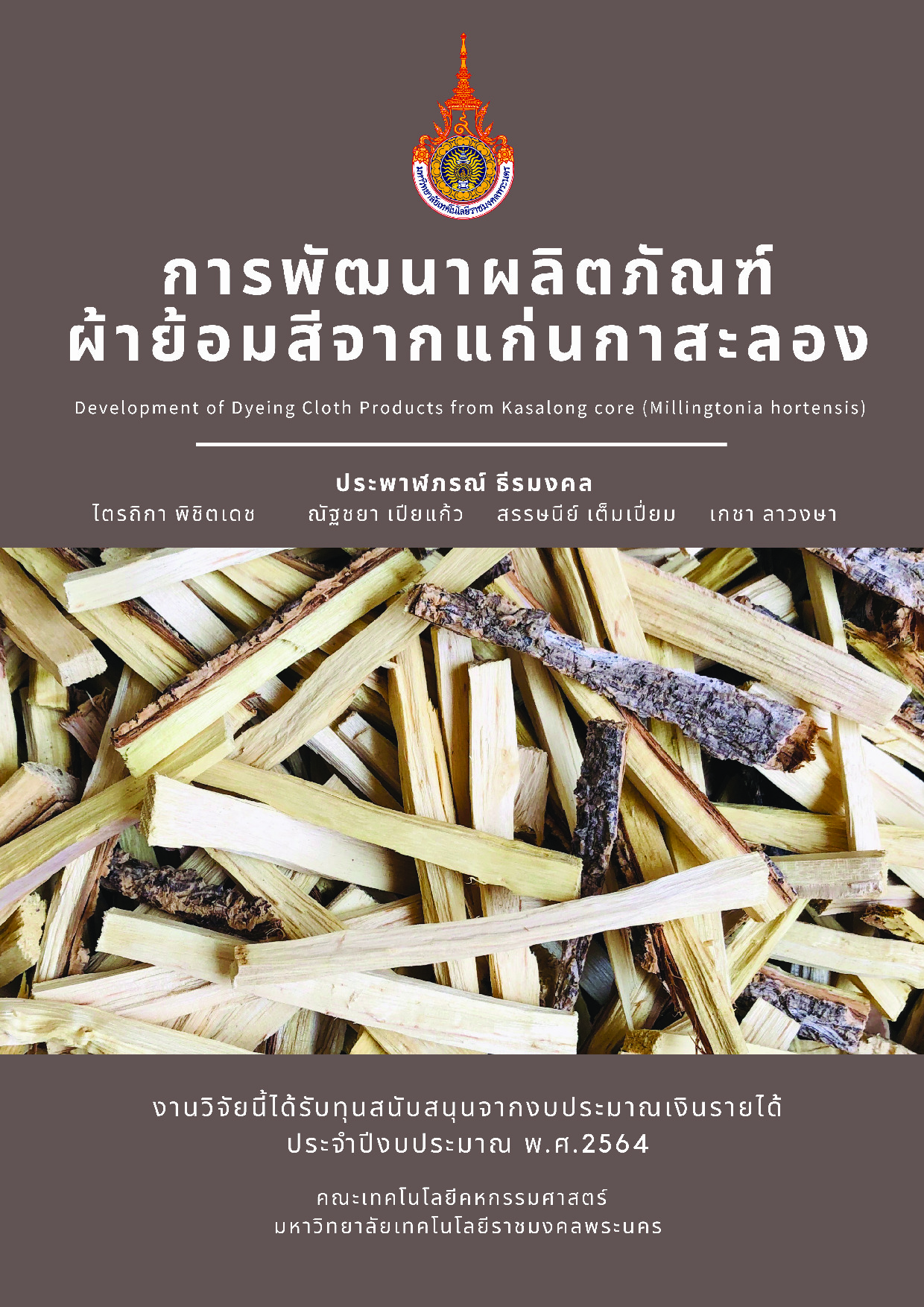
การพัฒนาผลิตภัณฑ์ผ้าย้อมสีจากแก่นกาสะลอง
Promotion of handicrafts in the field of natural dyes in the country. Increase the potential of the community and use the strengths of the cultural community. way of life and wisdom by finding ways to develop textile products by using creative textile innovations based on local wisdom in sustainable community areas To add added value to products in the ECO PRODUCT and ZERO WASTE product groups from the aforementioned concept To conserve plant genetics that exist throughout the country. The researcher therefore studied the process of dyeing fabrics by natural methods. By taking natural ingredients that are locally available and transforming them into environmentally friendly home products. This research is to study the natural dyeing of cotton fabric from Kasalong core. have a purpose Study on the effect of dyeing and the use of adjunctive agents in natural dyeing from Kasalong kernels. To develop dyed fabric products from Kasalong core and to pass on the knowledge and technology of developing dyed fabric products from Kasalong core for the general public. The result of dyeing cotton with natural dyes from Kasalong core. Four types of adhesives were used at a concentration of 20 percent as tamarind juice lime juice lime juice ash water and to test the washing fastness and sunlight resistance with the AATCC standard. The results can be summarized as follows. 1. The results of the study found that from the extraction of color from Kasalong kernels and then filtered with cloth. The color water extracted from Kasalong essence is brown. and when left for 24 hours the water color is dark brown and in this research using hot dyeing methods. 2. The result of dyeing cotton with natural dyes from Kasalong core without mordant using was found to yellow-brown but after washing the color intensity on the fabric fades slightly. 3. The result of dyeing cotton with natural color from Kasalong core. It was found that after washing the color intensity on the fabric was moderately fading. 4. The color measurement L* a* b* found that when the dye was measured in the CIELab system L* = 26.81 a* = 33.33 b* = 45.69 dL = 0.36 and dE*ab = 0.85 water. The resulting color from Kasalong will be reddish yellow. 5. Make the research prototypes as 10 of bag products. 6. Conducting technology transfer by organizing workshops dyeing course and sewing durating of the workshop for students and the general public was 1 day. Most of the participants had the highest level of satisfaction in all questions.
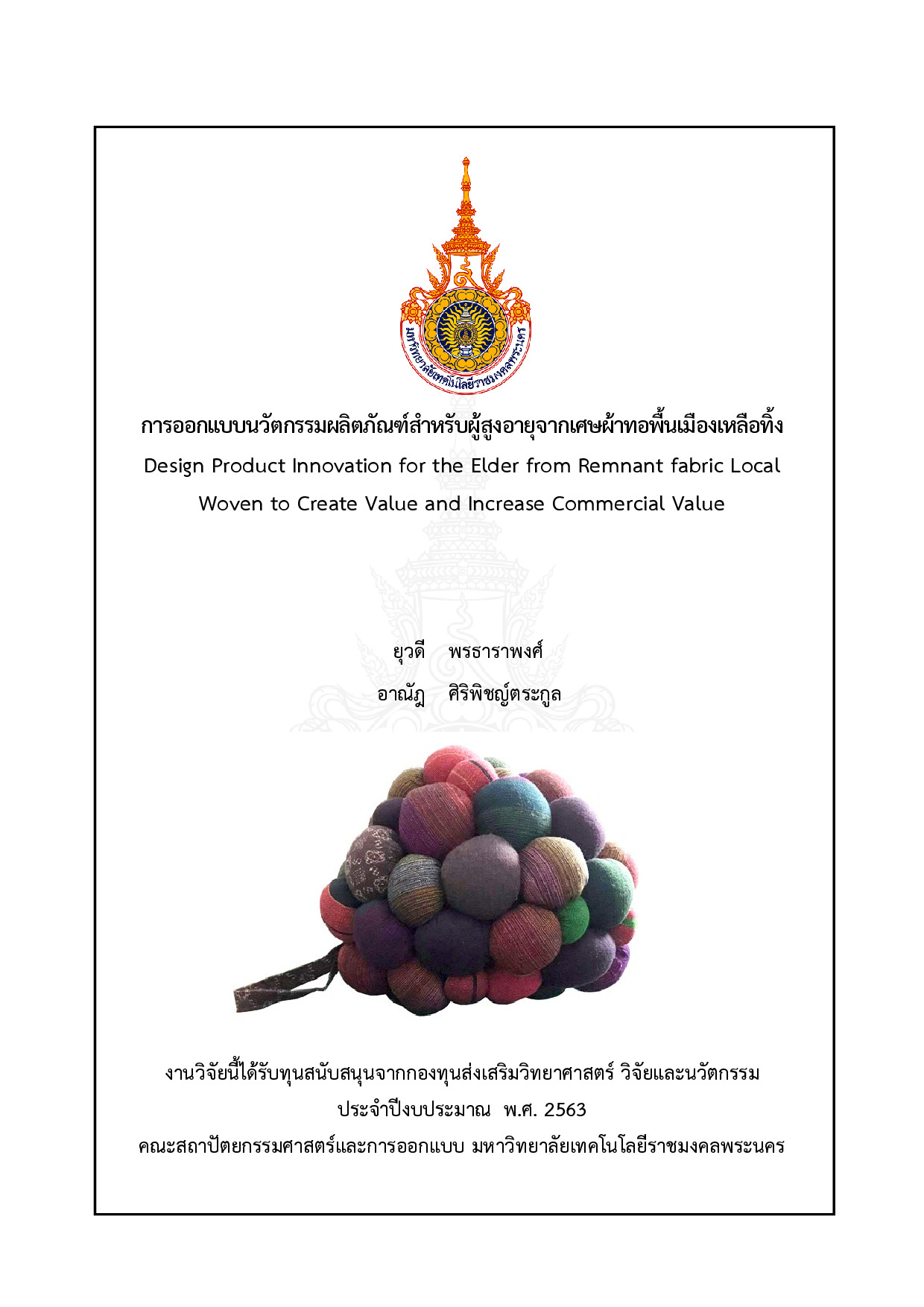
การออกแบบนวัตกรรมผลิตภัณฑ์สำหรับผู้สูงอายุจากเศษผ้าทอพื้นเมืองเหลือทิ้ง
The objectives of this research are: 1. to design innovative products for the elderly from local woven fabric scraps left over from sewing that can help and promote health in their lives; 2. to create product guidelines for the elderly from woven fabric scraps. Native leftovers from tailoring that are unique create value and add commercial value. From the study of rags from local woven cloth left over from sewing Weaving indigenous fabrics which are local wisdom. Has been used to process various products such as clothing bags guards there will be a discarded part that is not used Therefore in this research the rag was used to develop the design of products for the elderly. There is a worthwhile use of local fabric scraps. focus on style Techniques for creating curved surfaces Embossed into a ball to create a texture and pressure. In terms of shape design it can be used with the elderly. can help and promote health in life Characteristics of the product is a product that can be administered to muscles. parts of the body of the elderly. The results of the experiment by bringing innovative products for the elderly from the waste of local woven cloth were tested on 22 elderly people in terms of form beauty function use. It was found that the elderly were satisfied with the innovative products for the elderly. with an average of 4.51 is the most innovative product for the elderly from various forms of local woven fabrics It is designed to be a guideline for application. production for sale This will result in the community learning to design products related to the elderly. Community can develop potential Community products and products for the elderly resulting in the creation of local product identity It is a process of creating a body of knowledge and extending local wisdom for benefits.
แนวทางการพัฒนารูปแบบการจัดการเรียนการสอนสาขาวิชาออกแบบแฟชั่นผ้าและเครื่องแต่งกายคณะเทคโนโลยีคหกรรมศาสตร์ มหาวิทยาลัยเทคโนโลยีราชมงคลพระนคร
The aims of this Guidelines for the Development of Teaching and Learning Models in the Department of Fashion and Apparel Design Faculty of Home Economics Technology Rajamangala University of Technology Phra Nakhon were to compare the department of fashion and apparel designs teaching and learning outcomes and to find guidelines for the development of teaching and learning management styles in the department of fashion and apparel design. To gather feedback on teaching and learning satisfaction from current students enrolled in the 2020 academic year faculty members and alumni a convenient random sampling of 104 people willing to participate in the online survey was used. Cronbachs alpha coefficient was 0.980 which was quite confident. Four external experts provide feedback on the training. The frequency percentage and mean were used to analyze the data. The results were summarized as follows: The majority of those who responded were alumni (50.96 %). The average degree of satisfaction in teaching was at its highest (mean 4.23). Other components of the situation were excellent. (mean 4.12) curriculum (mean 4.11) learning facilities and infrastructure (mean 4.03) and educational aid were the averages (mean 3.85). In the department of Fashion and Apparel Design the average satisfaction with teaching and learning was compared. There was no variation in classification based on the respondents status. The findings of the data analysis based on respondents feedback and course reviews Department of Fashion and Apparel Design Bachelor of Home Economics (Course revised 2017) from external experts It was used as a guideline for the development of teaching-learning management styles in the field of study by: (1) the curriculum the name of the curriculum the adjustment of the philosophy objectives and the addition of elective courses in the curriculum for students to choose according to their interests; (2) Instructors adjust the use of teaching methodologies evaluation course content and teaching media knowledge exchange team teaching and online teaching are all options learner-centered teaching activities are critical and devise a self-improvement strategy. (3) in terms of educational aid to sign an MOU contract with the establishment obtaining a budget for the purchase of learning equipment and maintenance to be in good working in order to be used. (4) learning facilities and infrastructure provide books that are relevant to the subject. Improve the computer system and internet signal utilized in teaching. And (5) other areas such as the number of channels available for the courses public relations efforts. Collaboration with former students Follow-up on scholarship recipients participation in activities Field trips and study tours Suggestions for future study The findings should be analyzed using the principles for developing teaching and learning management styles. every academic year to provide the findings in order to develop the curriculum further.