จำนวน Repository ( 35 )
รูปแบบความอยู่รอดของธุรกิจโรงแรม กลุ่มจังหวัดภาคใต้ฝั่งอันดามัน
This research aims to 1) study current conditions trends in change management transformational leadership and service innovation in the future for hotel business survival in Southern Andaman provinces and 2) present survival model of hotel business in Southern Andaman provinces. The research methodology used in the study was Qualitative research by using the Delphi technique with 19 experts and added with quantitative research which the sample was 400 Thai consumers. The research results revealed that the current conditions of the hotel business in Southern Andaman provinces in the past most of the consumers were foreigners but from the effects of the epidemic causing change in consumer behavior. At present and in the future there will be more Thai consumers. Therefore business owners need to plan to support on Thai tourists by focus on natural attractions and increase in safety measures from the epidemic. Transformational leadership would focus on inspiration motivation. Service innovation in the future would focus on marketing innovation and reduce exposure. Survival model of hotel business in Southern Andaman provinces consist of 1) competitiveness 2) adaptability and 3) efficiency. Survival model of hotel business in Southern Andaman provinces checked by index of congruence (IOC) by 5 experts and found that index of congruence was greater than 0.50.
พฤติกรรมการเลือกซื้อน้ำมะพร้าวพร้อมดื่มของผู้บริโภคในเขตกรุงเทพมหานคร
The purposes of this research were 1) to study the purchasing behavior of readyto- drink coconut juice. 2) To study the marketing factors of ready-to-drink coconut juice of consumers. 3) To study the relationship between personal factors and behavior in purchasing ready-to-drink coconut juice and 4) to study the relationship between marketing factors and purchasing behavior of ready-to-drink coconut juice. This was a quantitative research using questionnaires as a tool to collect data from a sample of 400 people without gender who are 20 years of age or older and live in Bangkok. The statistics used in the data analysis consisted of percentage mean standard deviation and correlation was determined by chi-square statistical test. The results showed that 1) most consumers behaviors had a reason to choose ready-to-drink coconut juice as a healthy drink with a purchase frequency of 1-2 times per week. The amount of purchase per time is at 1 bottle / box / bag which the purchase cost per time is 51- 100 baht and most of them choose to buy products from convenience stores. 2) The overall marketing factors in purchasing ready-to-drink coconut juice of the sample group were at the highest level. When considering the factors by aspect they were found that almost all aspects had the highest level of opinion in terms of price products and distribution channels respectively. Except for marketing promotion it was found that the sample group had a high level of opinion. 3) The relationship between personal factors and behavior in purchasing ready-to-drink coconut juice found that gender was related to the purchase frequency and the cost of each purchase. The education level was related to the reason for the purchase purchase frequency and cost of each purchase. Age occupation and average monthly income were related to all aspects of purchasing behavior which were the reason for purchase frequency of purchase location of purchase quantity of each purchase and cost of each purchase were found to be (P ≤ 0.01) and 4) the relationship between marketing factors and purchasing behavior of ready-to-drink coconut juice found that the overall marketing factors were related to behavior in all aspects which were the reason for purchasing purchase frequency purchase location quantity of each purchase and each purchase cost were found to be statistically (P ≤ 0.05)
ปัจจัยที่ส่งผลต่อความตั้งใจบริโภคอาหารประจำถิ่นเกาะสมุย
The purposes of this research were 1 ) to study the consumption behavior of local food in Koh Samui. 2 ) To study the levels of factors affecting the intention of local food consumption. 3) To compare personal factors to the intention of local food consumption and 4 ) To find out the correlation between local food consumption factors and the consumption intention. This study was conducted by mixed methods research.The sample consisted of a total of 400 Thai consumers who used to eat local food in Koh Samui and were selected by accidental sampling method. The results showed that 1) the consumption behavior of local food was mostly eaten alone. The top 3 local savory dishes in Koh Samui that the consumer used to eat were as follows: Moo Ko Yum Sarai Kor and Wai Kua. The sweet dishes were Kalamae Khanom Ko and Tho Won. The types of fruit were Lukfai Ka Luk Tho and Luk Kee Kwang. Popularly dined in Koh Samui at famous restaurants. Eat local food because of its unique taste. Family or relatives were influential in choosing the type of food. Local food was usually eaten at lunch and purchasing ingredients from the local community to prepare local dishes. 2) Factors affecting the Intention in term of food identity food quality attitude and convenience of finding local food were found to affect the intention to consume local food at the highest level. 3) Personal factors in terms of age average monthly income whether they were Koh Samui residents or not and whether they had different accommodation in Koh Samui were found to have a difference in their intention to consume local food at the statistically significant level of .05 and 4) factors of food unique food quality attitude and convenience of finding local food to eat were found to have correlation with the intention to consume local food in all variables by statistically significant at the .05 level.
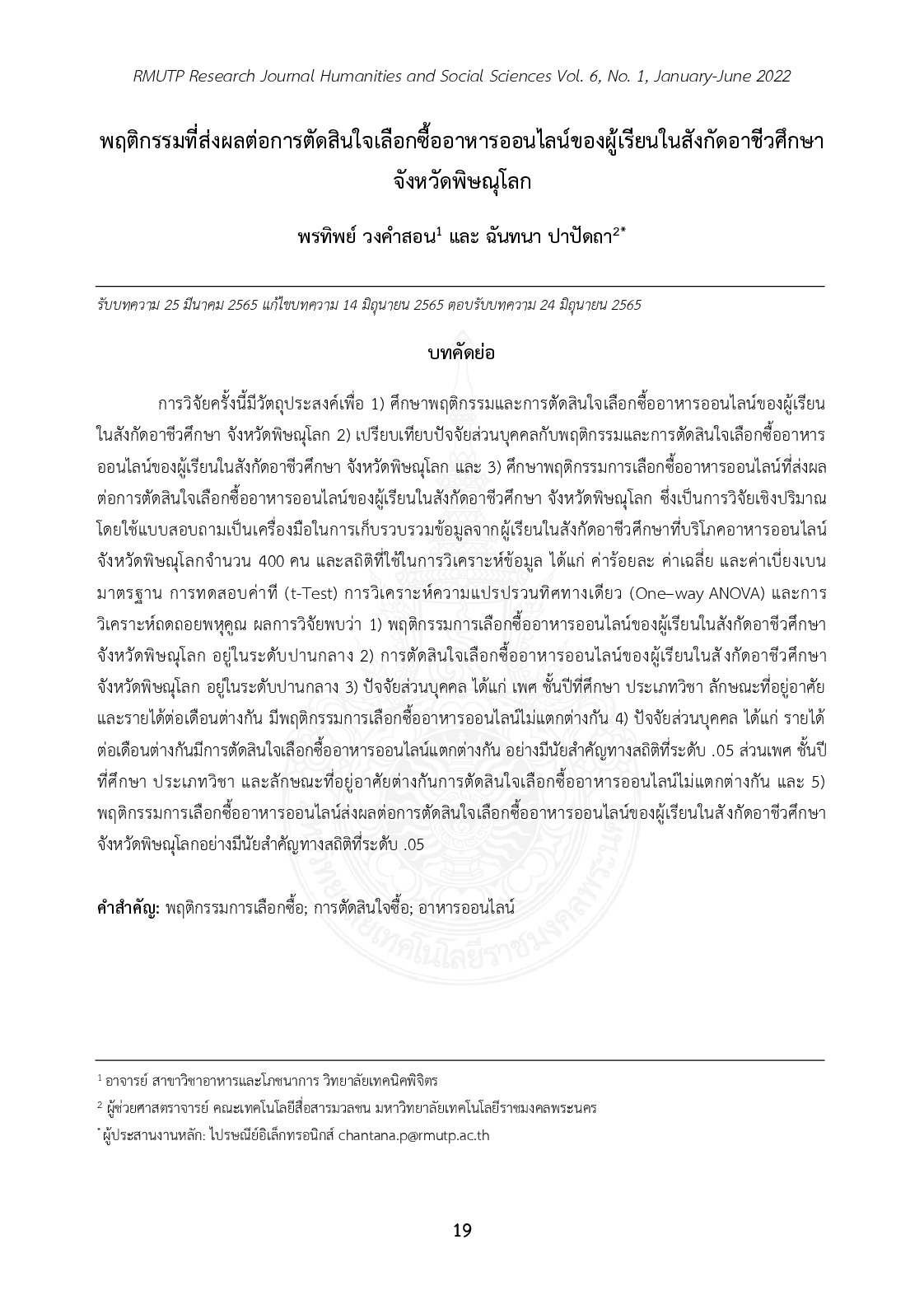
พฤติกรรมที่ส่งผลต่อการตัดสินใจเลือกซื้ออาหารออนไลน์ของผู้เรียนในสังกัดอาชีวศึกษา จังหวัดพิษณุโลก
The objectives of this research were 1) to study the behavior and decision to buy online food of vocational students in Phitsanulok Province 2) to compare of personal factors with behavior and decision to buy online food of vocational students in Phitsanulok Province and 3) to study online food shopping behavior affecting to buy online food decisions of students vocational in Phitsanulok Province. The research was a quantitative research using questionnaires from 400 vocational students in Phitsanulok Province. Data was systematically analyzed by percentage mean standard deviation (S.D.) t-Test One-way ANOVA and multiple regression analysis. The result showed that the behavior of buying online food was at moderate level. The decision to buy online food was at moderate level. Difference Personal factors including gender year of study type of subject housing type and monthly income had different of behavior of online food shopping with no statistical significance. Difference Personal factors including type of subject and monthly income had different of decision to buy food online with statistical significance at .05. Online food purchasing behavior effecting decision to buy food online with statistical significance at .05.
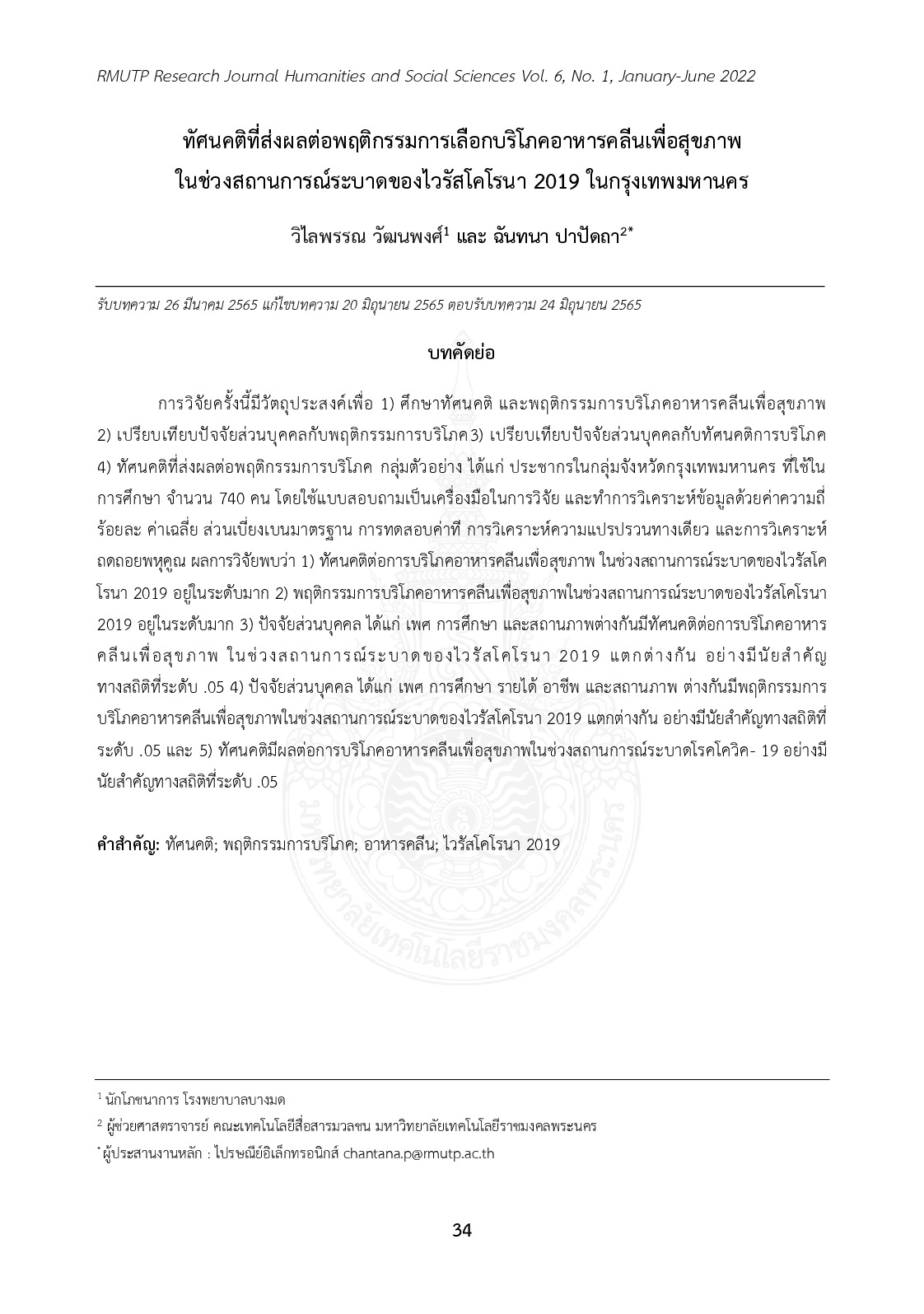
ทัศนคติที่ส่งผลต่อพฤติกรรมการเลือกบริโภคอาหารคลีนเพื่อสุขภาพในช่วงสถานการณ์ระบาดของไวรัสโคโรนา 2019 ในกรุงเทพมหานคร
The objectives of this research were to 1) study attitudes and consumption behavior of clean food for health 2) compare personal factors with consumption behavior 3) compare personal factors with consumption attitudes and 4) study attitudes affecting consumption behavior. The sample group was the population of Bangkok Province. Used in the study: 740 people. The questionnaire was used as a research tool. The data were analyzed by frequency percentage mean standard deviation. T-value test Analysis of one-way ANOVA and multiple regression analysis. The research results were found that: attitudes towards the consumption of clean food for health during the Covid-19 epidemic situation was at a high level. Clean food for health consumption behavior during the Covid-19 epidemic situation was at a high level.Individual factors including gender education and status had different attitudes towards healthy food consumption. During the Covid-19 epidemic situation the difference was statistically significant at the .05 level Individual factors including gender education income occupation and status had different healthy clean food consumption behaviors during the Covid-19 epidemic with statistical significance at the .05 level. Attitudes had a statistically significant effect on healthy food consumption during the Covid-19 epidemic at .05 level.