จำนวน Repository ( 6 )
สมบัติการดูดซับน้ำมันทอดอาหารของนอนวูฟเวนจากเส้นใยเซลลูโลสฟางข้าว
The objectives of this research were to study cellulose fiber extraction from rice straw with sodium hydroxide in various conditions (with 5 1 0 and 1 0 % of sodium hydroxide at room temperature 60ºC and 90 ºC for 0.5 1 2 and 3 hours) and to study rice straw nonwovens preparation by the wet-laid process. Oil wicking ability oil absorption ability air permeability morphology and physical properties of prepared nonwovens were investigated. It was found that the optimal condition for cellulose fiber extraction from rice straw was 5% of sodium hydroxide at 90 ºC for 2 hours. At this condition the cellulose fiber yield of 2 2% and the fiber length of 1 . 9 6 cm were obtained. The oil wicking ability and oil absorption ability of rice straw nonwovens increased when weight per unit area increased. Therefore oil absorbed into gaps between fibers of the nonwovens by capillary effect. Moreover the nonwovens could wick and absorb virgin palm oil better than fried palm oil because virgin palm oil has a lower viscosity than fried palm oil. The viscosity increased from derived lipid and other substances which dissolve and disperse increasing after frying food. The results indicated that the rice straw nonwovens had oil absorption ability.

การออกแบบบรรจุภัณฑ์จากกระบวนการพัฒนาวัสดุทดแทนด้วยฟางข้าวผสมเมล็ดพืชสำหรับผลิตภัณฑ์แปรรูปเพื่อสิ่งแวดล้อม กรณีศึกษาผลิตภัณฑ์ ร้านมาสมัวแซลล์ (Mazmoizelle)
This paper presents the packaging design of the straw material replacement process. For environmentally - friendly products Product Case Studies MAZMOIZELLE Shop Due to the awareness of the environmental problems that affect the lives of all living. The weather is changing. One solution is Eco-design (Economic & Ecological Design) which plays an important role in the production process. Environmental concepts are added to the design process to develop environmentally friendly designs. The sample consisted of the research instruments used in this research were 80 persons. Pre-design questionnaire the questionnaire evaluates the satisfaction of the packaging structure for the environment. Data were analyzed using percentage analysis. The results are evaluated by experts and experts in three aspects: packaging graphic and marketing. The instruments used in the research were questionnaires and satisfaction questionnaires. The results showed that. 89% of respondents agreed to use recycled materials for packaging. The evaluators have a need for environmentally friendly packaging by developing robust packaging. Product Protection And graphics on the beautiful packaging. This shows that packaging is environmentally friendly. And the evaluator needs the uniqueness of the product for the environment. The results of the study concluded that the design of the structure and graphics on the packaging for the environmental products of the five structures from the MAZMOIZELLE product include the packaging for the camera strap. Sack bag Packaging for documents A5 packaging for wallets and notebook bag packaging very good. Packaging can protect the product well and easy to use. Graphic design on packaging that represents a unique identity for environmental conservation. And the results of the replacement test with rice straw mixed grain. Seeds can be grown at a rate of 70% which is good.
บายศรีพรหมจากกระดาษฟางข้าว
The purposes of the research were to study the process of making bai Sri Phrom from rice-straw paper and to investigate the participants’ satisfaction on the product. By studying and collecting the information related the title the researchers drew 3 sketch-designs of the product which were commented from 5 experts. The chosen design was used to make Bai Sri Phrom and determined the product satisfaction from 50 to the participants. Data were analyzed statistically by frequency percentage and mean. And the results of the study were found as follows :Most of the experts chosen the sketch C. Owing to properly making the product fine proportion and elaborate composition. For the participants’ satisfaction on the product it was found that as a whole the product’s material were satisfied at high level with the mean value of 3.91. The product creativity was satisfied at the highest level with the mean value of 4.32. The delicacy of the product was satisfied at high level with the mean value of 4.18. The Product’s utilization was appropriate for instructional media at the highest level with the mean value of 4.42. The product prize of more than Bht 5000 was satisfied at high level with the mean value of 4.10. And product should be sold at the artificial-flower shop. lt was satisfied at the highest level with the mean value of 4.60.
การพัฒนาผลิตภัณฑ์กระดาษจากฟางข้าว
The objective of this paper was to study and development of rice straw paper and development of rice straw paper products-making. Part I. Rice straw paper-making. The bleached and unbleached with 2% HP2(aqJform rice straw fiber was boiled with 2% and 4% NaOH(aq) The 4 treatment was take out container and spread in to thin piece of paper. The 4 treatment were conducted to test physical properties and strength properties on rice straw paper. Part II Rice straw paper products-making. The populations in this research were 16 students and 16 teachers on RIT. Chotiwet Campus to making and evaluate the rice straw paper products. The instrument used in this research were questionnaires about the admission on specifics properties of rice straw paper products and satisfaction to rice straw paper products. The data were analyzed by SPSS program. The statistic used that mean standard deviation one way ANOVA and two way ANOVA. Differences between various groups were tested by Scheffs method.
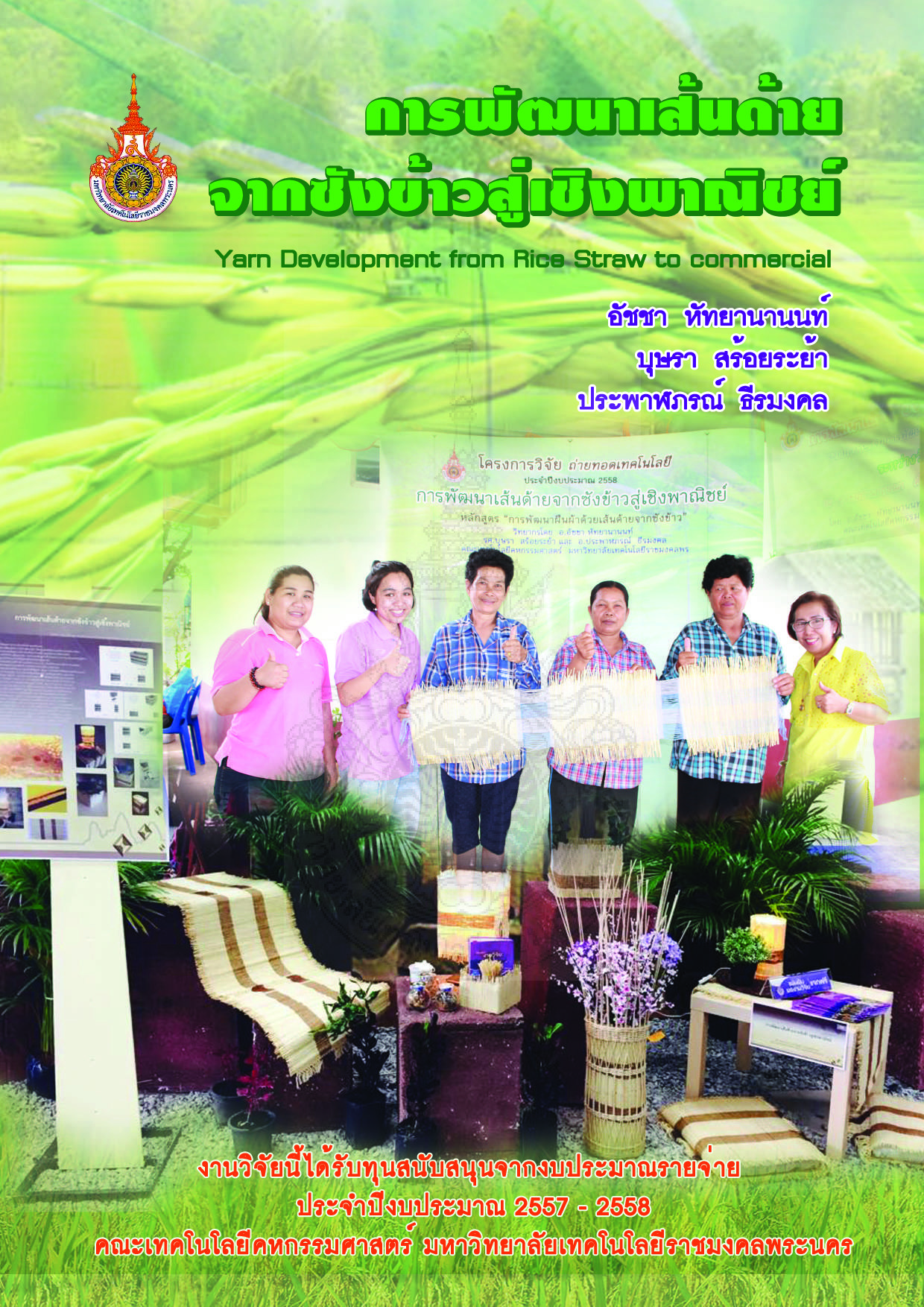
การพัฒนาเส้นด้ายจากซังข้าวสู่เชิงพาณิชย์
This research is Yarn Development from Rice straw to commercial. It aims to study the process of seperating fibers from rice straw. To study the physical properties of fibers from rice straw and to study the process of manufacturing yarn from rice straw fibers. The research material is rice straw fibers after that data was analyzed byphysical textile testing laboratory. The result of the first year’s research was the rice straw yarn has been developed as woven and develop into commercial products to promote. The process of separating fibers from rice straw which dried the sun for a few days. Selecting the rice straw fiber length at least 30 cm. to subtract the joints of the lower end of the stem by hand. peel off the rice straw fiber and place flat on a horizontal line. Then Rice straw fiber were tested in the physical laboratory was found that it is cellulose fibers tensile strength (Newton) at 28.18 elongation (percent) is at 2.01. The amounts of metals has plenty of CADMIUM at 0.1 mg/kg CHROMIUM (TOTAL) / (VI) at 0.5 mg/kg COPPER at 0.5 mg/kg and LEAD at 0.1 mg/kg which was not found to be risk for using. The fiber cross-section of rice straw fiber were found to be oval the middle is clearly. The fiber length is smooth and transparent when viewed from the side to see the clarity of the fiber. Rice straw fiber was weave in plain structure. Warp yarn uses a special brown cream and brown flat yarns. We use rice straw fiber with the same type of yarn. There are 2 warp yarn and using natural color without blench. Rice straw fabric was dyeing with dried hibiscus flowers (Kaa-Jeab herb) and mordant as ashes. The result is red light because of rice straw fiber surface is smooth and lustrous. Therefrom When woven as a fabric to develop be 4 products prototype : table lamps tablecloths in Japanese style potted plants and Accessories Box The result of the second year’s research there are focus group inquire for people it is interesting in this research and Date for transfer knowledge as: Ban-Krit-Sa- Na community Krit-Sa-Na sub-district bang-pra-ma district in Supanburi province. To plan the schedule and set the date place amount of participate and lectures 34 people The range of time to transfer as 3 days on 3 – 5 May 2015 and asking for consumer satisfaction of the curriculum and lecture for “transfer knowledge Yarn Development from Rice straw to commercial” by Questionnaire of participate satisfaction. Last the evaluation data was analyzed by using SPSS program in mean and percentage. The second year found that mostly participates were female aged under 21 years old finished the secondary school and also there are farmer. The participates are their income under 5000 baht and no income. For the participates questions relation to technology transfer of “Yarn Development from Rice straw to commercial” about course divided into 3 parts: The purpose The curriculum and The knowledge. The satisfaction of participates about project divided into 3 parts: Service process Lecturer and Facilities found that have been satisfied at maximum average and highest level of satisfaction in every parts of both satisfied participates questions. The participants are mainly used to provide benefits to themselves for one month to apply the gained after the training. Satisfaction with the benefits of technology transfer and utilization. Satisfaction at the highest level the participants used knowledge to apply with local and waste material. Moreover the participates make product as soon as finish course and they are planning to produce the table Hand Woven for weaving the Rice straw yarn fabric and push it to be OTOP products. The comments and suggestions of the participants found that they need for re-training again. They would like to have a longer period of training in order to gain more knowledge. All lecturer can transfer knowledge during the training as well.