จำนวน Repository ( 11 )
แนวทางการพัฒนารูปแบบการจัดการเรียนการสอนสาขาวิชาออกแบบแฟชั่นผ้าและเครื่องแต่งกายคณะเทคโนโลยีคหกรรมศาสตร์ มหาวิทยาลัยเทคโนโลยีราชมงคลพระนคร
The aims of this Guidelines for the Development of Teaching and Learning Models in the Department of Fashion and Apparel Design Faculty of Home Economics Technology Rajamangala University of Technology Phra Nakhon were to compare the department of fashion and apparel designs teaching and learning outcomes and to find guidelines for the development of teaching and learning management styles in the department of fashion and apparel design. To gather feedback on teaching and learning satisfaction from current students enrolled in the 2020 academic year faculty members and alumni a convenient random sampling of 104 people willing to participate in the online survey was used. Cronbachs alpha coefficient was 0.980 which was quite confident. Four external experts provide feedback on the training. The frequency percentage and mean were used to analyze the data. The results were summarized as follows: The majority of those who responded were alumni (50.96 %). The average degree of satisfaction in teaching was at its highest (mean 4.23). Other components of the situation were excellent. (mean 4.12) curriculum (mean 4.11) learning facilities and infrastructure (mean 4.03) and educational aid were the averages (mean 3.85). In the department of Fashion and Apparel Design the average satisfaction with teaching and learning was compared. There was no variation in classification based on the respondents status. The findings of the data analysis based on respondents feedback and course reviews Department of Fashion and Apparel Design Bachelor of Home Economics (Course revised 2017) from external experts It was used as a guideline for the development of teaching-learning management styles in the field of study by: (1) the curriculum the name of the curriculum the adjustment of the philosophy objectives and the addition of elective courses in the curriculum for students to choose according to their interests; (2) Instructors adjust the use of teaching methodologies evaluation course content and teaching media knowledge exchange team teaching and online teaching are all options learner-centered teaching activities are critical and devise a self-improvement strategy. (3) in terms of educational aid to sign an MOU contract with the establishment obtaining a budget for the purchase of learning equipment and maintenance to be in good working in order to be used. (4) learning facilities and infrastructure provide books that are relevant to the subject. Improve the computer system and internet signal utilized in teaching. And (5) other areas such as the number of channels available for the courses public relations efforts. Collaboration with former students Follow-up on scholarship recipients participation in activities Field trips and study tours Suggestions for future study The findings should be analyzed using the principles for developing teaching and learning management styles. every academic year to provide the findings in order to develop the curriculum further.

การพัฒนาผลิตภัณฑ์ของตกแต่งบ้านด้วยการย้อมสีธรรมชาติจากใบต้นคูน
The proposes of this research were to Home Decorative Product Development by Dyeing with Natural Dye from Klun Leaves (Golden shower: Cassia fistula). The effects of dye and mordant in dyeing silk fabric with Natural Dyestuff from Klun Leaves (Golden shower: Cassia fistula and textile testing standard AATCC in colour fastness: washing. The researcher used 20 percent of concentration and Textile Testing standard AATCC as follows. The result showed that the extraction of color from Klun Leaves (Golden shower: Cassia fistula. Dye extracted from the leaves of brown. The second night it will be a dark brown color. In this study using hot-dyed water. When left for 24 hours the water is dark brown. In this research 1. silk is dyed with natural dyestuff from Klun Leaves (Golden shower: Cassia fistula without mordant. There are light yellow colour. 2. The effect of dyeing silk with natural color from the tree. Without the help of additives found. Yellow But after washing the intensity of the color on the cloth fades a little. 3. The effect of dyeing silk with natural color from the tree. Five types of additive were added at 20 percent concentration namely vinegar lemon juice water rust lime and saline. The results showed that all five adjuvants were effective after washing the color intensity on the fabric. 4. Conducting technology transfer. Most of the participants were satisfied with the highest level of satisfaction in all questions.
การออกแบบและตกแต่งวัสดุสิ่งทอสาหรับเครื่องแต่งกายด้วยนวัตกรรมแผ่นฟิล์ม
This research Designing and Textile Materials Decorating for Apparels with Film Innovation. The objective is to study the use of film innovation and finishing materials for textiles. To design and decorate costume products with innovative films. This is a great way to showcase your knowledge and technology design and decorate your textiles for innovative costumes. The research instruments were 3 product designs and a satisfaction questionnaire for trainees. The samples used in the research were 12 randomly selected randomized individuals at the Faculty of Home Economics. Rajamangala University of Technology Phra Nakhon By analyzing data To find the average and average values. Summarize results in tabular form. And writing The tools used to collect data were: 1) three types of costume design namely jacket and skirt 2) three types of costume designs 3) On August 13 2018 at the Faculty of Home Economics Rajamangala University of Technology Phra Nakhon. 1) Film innovation The material is made of polymer. Chemical composition Polyvinyl alcohol It is a thermoplastic with special properties. Biodegradable And fire like paper. It can also be dissolved in water. The embroidery machine is easy to emboss but does not make the fabric thick or hard. Embroidery Machine And its easier to pull off than paper. When embroidered. When to use the costume can be washed normally. Because the film will react with the decomposition of the film with water. By soaking the warm water. Allow the film to dissolve for 15 minutes. 2) Design and decorate the costume products with innovative film. Then 3 innovative products were developed namely shirt jacket skirt. 3) Technology Transfer A workshop was held on August 13 2018 at the Faculty of Home Economics. Rajamangala University of Technology Phra Nakhon Most participants were satisfied at the highest level in all questions.
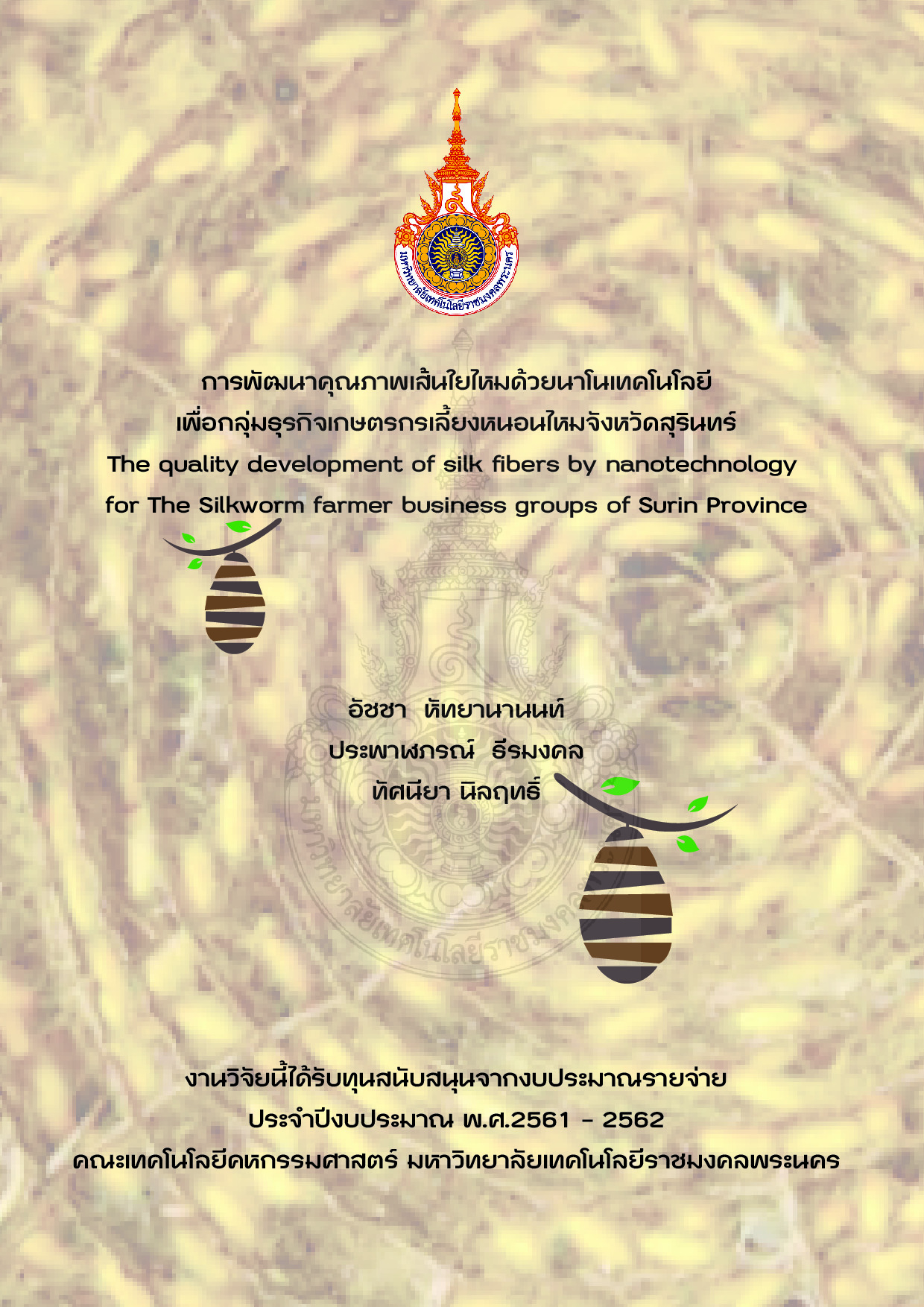
การพัฒนาคุณภาพเส้นใยไหมด้วยนาโนเทคโนโลยี เพื่อกลุ่มธุรกิจเกษตรกรเลี้ยงหนอนไหมจังหวัดสุรินทร์
This research is to study the quality development of silk fibers by nanotechnology for the Silkworm farmer business groups of Surin Province. The research purposes are to study the efficiency and process of silkworm rearing using nanotechnology. To test the quality of silk fibers obtained from raising silkworms using nanotechnology. To compare of silkworm rearing results using nanotechnology and to transfer technology to improve silk quality with nanotechnology for silkworm farming business group in Surin Province. The results are as follows 1. The researchers designed the recording schedule which the party can record the changes easily of silk worm development during each day. This research allows the researchers to collect data from the farmer is more easily and finely into 4 groups of experiments with 3 nanotechnology formulas: 1. ZINC OXIDE 2. SILVER NANO and 3. ZINC OXIDE and SILVER NANO with 50:50 percentages each. The silk used in the experiment was “Nang Noi” which is popularly silkworm variety in every household in Surin province.When experimenting must clean the house and rinsing the container with DI WATER for aperiod of 7 months 2. This research is divided into 4 groups. Group 1: Silkworm feed normal methods without the use of nanotechnology. Group 2 silkworms feed with Nano substances such as ZINC OXIDE SILVER NANO ZINC OXIDE and SILVER NANO in 15 percentage concentration. Group 3 silkworms feed with Nano substances are ZINC OXIDE SILVER NANO ZINC OXIDE and SILVER NANO with 30 percentage concentration. Group 4 silkworms feed with Nano substances are ZINC OXIDE SILVER NANO ZINC OXIDE and SILVER NANO with 45 percentage concentration 3. The Results and comparison of silkworm rearing using nanotechnology the best formula feed is formula 1. When feeding Nano-sprayed on mulberry leaves using 3% 15% zinc silver and silver zinc it is found that the growth of worms in each age was good growth and not being a disease. Moreover Silkworms are slightly better and more alert than normal farming. The length in ages 3 - 4 - 5 is going in a better direction. Amount of eating mulberry leaves in each age. As usually eating more in ages 2 and 3 after passing the silk production process and testing the quality of silk fibers in the laboratory were found that the silk fibers are smooth not lacking toughness: Tenacity at 3.06 4.60 and 4.60 respectively and also result in fiber amount increase and also the color of the silk fibers is golden quite clear beautiful and consistent color. 4. When technology transfer to the Silkworm farmer business groups of Surin Province as workshop for 3 days. Most participants are satisfied with the highest levels in all questions.
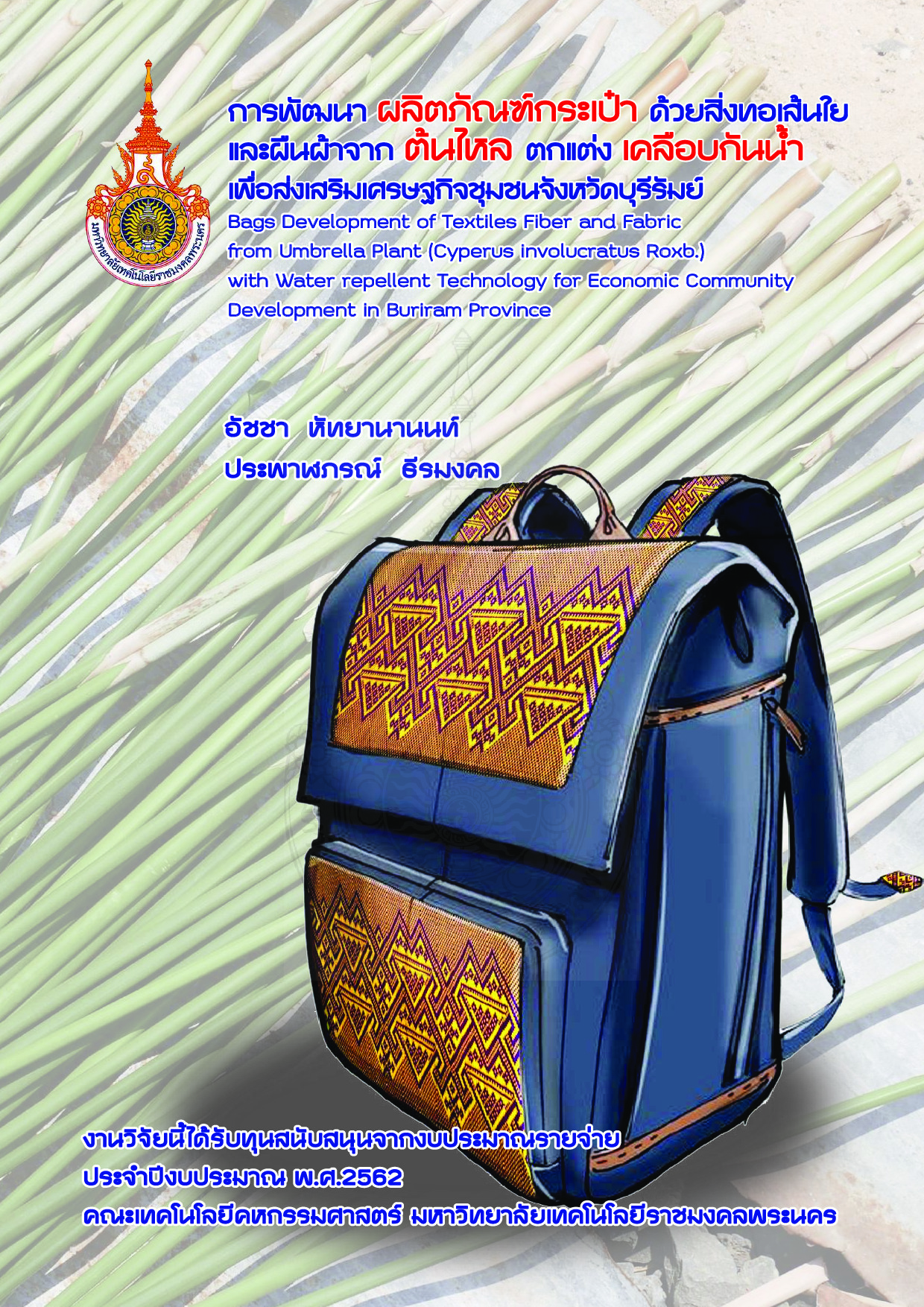
การพัฒนาผลิตภัณฑ์กระเป๋าด้วยสิ่งทอเส้นใยและผืนผ้า จากต้นไหลตกแต่งเคลือบกันน้ำ เพื่อส่งเสริมเศรษฐกิจชุมชนจังหวัดบุรีรัมย์
The proposes of this research were to study the development of bag products with textiles fibers and fabrics from decorative flowing water-resistant coating to promote community economy in Buri Ram Province. With the objective To study the process of producing yarn from fibers from the flow source To design and develop textile and bag products from yarn from the Lai Ton To study the effect of coating with waterproofing on bag products using textiles fibers and fabric from the flow. And to transfer knowledge and technology for utilization to community groups and interested people in next fiscal year This research can be summarized as follows: 1. The study of Ton Lai found that most villagers grow Lai Ton and make products as a supplementary career. In using this flow source in this research the researcher used a large flow source with a diameter of about 1 hour and can be separated into 4 small strands for research and production. The dyes used are synthetic because they will get fresh colors save time and be consistent. 2. The researcher designed 2 designs of weaving designs with the idea of using the original pattern to add edit and then create the pattern that the community groups like and can actually produce it as a product. After getting the fabric pattern then design into 10 bags of women and men bags using leather as an ingredient Decorate the bag to look interesting increase the price and increase the target audience. Which will be different from the original. That uses colored fabric and striped fabric as decorative items. 3. Coating with waterproofing on the bag products with textiles fibers and fabrics from the flow found that the fabric that has been coated with water repellent. When pouring water on the water surface there is a clumping together. No water penetration through fibers. When wiping clean the fibers are still dry not wet. Which is different from fabric that has not been coated namely water is able to penetrate immediately and create moisture on the fabric surface. If stored for a long time it can cause mold. 4. Schedule of technology transfer with the plan to transfer the research in the budget year 2020. For 3 day knowledge transfer and workshop was 30 participants. The group consisted of weaving mats from Ban Bu community Chorakhe Mak Subdistrict Prakhon Chai District. Buriram province