จำนวน Repository ( 7 )
การลดฟอสเฟตในน้ำทิ้งจากกระบวนการซักผ้าโดยใช้เปลือกไข่ไก่และเปลือกหอยแมลงภู่
This research studied the factors that affect the efficiency of phosphate reduction in the wastewater of the washing process with CaCO3 and CaO produced from eggshell and mussel shell. The study found that the optimum condition for adsorption when using CaCO3 from eggshell is to adjust the pH to be equal to 10 take 15 minutes to absorb and add 1 gram of sorbent which can reduce the phosphate content by 25 percent and when changing the adsorbent to CaO the optimum condition for phosphate removal is to adjust the pH to 7 take 15 minutes to absorb and add 1 gram of adsorbent which can reduce the phosphate content by 24 percent. The optimum conditions for adsorption when using CaCO3 from mussel shell were to adjust the pH to 10 take 45 minutes to absorb and add 1 gram of sorbent which can reduce the phosphate content by 25 percent and when changing adsorbents to CaO the optimum condition for phosphate removal is to adjust the pH to 10 take 15 minutes to absorb and add 3 grams of adsorbents which can reduce the phosphate content by 24 percent. In addition when studying the adsorption of impurities in the wastewater such as conductivity turbidity COD and BOD it is found that the optimum reduction conditions can reduce the impurities of the parameters that mentioned above were 19.32 2.60 54.77 and 16.67 percent respectively. CaCO3 and CaO produced from eggshell and mussel shell can be used to absorb impurities in wastewater before releasing into natural water sources.
การพัฒนาปูนดิบจากเปลือกหอยครางเพื่อส่งเสริมวิสาหกิจชุมชน
This research aimed to study the optimum conditions for making raw lime from shells which consisted of 9 conditions: calcined at three levels of 700 800 and 900 degrees Celsius for 1 2 and 3 hours. Calcium element content in raw lime using X-ray fluorescence (XRF) measurement and structural analysis of calcium compounds by X-Ray Diffraction (XRD). The research results were found. 1. Optimal conditions for making lime mortar are temperature 800 degrees Celsius duration 2 hours. The physical characteristics of raw lime are white and porous. 2. The calcium content from the shells calcination at 800 degrees Celsius for 1 2 and 3 hours was 98.22% 96.70% 97.89%. 3. Changes in the calcium compounds of raw lime obtained by calcining the shell at 800 degrees Celsius for 1 hour were mainly found in the form of calcium carbonate (CaCO3). At 2 3 hours calcium carbonate (CaCO3) is mostly converted to form calcium hydroxide (Ca(OH)2)compound calcium oxide (CaO) compound is formed.
การศึกษาอุณหภูมิการเผาเปลือกหอยลาย เพื่อเพิ่มสมบัติของอิฐมอญผสมวัสดุรีไซเคิลจากเปลือกหอยลาย
This research is to study the recycling of residue clams shell from Mahachai Samutsakorn Thailand. This waste was collected from canned clams industry and it can be recycled as the composition of Mon brick instead of the rice husk. The study of clams shell composition found that Calcium was main composition as 98.50%VS. The moisture and ash content was 0.88% and 58.27%TS respectively. The works methodology is using ash from clams shell incinerated at temperature 900 1000 1100 and 1200oC in 5 hours respectively instead of rice husk in Mon brick processing. The fabrication of Mon brick was in size 5x5x5 cm adding ash from clams shell intead of rice husk. The result found that increasing the temperature to incinerate clams shell ash instead density and compressive strength increased while moisture and water absorption deceased. When Mon brick was fabricated in standard size at 6x15x3.5 cm the changed material characteristics was in the same trend as previous size. Mon brick in standard size adding 100% clams shell ash instead of rice husk had density 2.63 g/cm3 moisture content was 2.86% water absorption at 1 and 24h was 17.40 and 20.16% respectively and compressive strength was 0.52 MPa. These characteristics was according to standard of Engineering Institute of Thailand. It can reduce the cost of rice husk in Mon brick factory 28800 bath/year while the waste from canned clams factory could be reduced 20.94%.
การศึกษาอุณหภูมิในการเผาเปลือกหอยลายเพื่อการปรับปรุงคุณภาพดิน
The purpose of this research was to study the temperature of burning surf clam shell for soil quality improvement. The experiment was divided two parts 1) the study of the optimum temperature for calcium oxide production by burning 800 900 1000 and 1100 °C 2) the study of using calcium oxide to improve soil qualities of acidic soil and saline soil. The parameters used in the analysis included elements of soil particles soil moisture pH conductivity total content nitrogen phosphorus and potassium. The results showed that the optimum temperature for the production of calcium oxide was 1100 °C since it provided the highest calcium oxide content of 90 % by weight. After applying calcium oxide into acidic soil the composition of soil particles was changed from sandy clay to sandy clay loam. In contrast the soil particle was not changed but the proportion was changed in saline soil. It was also found that calcium oxide reduced soil moisture and influenced the acidity of soil by increasing the pH from 3.39 to 6.92 in acidic soil and 6.49 to 9.11 in saline soil. In addition it was found that the electrical conductivity of the soil was related to salinity. In acidic soil the conductivity of before and after inputting calcium oxide were 0.87 and 1.24 dS/m respectively. In the case of saline soil the conductivity of before and after improvement were 14.37 and 18.80 dS/m respectively. Besides it was found that the total content of nitrogen phosphorus and potassium were reduced after the experiment.
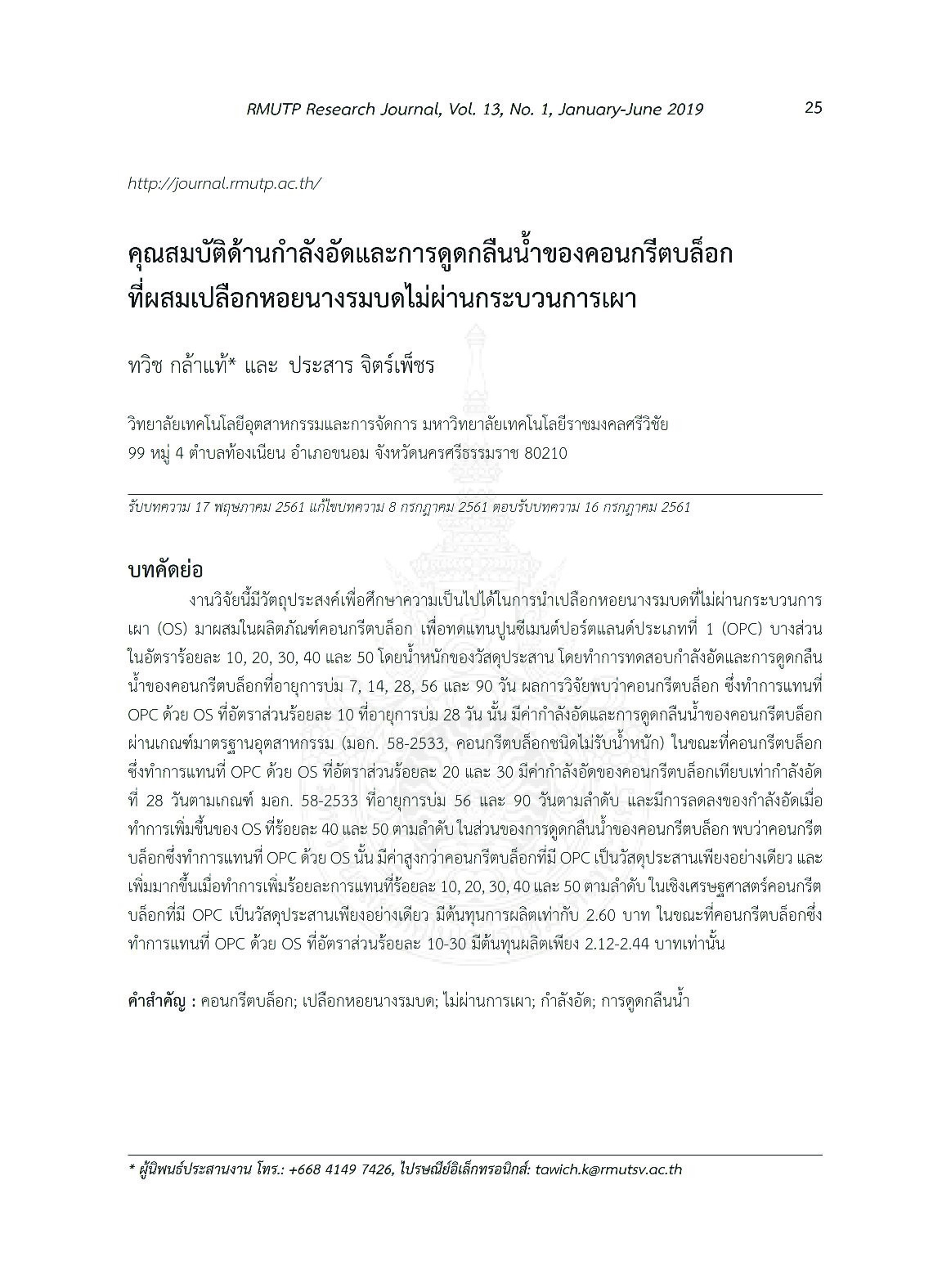
คุณสมบัติด้านกำลังอัดและการดูดกลืนน้ำของคอนกรีตบล็อกที่ผสมเปลือกหอยนางรมบดไม่ผ่านกระบวนการเผา
The research aims to investigate the possibilities of crushed oyster shell (OS) not have to go through the process of burning as a substitution cement for concrete blocks. The cement was replaced with crushed oyster shell not process burning (OS) at 0% 10203040 and 50% by the weight of the binder. After that the concrete blocks were tested to determine the compressive strength and moisture absorbed of the concrete blocks cured for 7 142856 and 90 days The result showed that the compressive strength of the concrete blocks which replaced cement with OS (at the proportion of 10% by the weight of the binder) at 28 days had the compressive strength and water absorbed accordance with the TIS 58-2533 on non-load bearing concrete blocks.Moreover the concrete blocks which replaced cement with OS at the proportion of 20 % and 30 % had the compressive strength equivalent to 28 days compressive strength of TIS 58-2533 standard at 56 and 90 days respectively and decreased when the percentage in addition to OS in concrete blocks of 40 and 50 %. Tested results also showed that the water absorbed of concrete blocks increased when the percentage of replacement of OS in binder increased at 10 20 30 40 and 50%. The economical of concrete blocks it has manufactured unit cost is 2.60 baht. Whereas the concrete block containing crushed oyster shell at 10-30% it has manufactured unit cost at 2.12-2.44 baht respectively.