จำนวน Repository ( 8 )
การแปลงหน้าที่ทางคุณภาพเพื่อพัฒนาผลิตภัณฑ์ผลิตไฟฟ้าจากลมระบายความร้อนของเครื่องปรับอากาศ
This research had the objective to design and develop power production from daily life leftovers for their highest benefit of utilization by using the principle of quality function development and power generator that changed mechanical energy into electric energy. In developing electric generator product from air conditioner condensing unit the researcher found that there were 4 important factors including speed installation distance size and cross-sectional area of the fan and the test was conducted between 8.00-17.00 hours. The researcher collected the data and analyzed the test result and found that the best result in the test was to install the product at the distance of 10 cm by using an 18 fan in order to acquire the best voltage and the data were collected so that they could be implemented in developing such product in the future.
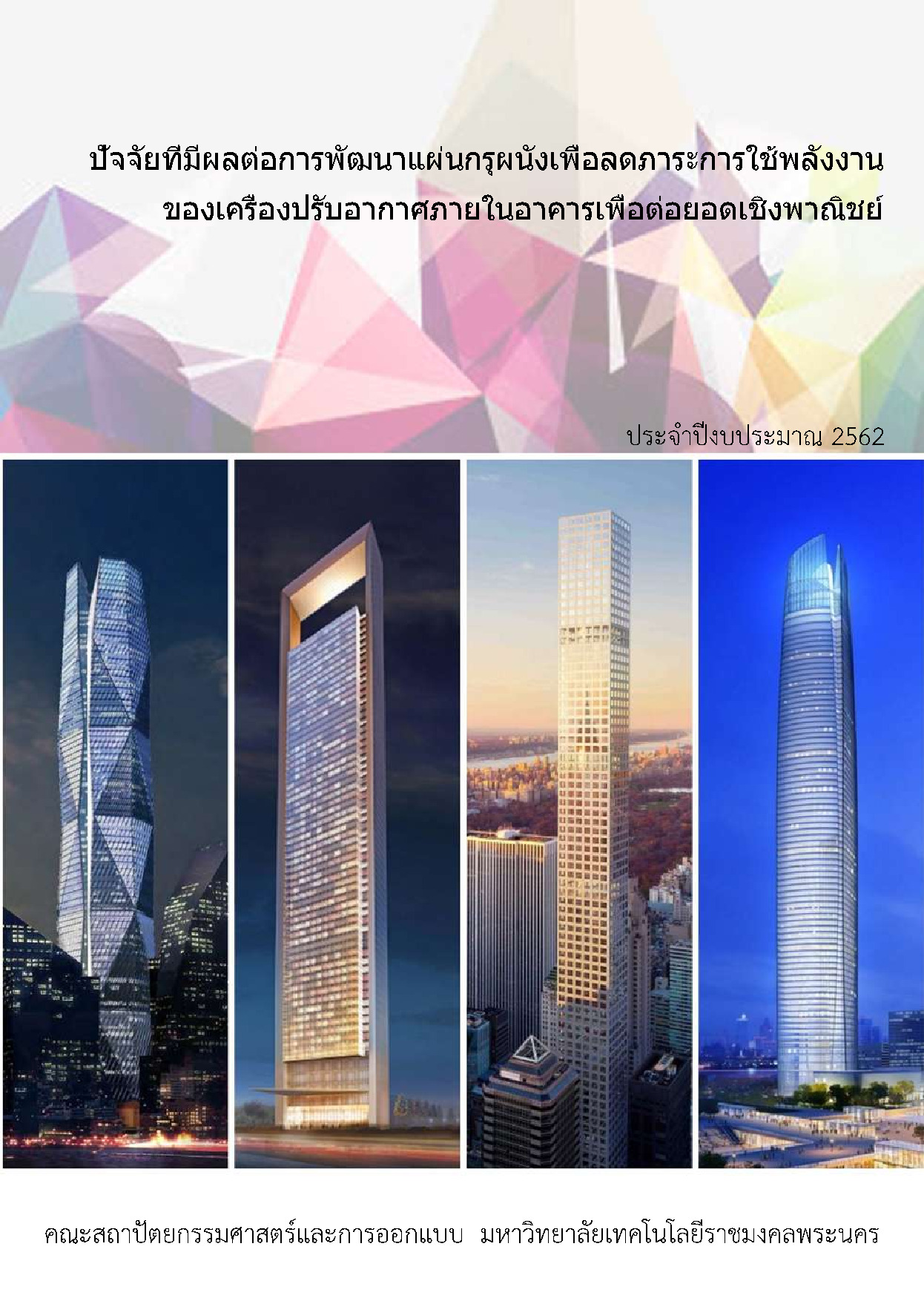
ปัจจัยที่มีผลต่อการพัฒนาแผ่นกรุผนังเพื่อลดภาระการใช้พลังงานของเครื่องปรับอากาศภายในอาคารเพื่อต่อยอดเชิงพาณิชย์
This research approach to study the development of interior wall for reduce energy consumption by air conditioning in the building. In order to be a prototype in the development of an industrial system for the export of green architecture in order to generate income for the community or entrepreneurs to bring money into the country to upgrade the industrial economy to be sustainable It is an architectural material that is compatible with the weather in Thailand. It can be used as a guideline for people interested in applying it to their own home building or disseminating through various media to reduce energy costs for a comfortable living. The objective is to study the factors that affect the development of wall paneling in order to reduce the energy burden of the air conditioner in the building in order to further the commercial production. The researcher collected data for the past 6 months not including other thermal energy. Used to calculate the energy consumption index for 2 building groups it was found that the electricity consumption of green buildings were 531100 kilowatt hours. And an average of 5.31 kilowatt hours per square meter While the non-green building has an average of 653360 kilowatt hours. And an average of 6.53 kilowatt hours per square meter As for the results of the data analysis the damage level is mostly at level 1 which is the wall surface and no obvious damage. Especially the 4th and 5th height is 1.55 meters and 1.85 meters from the floor level in the building. Damage level 3 is found at the height level 3 at a height of 1.00 meters from the floor level in the building. Assessment of damage caused to the interior wall of the building that occurred in 3 levels. The results of the data analysis showed that most damage levels were at level 1 namely the wall surface without obvious damage. Especially the 4th and 5th height is 1.55 meters and 1.85 meters from the floor level in the building. Damage level 3 is found at the height level 3 at a height of 1.00 meters and from the results of collecting moisture content in the exterior wall materials And analyzed to find the average for each of the 5 levels of height which are 0.55 meters 0.75 meters 0.95 meters 1.55 meters and 1.85 meters found that the buildings have different moisture content in each wall level (p <0.05). In conclusion this green building index equation can be applied to other buildings to reduce energy consumption and meet the standards of the green building. From the equation the electricity consumption can be predicted using the electricity usage index and systematically designed energy management in buildings. The area with the most damage will find the humidity in the range of 47% -98% the highest damage level 3 at an elevation of 0.80 meters from the floor level in the building

การสร้างและหาประสิทธิภาพชุดสาธิตการจำลองกรณีศึกษาของระบบไฟฟ้าในระบบปรับอากาศ
This project is intended as a teaching medium air conditioning system and simulation of air conditioning system problems. Some of them have been modified to suit their teaching needs. Arduino microcontrollers are used to control the system. By starting the study of the air conditioning system thoroughly. The microcontroller is written to control the operation of devices like the air conditioning system when the system malfunction. It will be used to analyze the problems of air conditioning. The experimental set will display the voltage and current. The connection points of the air conditioning problem analysis. When the symptoms are bad. The analyst can solve the problem by connecting or pressing the button of the device. The results of the project. The test will measure the difference of the air conditioning unit. And read the amount of current and volume in the system. To diagnose abnormalities and choose a solution to the problem from the kit system that can be displayed to solve the problem that the analyst was correct or not with the LED status light. Based on the performance test a demonstration kit for the demonstration of efficiency of the air conditioning system was provided to 10 experienced air conditioning technicians. 80s of issues. The reliability of the demonstration set and the efficiency of the simulator case study of the electrical system in air conditioning systems is acceptable
การเลือกบำรุงรักษาเครื่องปรับอากาศแบบแยกส่วนตามสภาพ โดยพิจารณาจากค่าอัตราส่วนประสิทธิภาพพลังงาน (EER)
This research was studied to determine the optimum value for condition based maintenance of split type air conditioner by measuring the temperature humidity and flow of air through the fan coil unit. Measuring electric current and voltage of split type air conditioner. Find the energy efficiency ratio (EER) based on the actual use compared to the EER was determined by the manufacturer. To find the suitable maintenance and cleaning air conditioner for each. In conducting this research is split type air conditioner. Rated cooling 25000 Btu/hr. Rated power 2291 watts. Rated current 9.89 amperes. Rated voltage 220 volts single phase. Using the refrigerant R-22.EER 11.02Btu/hr/watts. Running 24 hour sperdayat a temperature of 18°C. Research indicates that the EER before maintenance is equal to6.23Btu/hr/watts. After maintenance is the EER of 20.2Btu/hr/watts or EER value the increase was 69%. Thus preserving the EER of air conditioner. The condition based maintenance in reasonable time is one way that can help save energy.
การเพิ่มประสิทธิภาพเครื่องปรับอากาศแบบแยกส่วนโดยใช้ลมเย็นจากพัดลมระบายอากาศ
This research aimed to find the possibility of increasing the efficiency of the split type air conditioner by using the cool air from a ventilation fan in the air conditioning room for cooling the condenser. Two simulation rooms size 120x120x200 centimeters were constructed. The first room was installed the evaporator and the second room was installed the condenser and a ventilation fan in the lower part of the air conditioning room to deliver the cool air for cooling the condenser. Then the system was tested and compared the energy efficiency ratio and the reduced power consumption between turning on and turning off a ventilation fan. The results of the proposed air conditioner system observed from the various load conditions at 0% 30% 60% and 100% The surrounding temperature of the condenser ranged in 30C 40C and 50C It was found that the energy efficiency ratios increased in the range of 2.94% to 5.92% and the power consumptions decreased in the range of 4.56% to 12.5% The possibility of increasing the efficiency of the air conditioner system by using the cool air from ventilation fan in the air conditioning room for cooling the condenser was verified by the increased energy efficiency ratios and the reduced power consumptions.