จำนวน Repository ( 9 )
การประดิษฐ์เซรามิกบิสมัทโซเดียมซาแมเรียมไททาเนต-แบเรียมไททาเนตด้วยเทคนิคการสังเคราะห์แบบเผาไหม้
Ceramic Bismuth Sodium Samarium Titanate - Barium Titanate at the concentration of samarium 0.04 mol% was preparing by ball mill technique. This research has increased the temperature in the combustion process at different temperatures from 940960 and 970 degrees Celsius for 7 hours. The results showed that firing at different temperatures made the ceramic beads very dense. In addition the study of the crystal structure by XRD technique to study the structure of the ceramic BSNT-BT found that the structure is the same substances in the ceramic group BaTiO3. The results of the study of dielectric properties and ferroelectric properties It was found that the dielectric and P-E hysteresis loops were related and tend to correlate with increasing density with sintering temperature. The mechanical properties of ceramics were tested by measuring the hardness of ceramics at different temperatures with temperatures affecting the changes in various properties of ceramics BSNT-BT.

การปรับปรุงสมบัติทางชีวภาพและสมบัติการละลายของแก้วและแก้วเซรามิกชีวภาพ ในระบบโซเดียมแคลเซียมฟอสเฟตเพื่อนาไปประยุกต์เป็นกระดูกเทียม
This research then has two main objectives. The first objective is to fabrication of bioactive glass ceramics containing BaFe12O19 (BF) crystals has been carried out for the application in hyperthermia treatment. The BaFe12O19 powder was firstly prepared and subsequently mixed with the non-silicate P2O5-CaO-Na2O bioactive glass with various BF concentrations. After that the glass ceramics were produced via a sintering method at 600◦C and their crystal phases were examined by XRD and in vitro test was carried out by soaking in simulated body fluid. Remanence and saturation magnetization and coercivity were deduced from magnetic measurement. It was found that the samples exhibited magnetic behavior which is similar to hard magnetic materials. Our second objective is the effects of sintering temperatures on the physical and bioactivity of SrFe12O19 (SF)-P2O5-CaO-Na2O bioglass ceramics were investigated. XRD results confirmed the existence of the strontium ferrite and calcium phosphate phases. SEM images showed that grain size and hardness were related to density and liquid phase present in the samples. A maximum coercivity value of 3138 Oe was obtained for the bioglass ceramic sintered at 600 ºC. The remanence (Mr) and saturation magnetization (Ms) of the bioglass ceramic sintered at 500 ºC possess the maximum value of 6.35 and 10.64 emu/g respectively. Moreover the apatite was formed on the surface layers of the bioglass ceramics confirming their biocompatibility
การปรับปรุงสมบัติทางชีวภาพและสมบัติการละลายของแก้วและแก้วเซรามิกชีวภาพ ในระบบโซเดียมแคลเซียมฟอสเฟตเพื่อนาไปประยุกต์เป็นกระดูกเทียม
This research then has two main objectives. The first objective is to fabrication of bioactive glass ceramics containing BaFe12O19 (BF) crystals has been carried out for the application in hyperthermia treatment. The BaFe12O19 powder was firstly prepared and subsequently mixed with the non-silicate P2O5-CaO-Na2O bioactive glass with various BF concentrations. After that the glass ceramics were produced via a sintering method at 600◦C and their crystal phases were examined by XRD and in vitro test was carried out by soaking in simulated body fluid. Remanence and saturation magnetization and coercivity were deduced from magnetic measurement. It was found that the samples exhibited magnetic behavior which is similar to hard magnetic materials. Our second objective is the effects of sintering temperatures on the physical and bioactivity of SrFe12O19 (SF)-P2O5-CaO-Na2O bioglass ceramics were investigated. XRD results confirmed the existence of the strontium ferrite and calcium phosphate phases. SEM images showed that grain size and hardness were related to density and liquid phase present in the samples. A maximum coercivity value of 3138 Oe was obtained for the bioglass ceramic sintered at 600 ºC. The remanence (Mr) and saturation magnetization (Ms) of the bioglass ceramic sintered at 500 ºC possess the maximum value of 6.35 and 10.64 emu/g respectively. Moreover the apatite was formed on the surface layers of the bioglass ceramics confirming their biocompatibility
การประดิษฐ์เซรามิกเฟร์โรอิเล็กทริกไร้ตะกั่วในระบบบิสมัทโซเดียมโพแทสเซียมไททาเนตเป็นองค์ประกอบหลัก
The research project investigated the effects of CoO additive on dielectric ferroelectric physical and mechanical properties of modified Bi0.5(Na0.81K0.19)0.5TiO3 ceramics were investigated. The samples were synthesized by solid state reaction technique where powders were calcined at 850 °C for 4 h and ceramics were sintered at 1050 °C for 4 h which difference heating rate controlled i.e. 100 300 and 600 °C/h for. The ceramics of BNKT/x wt.% CoO was added CoO by various x=0.00 0.10 0.20 0.30 0.60 and 0.90. Phase formation was determined by X-ray diffraction technique (XRD). The X-ray diffraction analysis of the ceramics suggests that all samples exhibited a perovskite structure. The dielectric properties under room temperature and various temperatures were also determined. Dielectric measurement data showed that the additive and heating rate controlled influenced dielectric constant and dielectric loss. Furthermore the hysteresis loop behaviors slightly changed with increasing the CoO contents.
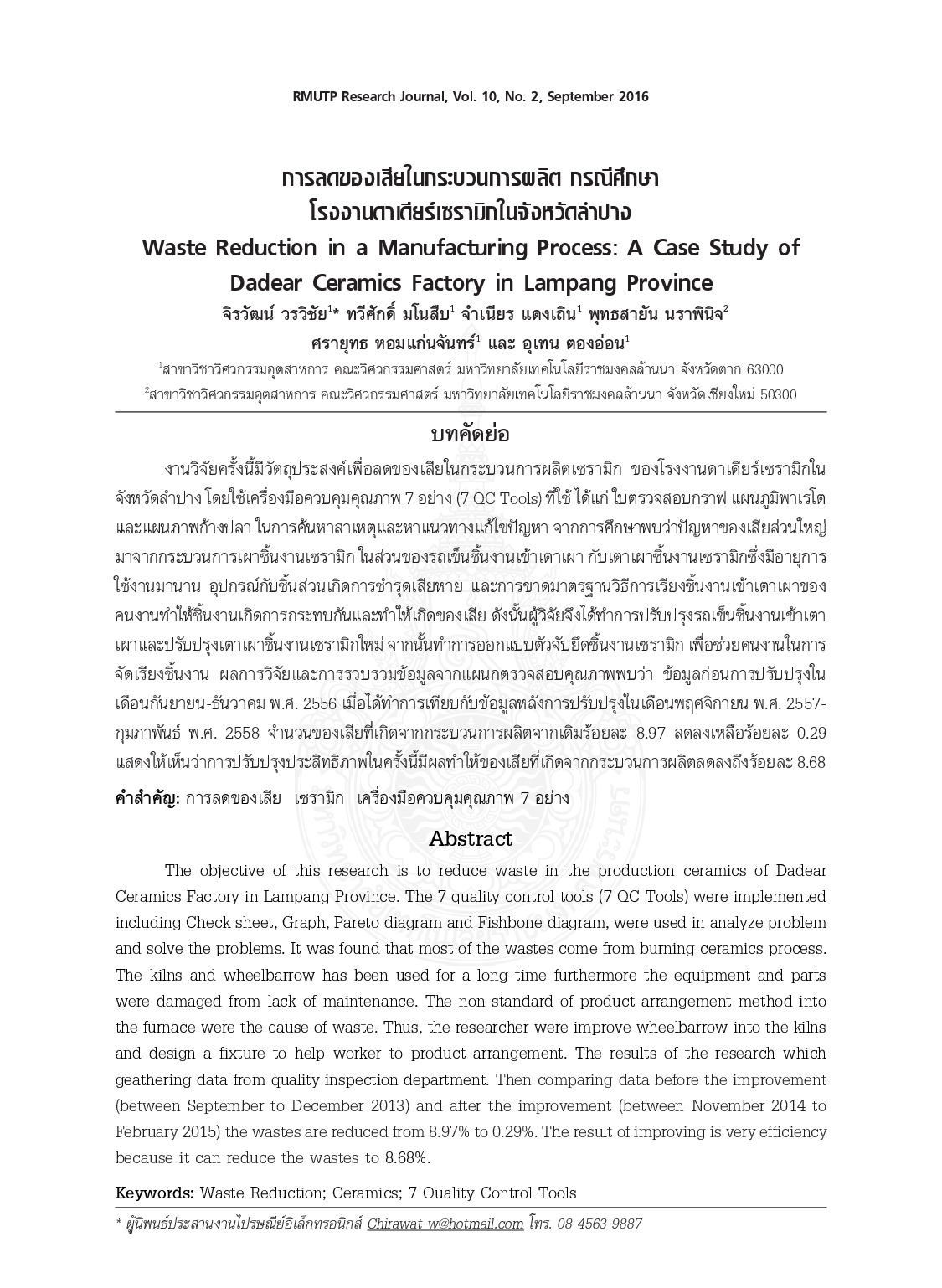
การลดของเสียในกระบวนการผลิต กรณีศึกษา : โรงงานดาเดียร์เซรามิกในจังหวัดลำปาง
The objective of this research is to reduce waste in the production ceramics of Dadear Ceramics Factory in Lampang Province. The 7 quality control tools (7 QC Tools) were implemented including Check sheet Graph Pareto diagram and Fishbone diagram were used in analyze problem and solve the problems. It was found that most of the wastes come from burning ceramics process. The kilns and wheelbarrow has been used for a long time furthermore the equipment and parts were damaged from lack of maintenance. The non-standard of product arrangement method into the furnace were the cause of waste. Thus the researcher were improve wheelbarrow into the kilns and design a fixture to help worker to product arrangement. The results of the research which geathering data from quality inspection department. Then comparing data before the improvement (between September to December 2013) and after the improvement (between November 2014 to February 2015) the wastes are reduced from 8.97% to 0.29%. The result of improving is very efficiency because it can reduce the wastes to 8.68%.