จำนวน Repository ( 7 )
การศึกษาการบำบัดน้ำเสียจากการย้อมผ้าแบบเคลื่อนที่โดยใช้ถ่านกัมมันต์จากกะลามะพร้าว
The dyeing industry both of business size and household size where the remaining water from the dyeing process is dumped into pipes and flows into natural water sources causing sewage problems. Therefore a column type wastewater treatment system has been developed by using a filtration system along with an adsorption system. The materials used to treat the wastewater from dyeing are gravel sand charcoal from wood and activated carbon from coconut shell. The study was conducted on the synthesis activated carbon from coconut shell using for color and molecules adsorption. The amount of activated carbon from coconut shell was varied at 200 400 600 and 800 g applying with filter media and other adsorption materials taking 1 hour to treat the wastewater from dyeing. The parameter using to measure water quality consisted of color value pH suspended solids conductivity turbidity value COD and TKN to indicate the water quality before and after treatment evaluating the efficiency of the wastewater treatment system. The best ratio that can treat the color is the formula containing 800 g of coconut shell activated carbon. It was able to treat the color equal to 5.94 SU or 99.43 percent compared to the wastewater before treatment.
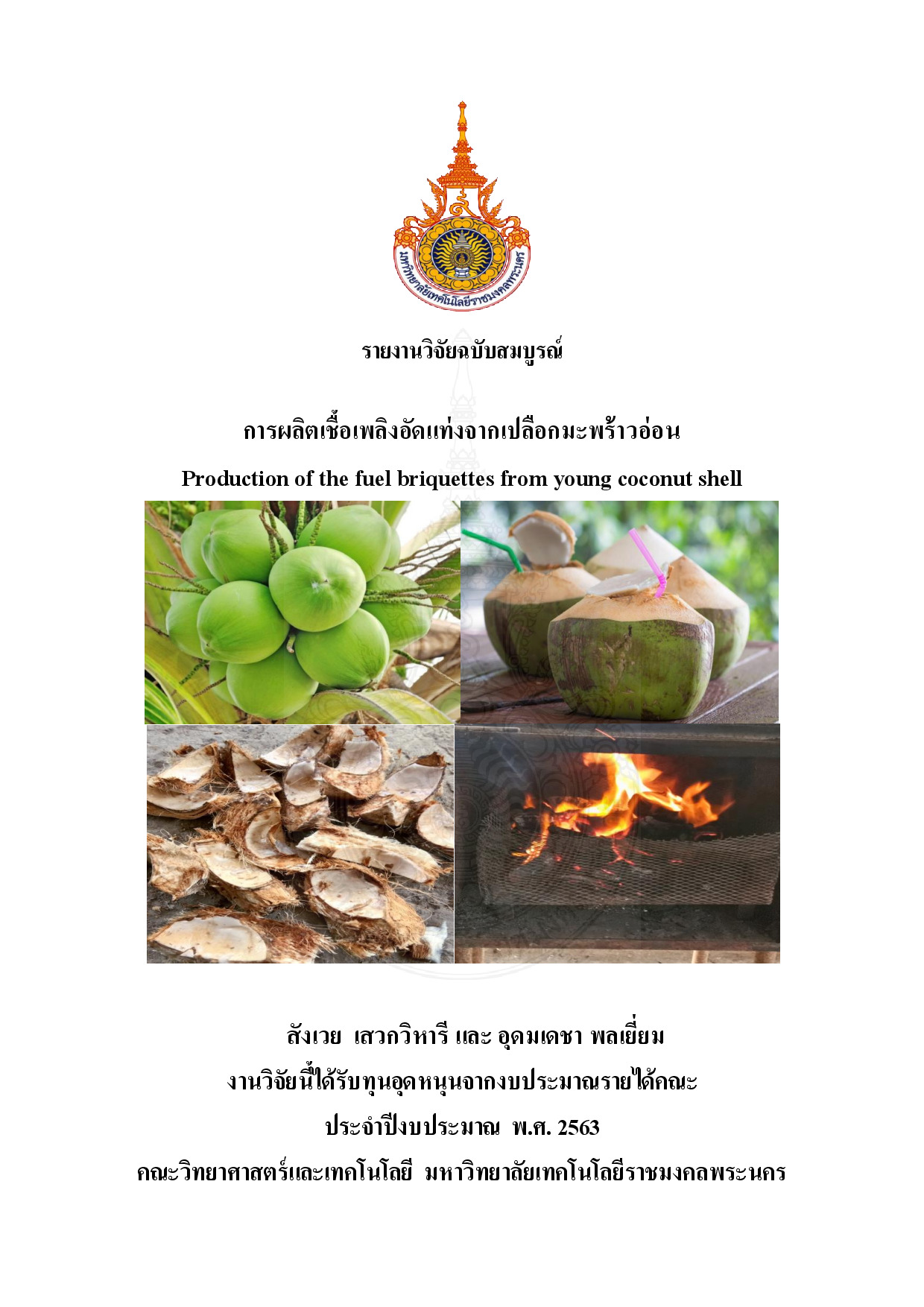
การผลิตเชื้อเพลิงอัดแท่งจากเปลือกมะพร้าวอ่อน
Young coconut shells are a byproduct after processing coconut juice which can be used to produce a solid-fuel. This fuel from the coconut shell is an alternative source instead of using firewood or charcoal made of timber in the natural forest. The solid-fuel from young coconut shells was prepared by using a wet glue powder as a binder then was compressed by using a briquette machine. The black coconut briquette was stable after exposure to the sun. The average of the briquette combustion rate was at 11.24 g /min. There is no eruption smut smoke and odor by using the young coconut shell briquette yo start a fire. To sum up a young coconut shell has a high potential as an alternative biomass material for producing a briquette especially for commercial. This solution can increase the reduction of haze weather in the sight of solid waste incineration and also global warming.
การศึกษาและพัฒนาเพื่อการออกแบบเฟอร์นิเจอร์จากกะลามะพร้าว
The study and Development for Furniture design by Coconut shell.. By giving priority to the use of natural materials in the development of products designed to replace the use of other types of wood with deforestation and the period of The study on Coconut shell. furniture design and furniture design and analysis to develop and test data from design professionals. To develop improvements in the production of prototype and test applications. To analyze and draw conclusions The piece consists of three pieces of furniture two seater sofa 160 cm wide and 80 cm long piece of 1 year and 1 sofa seat width 80 cm long and 80 cm 2. The research and development to design furniture from Coconut shell. can be found to develop products for the furniture to be used effectively. Can be developed to suit the use and beauty of natural forms.
การใช้เถ้ากะลามะพร้าวเป็นมวลรวมน้าหนักเบาในคอนกรีตบล็อกเพื่อการประหยัดพลังงาน
The objectives of this research are to study the production step proper ratio physical properties mechanical properties thermal insulation and sound insulation efficiency of concrete blocks mixed with coconut shell ash. The ratios of concrete block mixed with coconut shell ash include Portland cement type1: quarry dust: coconut shellash which equal to 1: 6.8: 0.2 1: 6.7: 0.3 1: 6.6: 0.4 1: 6.5: 0.5 and 1: 6.4: 0.6 by weight. Water per cement ratio are 0.6 by weight. The concrete block samples were casted by the general production as same as the ordinary concrete blocks and were tested follow TIS.58. From the results the best amount of coconut shell ash which put into concrete block is 1: 6.7: 0.3 of ratio. The proper ratios of coconut shell ash can decrease the density or weight and increase the thermal insulation and sound insulation efficiency of concrete blocks. However the high amounts of coconut shell ash effect to decrease the mechanical properties concrete blocks that are lower than TIS.58 standard.
การพัฒนาแผ่นซีเมนต์บอร์ดจากเถ้ากะลามะพร้าว สำหรับการอนุรักษ์พลังงานและสิ่งแวดล้อม
This research aims to develop the cement board from coconut shell ash. The Portland cement type1: fine sand: tap water ratio is equal to 1: 0.4: 0.33 by weight. The 5 ratios of Portland cement type1: coconut shell ash include 1: 0.12 1: 0.13 1: 0.14 1: 0.15 and 1: 0.16 by weight. The cement board production uses the pressure casting in normal temperature (30 – 35 degree of Celsius) and controls the 0.75 g/cm3 of density then test the properties of cement-bonded fiberboard follow TIS 878-2537 standard (cement bonded particle board: high density). From the results 1: 0.12 is the most suitable ratio of cement board from coconut shell ash. This developed cement boards can reduce the quantity of coconut shell ash waste and have the good thermal insulation.