จำนวน Repository ( 13 )
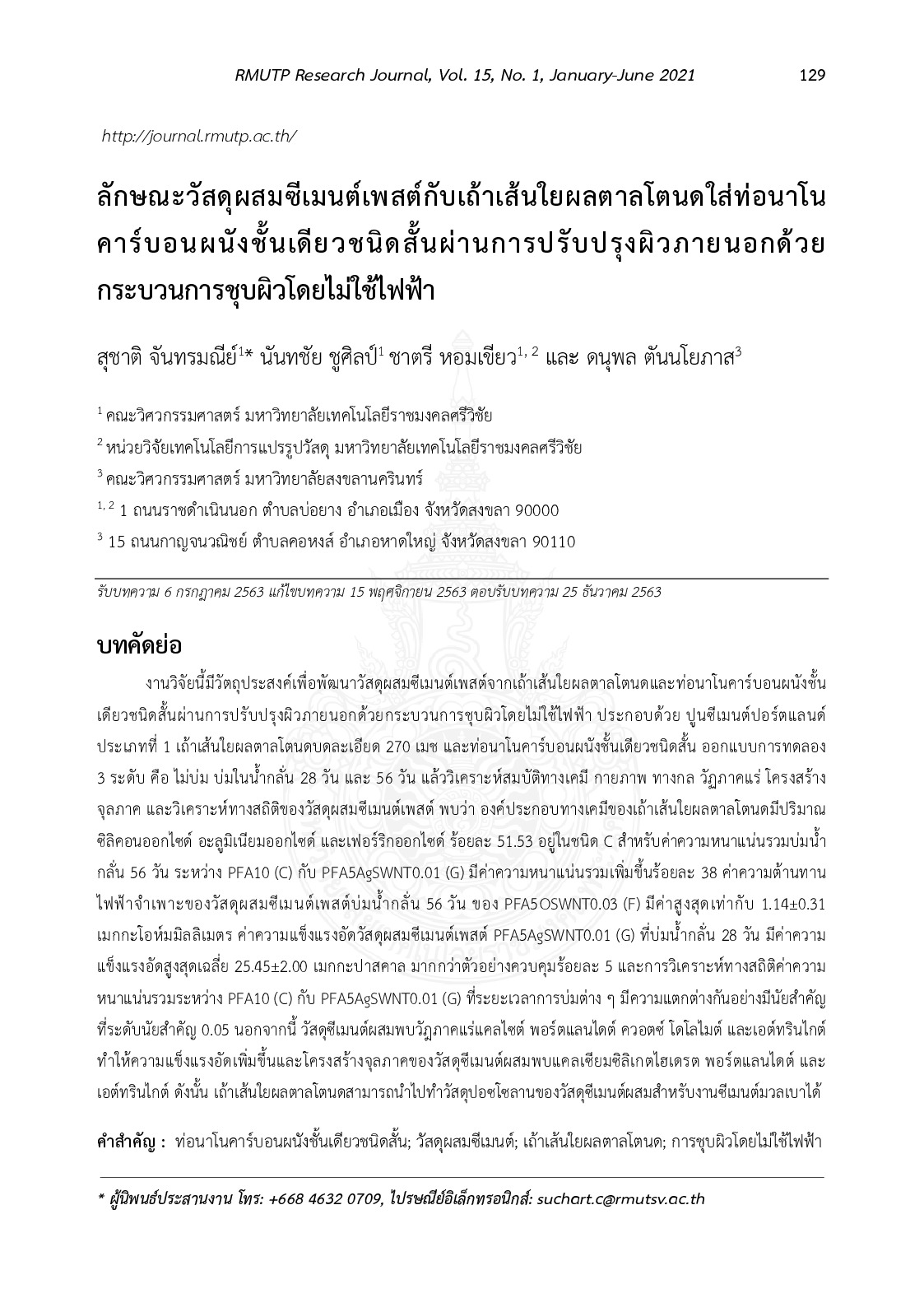
ลักษณะวัสดุผสมซีเมนต์เพสต์กับเถ้าเส้นใยผลตาลโตนดใส่ท่อนาโนคาร์บอนผนังชั้นเดียวชนิดสั้นผ่านการปรับปรุงผิวภายนอกด้วยกระบวนการชุบผิวโดยไม่ใช้ไฟฟ้า
This research was resulted of the characterization of cement paste composites (CPC) blended with palmyra fiber ash and surface-treated on short SWNT prepared by an electroless plating process. The cement paste composites included cement 270 meshes of palmyra fiber ash and short SWNT. The design of experiment was divided into 3 conditions namely uncuring 28 and 56 days in distilled water. The properties of CPC were carried out in chemical composition physical mechanical mineral phase microstructure and statistical analysis. It was found that in the chemical compositions an amount of silicon dioxide aluminium oxide and ferric oxide were 51.53% which was rated in class C. The bulk densities of CPC series between PFA10 (C) and PFA5AgSWNT0.01 (G) cured 56-day distilled water were an increased 38%. Then the highest specific electrical resistivity of CPC series PFA5OSWNT0.03 (F) cured 56-day distilled water was 1.14±0.31 mega-ohm.mm. The highest compressive strength of CPC series PFA5AgSWNT0.01 (G) cured at 28-day distilled water was 25.45±2.00 MPa compared with the OPC (A) was an increased 5%. Which the bulk densities of CPC series between PFA10 (C) and PFA5AgSWNT0.01 (G) were statistical analyzed the mostly cured at significant difference α = 0.05. In addition CPC series PFA5AgSWNT0.01 (G) mainly contained calcite portlandite quartz dolomite and ettringite were caused increasing compressive strength. And the SEM microphotograph were also displayed the calcium silicate hydrate portlandite and ettringite. Consequently the PFA was used to ability pozzolanic material using for lightweight concrete of CPC.
การผลิตและพัฒนาบรรจุภัณฑ์ที่ย่อยสลายได้จากวัสดุเชิงประกอบพลาสติก ชีวภาพและเส้นใยธรรมชาติที่ผ่านการปรับปรุงด้วยสารไซเลน
This work aimed to study the improvement of mechanical properties and cost reduction of biodegradable packaging made from polylactic acid (PLA) by using sisal fiber. Because sisal fiber as natural fiber is good mechanical properties biodegradable material and low cost. The variables studied were the addition of sisal fiber surface treatment with epoxy silane and fiber direction. Their effects were investigated by tensile flexural and impact testings and morphology analysis. The results suggested that the addition of sisal fiber increased Young’s modulus Flexural modulus and ultimate tensile stress whereas elongation at break and impact strength tended to decrease. For the effect of surface treatment it was found that tensile and flexural moduli increased with epoxy silane treatment but tensile flexural and impact strengths slightly changed. Surface treatment by epoxy silane led to good interfacial bonding by hydrogen bonding between oxirane ring of epoxy silane and hydroxyl group of PLA. The effect of fiber direction revealed that tensile properties of composite in fiber direction of 0o were higher than those of composite in fiber direction of 45o. Fiber direction did not affect flexural and impact properties.

Effects of chitosan contents on latex properties and physical properties of natural rubber latex/chitosan composites
In this study natural rubber latex/chitosan (NRL/CT) composites were prepared by latex mixing. The effects of chitosan on latex properties and physical Properties of NRL/CT composite films were focused. It was found that there was no significant change in the latex properties with increasing CT content. Increasing CT contents of 0.5 to 8.0 phr caused the rising of 300 % modulus of the NRL/CT composite whereas the opposite trend was found for tensile strength and elongation at break. The antimicrobial efficacy of the chitosan-incorporated rubber was slightly enhanced from that of the non-chitosan rubber. By comprehensive consideration CT content suitable for antibacterial gloves according to Thai industrial standards (TIS 1056-1: 2013) was 1 phr. For other latex products that require high modulus and antibacterial activity such as tubing pillow foam rubber nipple and catheter CT could be used at higher contents from 2 to 4 phr.
การศึกษาคุณสมบัติของวัสดุทดแทนไม้จากเส้นใยกาบมะพร้าว
Utilizing coconut coir fiber can offer an alternative method of adding value to agricultural wastes and help to conserve the environment. The aim of this research was to investigate the potential use of coconut coir fiber as cement composite as an environmentally material. The properties of cement composites mixed with different proportions of paper wastes were compared with ordinary white Portland cement. In addition the surface structure and chemical characteristics of samples were examined by a scanning electron microscope (SEM) and energy dispersive x-ray spectrometer (EDS). The results show that the main elements - C O Ca Al Si and K respectively were found in cement composites. The compressive and flexural strength of the cement composite decreased with an increase in the coconut coir fiber volume fraction.
การพัฒนาบรรจุภัณฑ์เพื่อสิ่งแวดล้อมจากวัสดุคอมโพสิตเส้นใยผักตบชวา แกลบ และใยมะพร้าว สำหรับรักษาอุณหภูมิ
The research was to develop environmental packaging from composite materials hyacinth fiber rice husk and coconut fiber for temperature preservation to replace the use of foam packaging that cannot be degraded naturally. In the composite materials water hyacinth fiber rice husk and coconut fiber at the ratios 7: 1: 2 1 : 1 : 2 and 1: 1: 1 were extruded by heat using isocyanate glue as a solder and testing the physical and biological properties of composite materials as fiberboard. For testing of temperature preservation of the bio packaging heat transfer test to obtain the bio-packaging for the environment the composite materials of fiber water hyacinth rice husk and coconut fiber at the ratio of 7 : 1 : 2 was the most appropriate type. Since it had a density of 0.7 grams per cubic centimeter strength of 26.76 MPa moisture content of 3.8 percent ages and swelling of 26.63 percent ages. In dry condition at room temperature it could store heat for 2 hours and could retain the cold temperature as shown for the temperatures rising from 4 to 30.7 degree Celsius within 2 hours. This research therefore presents a new alternative method of natural fiber composite materials application for temperature preservation in order to reduce the use of foam containers and increase cost value to natural bio waste materials.