จำนวน Repository ( 6 )
ทิศทางการพัฒนาศักยภาพชุมชนผลิตขนมหวานไปสู่แหล่งท่องเที่ยวอย่างยั่งยืนในจังหวัดเพชรบุรี
The study of Direction of the Potential Development Community of a Confectionery Production into the Sustainable Tourism in Phetchaburi Province aimed to study: The study of Direction of the Potential Development Community of a Confectionery Production into the Sustainable Tourism in Phetchaburi Province employed qualitative research by collecting data from interview and focus group discussion. Data was analyzed using content analysis. The main informants were community leaders local people in Phetchaburi community officers administrators sub-district administration organization. The results of this research showed that 1. This community has been empowered and also received many awards from government agencies and private sectors but there are tourism developments concerned which are the lack of cooperative from local people and academies including the shortage of staff officers for tourism promoting. 2. There are 3 process guidelines to develop the community into a potential tourism community which are 1) Encouraging people in the community to get involve with organizing confectionery tourism attractions which will be overseen by Sub-district administrations organization’s management operation responsibilities and evaluation. 2) Providing community of confectionery tourism roadmap to promote confectionery learning center confectionery festival along with setting up traditions which will symbolize the uniqueness of the community. 3) Educating youth and community members to be able to guide and show tourists around their community helping tourists to learn and to know more about the uniqueness of confectionery community to make the community more recognizable.
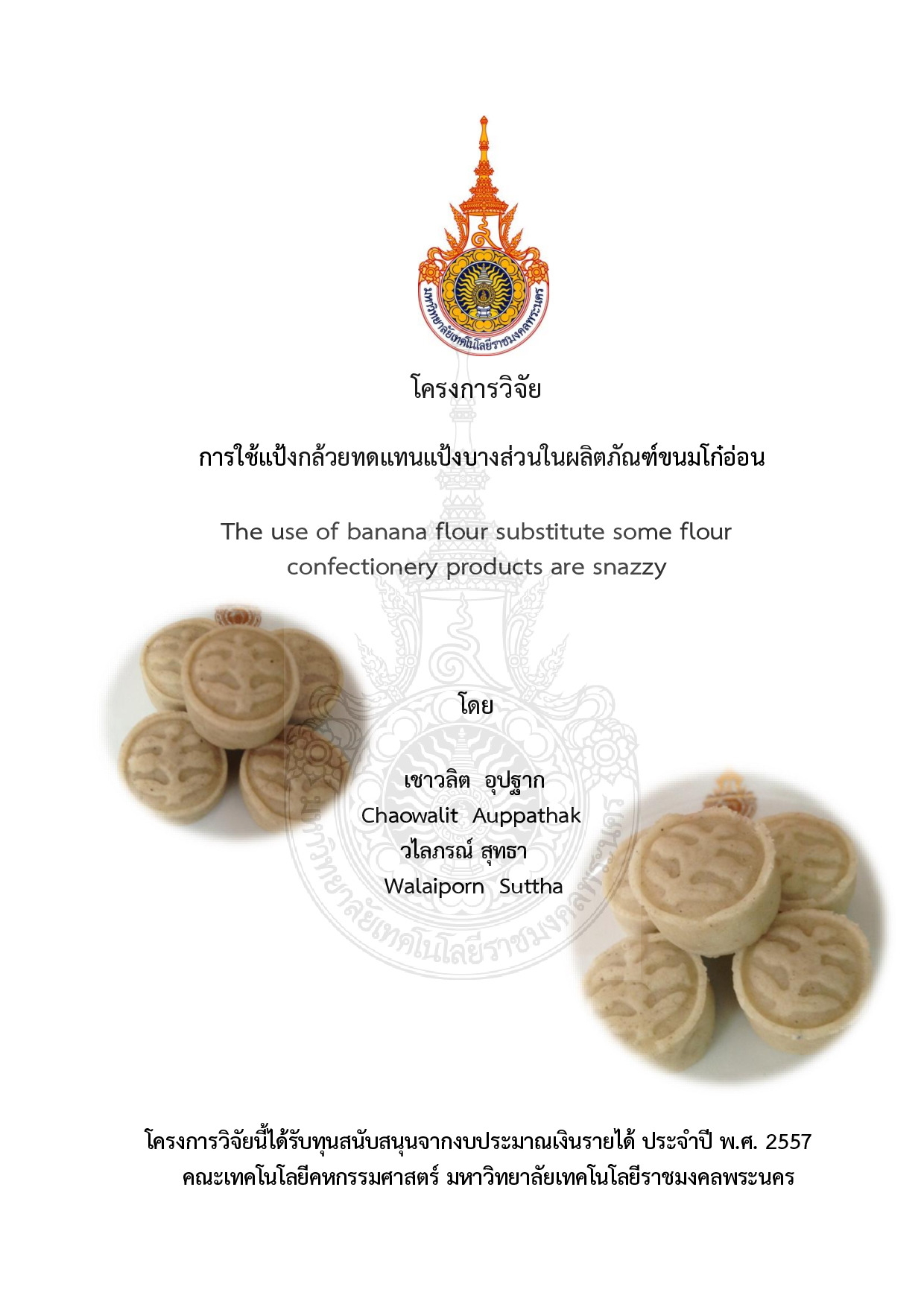
การใช้แป้งกล้วยทดแทนแป้งบางส่วนในผลิตภัณฑ์ขนมโก๋
This research has the objectives to study basic recipe of snow skin mooncake to study about suitable quantity of banana flour in snow skin mooncake stuffed with sweetened bean filling and to study waiting period of snow skin mooncake flour stuffed with sweetened bean filling adding banana flour. From the study results it is found that a test of the basic recipe of snow skin mooncake using 40 tasting persons who are instructors in Food and Nutrition Food and Nutrition Science and Food Service Industry by using method of giving score according to 9-point hedonic scale; it is found that the tasting persons gave favorite score to the third recipe of snow skin mooncake from moderate level to high level (7.49-7.99). After that the study was conducted to study the appropriate amount of banana flour in snow skin mooncake stuffed with sweetened bean filling by using banana flour replacing some part of flour in three different levels namely 40 60 and 80 per cent of all flour ingredient; it is found that at 80% the tasting persons recognized it from moderate level to high level (7.49-7.53). When the researcher brings the results to conduct variance analysis and find statistical difference it is found that the characteristics in the aspects of overall color taste texture and favorite do not have the difference with significant level at 0.05. When the period in waiting period of banana flour replacing some part of flour in Snow Skin Mooncake stuffed with sweetened bean filling in different periods was conducted at 3 levels namely 30 60 and 90 minutes it is found that at 90 minutes the tasting persons recognized from moderate level to high favorite level (7.51-7.78). When the researcher brings the results to conduct analysis in statistical difference it is found that the characteristics of appearance smell taste and texture do not have difference with statistical significant level at 0.05. As for the overall color and favor they have difference with statistical significant level at 0.05.

Development of Fruit - Confectionery Products From the Leftover from Fruit - Canning Factories in Small Business Industry
Development of fruit – confectionery products the leftover from fruit – canning factories in small business industry is the second – year continuous project. The aims were to study the product shelf life and to transfer production process to the community and private sectors. The result of shelf – life study indicated that the pH and water activity of Papaya Cream Guava Cream Pineapple Cream Mixed – flavoured fruit (yee) and Banana toffee were 3.78 3.62 3.20 3.48 3.57 3.92 and 0.97 0.97 0.91 0.60 0.51 0.58 respectively. At an 8-week period no microorganism – borne deterioration of the products was found;moreover they were accepted by the consumers. The target group of as participants as planned was trained for a 3 – day period to produce 5 fruit – confectionery products. The training evaluation revealed that the group considered management on instructors teaching materials and laboratories ‘much’ to ‘most appropriate’; whereas training operation was viewed ‘most appropriate’. At the project end it was found that 29.27% 29.27 and 28.05% of the target group made fruit – confectionery for family consumption and as a gift or a souvenir respectively; 9.76% put their products in stores for sale as a supplemental career; 3.65% transferred their knoeledge to others.
การใช้น้ำเฉาก๊วยทดแทนน้ำในขนมขี้หนู
The objectives of this special project were to investigate three basic formulas of Using black cincau water in Kanom Kee Noo and to study the content of black cincau water as partial substitute for water in Kanom Kee Noo with different four proportions of black cincau water at 0% 20% 40% and 80%. Randomized Complete Block Design (RCBD) was used as the research design. Sensory evaluation was conducted to assess appearance (rise crumbling) color flavor taste texture (softness) and overallikng preference with 9-Point Hedonic Scale. 80 tasters were instructors and students in Foods and Nutrition Faculty of Home Economics Technology Rajamangala University of Technology Phra Nakhon. Data collected were analyzed to determine mean (x̅) and Analysis of Variance (ANOVA). The statistical comparison was conducted by using Least Significant Difference (LSD) and Duncans New Multiple Range Test (DMRT). Data were analyzed through statistical software packages. The results of studying three basic formulas of Kanom Kee Noo indicated that tasters preferred the first formula over the second and the third formulas in terms of appearance (rise and crumbling) color taste and overall preference at a moderate level of preference with mean scores of 7.85 8.17 7.85 7.75 and 7.87 respectively. For the second formula over the first and the third formulas in terms of flavor at a moderate level of preference with mean scores of 7.45 respectively. The tasters had a moderate level of preference. When ANOVA and statistical comparison were considered there were the differences in appearance (rise crumbling) color flavor taste texture (softness) and overallikng preference with a statistical significance level of 0.05 The results of studying the content of black cincau water as partial substitute for water in Kanom Kee Noo with different four proportions of black cincau water showed that tasters preferred the 40% black cincau water formula over 0% 20% and 80% formulas in terms of color flavor taste texture (softness) and overallikng preference with mean scores of 7.60 7.51 7.69 7.58 and 7.63 respectively. The tasters had a moderate level of preference. The tasters preferred 20% black cincau water formula in terms of appearance (rise crumbling) over 0% 40% and 80% formulas with mean score of 7.67. The tasters had a moderate level of preference. When ANOVA and statistical comparison were considered there were statistically insignificant differences in appearance (rise crumbling) flavor taste texture (softness) and overallikng preference with a level of 0.05. There were the differences in color with a statistical significance level of 0.05.
ขนมกลีบลำดวนปราศจากกลูเตนเสริมงาดำ
This investigation aims to developing a recipe for making Gleb-Lum-Duan (Thai shortbread cookies) with black sesame from gluten-free flour by determining the appropriate ratio of glutinous flour to rice flour. According to the results from sensory quality evaluation of 50 panelist who were ordinary people using the nine-point hedonic scale it was found that Gleb-Lum-Duan having the ratio of glutinous flour to rice flour as 40:60 had the highest acceptance rating among the tasters. The results from adding texturizing additives in the gluten-free Gleb-Lum-Duan showed that the tasters panelists gave the highest acceptance rating for Gleb-Lum-Duan which xanthan gum on flavor smell texture (fracturability) and overall preference. For the amount of black sesame added in gluten-free Gleb-Lum-Duan the panelist gave the highest acceptance rating for Gleb-Lum-Duan which included 20% black sesame based on color smell taste texture (fracturability) and overall preference. For color of product the L* a* and b* values were 68.83 0.09 and 6.97 respectively. Increasing the amount of black sesame resulted in increasing a* value and decreasing b* value. The amount of free water differed significantly (p≤0.05). Increasing the amount of black sesame was found to decrease hardness (p≤0.05). Gleb-Lum-Duan with black sesame from gluten-free flour included carbohydrates protein ash fat and moisture of 63.69% 3.01% 0.95% 31.19% and 1.16% respectively. A group of 100 ordinary consumers identified taste and nutritional value of gluten-free Gleb-Lum-Duan mixed black sesame as the most important factors