จำนวน Repository ( 24 )
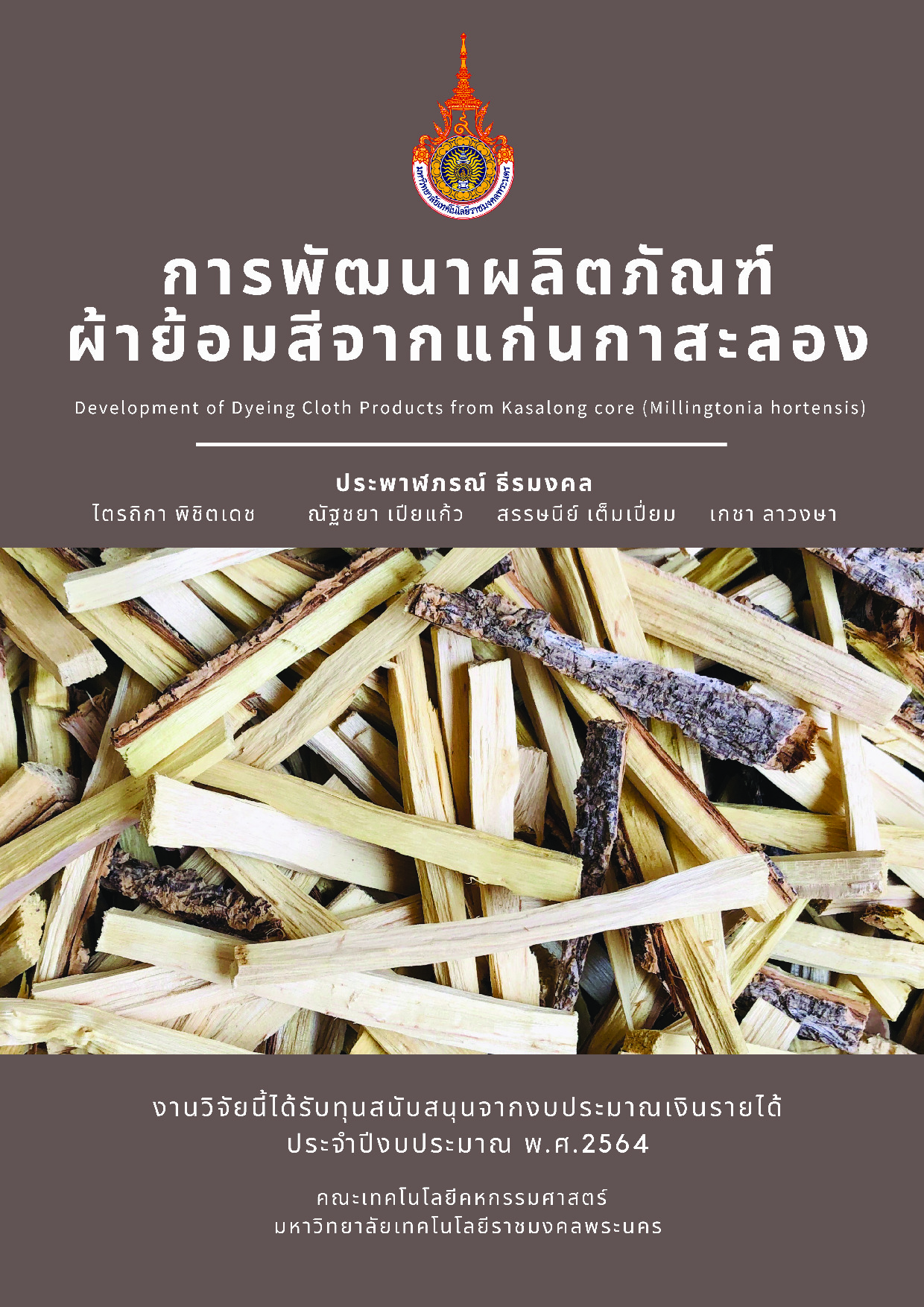
การพัฒนาผลิตภัณฑ์ผ้าย้อมสีจากแก่นกาสะลอง
Promotion of handicrafts in the field of natural dyes in the country. Increase the potential of the community and use the strengths of the cultural community. way of life and wisdom by finding ways to develop textile products by using creative textile innovations based on local wisdom in sustainable community areas To add added value to products in the ECO PRODUCT and ZERO WASTE product groups from the aforementioned concept To conserve plant genetics that exist throughout the country. The researcher therefore studied the process of dyeing fabrics by natural methods. By taking natural ingredients that are locally available and transforming them into environmentally friendly home products. This research is to study the natural dyeing of cotton fabric from Kasalong core. have a purpose Study on the effect of dyeing and the use of adjunctive agents in natural dyeing from Kasalong kernels. To develop dyed fabric products from Kasalong core and to pass on the knowledge and technology of developing dyed fabric products from Kasalong core for the general public. The result of dyeing cotton with natural dyes from Kasalong core. Four types of adhesives were used at a concentration of 20 percent as tamarind juice lime juice lime juice ash water and to test the washing fastness and sunlight resistance with the AATCC standard. The results can be summarized as follows. 1. The results of the study found that from the extraction of color from Kasalong kernels and then filtered with cloth. The color water extracted from Kasalong essence is brown. and when left for 24 hours the water color is dark brown and in this research using hot dyeing methods. 2. The result of dyeing cotton with natural dyes from Kasalong core without mordant using was found to yellow-brown but after washing the color intensity on the fabric fades slightly. 3. The result of dyeing cotton with natural color from Kasalong core. It was found that after washing the color intensity on the fabric was moderately fading. 4. The color measurement L* a* b* found that when the dye was measured in the CIELab system L* = 26.81 a* = 33.33 b* = 45.69 dL = 0.36 and dE*ab = 0.85 water. The resulting color from Kasalong will be reddish yellow. 5. Make the research prototypes as 10 of bag products. 6. Conducting technology transfer by organizing workshops dyeing course and sewing durating of the workshop for students and the general public was 1 day. Most of the participants had the highest level of satisfaction in all questions.
การย้อมสีผ้าพอลิเอไมด์ผสมอีลาสเทนด้วยสีครามจากธรรมชาติและการประยุกต์สำหรับผลิตชุดชั้นในสตรี
The purpose of this research was to study the dyeing polyamide/elastane fabric with natural indigo using exhaustion dyeing process. The effects from the concentration of the natural indigo dye thiourea dioxide and sodium hydroxide were investigated. The colour of each dyed material was investigated in term of the CIELAB (L* a* and b*) and K/S value. The color fastness to washing rubbing perspirdation light water sea water and chlorinated water of the dyed samples was determined. The bursting strengrh of dyed polyamide/elastane was evaluated. The best vatting condition was at 50 ̊C for 30 minutes. The optimal formula of dyeing polyamide/elastane fabric using natural indigo was prepared by mixing 200 g/L natural indigo paste 60 g/L thiourea dioxide 1 g/L sodium hydroxide. The fabric dyed in the solution of indigo vatting a shade of dark blue colour. The color fastness to light washing water sea water perspiration and chlorinated water were good to very good. However the rubbing fastness results showed fair level. The bursting strength of dyed fabrics is less than the undyed fabric 3.1%. The optimal ratio of discharge printing on polyamide/elastane fabric were compose of 70 % starch print paste and 30 % discharging agent (KMnO4). The pattern design produced from these combinations in the printing areas on fabrics showed an excellent standard of printing quality. The results confirmed that natural indigo dyes have potential applications in polyamide/elastane fabric dyeing and the dyed fabric can be used produce women’s intimate apparel.

การใช้ประโยชน์จากน้ำแช่เมล็ดถั่วดำแห้งในกระบวนการย้อมสีสิ่งทอ
The purpose of this research was to investigate the use of soaked black bean water and to add value to it otherwise it is considered as colored waste water. The soaked black bean water was analyzed for phytochemicals and dyeing process was carried out silk cotton and polyester fibers. Dried black beans were soaked in water ratio 1:1 for at least 12 hours. The dyeing process involved soaking the fiber in soaked black bean water at 100o for 30 min. to determine the type of fiber staining and color fastness. Results showed presence of Anthocyanin Anthraquinonoid Terpenoid Saponin Tannin and Flavonoids in soaked black bean water. It was found that dye could be absorbed by silk fabric in an acidic condition. The shade appeared red-brown at L*44.17 a*16.88 and b*20.13 color strength was 6.19 and ultraviolet protection was blocked more than 97.5 percentages as UPF 50+. Moreover the color fastness grading in crocking property was very good to excellent (CF 4-5) good washing fastness (WF4) and moderate fastness in the presence of light (LF 4). In conclusion soaked black bean water can be used for dyeing for silk fabric and enhance UV protection.
การพัฒนาผลิตภัณฑ์ของตกแต่งบ้านด้วยการย้อมสีธรรมชาติจากใบต้นคูน
The proposes of this research were to Home Decorative Product Development by Dyeing with Natural Dye from Klun Leaves (Golden shower: Cassia fistula). The effects of dye and mordant in dyeing silk fabric with Natural Dyestuff from Klun Leaves (Golden shower: Cassia fistula and textile testing standard AATCC in colour fastness: washing. The researcher used 20 percent of concentration and Textile Testing standard AATCC as follows. The result showed that the extraction of color from Klun Leaves (Golden shower: Cassia fistula. Dye extracted from the leaves of brown. The second night it will be a dark brown color. In this study using hot-dyed water. When left for 24 hours the water is dark brown. In this research 1. silk is dyed with natural dyestuff from Klun Leaves (Golden shower: Cassia fistula without mordant. There are light yellow colour. 2. The effect of dyeing silk with natural color from the tree. Without the help of additives found. Yellow But after washing the intensity of the color on the cloth fades a little. 3. The effect of dyeing silk with natural color from the tree. Five types of additive were added at 20 percent concentration namely vinegar lemon juice water rust lime and saline. The results showed that all five adjuvants were effective after washing the color intensity on the fabric. 4. Conducting technology transfer. Most of the participants were satisfied with the highest level of satisfaction in all questions.
การควบคุมคุณภาพการย้อมสีและตกแต่งสำเร็จเส้นด้ายผักตบชวาและวัสดุประกอบเพื่อการแปรรูปผลิตภัณฑ์เชิงพาณิชย์
Quality control of dyeing and finishing of Water Hyacinth yarns and their transformed materials for commercial was a main objective to establish the dye database of synthetic dye and natural dye. The dye database was a data for quality control in dyeing process of raw material as Water Hyacinth yarns also it resolved the un-repeatability dyeing problem. Reactive dye was used for synthetic dye database creation on dry Water Hyacinth yarns at 80oC for 30 minutes. Red as Hicion Red He-3B yellow as Hicion Yellow HE-4RN Blue as Hicion Navy Blue HER 150% and black as Hifix Black KNN were the represent synthetic dye and Sodim sulphate 20 g/l and sodium carbo nate 20 g/l were used as auxiliaries. The other hands the natural dye database was forming from Ebony tree Caesalpinia sappan and Turmeric. They were dye on dry Water Hyacinth yarns at 80oC for 30 minutes and Sodim sulphate 20 g/l was the auxiliary. Whereas Butterfly pea were dye at 80oC for 30 minutes by Sodim sulphate 20 g/l and sodium carbonate 20 g/l were the auxiliaries. The whole dye database was defined the totally in Primary Secondary and ternary dye cycle. The transfer knowledge was distributed to the enterprise at Nakhon Prathom Provincd as “Chumchonjaksanpaktobchawha Bann klongnokkratum”. The topics were “How to establish the synthetic and natural dye database” “Water repel lent finishing” and “developed and transformed the Water Hyacinth to products”. The target group was very satisfied in this topic as 4.39. In the result the proportion between economic and social factor by the income increasing in 1 year was 5.04. So the research project was achievement.