จำนวน Repository ( 7 )

การศึกษาเชิงทดลองการเพิ่มประสิทธิภาพแผงเซลล์แสงอาทิตย์โดยใช้ท่อความร้อนแบบแบน
The purpose of this research was to improve the efficiency of solar cell modules by cooling with heat pipes. The test set consisted of three 80 watt solar modules that were made of mono-crystalline. The first module did not install heat pipes while the second module installed heat pipes using ethanol as the working fluid and the third module installed heat pipes using R-11 as working fluid. Solar radiation intensity electrical energy produced by the solar modules and temperature of the solar modules were recorded. The results showed that the average temperature of the first solar cell module was 52.9oC and the case of not install heat pipes on module. For the units with heat pipes it was found that unit with ethanol heat pipe had an average temperature of 50.7oC and efficiency at 10.2% whereas the unit using R-11 heat pipe had an average temperature at 49.2oC and efficiency at 11.8% From the experiments it was concluded that the installation of heat pipes could increase the efficiency of solar cell mokules.
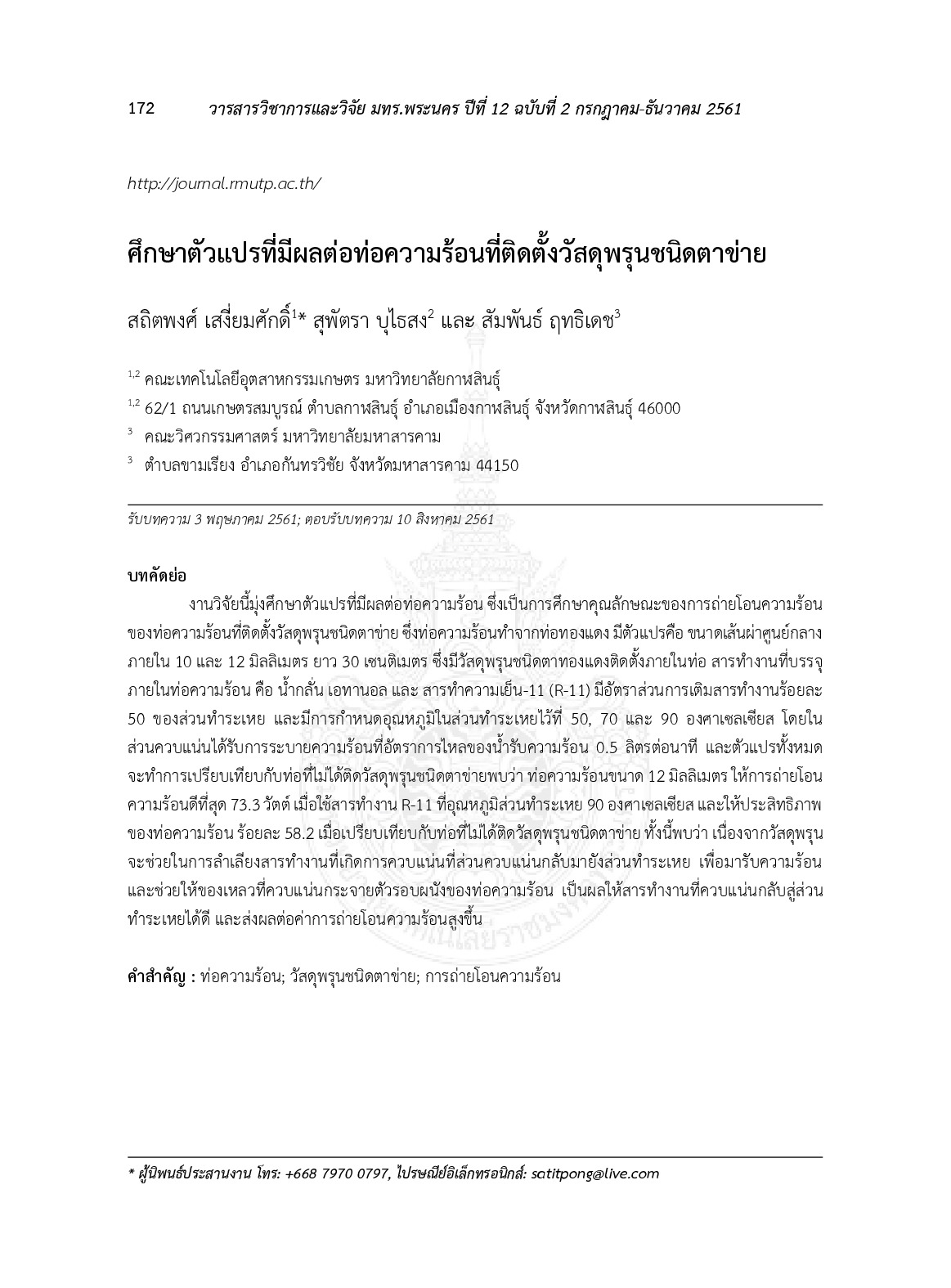
ศึกษาตัวแปรที่มีผลต่อท่อความร้อนที่ติดตั้งวัสดุพรุนชนิดตาข่าย
This research aims to study the parameters have affected the pipe which was studied the heat transfer characteristics of a heat pipe with a mesh wick. The heat pipe made from copper tubes with intemal (ID) as 10 and 12 mm and length of 30 cm which was installed a copper mesh wick inside a tube. Three working fluids are distilled water ethanol and refrigerants-11 (R-11). The filling ratios is 50% with respect to evaporator volume. The operating temperature at the evaporator section is: 50 70 and 90 oC. The condenser section has cooked by water with a flow rate of 0.5 L/min. Then all of the experimental data were compared with the heat pipe without copper mesh wick. It was found that heat pipe at ID 12 mm yielded a better heat transfer rate when compared with heat pipe without a mesh wick. The heat pipe produced a heat transfer rate value of 7.3 W and heat pipe efficiency of 58.5 at evaporator section’s temperature of 90oC. In addition the mesh wicks will help transfer the working fluid in the condenser section return to the evaporator section. The condensed liquid had spread around the walls of the heat pipe. The working fluid was condensed to the evaporator section then affected to a higher heat transfer rate.
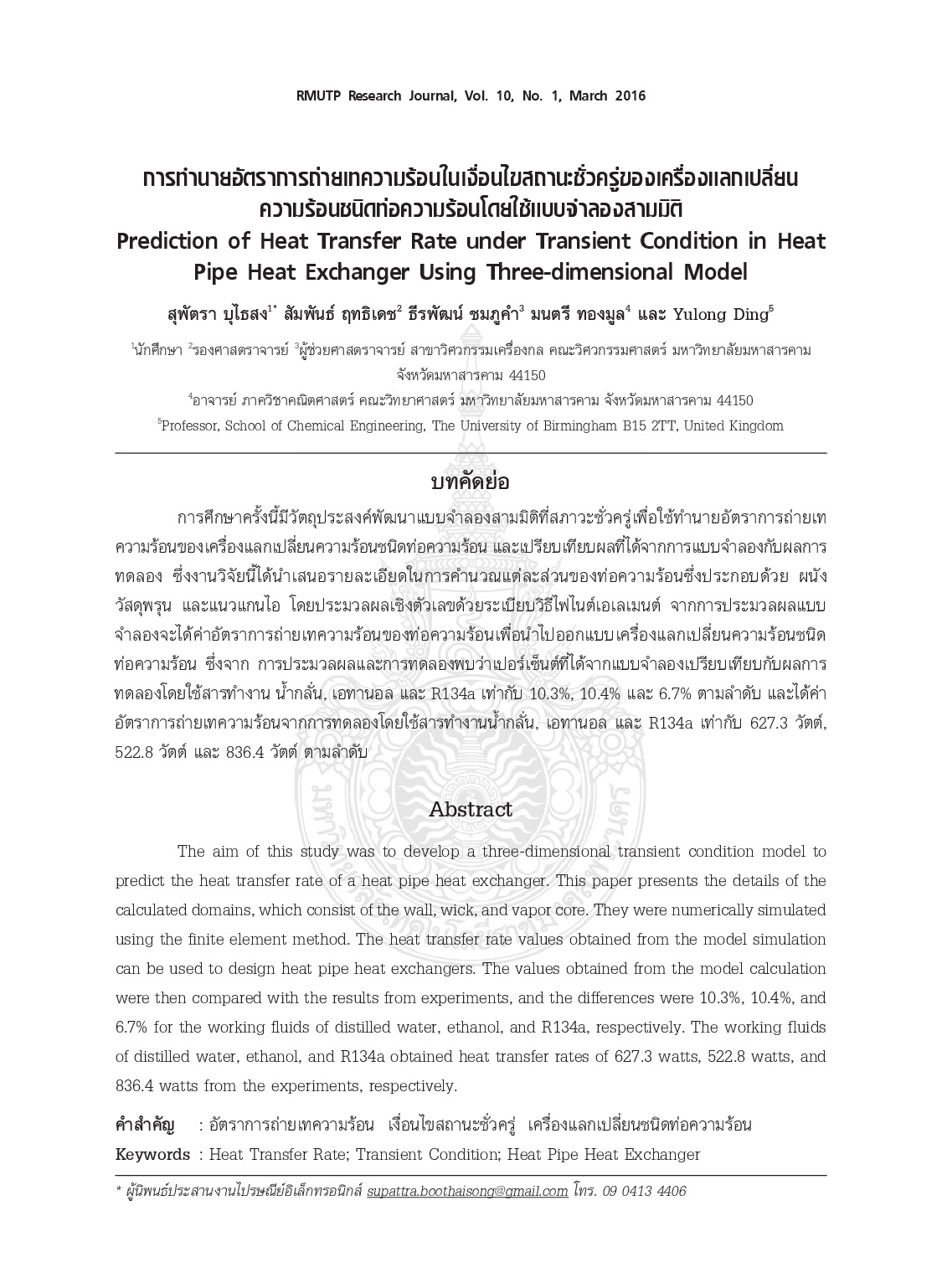
การทำนายอัตราการถ่ายเทความร้อนในเงื่อนไขสถานะชั่วครู่ของเครื่องแลกเปลี่ยนความร้อนชนิดท่อความร้อนโดยใช้แบบจำลองสามมิติ
The aim of this study was to develop a three-dimensional transient condition model to predict the heat transfer rate of a heat pipe heat exchanger. This paper presents the details of the calculated domains which consist of the wall wick and vapor core. They were numerically simulated using the finite element method. The heat transfer rate values obtained from the model simulation can be used to design heat pipe heat exchangers. The values obtained from the model calculation were then compared with the results from experiments and the differences were 10.3% 10.4% and 6.7% for the working fluids of distilled water ethanol and R134a respectively. The working fluids of distilled water ethanol and R134a obtained heat transfer rates of 627.3 watts 522.8 watts and 836.4 watts from the experiments respectively.
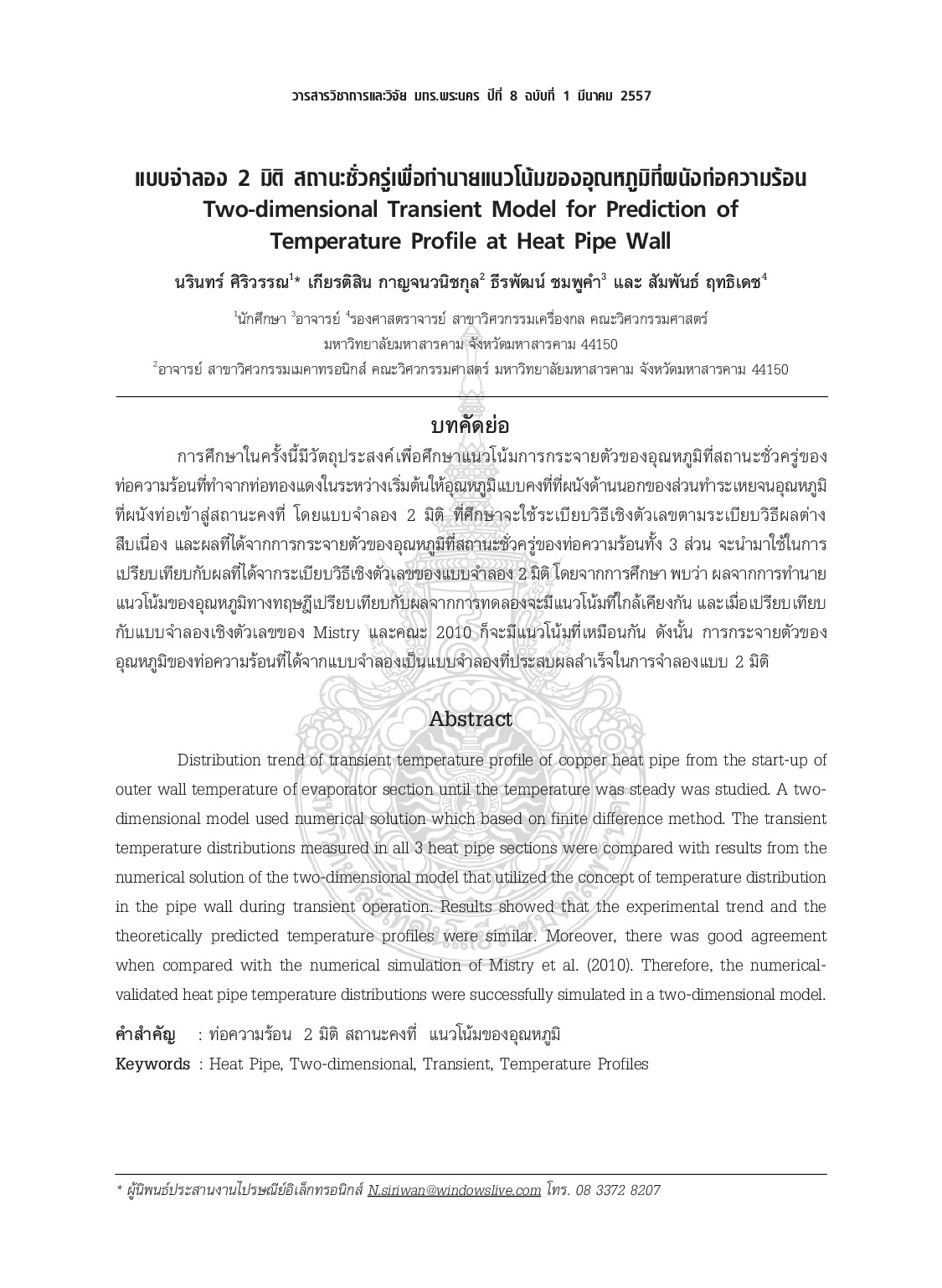
Two-dimensional transient model for prediction of temperature profile at heat pipe wall
Distribution trend of transient temperature profile of copper heat pipe from the start-up of outer wall temperature of evaporator section until the temperature was steady was studied. A two-dimensional model used numerical solution which based on finite difference method. The transient temperature distributions measured in all 3 heat pipe sections were compared with results from the numerical solution of the two-dimensional model that utilized the concept of temperature distribution in the pipe wall during transient operation. Results showed that the experimental trend and the theoretically predicted temperature profiles were similar. Moreover there was good agreement when compared with the numerical simulation of Mistry et al. (2010). Therefore the numerical-validated heat pipe temperature distributions were successfully simulated in a two-dimensional model.
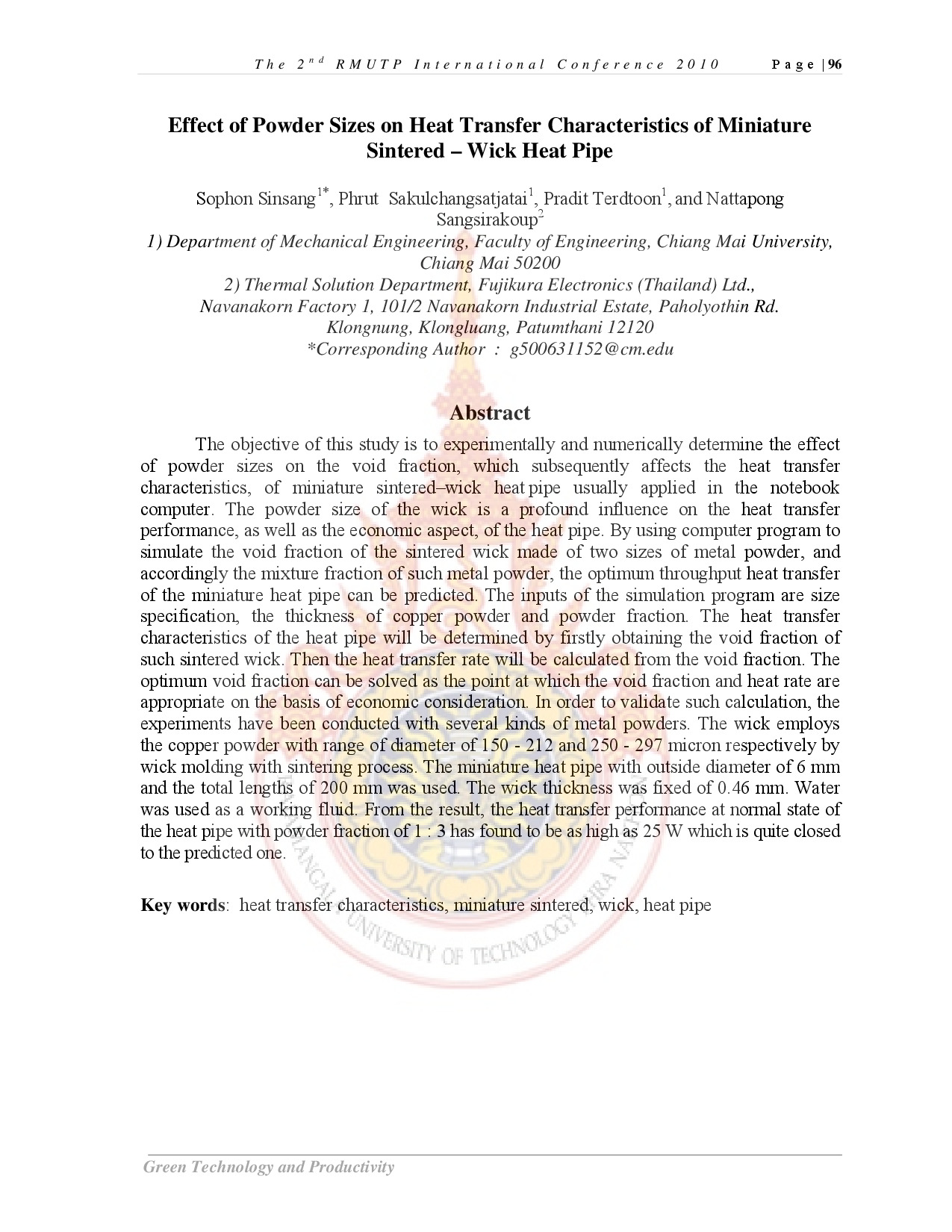
Effect of Powder Sizes on Heat Transfer Characteristics of Miniature Sintered – Wick Heat Pipe
The objective of this study is to experimentally and numerically determine the effect of powder sizes on the void fraction which subsequently affects the heat transfer characteristics of miniature sintered–wick heat pipe usually applied in the notebook computer. The powder size of the wick is a profound influence on the heat transfer performance as well as the economic aspect of the heat pipe. By using computer program to simulate the void fraction of the sintered wick made of two sizes of metal powder and accordingly the mixture fraction of such metal powder the optimum throughput heat transfer of the miniature heat pipe can be predicted. The inputs of the simulation program are size specification the thickness of copper powder and powder fraction. The heat transfer characteristics of the heat pipe will be determined by firstly obtaining the void fraction of such sintered wick. Then the heat transfer rate will be calculated from the void fraction. The optimum void fraction can be solved as the point at which the void fraction and heat rate are appropriate on the basis of economic consideration. In order to validate such calculation the experiments have been conducted with several kinds of metal powders. The wick employs the copper powder with range of diameter of 150 - 212 and 250 - 297 micron respectively by wick molding with sintering process. The miniature heat pipe with outside diameter of 6 mm and the total lengths of 200 mm was used. The wick thickness was fixed of 0.46 mm. Water was used as a working fluid. From the result the heat transfer performance at normal state of the heat pipe with powder fraction of 1 : 3 has found to be as high as 25 W which is quite closed to the predicted one.