จำนวน Repository ( 6 )
การพัฒนารูปแบบการเรียนรู้เพื่อเสริมสร้างสมรรถนะการเป็นผู้ประกอบการ สำหรับนักศึกษาคณะศิลปศาสตร์ มหาวิทยาลัยเทคโนโลยีราชมงคลพระนคร
The objectives of this research were 1) to study factors that promote and support entrepreneurial skill building for students of the Faculty of Liberal Arts. Rajamangala University of Technology Phra Nakhon 2) Develop a learning model to enhance entrepreneurial capacity For students of the Faculty of Arts Rajamangala University of Technology Phra Nakhon which summarizes the results of the study as follows: The results of a study of elements and indicators of entrepreneurial competency for setting goals developing and evaluating student competency. with the research process to analyze the exploratory factor analysis (EFA) sample of teachers Faculty of Arts Rajamangala University of Technology Phra Nakhon found that the performance components of Entrepreneurship of students of the Faculty of Liberal Arts Rajamangala University of Technology Phra Nakhon consists of 4 competencies: (1) Competency in promoting holistic thinking: 14 indicators; (2) Evidence-based competency: 8 indicators; (3) Empowerment competence. and quality of care with 11 indicators and (4) ethical competency with 8 indicators of which 41 performance indicators out of a total of 42 indicators were accurate to the actual condition.
การใช้เวลาว่างกับรูปแบบการเรียนรู้ของนักศึกษา คณะครุศาสตร์อุตสาหกรรม มหาวิทยาลัยเทคโนโลยีราชมงคลพระนคร
The purpose of this research was to 1) study the students leisure time. 2) study the learning patterns of the students of the Faculty of Industrial Education. And 3) find out the relationship between leisure time and learning styles of the students of the Faculty of Industrial Education Rajamangala University of Technology Phra Nakhon. The samples of this research were Faculty of Industrial Education 245 students Rajamangala University of Technology Phra Nakhon were sampled stratified by stratified random sampling. Tools used in this research were questionnaire about the leisure time habits and the learning patterns of the students. The results of the research were; firsty the study of students leisure time behavior. Rajamangala University of Technology Phra Nakhon showed that the leisure time of students The overall score was moderate.The students leisure time is the interaction activity followed by the leisure activity. Learning Activities and health activities. Secondly results of learning models showed that learning styles of students of Faculty of Industrial Education Rajamangala University of Technology Phra Nakhon At the mean level. it was found that there were 6 mean scores in the mean. The first was the collaborative learning model. Independent competitive and avoided. Finally Results of the relationship between leisure time and learning styles of students in Faculty of Industrial Education found that the behavior of leisure time in learning activities. Leisure activities There was a statistically significant positive correlation between the learning activities and the six learning styles at the .05 and .0.01 levels. There are positive relationships only with participatory learning models. At the .01 level of significance.

รูปแบบการเรียนภาษาอังกฤษของนักศึกษาคณะศิลปศาสตร์ มหาวิทยาลัยเทคโนโลยีราชมงคลพระนคร
This research is aimed to study the English language learning styles of Liberal Arts students Rajamangala University of Technology Phra Nakhon. The target group of this study include 248 first-year students of Liberal Arts studying English II in the academic year 2012.The tools used for this research are the Perceptual Learning Style Preference Questionnaire (PLSPQ) (Reid 1987) and data analysis using SPSS for Windows program version 11.5. The statistics used include the percentage mean and standard deviation. It was found that the three main learning styles were: GLS- Group Learning Style (3.63); ALS- Audio Learning Style (3.54) and KLS- Kinesthetic Learning Style (3.45) respectively.
รูปแบบการเรียนที่มีผลต่อผลสัมฤทธิ์ทางการเรียนของนักศึกษา มหาวิทยาลัยเทคโนโลยีราชมงคลพระนคร
The purposes of this research were to study the learning styles affecting learning achievement of students on Rajamangala University of Technology Phra Nakhon The sample consisted of 257 the fourth year students of the faculty of Liberal Arts Mass Communication Technology Textile Industry and Fashion Design Home Economics Technology and Architecture and Design in the first semester of 2007 academie year the instrument uesd for collecting data was the 5 rating scales -questionnaire on learning styles. The questionnaires consisted of 6 learning styles classified by Reichman and Grasha : Independent Dependent Avoidance Collaborative Participant and Competitive consisted of 60 items. The reliability was 0.85. The data were analyzed by using the computer program SPSS for window. The statistics analysis includes a -coefficients percentage mean and standard deviation The results were as follows : 1. Most students occupied collaborative and participant learning styles then independent dependent avoidance and competitive respectively. 2. The competitive and collaborative affecting learning achievement were significantly different at P<05. The competitive learning style has the negative affecting towards learning achievement. The Collaborative learning style has the positive affecting towards learning achievement. 3. The equation used for predicting learning achievement is Y = 2.697 -0.118 X6 +0.158 Xs
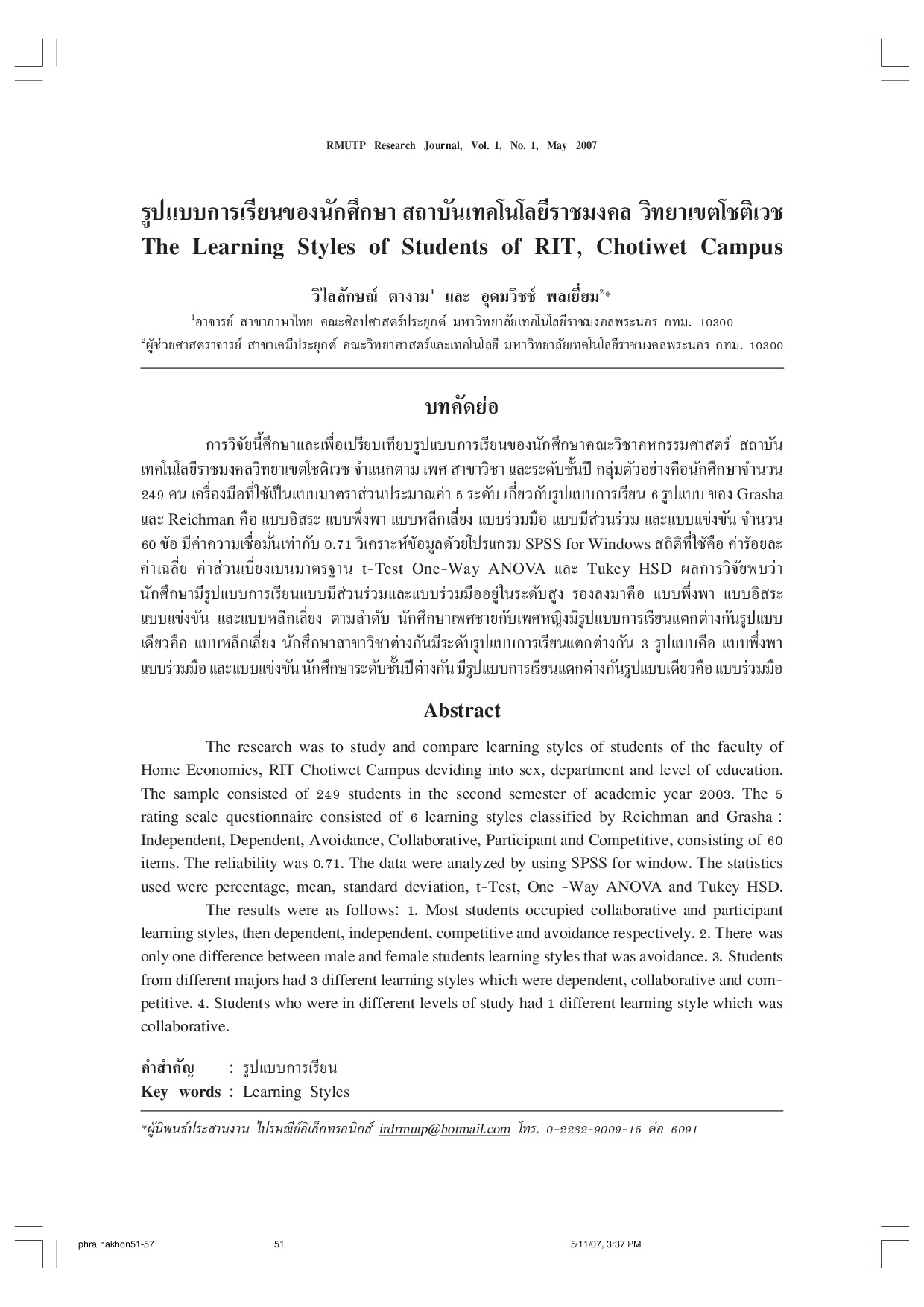
The Learning Styles of Students of RIT, Chotiwet Campus
The research was to study and compare learning styles of students of the faculty of Home Economics RIT Chotiwet Campus deviding into sex department and level of education. The sample consisted of 249 students in the second semester of academic year 2003. The 5 rating scale questionnaire consisted of 6 learning styles classified by Reichman and Grasha : Independent Dependent Avoidance Collaborative Participant and Competitive consisting of 60 items. The reliability was 0.71. The data were analyzed by using SPSS for window. The statistics used were percentage mean standard deviation t-Test One -Way ANOVA and Tukey HSD. The results were as follows: 1. Most students occupied collaborative and participant learning styles then dependent independent competitive and avoidance respectively. 2. There was only one difference between male and female students learning styles that was avoidance. 3. Students from different majors had 3 different learning styles which were dependent collaborative and competitive. 4. Students who were in different levels of study had 1 different learning style which was collaborative.