จำนวน Repository ( 8 )
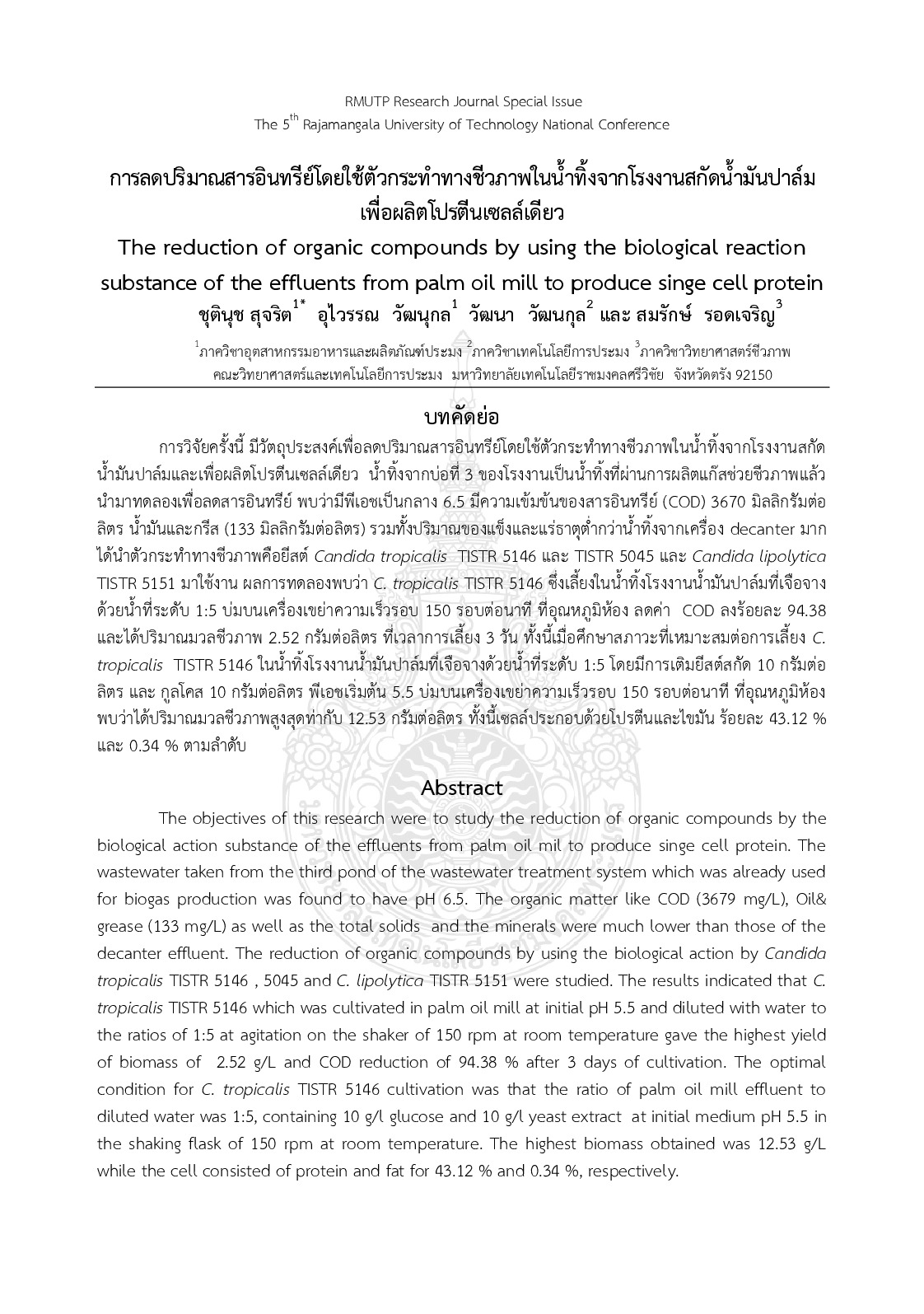
The reduction of organic compounds by using the biological reaction substance of the effluents from palm oil mill to produce singe cell protein
The objectives of this research were to study the reduction of organic compounds by the biological action substance of the effluents from palm oil mil to produce singe cell protein. The wastewater taken from the third pond of the wastewater treatment system which was already used for biogas production was found to have pH 6.5. The organic matter like COD (3679 mg/L) Oil& grease (133 mg/L) as well as the total solids and the minerals were much lower than those of the decanter effluent. The reduction of organic compounds by using the biological action by Candida tropicalis TISTR 5146 5045 and C. lipolytica TISTR 5151 were studied. The results indicated that C. tropicalis TISTR 5146 which was cultivated in palm oil mill at initial pH 5.5 and diluted with water to the ratios of 1:5 at agitation on the shaker of 150 rpm at room temperature gave the highest yield of biomass of 2.52 g/L and COD reduction of 94.38 % after 3 days of cultivation. The optimal condition for C. tropicalis TISTR 5146 cultivation was that the ratio of palm oil mill effluent to diluted water was 1:5 containing 10 g/l glucose and 10 g/l yeast extract at initial medium pH 5.5 in the shaking flask of 150 rpm at room temperature. The highest biomass obtained was 12.53 g/L while the cell consisted of protein and fat for 43.12 % and 0.34 % respectively.

An Experimental investigation of the carbonation of blended portland cement palm oil fuel ash mortar in an indoor environment
In this research palm oil fuel ash was utilized as a pozzolanic material in blended Portland cement mortar. The mortar was tested on the normal compressive strength and the negative effect of carbonation in indoor environment using the accelerated carbonation test of 5% CO2 in 50% relative humidity. Three palm oil fuel ash fractions of different fineness viz. coarse original palm oil fuel ash (CPOA) medium palm oil fuel ash (MPOA) and fine palm oil fuel ash (FPOA) were used for the study. Ordinary Portland cement (OPC) was partially replaced by these palm oil fuel ashes at the dosages of 20% and 40% by weight of binder. The results showed that the incorporation of the ashes affected the strength and the carbonation depths of mortars. The strengths of mortar slightly decreased with the increases in the dosage of the ash. The fineness of ash on the other hand improved the strength and the carbonation of the mortars. The mortars containing FPOA exhibited high strength and relatively low carbonation in comparison to those using coarser MPOA and CPOA. The use of FPOA resulted in a strong and dense mortar owing to the increased packing effect and pozzolanic reaction. It was therefore demonstrated that the FPOA could be used as a pozzolanic material to replace part of Portland cement for use in the indoor environment.
Pore structure changes of blended cement pastes containing fly ash, rice husk ash, and palm oil fuel ash caused by carbonation
In this paper the effects of carbonation on pore structure of blended pozzolan cement pastes were investigated. Ordinary Portland cement _OPC_ was partially replaced with ground palm oil fuel ash _POA_ ground rice husk ash _RHA_ and classified fine fly ash _FA_. The strength total porosity specific surface area and pore size distribution were tested. In general incorporation of pozzolans increased the total porosity of blended cement pastes in comparison to that of OPC paste. Carbonation of pastes under 5% CO2 and 50% relative humidity _RH_ for 28 days resulted in filling of the pore voids and possible attack on calcium silicate hydrate _CSH_ depending on the type of pozzolan used. After carbonation total porosity decreased and specific surface areas of the blended pozzolan cement pastes reduced indicating the infilling of voids. Pore size distributions of POA and RHA pastes were different to those of FA pastes. Large pores of the POA and RHA pastes were increased indicating coarsening of pores owing to possible attack on CSH. It is possible that POA and RHA were highly reactive and hence their uses resulting in severe carbonation compared to use of FA.
Strength and chloride resistance of blended Portland cement mortar containing palm oil fuel ash and fly ash
This paper presented a study on the strength and chloride resistance of mortars made with ternary blends of ordinary Portland cement (OPC) ground palm oil fuel ash (POA) and classified fly ash (FA). The mortar mixtures were made with Portland cement type I containing 0-40wt% FA and POA. FA and POA with 1wt%-3wt% retained on a sieve No.325 were used. The compressive strength and rapid chloride penetration depth of mortars were determined. The results reveal that the use of ternary blended cements produces good strength mortars. The use of the blend of FA and POA also produces high strength mortars and excellent resistance to chloride penetration owing to the synergic effect of FA and POA. A mathematical analysis and two-parameter polynomial model were presented to predict the compressive strength. The mathematical model correlated well with the experimental results. The computer 3-D graphics of strength of the ternary blended mortars were also constructed and could be used to aid the understanding and the proportioning of the blended system.
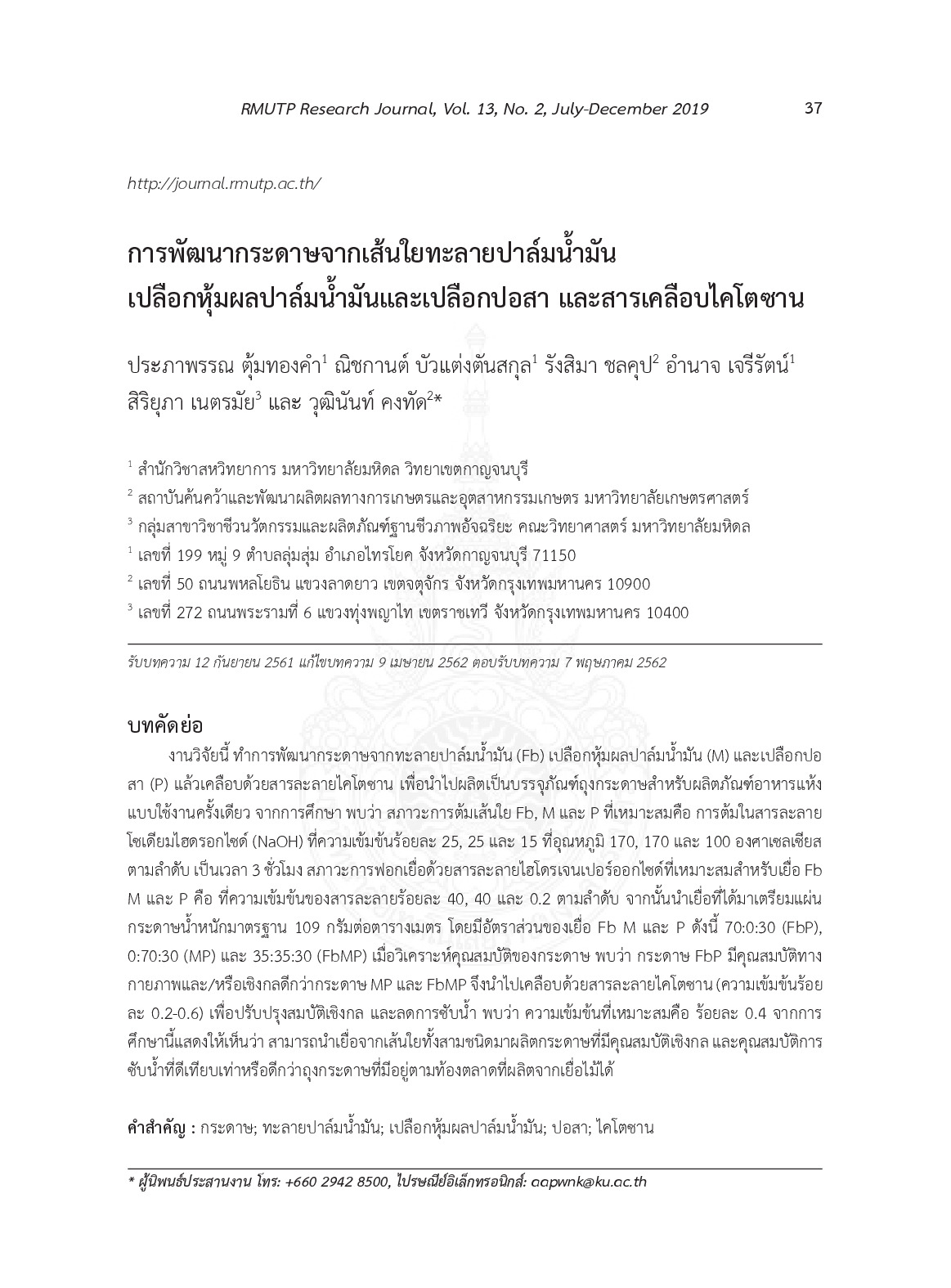
การพัฒนากระดาษจากเส้นใยทะลายปาล์มน้ำมันเปลือกหุ้มผลปาล์มน้ำมันและเปลือกปอสา และสารเคลือบไคโตซาน
This research aimed to develop paper from oil palm empty fruit bunch (Fb) oil palm mesocarp (M) and paper mulberry (P) with chitosan coating to be used as single-use paper bag for dry food products. The optimal pulp preparation conditions for Fb M and P fibers were boiling in 25 25 and 15% NaOH solution at 170 170 and 100°C for 3 hours respectively. The optimal H2O2 concentrations for bleaching of Fb M and P pulps were 40% 40% and 0.2% respectively. The obtained pulps were used to prepare papers with the basis weight of 109 g/m2 . The papers consisted of Fb M and P pulps at ratios of 70:0:30 (FbP) 0:70:30 (MP) and 35:35:30 (FbMP). It was found that FbP paper showed superior physical and/or mechanical characteristics than those of MP and FbMP. FbP papers were then coated with chitosan solutions (0.2-0.6%) to further improve their mechanical properties and reduce their water absorption characteristics. The optimal concentration of chitosan was 0.4%. This study showed that all three types of pulps could be used to produce papers that had equal or superior mechanical- and water adsorption properties as compared to those of commercially available paper bags made from wood pulp.