จำนวน Repository ( 6 )
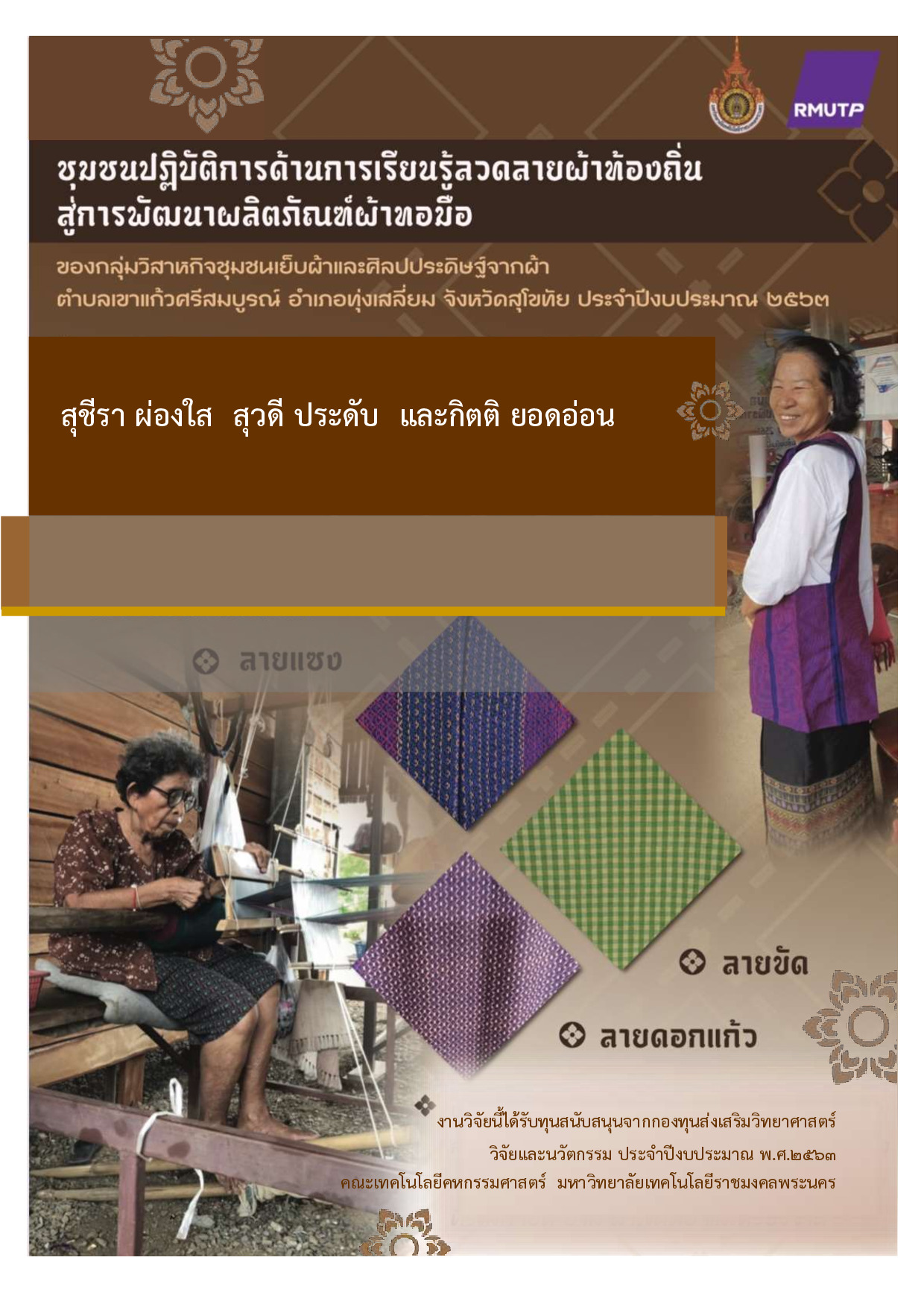
ชุมชนปฏิบัติการด้านการเรียนรู้ลวดลายผ้าท้องถิ่นสู่การพัฒนาผลิตภัณฑ์ผ้าทอมือของกลุ่มวิสาหกิจชุมชนเย็บผ้าและศิลปะประดิษฐ์ ตำบลเขาแก้วศรีสมบูรณ์ อำเภอทุ่งเสลี่ยม จังหวัดสุโขทัย
Research on the community of Participatory Learning Practice Fabric Pattern to Development of Local Hand-mend Cloth Products of Sewing Community Enterprise and Craft Khao of Sewing Khao Kaew Srisomboon Thung Saliam Sukhothai Province. The objectivity of this project is to study the patterns of cloth to develop hand-woven fabric products. The learning practice of local fabric patterns to develop 5 sets of hand-woven jewelry products then 5 sets of jewelry experts were asked to consider selecting suitable hand-woven jewelry sets for making. 3 sets of jewelry and asked 5 experts from the community state enterprise sewing and artificial arts to transfer the invention of handwoven jewelry to the community 1 set and to study the satisfaction of the target group of 30 people and analyze the data. By using statistics frequency percentage standard deviation and mean with the following analysis results. The findings of the study were as follows. It was found that Local fabric patterns Appeared in 3 traditional fabric patterns: Saeng pattern Plain pattern and Kaew pattern. Learning practice of local fabric patterns for the development of hand-woven fabric accessories. All 5 jewelry experts chose the style of jewelry set A set B and set D commenting that the style has suitable elements of jewelry. In particular the combination of local fabric patterns and geometric shapes creates a contemporary look. Size and proportion should be adapted to the proportion of the wearer. And the use of color always use the original color of the fabric especially red. Because it is a color that is unique when it comes to making the piece it will help make the jewelry more beautiful and dimension as well as indicate the identity of the people of Khao Kaew Srisomboon. The expert representative of the community enterprise group I chose the A Series because of the contemporary style. Can generate income for people in the community And the satisfaction of the target groups towards making jewelry sets it was found that the product Satisfaction with aesthetics was the highest at an average of 4.83 in terms of suitability of the fabricated material. The satisfaction of the materials used was interesting at an average of 4.67 in terms of utility. Satisfaction in wearing on various occasions at the average 4.66 and distribution. Satisfaction in the jewelry trade show at an average of 4.60 communities working on learning patterns of local fabrics to develop hand-woven products. Has given importance to the history the meaning use of color and the belief in cloth pattern hooves from shared memories of people in the community. Fabric patterns both Saeng pattern Plain pattern and Kaew pattern Therefore it is a reflection of the people in Khao Kaew Srisomboon community that has inherited the wisdom heritage that is more than precious. Rather it is the inheritance of intent from generation to generation.

Participatory curriculum administration on creative environment integration of Rajamangala University of Technology Lanna
The purposes of this research were to study the approaches for the participatory curriculum administration creatively integrating the environment used by Rajamangala University of Technology Lanna (RMUTL) and to evaluate the desired objectives of the curriculum namely the creative thinking skill aspect in students. The target group selected by purposive sampling technique was 180 representatives of RMUTL faculty curriculum boards administrators instructors and entrepreneurs in the Chiang Mai community. The research instruments included questionnaires and behavioral observation checklists. The collected data were analyzed by using descriptive methodology and by calculating percentage mean and standard deviation. As a result of the study there are seven steps developed in the administration of the curriculum that creatively integrated the environment. In this case the participation of the target group in the administration of environment-integrated curriculum was at a high level while the students’ participation was at a moderate level. The students’ desired characteristics in regards to the curriculum’s objectives of creative thinking skills was at a high level.
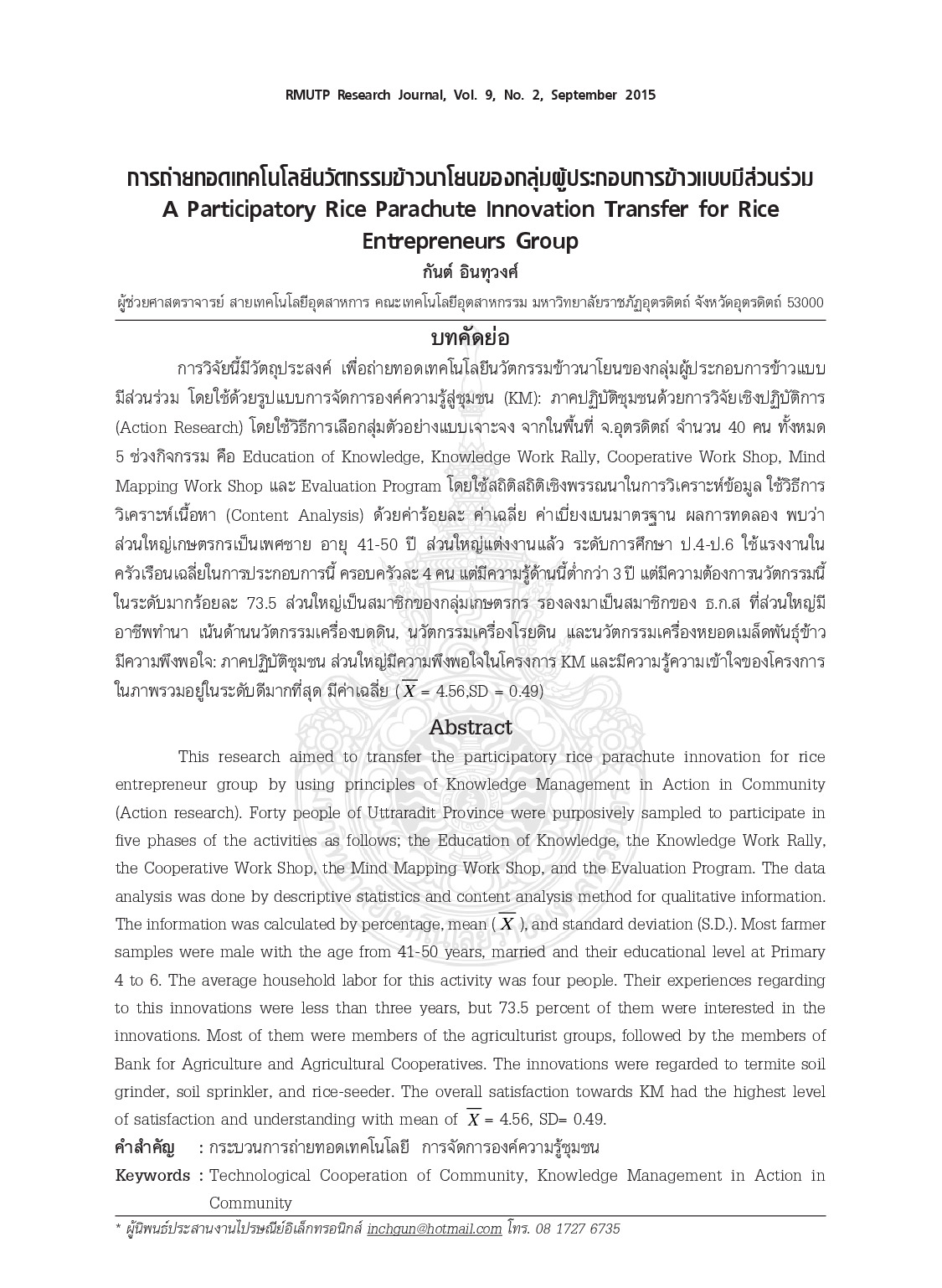
การถ่ายทอดเทคโนโลยีนวัตกรรมข้าวนาโยนของกลุ่มผู้ประกอบการข้าวแบบมีส่วนร่วม
This research aimed to transfer the participatory rice parachute innovation for rice entrepreneur group by using principles of KM: Knowledge Management in Action in Community (Action Research). Forty people of Uttraradit Province were purposively sampled to participate in five phases of the activities. The first activity was the Education of Knowledge the second activity was the Knowledge Work Rally the third activity was the Cooperative Work Shop the fourth activity was the Mind Mapping Work Shop and the fifth activity was the Evaluation Program. Statistics used in data analysis was descriptive statistics and qualitative information was analyzed by using content analysis method. The information was calculated by percentage mean ( ) and standard deviation (S.D.). Most of the samples were male with the age ranged from 41-50 years. Most farmers were married and their educational level was between Primary 4 and Primary 6. The average household labor amount for rice parachute agricultural practice was four people. Their experiences regarding to the rice parachute innovations were less than three years but 73.5 percent of them were interested in the innovations. Most of them were members of the agriculturist groups followed by the members of Bank for Agriculture and Agricultural Cooperatives. Most of them were farmers who have learned the innovations regarding termite soil grinder soil sprinkler and rice-seeder. As for the overall satisfaction towards KM: Knowledge Management in Action in Community most of them had the highest level of satisfaction and understanding with mean of = 4.56 SD= 0.49. In conclusion the participatory innovation transfer project by providing the know-how to the communities using the KM Principle: Knowledge Management in Action in Community was at the highest satisfactory level.
The participatory learning process of leaung rice 11 production without toxic substance case study : khoklam village kamalasai district kalasin provice
This research aims to study participatory learning process to strengthen rural communities through Leaung Rice 11 production which promotes self-reliability and capability of the communities. This is a participatory action research (PAR) with farm experimental methods. It demonstrates a model to empower community which allows members to identify problems discuss find commitment and approve incoming development. Researchers here are therefore facilitators helping people in the community to achieve effective production of Yellow Rice 11. After providing sufficient information about Leaung Rice 11 production the main problems identified is a high production cost with chemical fertilizer being abundantly used causing health and environment problems to the community. This results in a solution of choosing organic Yellow Rice 11 production that is harmless and friendly to the environment. Despite co-operative learning and problems identification locals also get an opportunity to plant Leaung Rice 11 with organic fertilizer and Effective Microorganisms (EM) as a model to safe cost. It is obvious that rice production is also increased (737.69 Kilogram per Rai). Moreover production cost decreases to 1227.50 Baht per Rai per family. This research provides the community ability to analyze self-problems and potentiality under modern research methodology; problems identification solution identification experiment process co-operative learning data collection data discrimination data analysis and data application.
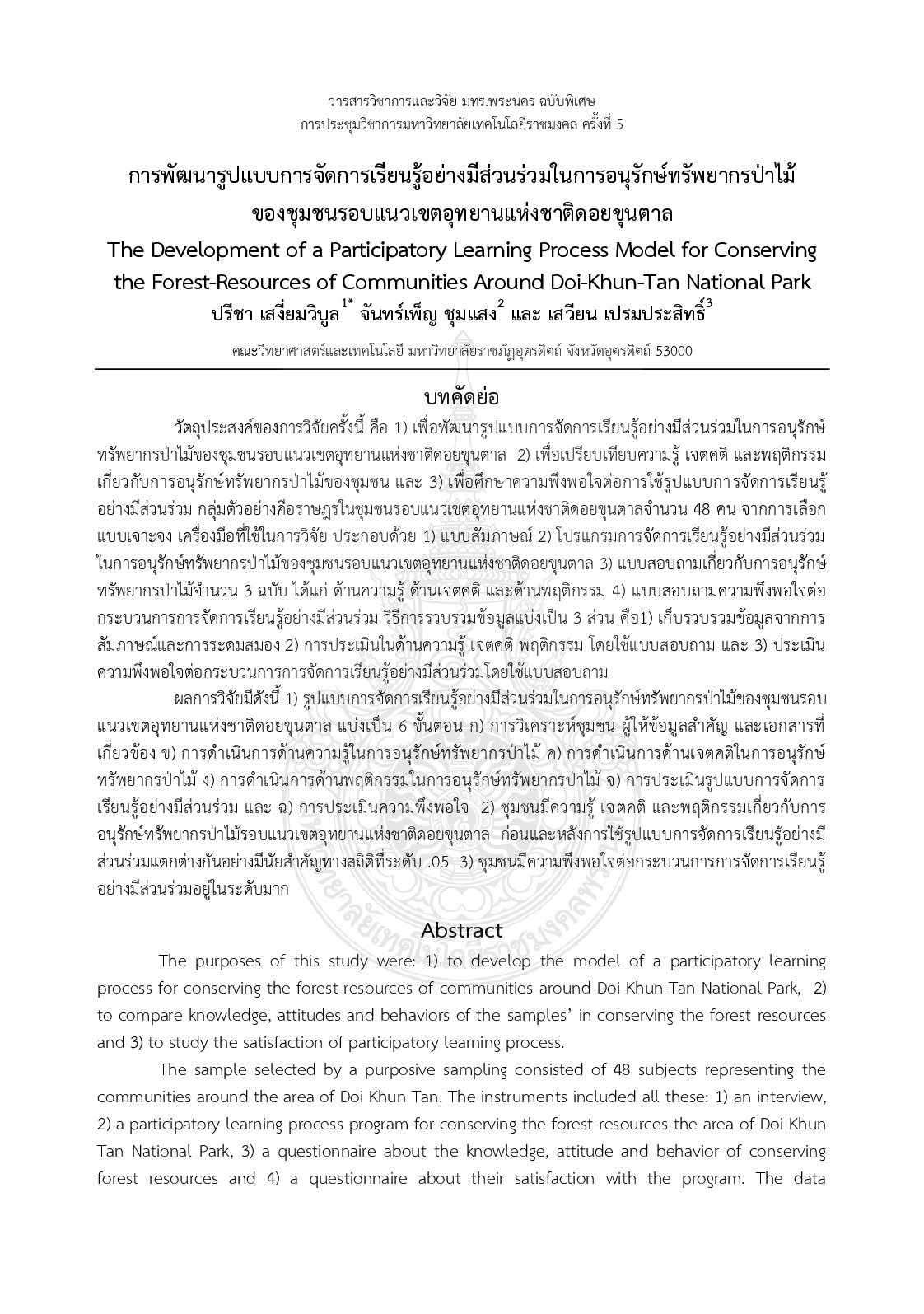
The development of a participatory learning process model for conserving the forest-resources of communities around doi-khun-tan national park
The purposes of this study were: 1) to develop the model of a participatory learning process for conserving the forest-resources of communities around Doi-Khun-Tan National Park 2) to compare knowledge attitudes and behaviors of the samples’ in conserving the forest resources and 3) to study the satisfaction of participatory learning process. The sample selected by a purposive sampling consisted of 48 subjects representing the communities around the area of Doi Khun Tan. The instruments included all these: 1) an interview 2) a participatory learning process program for conserving the forest-resources the area of Doi Khun Tan National Park 3) a questionnaire about the knowledge attitude and behavior of conserving forest resources and 4) a questionnaire about their satisfaction with the program. The data elicitation was drawn from three sources: 1) interviews and brainstorming 2) the assessment of the knowledge attitudes behaviors by the questionnaire and 3) the assessment of the satisfaction with the participatory learning process by the questionnaire. The study revealed these findings: 1) the participatory learning process of model fell into 6 steps consisting of a) the analysis of communities key informants and literature reviews b) the implementation of the knowledge to conserve the forest resources c) the implementation of the attitude towards conserving the forest resources d) the implementation of the behaviors of conserving the forest resources e) the assessment of the participatory learning process and f) the evaluation of satisfaction with the program; 2) the subjects’ knowledge attitudes and behaviors regarding forest conservation at the boundary of Doi Khun Tan before and after the participatory learning process are statistically different at the significance level of .05; and 3) the level of their satisfaction with the participatory learning process was high.