จำนวน Repository ( 6 )

ความเป็นพิษร่วมกันระหว่างพอลิไซคลิกอะโรมาติกไฮโดรคาร์บอนกับไทรทรอนเอ็กซ์-100 หรือทวีน 80 ต่อการเจริญเติบโตระยะต้นกล้าของบานเย็นและกระเจี๊ยบเขียว
Use of synthetic surfactant is another choice to increase efficiency of polycyclic aromatic hydrocarbon (PAH) phytoremediation in soil. In this study the toxicity of soil contaminated with anthracene and fluoranthene at total concentration as 0 200 and 800 mg/kg in combination with 2 synthetic surfactants that were triton x-100 and tween 80 at concentration as 0 1 and 10 times of critical micelle concentration (CMC) on seedling growth of Hibiscus sabdariffa and Mirabilis jalapa. Both synthetic surfactants were watered separately on day 13 after inoculation and seedling growth were measured on day 20 after inoculation. The result shown that both H. sabdariffa and M. jalapa could grow in soil contaminated with anthracene and fluoranthene at all concentrations in combination with both synthetic surfactants. Tween 80 at 1 time of CMC were the least toxic to H. sabdariffa while toxicity of all surfactants on M. jalapa were not different. Decrease of plant growth depended on the increasing of PAH concentration in soil. With these reasons both plants were possible to use for PAH phytoremediation at total concentration 200 mg/kg in combination with synthetic surfactant
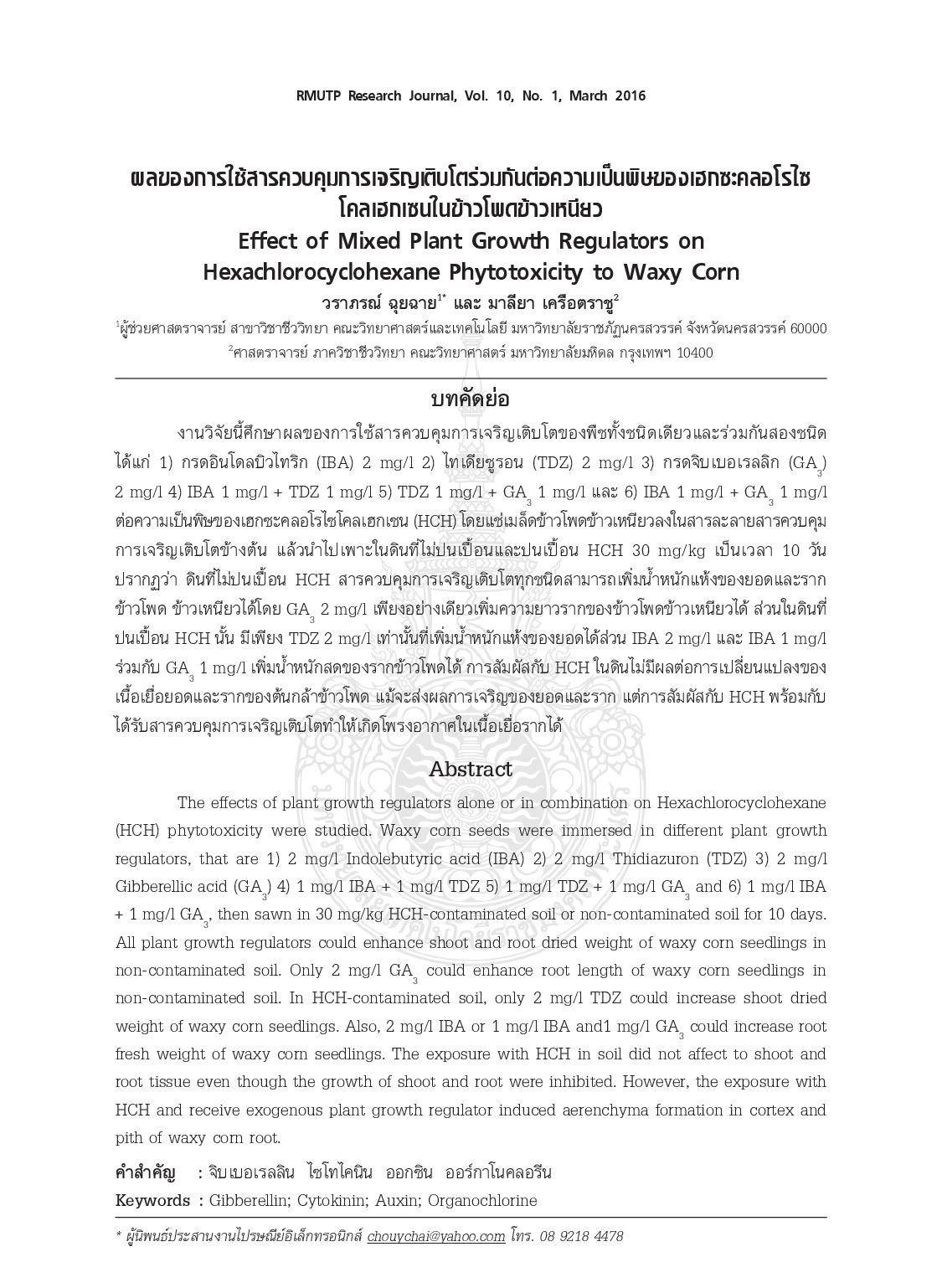
ผลของการใช้สารควบคุมการเจริญเติบโตร่วมกันต่อความเป็นพิษของเฮกซะคลอโรไซโคลเฮกเซนในข้าวโพดข้าวเหนียว
The effects of plant growth regulators alone or in combination on Hexachlorocyclohexane (HCH) phytotoxicity were studied. Waxy corn seeds were immersed in different plant growth regulators that are 1) 2 mg/l Indolebutyric acid (IBA) 2) 2 mg/l Thidiazuron (TDZ) 3) 2 mg/l Gibberellic acid (GA3) 4) 1 mg/l IBA + 1 mg/l TDZ 5) 1 mg/l TDZ + 1 mg/l GA3 and 6) 1 mg/l IBA + 1 mg/l GA3 then sawn in 30 mg/kg HCH-contaminated soil or non-contaminated soil for 10 days. All plant growth regulators could enhance shoot and root dried weight of waxy corn seedlings in non-contaminated soil. Only 2 mg/l GA3 could enhance root length of waxy corn seedlings in non-contaminated soil. In HCH-contaminated soil only 2 mg/l TDZ could increase shoot dried weight of waxy corn seedlings. Also 2 mg/l IBA or 1 mg/l IBA and1 mg/l GA3 could increase root fresh weight of waxy corn seedlings. The exposure with HCH in soil did not affect to shoot and root tissue even though the growth of shoot and root were inhibited. However the exposure with HCH and receive exogenous plant growth regulator induced aerenchyma formation in cortex and pith of waxy corn root.
Phytotoxicity assessment of polycyclic aromatic hydrocarbons Co-Contamination in Soil during Economic Legume Seedling Growth
This research studied combined toxicities of 4 generally found Polycyclic Aromatic Hydrocarbons (PAHs) - anthracene fluorene fluoranthene and phenanthrene – during growth of 3 legume seedlings - cow pea mungbean and longbean - planted in varied combination of PAH contaminant in soil. Results showed that mungbean growth was more sensitive to PAH co-contaminated soil than cow pea and longbean. Co-contamination of all 4 PAHs was more toxic to legume than each pair of PAHs. Shoot length and fresh weight of legume seedling were more sensitive to co-contamination of all 4 PAHs than root length. Dry weight of legume seedling was the least sensitive to co-contamination of all PAHs.
Phytotoxicity assessment of polycyclic aromatic hydrocarbons Co-Contamination in Soil during Economic Legume Seedling Growth
This research studied combined toxicities of 4 generally found Polycyclic Aromatic Hydrocarbons (PAHs) - anthracene fluorene fluoranthene and phenanthrene – during growth of 3 legume seedlings - cow pea mungbean and longbean - planted in varied combination of PAH contaminant in soil. Results showed that mungbean growth was more sensitive to PAH co-contaminated soil than cow pea and longbean. Co-contamination of all 4 PAHs was more toxic to legume than each pair of PAHs. Shoot length and fresh weight of legume seedling were more sensitive to co-contamination of all 4 PAHs than root length. Dry weight of legume seedling was the least sensitive to co-contamination of all PAHs.
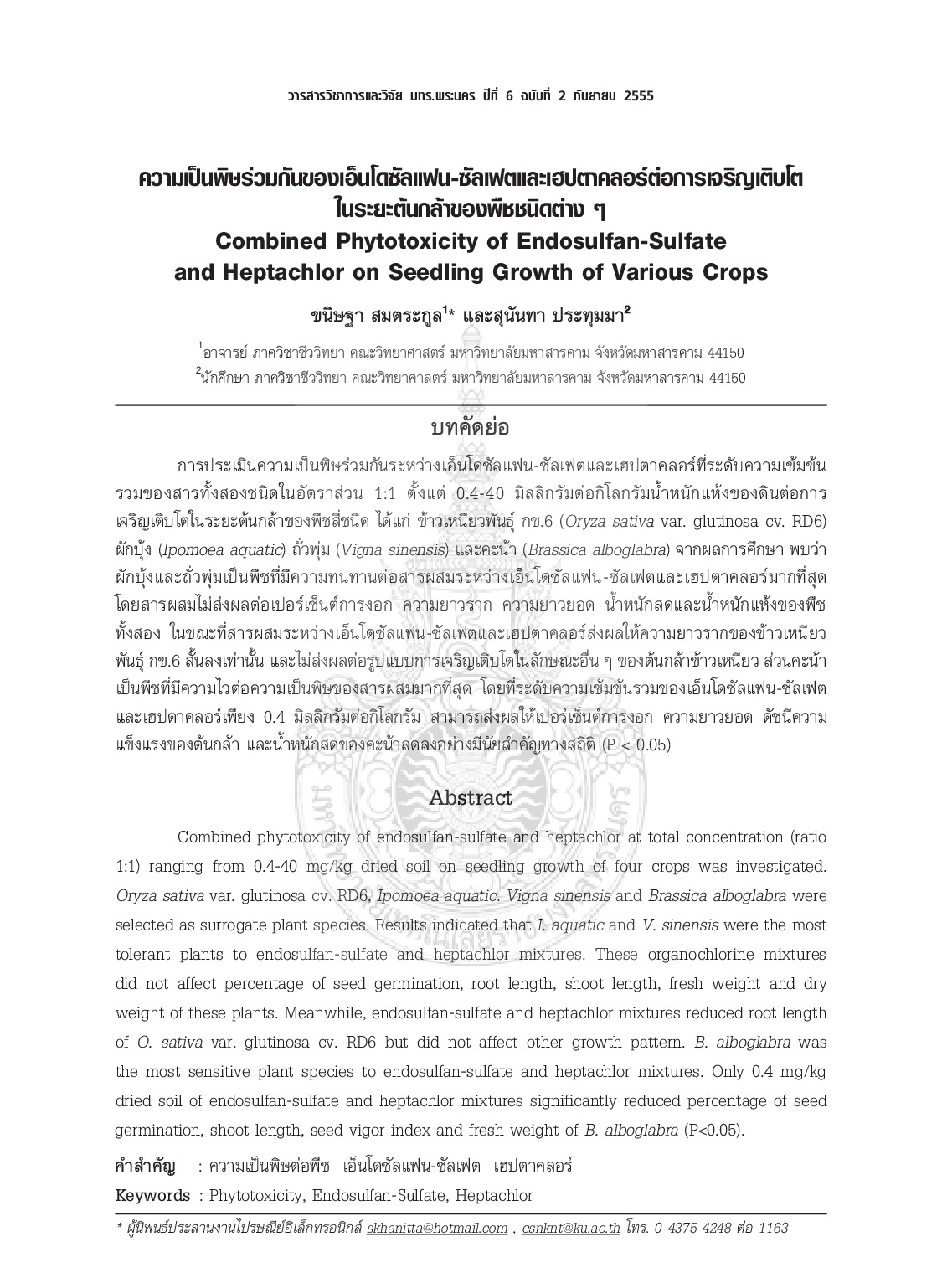
Combined Phytotoxicity of Endosulfan-Sulfate and Heptachlor on Seedling Growth of Various Crops
Combined phytotoxicity of endosulfan-sulfate and heptachlor at total concentration (ratio 1:1) ranging from 0.4-40 mg/kg dried soil on seedling growth of four crops was investigated. Oryza sativa var. glutinosa cv. RD6 Ipomoea aquatic. Vigna sinensis and Brassica alboglabra were selected as surrogate plant species. Results indicated that I. aquatic and V. sinensis were the most tolerant plants to endosulfan-sulfate and heptachlor mixtures. These organochlorine mixtures did not affect percentage of seed germination root length shoot length fresh weight and dry weight of these plants. Meanwhile endosulfan-sulfate and heptachlor mixtures reduced root length of O. sativa var. glutinosa cv. RD6 but did not affect other growth pattern. B. alboglabra was the most sensitive plant species to endosulfan-sulfate and heptachlor mixtures. Only 0.4 mg/kg dried soil of endosulfan-sulfate and heptachlor mixtures signif icantly reduced percentage of seed germination shoot length seed vigor index and fresh weight of B. alboglabra (P<0.05)