จำนวน Repository ( 17 )
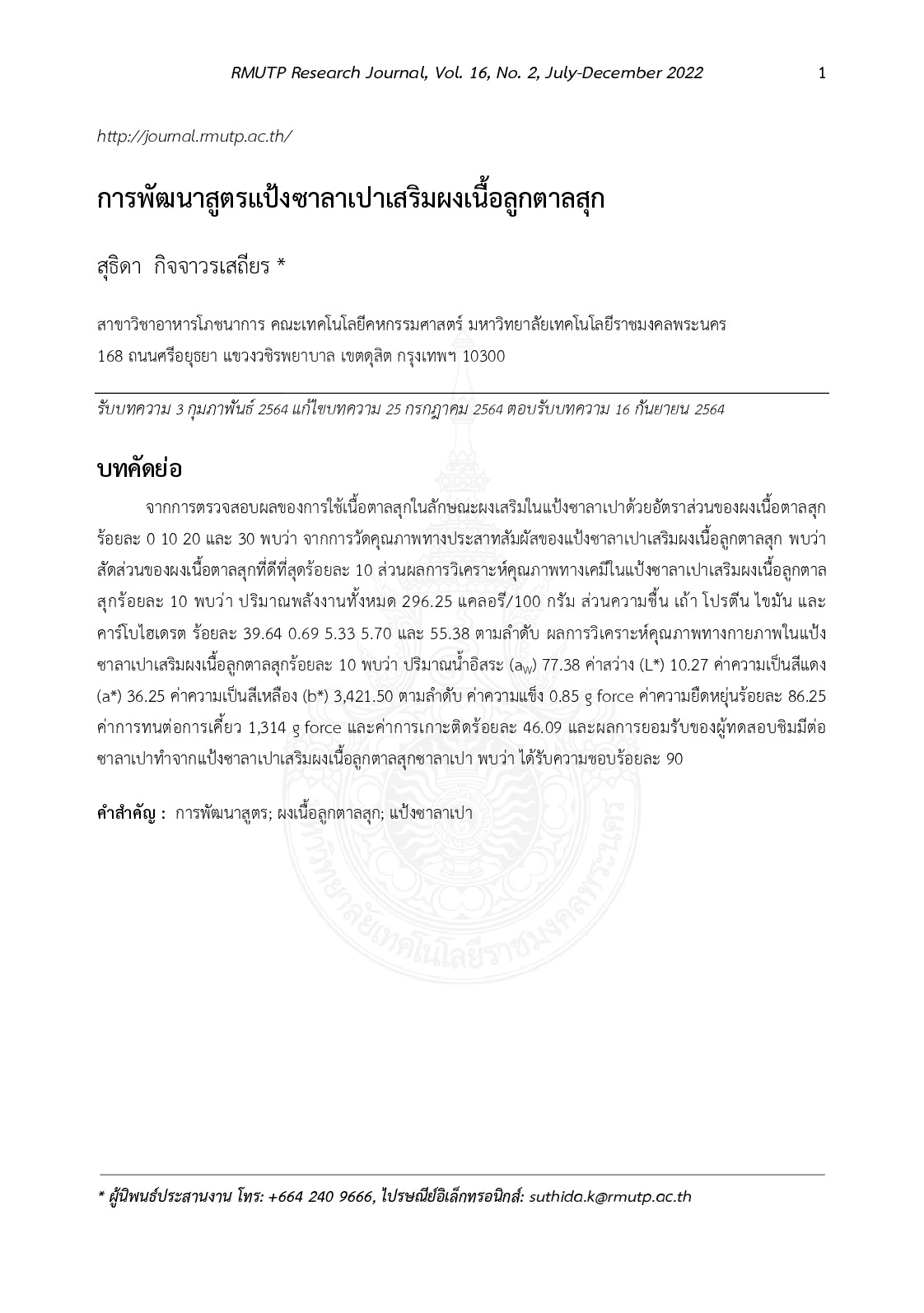
การพัฒนาสูตรแป้งซาลาเปาเสริมผลเนื้อลูกตาลสุก
The results of the using of toddy palm pulp powder form added to steamed buns using ratios of 0 10 20 and 30 %. It was found that from the sensory quality measurements of steamed buns by supplemented toddy palm pulp powder was 10%. As the results of chemical quality analysis of 10% steamed buns by supplemented toddy palm pulp powder was found that the total energy content was 296.25 calories per100g. the moisture ash protein fat and carbohydrate was 39.64 0.69 5.33 5.70 and 55.38 % respectively. The results of physical quality analysis of 10% steamed buns by supplemented toddy palm pulp powder showed that water activity (aw) 77.38 brightness (L*) 10.27 red (a*) 36.25 yellow (b*) 3421.50 respectively Hardness 0.85 g force Springiness 86.25 % Chewiness 1314 g force and Cohesiveness 46.09%. From consumer acceptance testing of 40 testers 90 % of them accepted in this product.
การพัฒนาศักยภาพผลิตภัณฑ์เนื้อสัตว์แปรรูปเสริมกากสับปะรด ที่เหลือจากการคั้นน้ำ
The potential development the of processed meat products enhancing pineapple pulp left by juicing. Pattawia pineapple pulp used in research. Boil to extract the acid and sugar. The pulp looks like fresh pulp light yellow. The processed meat products used include coarse ground pork sausage pork ball and Moo Yor. Pineapple pulp supplementation in coarse ground pork sausages could be supplemented by up to 15 percent. Pork balls can be supplemented up to 20 percent and Moo Yor can be added up to 10 percent. The addition of pineapple pulp to processed meat products resulted in an increase in crude fiber content in all 3 processed meat products. At the same time resulting in light processed meat products and has a reduced texture characteristics score which affects acceptance. Consumer acceptance test in The potential development the of processed meat products enhancing pineapple pulp left by juicing for 100 tester found that most testers are more than 95 percent acceptance in the product of The potential development the of processed meat products enhancing pineapple pulp left by juicing. For the technology propagation of the potential development the of processed meat products enhancing pineapple pulp left by juicing in faculty of Homes Economocs Technology the participants were most satisfied with all aspects of the technology propagation.

การทดสอบประสิทธิภาพระบบการพิมพ์พื้นนูนและการพิมพ์พื้นฉลุบนวัสดุจากเยื่อธรรมชาติเพื่อพัฒนาเป็นบรรจุภัณฑ์ที่เพิ่มมูลค่าและการใช้งานในเชิงพาณิชย์
This research is to study and develop natural pulp materials for packaging. This is the agricultural waste. To benefit commercially To build capacity and capability in economic development and environmental conservation Is the creation of packaging work Formed in sheets and shapes using natural materials such as mulberry paper pineapple paper. And banana paper Then design and create the packaging. To test the properties. According to the standard packaging. They also sought satisfaction in the form and use of natural pulp materials. Include the packaging according to the case study. Research indicates that When developing pulp quality The banana paper can not be printed. Can print lines. But screen printing is not suitable for banana paper. Foil printing case when mulberry paper and pineapple paper Foil printing Printing lines Can be done well on mulberry paper and pineapple paper. Death images can be printed on all three types of paper but the screen is not good. Sealing material from natural pulp onto corrugated paper. From the test it was found that the amount of adhesive that was suitable for sealing was between 20-30 mg. If the adhesive was less than 20 milligrams only mulberry paper was sealed. The amount of glue at 50 milligrams is the amount of glue is too high causing all three types of paper to rot. Because of the adsorption of glue to the pulp. Packaging material from natural pulp. Fold of banana paper that does not pass the test. The banana paper is high in strength. When folding the packaging causes the pulp to split along the crease. Can not be molded. Evaluation of the satisfaction with the form and use of packaging materials from natural pulp. It was found that the average value of paper pulp suitable for packaging materials from natural pulp was the most agreeable paper. Secondly paper shreds are very popular and the last one is banana paper. Moderate agreement
การพัฒนาศักยภาพผลิตภัณฑ์เนื้อสัตว์แปรรูปเสริมกากสับปะรดที่เหลือจากการคั้นน้ำ
The potential development the of processed meat products enhancing pineapple pulp left by juicing. Pattawia pineapple pulp used in research. Boil to extract the acid and sugar. The pulp looks like fresh pulp light yellow. The processed meat products used includecoarse ground pork sausage pork ball and Moo Yor. Pineapple pulp supplementation in coarse ground pork sausages could be supplemented by up to 15 percent. Pork balls can be supplemented up to 20 percent and Moo Yor can be added up to 10 percent. The addition of pineapple pulp to processed meat products resulted in an increase in crude fiber content in all 3 processed meat products. At the same time resulting in light processed meat products and has a reduced texture characteristics score which affects acceptance. Consumer acceptance test in The potential development the of processed meat products enhancing pineapple pulp left by juicing for 100 tester found that most testers are more than 80 percent acceptance in the product of The potential development the of processed meat products enhancing pineapple pulp left by juicing.
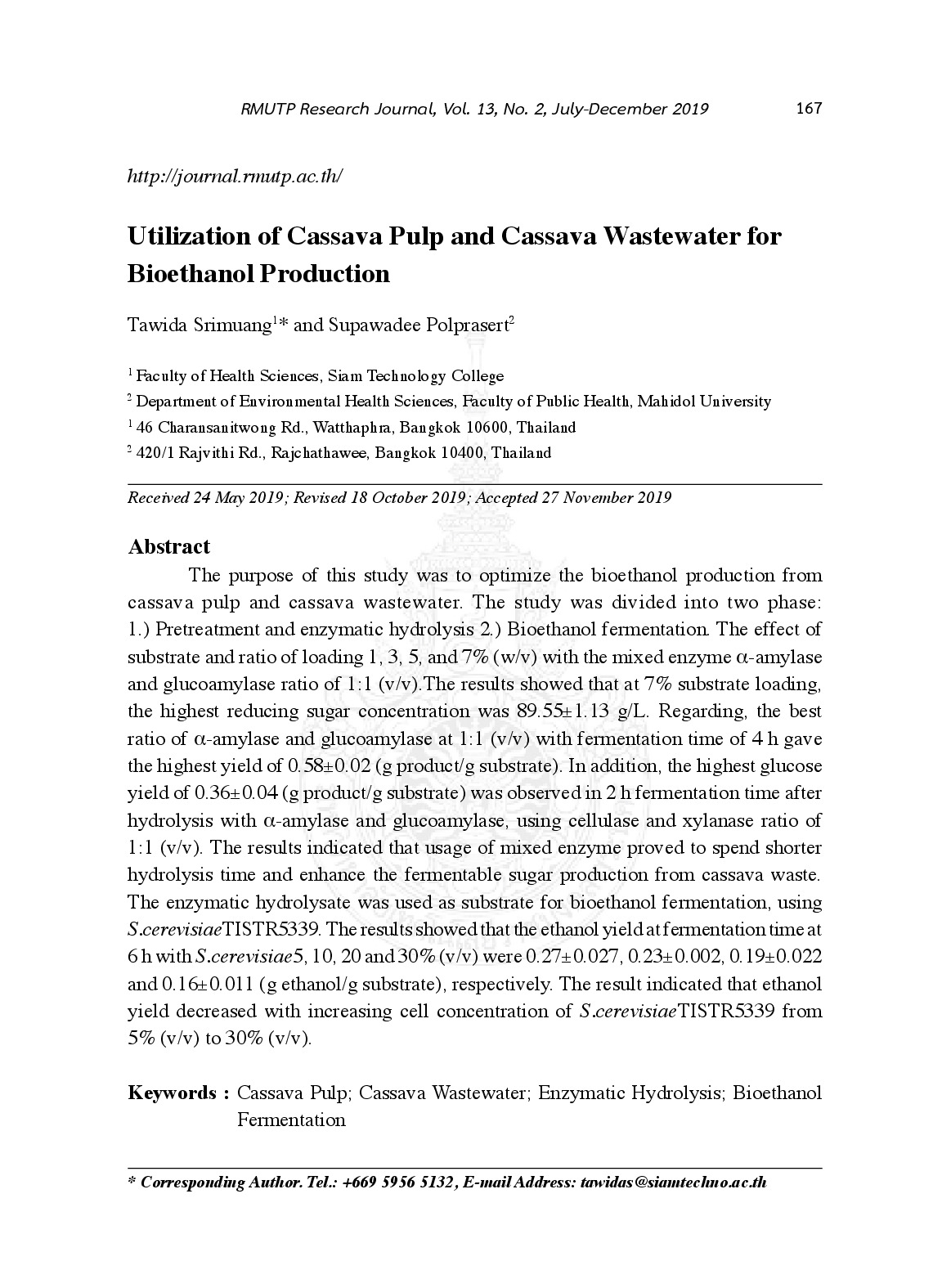
Utilization of cassava pulp and cassava wastewater for bioethanol production
The purpose of this study was to optimize the bioethanol production from cassava pulp and cassava wastewater. The study was divided into two phase: 1.) Pretreatment and enzymatic hydrolysis 2.) Bioethanol fermentation. The effect of substrate and ratio of loading 1 3 5 and 7% (w/v) with the mixed enzyme α-amylase and glucoamylase ratio of 1:1 (v/v).The results showed that at 7% substrate loading the highest reducing sugar concentration was 89.55±1.13 g/L. Regarding the best ratio of α-amylase and glucoamylase at 1:1 (v/v) with fermentation time of 4 h gave the highest yield of 0.58±0.02 (g product/g substrate). In addition the highest glucose yield of 0.36±0.04 (g product/g substrate) was observed in 2 h fermentation time after hydrolysis with α-amylase and glucoamylase using cellulase and xylanase ratio of 1:1 (v/v). The results indicated that usage of mixed enzyme proved to spend shorter hydrolysis time and enhance the fermentable sugar production from cassava waste. The enzymatic hydrolysate was used as substrate for bioethanol fermentation using S.cerevisiaeTISTR5339. The results showed that the ethanol yield at fermentation time at 6 h with S.cerevisiae5 10 20 and 30% (v/v) were 0.27±0.027 0.23±0.002 0.19±0.022 and 0.16±0.011 (g ethanol/g substrate) respectively. The result indicated that ethanol yield decreased with increasing cell concentration of S.cerevisiaeTISTR5339 from 5% (v/v) to 30% (v/v).