จำนวน Repository ( 8 )

การเพิ่มความน่าเชื่อถือได้ของระบบไฟฟ้าสำหรับรถไฟฟ้าขนส่งมวลชน
The propose of this research present a comparative study of the Reliability Improvement of Electrical System for Electric Mass Rapid Transit Train which describes in term of the power supply efficiency including voltage imbalance that could indicate how much the electric power quality is being more or less. The electrical system to be used in the Mass Rapid Transit system has 4 types of connection between three (3) phases of Metropolitan Electricity Authority (MEA) transformer and station transformer which is Single phase V-Type Scott and Le- Blanc to be considered for the different transformer connections type could be carried out and resulted in the most unbalanced in power supply as well as properly solution for power supply mitigation of voltage imbalance. From foregoing the data analyst was discovered that a single phase connection could cause the most unbalance voltage but on the other hand Le-Blanc connection is the least unbalance which could be reduced the impact on the Mass Transit Train and increase the credibility of consumers in order to continuity implement service usage.

การปรับปรุงความเชื่อถือได้เชิงบูรณาการต่อความผิดพลาดถาวรและชั่วครู่สำหรับตัวประมวลผลระดับนาโนมิเตอร์
For modern processors permanent and transient errors due to increased temperature and single event effect continue to intensify as device technologies scale down to small nanometers. While many researchers have proposed efficient methods to limit one of these two problems those techniques may worsen the other reliability aspect. In this project we introduce a novel leakage reduction approach for long-term reliability improvement which considers the impact of shortterm reliability effect from soft errors. In particular we firstly employ body bias tuning to reduce leakage and further investigate its impact on delay and soft error rate of the circuit. It has been discovered from our experiment that use of reverse body bias to control leakage can raise the soft error rate in addition to the delay performance. We therefore integrate several effects of body bias into the proposed leakage reduction technique. The experimental results show that our approach provides satisfactory leakage reduction with confined soft error and delay degradation in 32 nm high-k/metal gate benchmark circuits.
การติดตั้งแหล่งผลิตไฟฟ้าแบบกระจายตัวเพื่อเพิ่มความเชื่อถือได้ในระบบจำหน่ายไฟฟ้า
This paper presents reliability evaluation in distribution system with distributed generation. The main objective is to minimize the customer interruption cost subject to given number of distributed generation. The minimization problem for customer interruption cost in solved by the developed tabu search algorithm together with reliability worth analysis that provide an indirect measure for cost implication associated with power outages. The developed methodology is tested with a distribution system of Roy Billinton Test System (RBTS) bus 2 consist of 15 buses and 22 load points. Numerical results from the tests demonstrate that the optimal distributed generation placement can be used to promote reliability of the distribution systems.

การวิเคราห์ความน่าเชื่อถือได้ในการทำงานของเครื่องจักร และหาสาเหตุของเครื่องจักรเสีย: กรณีศึกษาโรงงานผลิตชิ้นส่วนรถยนต์
This research proposes reliability analysis in order to find the probability that a machine will work properly the failure rates of a machine and the factors related to the failure rates. The data were collected from 8 types of machines in an autoparts manufacturing factory. They consist of the times measured from the first day of the study until the machine produces defective product workers and production steps. The study duration is 90 days. The results show that the probability that the machine type 4 will work properly more than days is 0.40 machine type 5 more than 68 days is 0.32 machine type 6 more than 72 days is 0.31 machine type 8 more than 85 days is 0.26 machine type 9 more than 109 days is 0.80 machine type 10 at more than 52 days is 0.38 machine type 11 more than 71 days is 0.32 and the probability that the machine type 12 will work properly more than 85 days is 0.26. The failure rate of the machine type 4 at day 51 is 6.61 machine type 5 at day 68 is 1.61 machine type 6 at day 72 is 0.77 machine type 8 at day 85 is 1.26 machine type 9 at day 109 is 1.31 machine type 10 at day 52 is 0.92 machine type 11 at day 71 is 1.24 and the failure rate of the machine type 12 at day 85 is 2.15. The factors influencing on the failure rates are worker group 2 and production step 3 at the significance of 0.05.
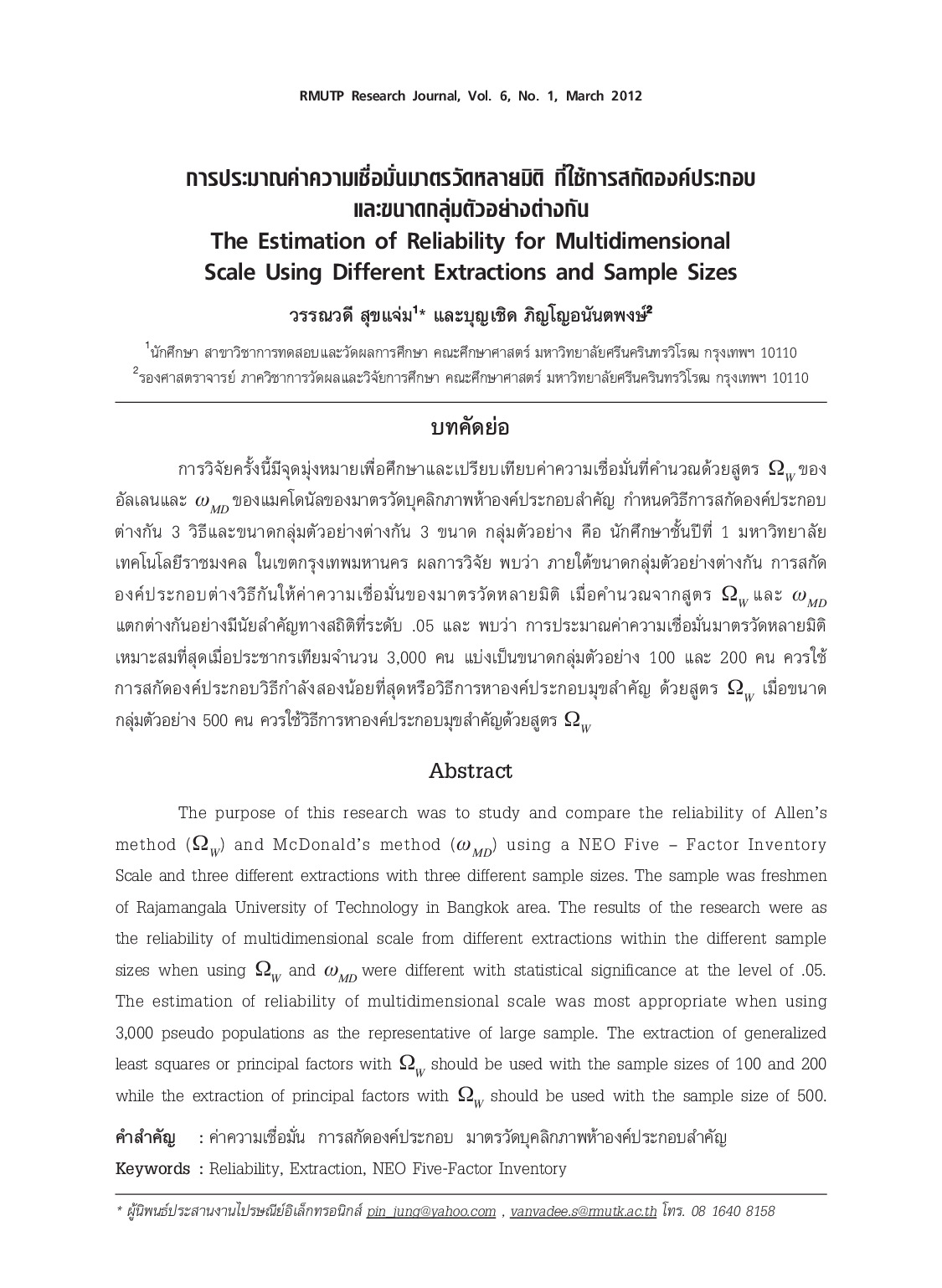
The Estimation of Reliability for Multidimensional Scale Using Different Extractions and Sample Sizes
The purpose of this research was to study and compare the reliability of Allen’s method (ΩW) and McDonald’s method (ωMD) using a NEO Five – Factor Inventory Scale and three different extractions with three different sample sizes. The sample was freshmen of Rajamangala University of Technology in Bangkok area. The results of the research were as the reliability of multidimensional scale from different extractions within the different sample sizes when using ΩW and ωMD were different with statistical significance at the level of .05. The estimation of reliability of multidimensional scale was most appropriate when using 3000 pseudo populations as the representative of large sample. The extraction of generalized least squares or principal factors with ΩW should be used with the sample sizes of 100 and 200 while the extraction of principal factors with ΩW should be used with the sample size of 500.