จำนวน Repository ( 15 )

การย้อมสีสมุนไพรไทยเพื่อป้องกันรังสียูวีสาหรับประยุกต์ใช้งานด้านผลิตภัณฑ์สิ่งทอ
This research studies dyeing with Thai herbs for UV protection properties in textile products applications and aimed to: study procedures and techniques for this; investigate the use of herbal plant for UV protection; study UV protection properties in fabrics dyed with Thai herbs that can protect against UV rays. The process involved dyeing from natural surplus materials (militia kityana leaves lemongrass leaves and areca palm seeds) extracting the dyes for use in silk dyeing with a mordant to increase the affinity of the dye and fiber then rating the percentage of UV light blocked. Finally the fabric was used to design clothes as a prototype for five Muslim outfits. The research team chose dyed silk fabric with the percentage of UV light blocked are 95.67 – 96.24 which is in good to excellent protection level. Five outfits were designed for this study: 1) Silk dyeing with dyes extracted from the lemongrass leaves – using the first method of fabric dyeing with clear muddy water 1% as mordant 2) Silk dyeing with dyes extracted from lemongrass leaves – using the fourth method of fabric dyeing with the fabric fermented for 30 minutes in mud before dyeing 3) Silk dyed with dyes extracted from areca palm seeds – using the first method of fabric dyeing with 3% tamarind water as mordant 4) Silk dyed with dyes extracted from areca palm seeds – using the fourth method of fabric dyeing with the fabric fermented for 30 minutes in mud before dyeing and 5) Silk dyed with natural dyes extracted from militia kityana leaves – using the first method of fabric dyeing with 1% tamarind water as mordant.
การออกแบบและพัฒนาสิ่งทอด้วยเทคนิคการปักของชาวไทยทรงดe จังหวัดสุพรรณบุรี
The project of design and development of textile product using Thai Song Dam’s stitching technique at Supanburi provinces. “Nowadays it was difficult to find someone who loves weaving; however finding someone who loves stitching was more difficult. The designs of stitching pattern were altered by trend; however they still kept in their identity” Mrs. Lamduan Konthong a specialist in Thai Song Dam’s embroidering style said. According to the questionnaire regarding the requirement of the sample it showed that the sample was interested in the textile products for living room decoration such as a backrest pillow a decorating table runner and a lantern. Thai Song Dam’ stitching technique and “Kor Kood” pattern should be applied with the design of the designated products. To find the appropriate fabric for stitching the experiment was done by stitching of “Kor Kood” pattern on the following type of cotton silk linen hemp and knitted fabric. The chosen one was linen fabric because of its light weight good dimensional stability. To create the model of the products and find the appropriate pattern for stitching the pattern was designed by the concept of Art Nuvo characterized by the appearance of woman. From the questionnaire it was found that the satisfaction of the sample regarding the design of the Thai Song Dam’s stitching in textile products were as follows; 66% kept in the identity of Thai Song Dam 72% style the products of Thai Song Dam 58% Thai Song Dam style the design of the products characterized by Art Nuvo 50% suitable the composition of the pattern of the products 74% suitable the whole pattern design of the products 64% suitable the colors of silk stitching on the products 60% suitable the use of colors of the products 60% suitable the size of the products and 62% suitable for the purposes of using.
การออกแบบและพัฒนาผลิตภัณฑสิ่งทอด้วยเทคนิคการพิมพ์เส้นด้ายแบบซิลค์สกรีนจากสีธรรมชาติ
The project of design and development of textile product using wrap yarn printing with natural dyes by silk screen technique. The purpose of this study was to find out the silk screen printing technique for patterning on Ikat or Mud Mee textile. Due to the complicated Mud Mee process for patterning the design on Mud Mee textile silk screen printing was chosen because of its convenience and rapidity. Silk screen printed on warp yarn with dyed weft yarn created the plain weave pattern. Pattern design was inspired by the natural form of vortex. Such form was applied with silk screen printing technique with extract of natural dye from jackfruit heartwood. The research showed that the product interested the sample was home textile product by using for bedroom which designed using home textile design principle. Three tone of color were chosen for warp yarn by screen printing technique such as red colour from lac blue colour from natural indigo and yellow colour from jackfruit heartwood . Weft yarn were dyed with lac and natural indigo using cationic agent. The cationic agent using before mordanting along with dying by 5 g/l aluminum potassium sulfate (alum) which is the best result because the outcome colors were intense and bright like vermilion and natural indigo. The color extracted from jackfruit heartwood was used for silk screen printing process. Color extracted from jackfruit heartwoodwas in the form of powder color integrated with 4% sodium alginate. The viscosity was optimize for printing. Printed warp yarn was dried at 120 °C. Weaving in plain weave pattern which created the strength structure of textile. Mordants with alum showed bright and intense color. The fastness tests were at good to excellent level for producing home textile product for bedroom application. From the questionnaire it was found that the satisfaction of the sample were as follows 54% printing fabric by printing of warp yarn is similar to Mud Mee weaving 58% textile made by printed warp yarn showed the identity of Thai color tone using for printing 80% weaving pattern design inspired by the form of vortex was suitable 84 % plain textile was suitable for weaving in the form of vortex 64 % the composition of the whole pattern of the products was suitable 86% the color of the pattern was suitable 70% the color of the weft yarn was suitable with the color of the pattern 76 % the size of the products was fitting and 92 % the products were suitable for the purpose of using.
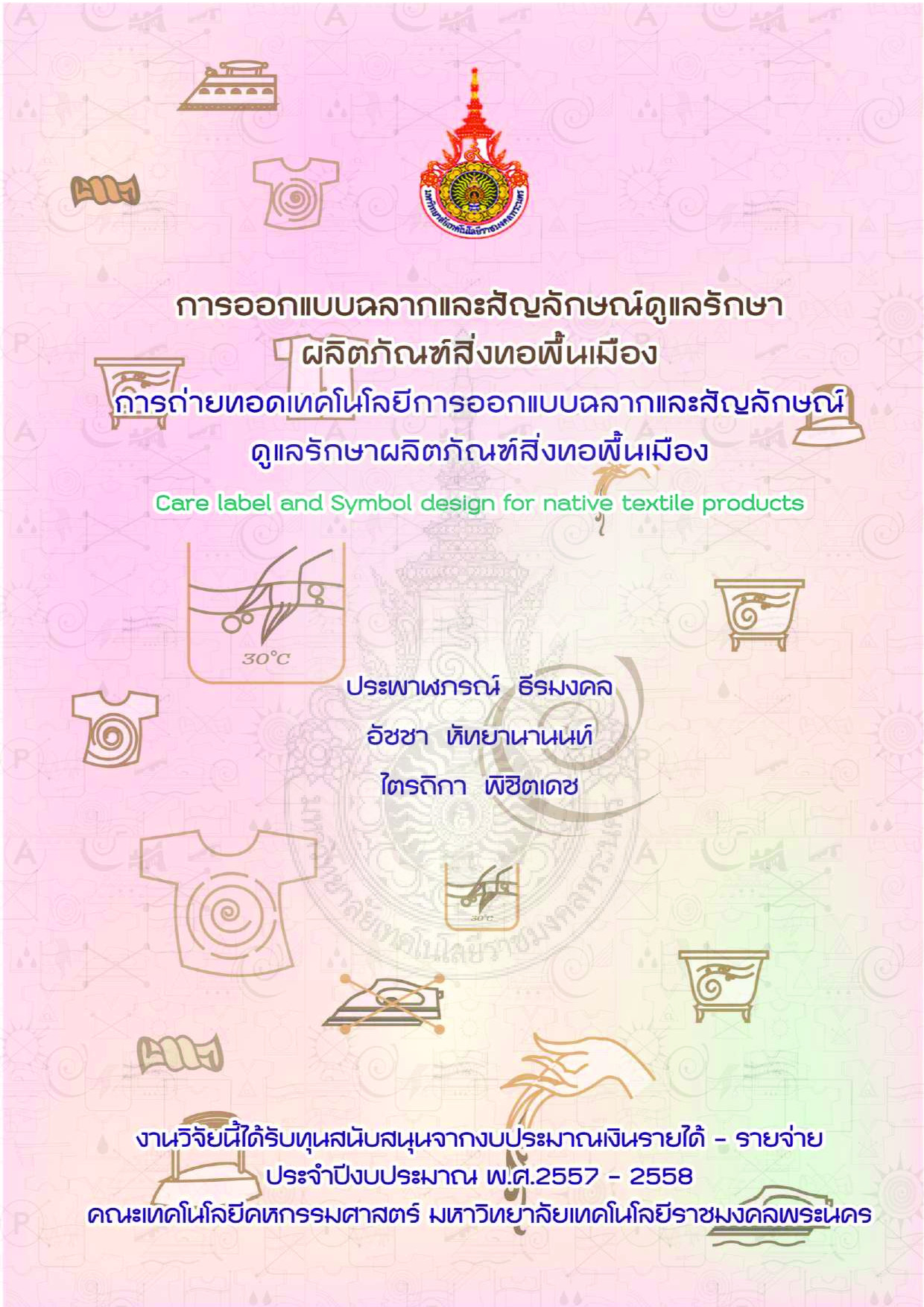
การออกแบบฉลากและสัญลักษณ์ดูแลรักษาผลิตภัณฑ์สิ่งทอพื้นเมือง
This research is Care label and Symbol design for native textile products. The purpose of this research were 1) to study and design the care label and symbol design of native textile products. 2) to design the care label and symbol design of native textile products and 3) to assessment the consumers satisfaction towards the care label and symbol design for native textile products. 4) to transfer knowledge towards the SMEs production communities about the care label and symbol design for native textile products. 5) to assessment the consumers satisfaction towards the care label and symbol design for native textile products. The research instruments used to collect data: 1) a draft care label and symbol design of native textile products of 6 types (10 prototypes) as 60 prototypes of washing bleaching spinning twisting and drying ironing and colour dropping. 2) Questionnaire of expert opinion and selective drafts for 3 models as 18 prototypes. 3) Questionnaire of consumers satisfaction towards the care label and symbol design for native textile product of 100 people: buyers sellers manufacturers and those interested in native textiles. The evaluation data was analyzed by using SPSS program in frequency mean and percentage. All in conclusion as table and descriptive. In the second research year the process are focus group people for transfer knowledge as SMEs community Enterprise OTOP production communities and other that it is interesting in this research : MEA-LA small enterprise in Singburi province PAMONT Hand-woven Communities in Ratchaburi province and Thai SONG-DUM Woven Ban-Sa-Kee-Rai in Nakhompathum province. To plan the schedule and set the date place amount of participate and lectures 102 people on 12 22 and 28 July 2015 and asking for consumer satisfaction of the curriculum and lecture for “transfer knowledge the care label and symbol design for native textile product” by Questionnaire of participate satisfaction. Last the evaluation data was analyzed by using SPSS program in mean and percentage. The First year’s research showed that mostly respondents were male at 59 percent aged 46 years at 52 percent and also being the entrepreneurs / business owners at 45 percent. 48 percent as bachelors degree and their income were an average of 20001 - 25000 baht at 46 percent. The analysis of consumers satisfaction can be concluded that the first types of care label and symbol design for native textile product at highest levels satisfaction is Colour dropping at 4.46. The next types is bleaching at 4.44 Washing at 4.42 Ironing at 4.38 Twisting and Drying at 4.32 and the last types is at least levels satisfaction is Spinning at 4.28 but all have been satisfied at maximum average and highest level of satisfaction. The research in the second year found that mostly participates were female aged 51 – 60 years old finished the secondary school and also there are farmer. The participates are their income under 5000 baht and They are moderately understanding symbol and care label but they are not make for their products. In relation to technology transfer of “the care label and symbol design for native textile product” divided into 3 parts it is also the curriculum and lecture for this research. The analysis of participate satisfaction It have been satisfied at maximum average and highest level of satisfaction in facilities. The participants are mainly used to provide benefits to themselves for one month to apply the gained after the training. The participants used care and symbol label for their products. Moreover a focus will be capped by the other communities to teach another one for working out. Satisfaction with the benefits of technology transfer and utilization. Satisfaction at the highest level. The comments and suggestions of the participants found that they need for re-training again. They would like to have a longer period of training in order to gain more knowledge. All lecturer can transfer knowledge during the training as well.
การพัฒนาผลิตภัณฑ์สิ่งทอจากเส้นใยตะไคร้
A study on developing textile products from fiber lemongrass has been carried out aimed at processing yarn from lemongrass fiber developing textile fabrics such as clothing hats and shoes and teaching product design and technology to a community. Lemongrass leaves were processed with chemicals to produce a fiber lemongrass then spun to 100% lemongrass yarn with large unsmooth surfaces the used to produce handbag hats and shoes. However for garment fabrics the researchers developed the lemongrass yarn for weaving by mixing cotton in a 60:40 ratio to produce hand-woven cloth. Using hand-woven folk wisdom the Takfa community in Nakhon Sawan produced natural dyes from Bengal Almond leaves a performed surface finishing for a smoother touch. After weaving lemongrass fiber cloth gives off a lemongrass odor but this fades gradually. The physical properties of lemongrass fiber cloth are then tested for strength resistance and abrasion. Processing lemongrass cloth fiber to textile products enables us to produce various products such as clothes bags and hats. In passing technology to the community the residents recognized the advantages and benefits of using the fabric. Further research should investigate mixing lemongrass fibers with other natural fibers improved fiber durability luster of the fiber to increase fiber value or using lemongrass fiber for household products.