จำนวน Repository ( 7 )
การมีส่วนร่วมของชุมชนต่อการจัดการแหล่งท่องเที่ยว ตำบลต้นมะพร้าว อำเภอเมืองเพชรบุรี จังหวัดเพชรบุรี
This research aims to study the degree of public participation in the management of tourist attractions in the the Ton Maphrao sub- district Mueang Phetchaburi District Phetchaburi Province to compare the level of public participation in the arrangement of tourist attractions in the community with various personal factors and to study the guidelines for public participation in the management of tourism attractions in the Ton Maphrao sub- district. The data collection was conducted between October 2021 and September 2022. The mixed research method was employed: both qualitative research with in- depth interviews and focus- group interviews and and quantitative research. The sample group in the research was people in the community. Both random sampling and convenience sampling was used to collect data. The results of the study indicate that the participation of people in the community mainly takes the form of community members and government agencies brainstorming to solve problems together attending meetings and organizing activities within the community. In addition people in the community participate in coordinating to educate or provide services to tourists. They also create publicity for tourist attractions within the community which involves the establishment of a committee to operate within the community and volunteers who participate in coordinating with departments within the community. The local government supports this activity with funds and equipment and has strong coordination with external agencies so that people in the community receive new information and knowledge from community activities have pride in the community and benefit from the management of tourist attractions within the community.
แนวทางการพัฒนาการมีส่วนร่วมของชุมชนในการการจัดการท่องเที่ยว ชุมชนท่องเที่ยวเชิงวัฒนธรรมย่านเมืองเก่าริมแม่น้ำเพชรบุรี
The purposes of this study were 1) Study the participation of the community in tourism development. 2)To know the problems and obstacles in community participation in tourism development. 3)Guidelines for the development of community participation in tourism management Cultural Tourism Community of Old Town by the Phetchaburi River. The instruments used of the study was in-depth interviews with key informants 12 people. The research findings were as follows: Cultural Tourism Community of Old Town by the Phetchaburi River participate in decision making operation benefit and participate in the evaluation of tourism management. Problems and obstacles to community participation: downtime in sync disagreement participation. Guidelines for the development of community participation in tourism management: community participation give precedence to the people in the community emphasis on working according to plan know how to solve problems for development.
รูปแบบการจัดการท่องเที่ยวเชิงสร้างสรรค์ชุมชนคูบัว จังหวัดราชบุรี
The purposes of this research were to study the potential of creative tourism resources and the creative tourism management model of Khu Bua community Ratchaburi. This research was qualitative. The research tools were the in-depth interview and focus-group. The target groups were local people consisting of community leaders entrepreneurs merchants and government officials working in the area and tourist groups. The accidental sampling was applied for selecting tourist groups and the purposive sampling for other key informants. The data was analyzed by content analysis. The research results were as follows: 1. It was found that Khu Bua community’s potential for creative tourism were community history the ancient city area of Ban Khu Bua Thai-yuan cultural identity and community readiness. 2. As for strengths weaknesses opportunities and obstacles of Khu Bua Communitys Internal and External Environment the community strengths were famous woven fabrics ancient tourist sites occupational groups’ product development and promotion learning centers and an easily accessible location. The community weaknesses were a lack of career knowledge skills and experiences; no land of their own; without descendants’ awareness of their roots as well as no successors to the community culture. The community opportunities were more communicational channels the official tourism promotion policy and the increase of cultural tourism trend. The community obstacles were consumerism social change and lack of integration and linkage between central and local authorities. 3. Opinions and demands of tourists towards creative tourism in Khu Bua community were: 1. Due to the community tourist attractions information most tourists got the information from online social media. 2. According to tour time the tour in the community took no more than half a day. 3. As for the knowledge and understanding of creative tourism of the community most tourists replied that they participated in various activities the community planned. 4. Due to creative tourism activities the demand for the community activities mainly focused on learning about the Thai-yuan identity and local ancient sites. 5. According to the problem or suggestion for the creative tourism of the community most tourists suggested that there should be various channels directly informed by its responsible agency. 4. There were two models of creative tourism management for Khu Bua Community Ratchaburi including (1) tourism models changing from high-class cultural products to everyday cultural ones and (2) tourism models allowing tourists to participate in local community tourism activities. As for the community creative tourism management there were two phases: the experience and product creation phase and the product delivery and service phase.

การมีส่วนร่วมของชุชนตลาดน้ำลำพญาจังหวัดนครปฐม ในการจัดการท่องเที่ยวอย่างยั่งยืน
This research on the participation of the community in Lamphaya Floating Market Nakhon Pathom Province to develop sustainable tourism has the objective of studying the participation of locals in the community to manage tourism at Lamphaya Floating Market sustainably and to identify ways to encourage locals in the community to co-operate in sustainable tourism management at Lamphaya Floating Market. The research method involved the collection of both primary and secondary data. The primary data was obtained from interviews and questionnaires. The interview were in-depth interviews with structured interview questions. The researcher interviewed one participant who identified other potential informants to interview and the process was repeated until the interviews were completed. The qualitative data analysis involved Content Analysis which was performed by coding interview transcripts. The quantitative method was also employed: 100 questionnaires were distributed through Accidental Random Sampling to locals living in the Lamphaya area and to local government officials (Sub district Administrative Organization) at Lamphaya Floating Market. This process produced results about how locals in the community co-operate in sustainable tourism management at Lamphaya Floating Market. All data are analysis was performed by computer program. The research found that the participation of locals in tourism management was at a high level especially in terms of location management. Locals participate in planning attend meetings about policy and discuss new ideas with regard to many things. However while locals are able to evaluate tourism facilities as good or not good they are not directly involved in the process of planning or policy or management. Locals co-operate to manage human resources very well but they do not participate much in setting the rules of the village. This is because the rules are flexible and are transferred from generation to generation rather than being fixed. On the other hand locals participate in the management of the creative local product process at a high level. Suggestions 1. The new generation should be encouraged to participate in tourism management. 2. The locals should think about the public and love the community more than seek private benefits through their own business. 3. Government should be involved in helping locals and local government should be involved in meeting and planning about tourism management at Lamphaya Floating Market. 4. Locals and the community in the nearby area should be encouraged to recognize the importance of sustainable tourism management.
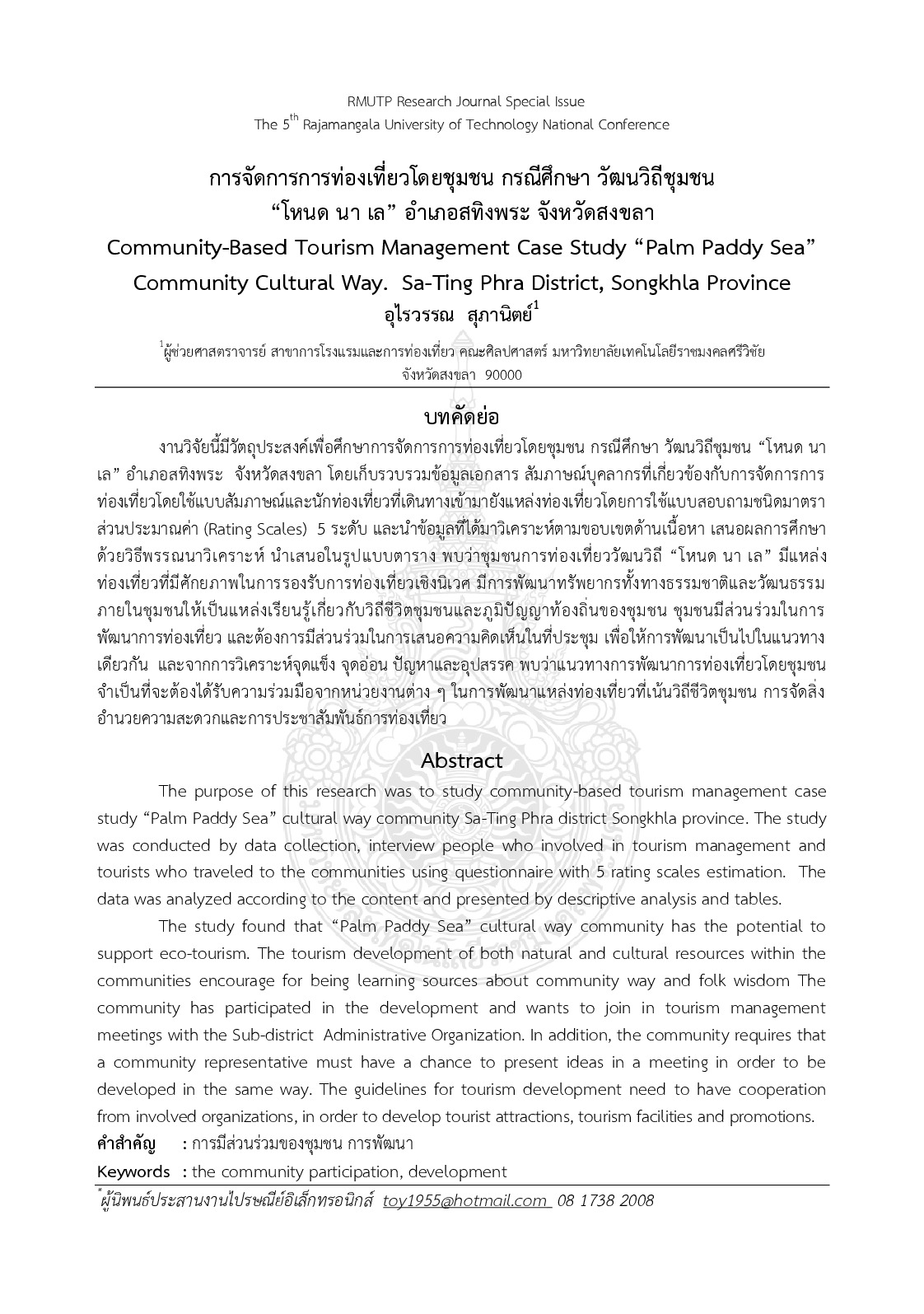
Community-based tourism management case study “palm paddy sea” community cultural way. sa-ting phra district, songkhla province
The purpose of this research was to study community-based tourism management case study “Palm Paddy Sea” cultural way community Sa-Ting Phra district Songkhla province. The study was conducted by data collection interview people who involved in tourism management and tourists who traveled to the communities using questionnaire with 5 rating scales estimation. The data was analyzed according to the content and presented by descriptive analysis and tables. The study found that “Palm Paddy Sea” cultural way community has the potential to support eco-tourism. The tourism development of both natural and cultural resources within the communities encourage for being learning sources about community way and folk wisdom The community has participated in the development and wants to join in tourism management meetings with the Sub-district Administrative Organization. In addition the community requires that a community representative must have a chance to present ideas in a meeting in order to be developed in the same way. The guidelines for tourism development need to have cooperation from involved organizations in order to develop tourist attractions tourism facilities and promotions.