จำนวน Repository ( 7 )

The relationship between learner control and online learning self-efficacy
Online learning has been growing rapidly in recent years providing increased opportunities for tertiary institutes to reach out to learners who previously may have had limited access to a traditional university. Although students frequently use information technologies in their daily life online learning requires considerably more competencies than basic computer skills. Many students are unsuccessful in their learning without face-to-face contact and collaboration with lecturers and peers. They can feel isolated and doubt their ability to succeed in the online course. To increase online learner success support is needed especially to improve learner self-efficacy. Very few studies have focused on student self-efficacy in an online learning environment and especially those conducted in an authentic setting. Learner control is thought to facilitate students in online learning but the relationship between learner control and learner self-efficacy is still unclear. Therefore this study intends to examine this relationship using an embedded-correlational mixed method design to answer the research question what is the relationship between learner control and online learning self-efficacy? The quantitative approach was used to find the correlations among learner control online learning self-efficacy and related variables such as age gender prior online experience and computer skills. An online Learning Self-efficacy Scale (OLSES) was constructed and validated with an internal consistency of 0.895. Open-ended questions were added to the questionnaire to gain a greater level of insight of online learning experience in relation to self-efficacy and learner control. Seventy-five students in a four year teaching online programme at a New Zealand tertiary institute participated in the online survey. Data analyses revealed that the relationship between learner control and online learning self-efficacy was confirmed r = .526 p < .01. Age and gender had no effect on the relationship while prior online experience computer skills for social and academic purposes did. The multiple linear regression showed that learner control and computer skills for academic purpose are good predictors of online learning self-efficacy. Analyses of the qualitative data not only confirmed the quantitative findings but also provided insight into the nature of self-efficacy and importance of feedback in the online setting. As a result of this study the embedded framework for successful line learners (SUCCESS) was developed and is recommended as a set of guidelines for online learning developers.
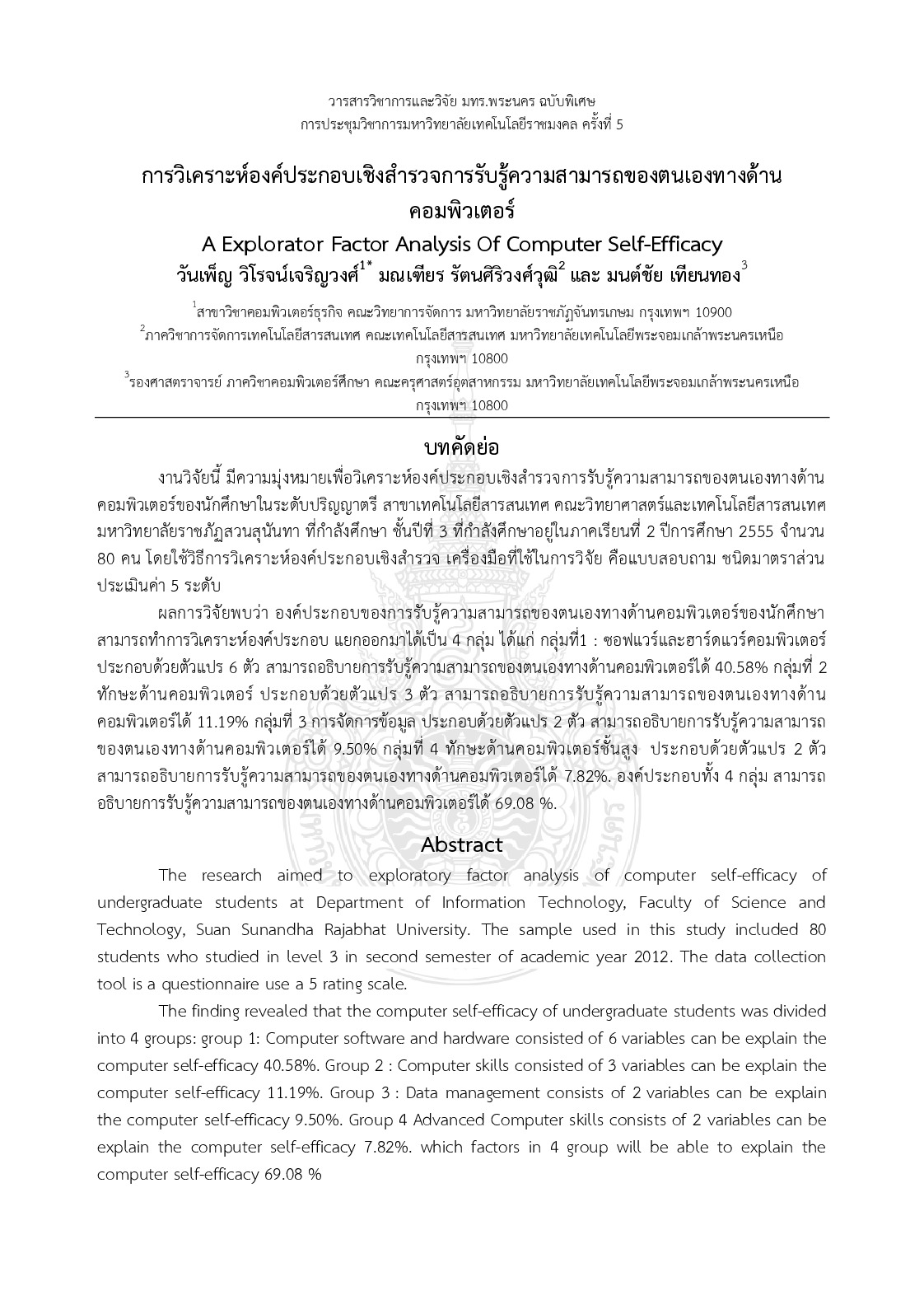
A explorator factor analysis Of computer self-efficacy
The research aimed to exploratory factor analysis of computer self-efficacy of undergraduate students at Department of Information Technology Faculty of Science and Technology Suan Sunandha Rajabhat University. The sample used in this study included 80 students who studied in level 3 in second semester of academic year 2012. The data collection tool is a questionnaire use a 5 rating scale. The finding revealed that the computer self-efficacy of undergraduate students was divided into 4 groups: group 1: Computer software and hardware consisted of 6 variables can be explain the computer self-efficacy 40.58%. Group 2 : Computer skills consisted of 3 variables can be explain the computer self-efficacy 11.19%. Group 3 : Data management consists of 2 variables can be explain the computer self-efficacy 9.50%. Group 4 Advanced Computer skills consists of 2 variables can be explain the computer self-efficacy 7.82%. which factors in 4 group will be able to explain the computer self-efficacy 69.08 %
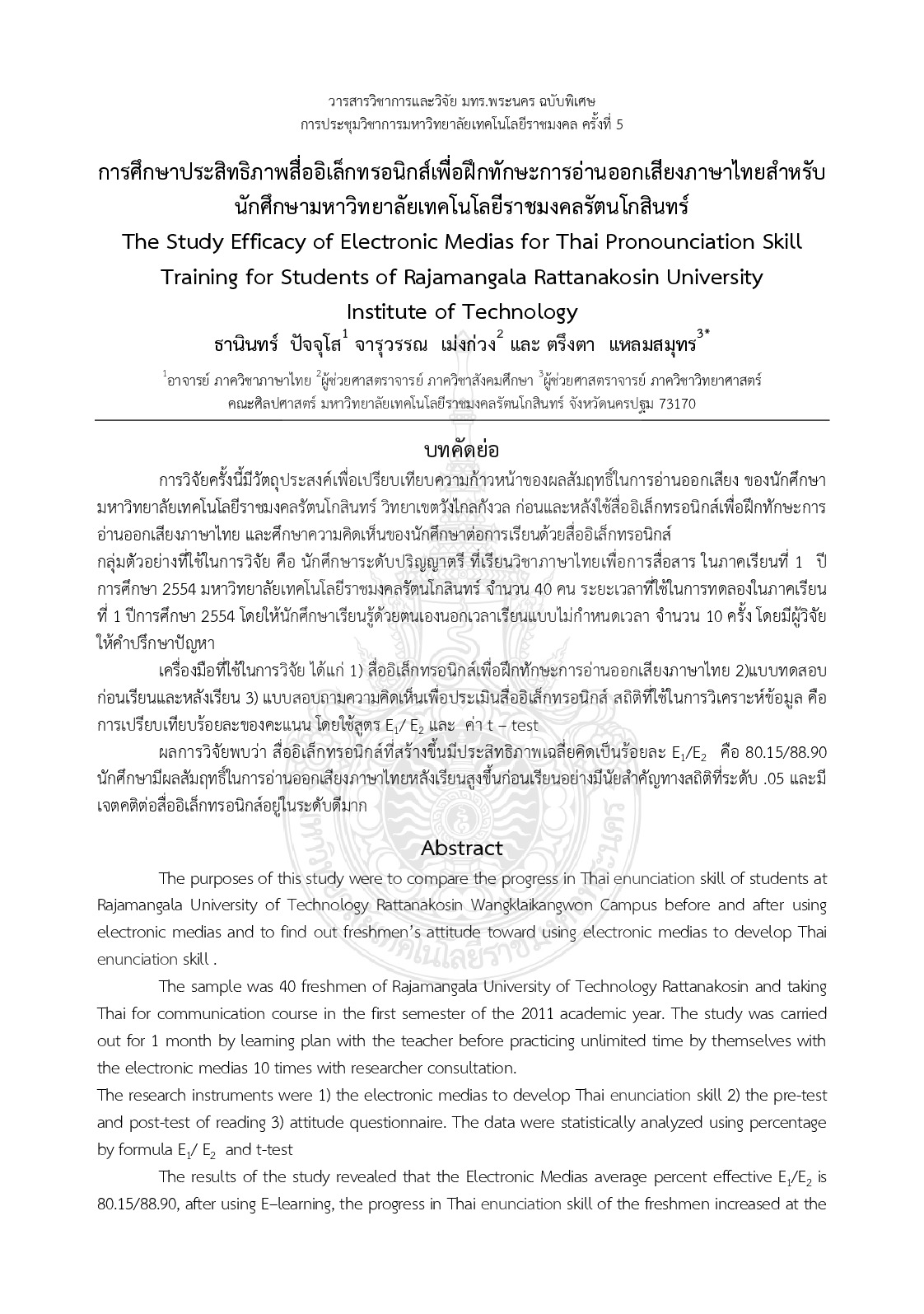
The study efficacy of electronic medias for thai pronounciation skill training for students of Rajamangala Rattanakosin University institute of technology
The purposes of this study were to compare the progress in Thai enunciation skill of students at Rajamangala University of Technology Rattanakosin Wangklaikangwon Campus before and after using electronic medias and to find out freshmen’s attitude toward using electronic medias to develop Thai enunciation skill . The sample was 40 freshmen of Rajamangala University of Technology Rattanakosin and taking Thai for communication course in the first semester of the 2011 academic year. The study was carried out for 1 month by learning plan with the teacher before practicing unlimited time by themselves with the electronic medias 10 times with researcher consultation. The research instruments were 1) the electronic medias to develop Thai enunciation skill 2) the pre-test and post-test of reading 3) attitude questionnaire. The data were statistically analyzed using percentage by formula E1/ E2 and t-test The results of the study revealed that the Electronic Medias average percent effective E1/E2 is 80.15/88.90 after using E–learning the progress in Thai enunciation skill of the freshmen increased at the .05 level of significance and the freshmen’s attitude towards using electronic medias to develop Thai enunciation skill was very good.
The Efficacy of Peroxyacetic Acid and Sodium Hypochlorite Solutions in Reducing Microorganisms on the Surface of Carved Fruits and Vegetables
This study examined the efficacy of two sanitizers; peroxyacetic acid (PAA) and sodium hypochlorite (NaOCl) in reducing total microbial counts on the carved leaf-shape surface of five types of fruits and vegetables: pumpkin carrot radish cantaloupe and Japanese cucumber. The samples were dipped for 3 or 5 min in various concentrations of PAA (40 60 or 80 mg/L) and NaOCl (50 or 75 mg/L) with distilled water as the control. After dipping the samples were drained for 5 min and the total plate counts were determined in triplicate. Dipping in 60 mg/L of PAA for 3 min was the best treatment for reducing microorganisms on the surface of carved carrot and radish; and 80 mg/L of PAA for 5 min was the best treatment for reducing microorganisms on the surface of carved pumpkin cantaloupe and Japanese cucumber. PAA at concentration 60 -80 mg/L showed potential as an effective sanitizer for carved fruits and vegetables more so than both concentrations of NaOCl.
ผลของการจัดกิจกรรมค่ายภาษาอังกฤษตามแนวทฤษฎีปัญญาพฤติกรรมที่มีต่อความเชื่อมั่นในการใช้ภาษาเพื่อการสื่อสาร
The purpose of this quasi-experimental research was to study the effect of an English camping program based on Cognitive Behavioral Theory on students self-efficacy in using the language for communication. The population of the study 118 first-year students of the faculty . of Liberal Arts Rajamangala University of Technology Phra Nakhon in the academic year 2009 were divided by using simple random sampling into 3 groups: experimental· group 1 whose members were assigned to participate in the English camping program based on Cognitive Behavioral Theory; experimental group 2 of which the members were given the infonnation on Cognitive Behavioral Theory and how to develop self-efficacy in using English for communication to read ; and the control group. The instruments used were a questionnaire a self-assessment questionnaire on self-efficacy developed by the researchers and Before & After reviews The statistics used were percentage and t-test. The results were as follows: 1. The level of self-efficacy in using English for communication after the groups participation in the English camping program based on Cognitive Behavioral Theory was significantly higher at the level of 0.05 which was not significantly different at the follow -up. 2. The self-efficacy level after participation in the English camping program was significantly higher at the level of 0.05 than that of the experimental group 2 after being assigned to read. 3. The level of self-efficacy after participation in the program was statistically higher than that of the control group at the level of 0.05. 4. The qualitative data collected from the group participating in the program indicated an improvement in the level of self-efficacy in using English for communication.