จำนวน Repository ( 8 )
การใช้ประโยชน์กากดินขาวเหลือทิ้งจากเหมืองหินเป็นมวลรวมละเอียดสำหรับก่อสร้างอาคารประหยัดพลังงานแบบสำเร็จรูป
The research aims to study and develop the Kaolinite mixed with cement powder for the mass wall. The Kaolinite development process to improve the characteristics. The Kaolinite mixed ratios are 10% 20% 30% and 40% and the result indicated that the experiment mortar-mix ratio at 0:8:2.75:0.2:0.05:0.04:0.5 of cement powder sand Kaolinite limestone superplasticised and clean water compared to No MK control sample covered ASTM standard in tensile strength more than 100 ksc compressive strength of MK20% with superplasticised at 434 ksc. The water absorption values under the standard passed
การรับแรงกระแทกของคอนกรีตผสมดินขาวและเถ้าลอย
This research to study the possibility of material pozzolan as binder by replacment cement by fly ash (FA) and meta kaolin (MK) some for testing compressive strength flexural strength and impact strength of concrete vary the ratio of water to binder (w / b) of 0.40 and 0.45 and the amount of fly ash to replace cement some 15 % 30 % MK and 35% for 10% 15% and 20% by weight of cement. The sample consisted of a cylinder diameter of 10 x 20 cm beam sizes 10 x 10 x 40 cm and 4 x 4 x 16 cm from the test results showed that the concrete samples at 28 days and w/ b of 0.40 to greater than 0.45 all mixed. the compressive strength by replacing cement with FA increase up to 30 % compression of 382 ksc higher than the 20 percent replace by MK were equal to 354 ksc and 32.48 ksc compared to replace cement with FA 15 % is equal to 31 ksc 30% were equal to 30 ksc and 45% were equal to 23.85 ksc while the MK was replaced by 10% were equal to 40.10 ksc higher than to 15% and 20% respectively. The control sample was replaced with MK by 10% is equal to 111 joules maximum replaced by fly ash more than 30% were equal to 110 joules and MK were 15% fly ash 15 and 45 percent respectively.
การใช้เศษหน้าดินขาวเพื่อเพิ่มประสิทธิภาพการป้องกันความร้อนภายในอาคารของอิฐก่อสร้างสามัญ
This research aims to produce scrap page kaolin of brick construction. The kaolin clay ratio of 100: 0 80:20 60:40 50:50 40:60 20:80 and 0: 100 by volume Add mixed with rice husk and rice 15 percent by weight A total of seven ratios. According to standard tests or TIS. 77-2545 ordinary story brick building. The moisture content and water absorption is increasing. While density Thermal conductivity resistance flexural and compressive strength tends to decrease. The best ratio of 80:20 by volume with compressive strength 43.16 kg / cm 2 and 24.93 percent water absorption. Criteria standard of TIS. 77-2545 requiring compressive strength not less than 35 kg / cm2 and water absorption must not be higher than 25 percent. Can be used in the manufacture of brick construction including building decorative wall can be developed into products. Because skin color and beautiful

การใช้เศษกระดาษเหลือทิ้งเป็นมวลรวมในบล็อกประสานมวลเบาจากหน้าดินขาว
The objective of this research is to study about physical mechanical and thermal insulation properties of light-weight Kaolin top soil interlocking block mixed with milk carton waste. The ratio of cement: aggregates (Kaolin top soil and milk carton waste): sanitary water is 1: 7: 1 by weight. 10 ratios of aggregates (Kaolin top soil to milk carton waste ratio) are fixed at 7: 0 6.8: 0.2 6.6: 0.4 6.4: 0.6 6.2: 0.8 6: 1 5.8: 1.2 5.6: 1.4 5.4: 1.6 and 5.2: 1.8 by weight. The interlocking block samples are cast for testing the necessary properties followed the TCPS standard 602-2547. From the experiment the best Kaolin top soil to milk carton waste ratio which has the most milk carton waste and can pass the standard is 6.2: 0.8. The suitable quantity of milk carton waste can reduce the density water absorption and thermal conductivity of Kaolin top soil interlocking block.
The application of kaolin with coconut meal, plywood from corncobs and durian peel in concrete masonry unit wall for increasing effective heat protection and lightweight
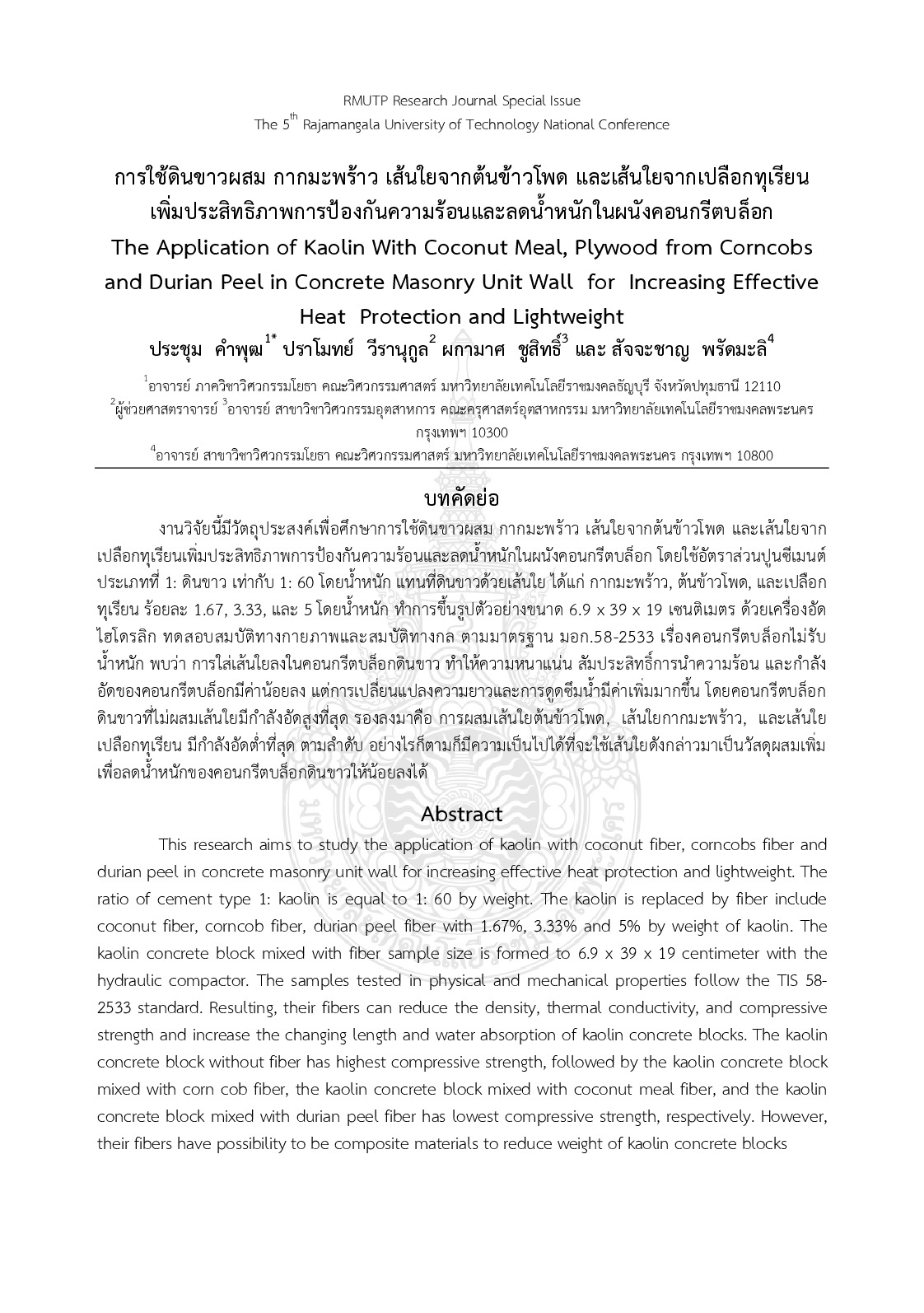
This research aims to study the application of kaolin with coconut fiber corncobs fiber and durian peel in concrete masonry unit wall for increasing effective heat protection and lightweight. The ratio of cement type 1: kaolin is equal to 1: 60 by weight. The kaolin is replaced by fiber include coconut fiber corncob fiber durian peel fiber with 1.67% 3.33% and 5% by weight of kaolin. The kaolin concrete block mixed with fiber sample size is formed to 6.9 x 39 x 19 centimeter with the hydraulic compactor. The samples tested in physical and mechanical properties follow the TIS 58-2533 standard. Resulting their fibers can reduce the density thermal conductivity and compressive strength and increase the changing length and water absorption of kaolin concrete blocks. The kaolin concrete block without fiber has highest compressive strength followed by the kaolin concrete block mixed with corn cob fiber the kaolin concrete block mixed with coconut meal fiber and the kaolin concrete block mixed with durian peel fiber has lowest compressive strength respectively. However their fibers have possibility to be composite materials to reduce weight of kaolin concrete blocks