จำนวน Repository ( 7 )
แนวทางการพัฒนารูปแบบการจัดการเรียนการสอนสาขาวิชาออกแบบแฟชั่นผ้าและเครื่องแต่งกายคณะเทคโนโลยีคหกรรมศาสตร์ มหาวิทยาลัยเทคโนโลยีราชมงคลพระนคร
The aims of this Guidelines for the Development of Teaching and Learning Models in the Department of Fashion and Apparel Design Faculty of Home Economics Technology Rajamangala University of Technology Phra Nakhon were to compare the department of fashion and apparel designs teaching and learning outcomes and to find guidelines for the development of teaching and learning management styles in the department of fashion and apparel design. To gather feedback on teaching and learning satisfaction from current students enrolled in the 2020 academic year faculty members and alumni a convenient random sampling of 104 people willing to participate in the online survey was used. Cronbachs alpha coefficient was 0.980 which was quite confident. Four external experts provide feedback on the training. The frequency percentage and mean were used to analyze the data. The results were summarized as follows: The majority of those who responded were alumni (50.96 %). The average degree of satisfaction in teaching was at its highest (mean 4.23). Other components of the situation were excellent. (mean 4.12) curriculum (mean 4.11) learning facilities and infrastructure (mean 4.03) and educational aid were the averages (mean 3.85). In the department of Fashion and Apparel Design the average satisfaction with teaching and learning was compared. There was no variation in classification based on the respondents status. The findings of the data analysis based on respondents feedback and course reviews Department of Fashion and Apparel Design Bachelor of Home Economics (Course revised 2017) from external experts It was used as a guideline for the development of teaching-learning management styles in the field of study by: (1) the curriculum the name of the curriculum the adjustment of the philosophy objectives and the addition of elective courses in the curriculum for students to choose according to their interests; (2) Instructors adjust the use of teaching methodologies evaluation course content and teaching media knowledge exchange team teaching and online teaching are all options learner-centered teaching activities are critical and devise a self-improvement strategy. (3) in terms of educational aid to sign an MOU contract with the establishment obtaining a budget for the purchase of learning equipment and maintenance to be in good working in order to be used. (4) learning facilities and infrastructure provide books that are relevant to the subject. Improve the computer system and internet signal utilized in teaching. And (5) other areas such as the number of channels available for the courses public relations efforts. Collaboration with former students Follow-up on scholarship recipients participation in activities Field trips and study tours Suggestions for future study The findings should be analyzed using the principles for developing teaching and learning management styles. every academic year to provide the findings in order to develop the curriculum further.
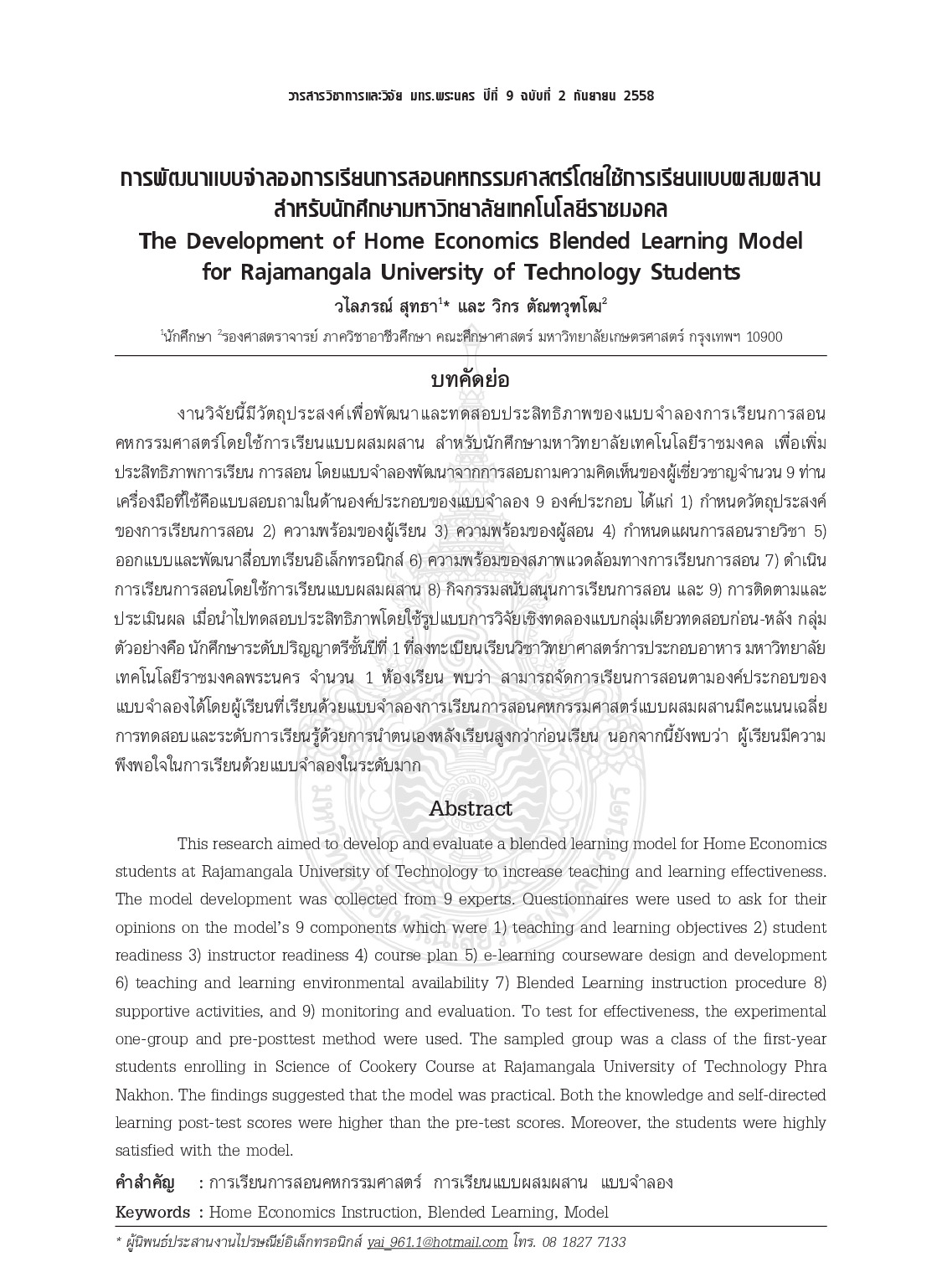
การพัฒนาแบบจำลองการเรียนการสอนคหกรรมศาสตร์โดยใช้การเรียนแบบผสมผสาน สำหรับนักศึกษามหาวิทยาลัยเทคโนโลยีราชมงคล
This research aimed to develop and evaluate a blended learning model for Home Economics students at Rajamangala University of Technology to increase teaching and learning effectiveness. The model development was collected from 9 experts. Questionnaires were used to ask for their opinions on the model’s 9 components which were 1) teaching and learning objectives 2) student readiness 3) instructor readiness 4) course plan 5) e-learning courseware design and development 6) teaching and learning environmental availability 7) Blended Learning instruction procedure 8) supportive activities and 9) monitoring and evaluation. To test for effectiveness the experimental one-group and pre-posttest method were used. The sampled group was a class of the first-year students enrolling in Science of Cookery Course at Rajamangala University of Technology Phra Nakhon. The findings suggested that the model was practical. Both the knowledge and self-directed learning post-test scores were higher than the pre-test scores. Moreover the students were highly satisfied with the model.
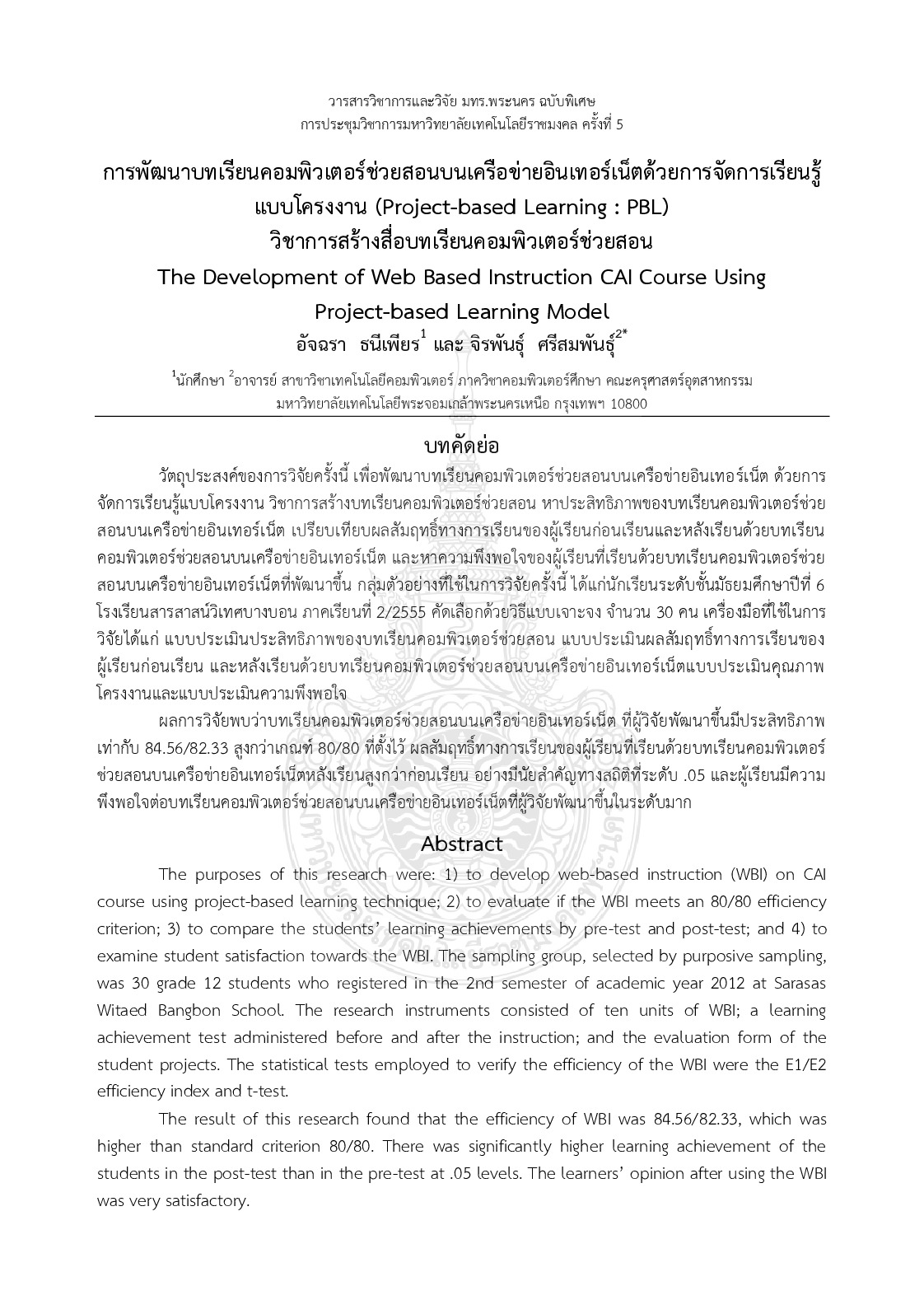
The development of web based instruction CAI course using project-based learning model
The purposes of this research were: 1) to develop web-based instruction (WBI) on CAI course using project-based learning technique; 2) to evaluate if the WBI meets an 80/80 efficiency criterion; 3) to compare the students’ learning achievements by pre-test and post-test; and 4) to examine student satisfaction towards the WBI. The sampling group selected by purposive sampling was 30 grade 12 students who registered in the 2nd semester of academic year 2012 at Sarasas Witaed Bangbon School. The research instruments consisted of ten units of WBI; a learning achievement test administered before and after the instruction; and the evaluation form of the student projects. The statistical tests employed to verify the efficiency of the WBI were the E1/E2 efficiency index and t-test. The result of this research found that the efficiency of WBI was 84.56/82.33 which was higher than standard criterion 80/80. There was significantly higher learning achievement of the students in the post-test than in the pre-test at .05 levels. The learners’ opinion after using the WBI was very satisfactory.
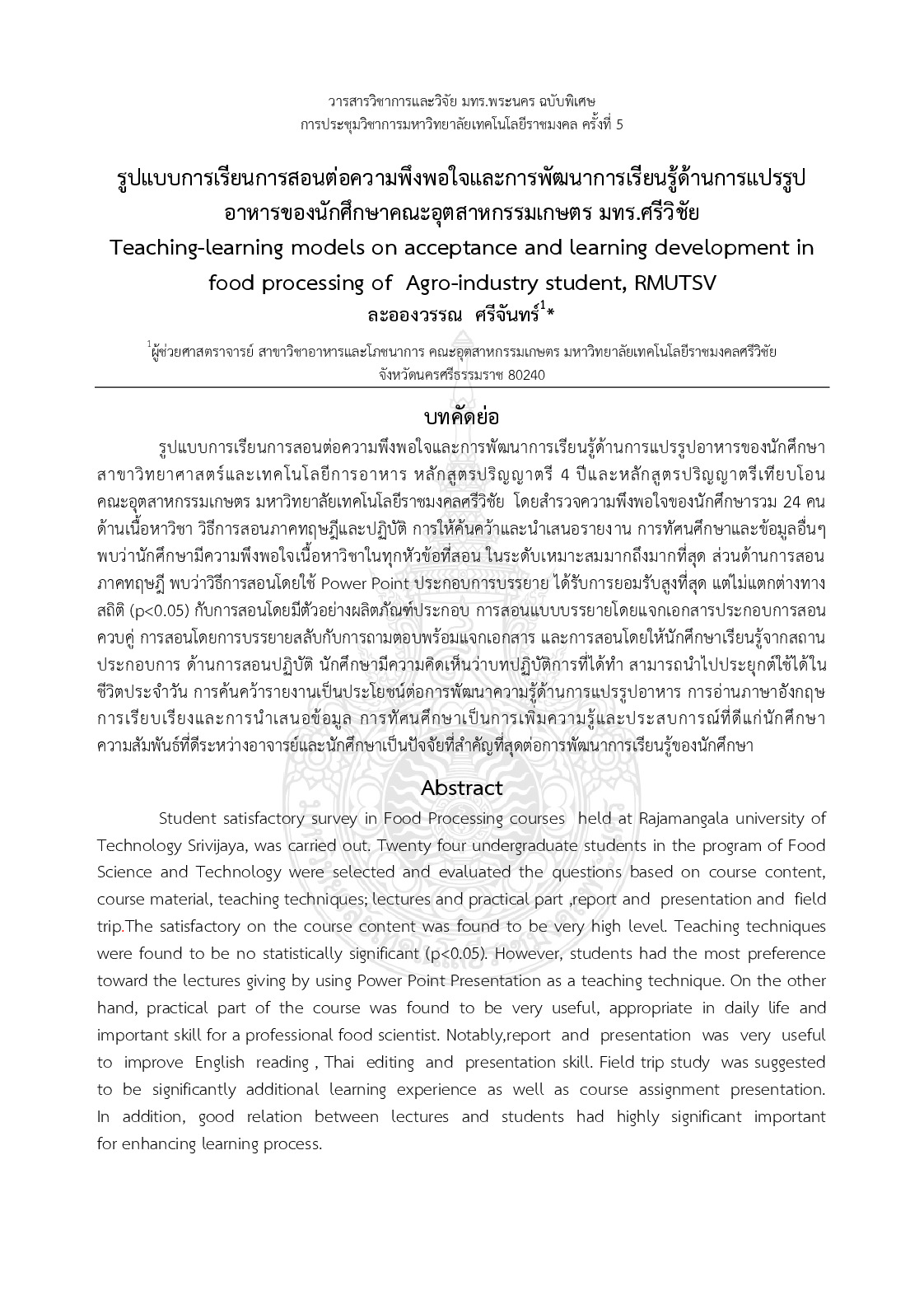
Teaching-learning models on acceptance and learning development in food processing of agro-industry student, RMUTSV
Student satisfactory survey in Food Processing courses held at Rajamangala university of Technology Srivijaya was carried out. Twenty four undergraduate students in the program of Food Science and Technology were selected and evaluated the questions based on course content course material teaching techniques; lectures and practical part report and presentation and field trip.The satisfactory on the course content was found to be very high level. Teaching techniques were found to be no statistically significant (p<0.05). However students had the most preference toward the lectures giving by using Power Point Presentation as a teaching technique. On the other hand practical part of the course was found to be very useful appropriate in daily life and important skill for a professional food scientist. Notablyreport and presentation was very useful to improve English reading Thai editing and presentation skill. Field trip study was suggested to be significantly additional learning experience as well as course assignment presentation. In addition good relation between lectures and students had highly significant important for enhancing learning process.
THE EFFECTS OF STUDY COOPERATIVE LEARNING MODEL THROUGH THE TEACHING OF FOUNDATION OF THAI CIVILIZATION SUBJECT: CERTIFICATED STUDENTS RAJAMANGALA INSTITUTE OF TECHONOLOGY ; POH-CHANG CAMPUS
The objective of this research was to compare the study achievement on Thai Government and Politics of Higher Technical Certificate students of Rajamangala Institute of Technology Poh Chang Art Campus based on the teaching techniques. The total of 49 Poh Chang art students of the 2nd Semester 2002 academic year were simple random sampled and then randomly divided into 2 grcJps; 20 students for the experimental group and the rest for controlled one. The learning-centered teaching technique was used for the experimental group whereas the standard teaching technique was for the other. This research was nonrandomized control group pretest-posttest design. The research tool were the measurement for study achievement teaching plan of StudentTeams-Achievement division: STAD) and the group observation form for collecting the qualitative and quantitative data. Statistics applied for quantitative data analysis was ANCOVA (One-Way Analysis of Covariance) with the pretest score as the covariate. Interpretation was used for qualitative data analysis. The findings revealed that 1.There was a significant difference between the study achievement of the students at the level of 0.05 based on teaching techniques. 2.The experimental group had a better team working performance.