จำนวน Repository ( 80 )
ศึกษาและพัฒนาผลิตภัณฑ์จากวัสดุพื้นถิ่นด้วยวัฒนธรรมโนรา เพื่อเพิ่มมูลค่า สู่ระดับสากล “ชุมชนวิถีพุทธคลองแดน จังหวัดสงขลา”
This research 1] is to study the identity of Nora cultural art for developing the product values and promoting the products to international level and 2] to synthesize and develop the prototype pattern of the products by studying the material relationship between handicraft context and community and Nora cultural art. The research tools are questionnaire observation survey and focus group interview of total 150 people and conducting satisfaction surveys of 420 people such as people in Klong-Dan community tourists specialists and designers before designing the draft pattern by 1] evaluating purchasing factors of souvenir from Klong-Dan community identity in Songkhla province and 2] satisfaction level of graphic pattern and summarize using percentage and standard deviation as follow; The study has founded that 1] the most popular handicraft among tourists is the products from sedge (Krajood) weaving. The weaving processing principally concerns utility which can be made into cloths and costume products. The natural processing from sedge (Krajood) together with Nora cultural identity will made it well known among tourists in appearances colorful dressing from other materials mixing design and 2] the character of the pattern on the products from the satisfaction survey shows that the design of the pattern Nora-6 has total average of 4.25 the detail of graphic design has total average of 4.33 (SD =0.77) the pantone using in the handicraft has total average of 4.25 (SD=0.77) the handicraft detail has total average of 4.27 (SD = 0.74) the relationship and the importance of mind has total average of 4.25 (SD = 0.71) the product having symbols indicating communication elements has total average of 4.21 (SD = 0.76) and the pattern suitability has total average of 4.18 (SD = 0.72). The result of the pattern development will be another identity storytelling and the social context in the present together with the development of the local product could continue to commercial world
การพัฒนาสื่อการสอนโดยใช้เกมเป็นฐาน สำหรับการเรียนรู้เรื่องการเลือกซื้ออาหาร ของนักเรียนระดับชั้นมัธยมศึกษาตอนต้น
The objectives of this research were 1) to create a game-based teaching media for learning about food selection among junior high school students. 2) To compare the learning achievements of lecture- based teaching with game- based teaching. And 3) to study the satisfaction of junior high school students with game- based teaching materials for learning about food selection. The sample consisted of 34 students studying in Mathayom 2 at Nawaminthrachinuthit Suankularb Wittayalai Samutprakarn School academic year 2022. The samples were selected using Cluster Random Sampling method. The instruments used in the research were the media quality assessment and student satisfaction assessment. The statistics used to analyze the data were mean standard deviation and t-test. The results of the research were as follows: 1) the creation of game-based teachingmedia for learning about food selection found that the suitability of teaching materials as a whole was of a very good quality while the content aspect was also at a very goodlevel and in terms of educational technology the quality was very good in all aspects. 2) The comparison of middle school student learning achievement after using method of lecture-based and game-based for learning in terms of buying food selection. It found out that the learning achievement after using between lecture- based and game- based were different as the statistic level of .05 which lecture-based achievement was lower than thestandard. While using game-based teaching was higher than the standard. 3) To study the satisfaction of junior high school students towards teaching media using games- based instructional media for learning about food selection it was found that the satisfaction of the learners on the teaching media in terms of content was at a good level. As for the media aspect of the game- based format it was at a very good level and the benefitsreceived from the media were at a very good level.
การผลิตวัสดุปรับปรุงดินจากเศษอาหารและผักตบชวาด้วยกรรมวิธีดีไฮเดรชั่น
The purpose of this study is to produce the soil improvement materials from food waste and water hyacinth by using a dehydration process. The experiments were divided into two parts : 1) the study of the optimum temperature and time for converting food waste and water hyacinths to soil improvement materials by determining the temperatures of 100 °C 150 °C and 200°C in the periods of 1 hour 2 hours and 3 hours respectively 2) the study of nutrient content in the materials before and after mixing into the soil for 5 days. The soil used in the experiment was sampled from Sai Ma Subdistrict Nonthaburi Province. The parameters used to evaluate the ability to improve the soil quality were soil moisture pH electro conductivity total nitrogen total phosphorus total potassium and organic matter. The results showed that the optimum temperature for drying the food waste was 150°C for 2 hours and the optimum temperature for drying the water hyacinth was 200°C for 3 hours. When the materials were mixed into soil it found that the soil drainage was improved. Mixing the materials into soil could increase the pH value from 5.2 to 5.4 and increase the electrical conductivity from 0.72 mS/cm to 14.78 mS/cm. Besides the plant nutrients including Nitrogen phosphorus and potassium also increased after adding soil improvement materials.
การตรึงอะโซโตแบคเตอร์แบคทีเรียตรึงไนโตรเจนในอากาศด้วยวัสดุธรรมชาติและผลต่อการเจริญเติบโตของผักกวางตุ้งในดิน
Nitrogen is an essential nutrient for plant growth. When the plants have been grown for a long-term effect to decreased nitrogen in soil and insufficiency of the plant growth. One biological method for increasing the nitrogen content in soil is utilize of free nitrogen-fixing bacteria Azotobacter. Therefore the objective of this research was to search natural material suitable for Azotobacter fixation. The 10 natural materials were observed physical structure and investigated the ability of natural materials for Azotobacter fixation. The results showed that water hyacinth and bagasse stalks were fixed the Azotobacter of 2.43x10⁸ and 1.94 x10⁸ CFU per gram of each natural material respectively. After that the selected fixed Azotobacter of water hyacinth and bagasse stalks were studied the growth of Brassica Chinensis. This experiment was designed to 4 treatments. The first treatment was mixed of water hyacinth stalks and the Azotobacter. Second treatment was mixed of bagasse stalks and the Azotobacter. The third treatment was the Azotobacter only. The last treatment was soil only. The results indicated that the average of plant growth include height leaf number root length fresh weight and dry weight of the mixed of water hyacinth stalks and the Azotobacter had significantly higher growth rates than other treatments. The total nitrogen was also increased 1.4 fold in the soil. All results suggest that the water hyacinth stalk is alternative for the fixation of the free nitrogen-fixing bacteria Azotobacter as induce nitrogen in the soil and plant growth promotion.
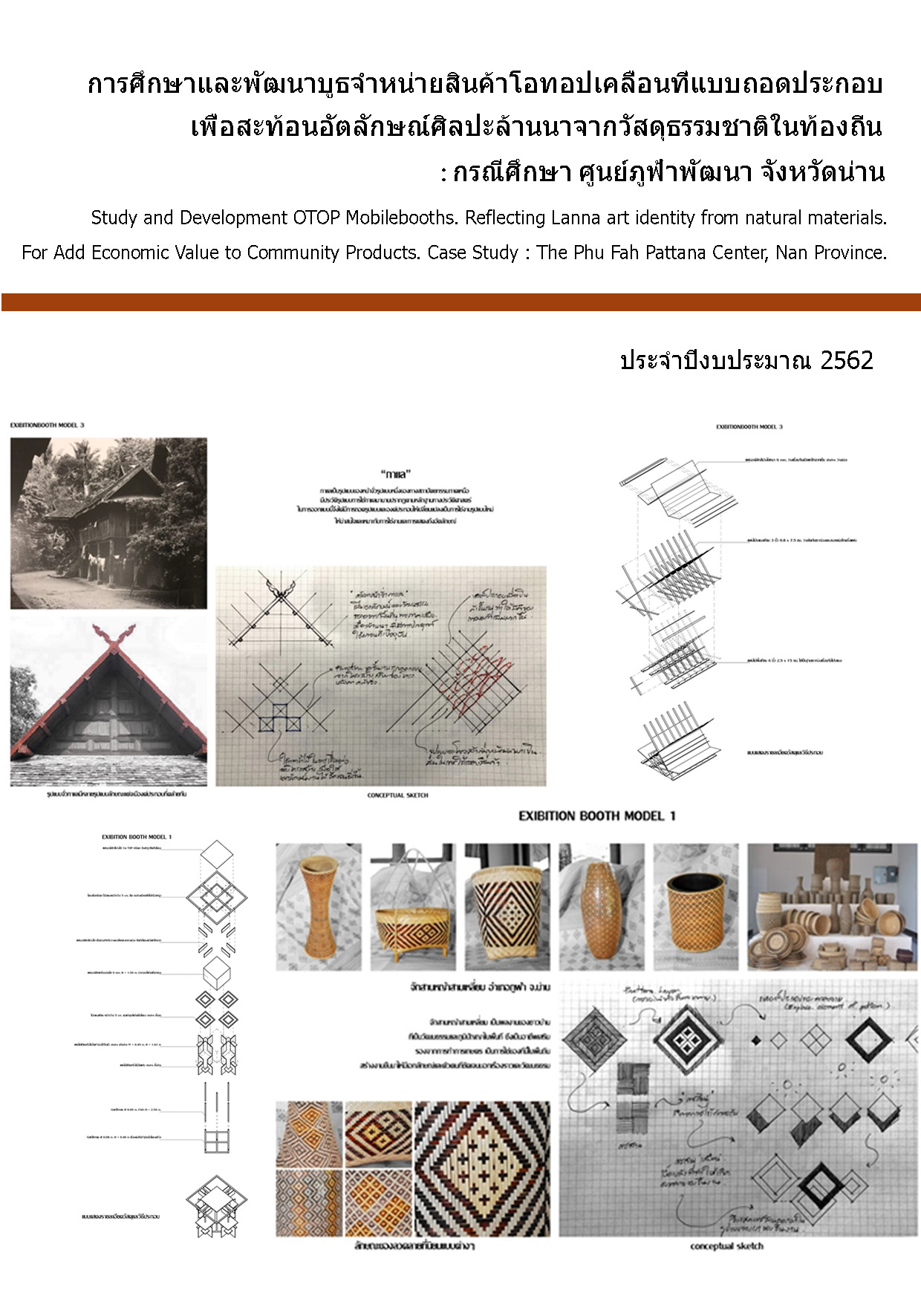
การศึกษาและพัฒนาบูธจำหน่ายสินค้าโอทอปเคลื่อนที่แบบถอดประกอบ สะท้อนอัตลักษณ์ศิลปะล้านนาจากวัสดุธรรมชาติในท้องถิ่นเพื่อเพิ่มมูลค่าทางเศรษฐกิจให้กับผลิตภัณฑ์ในชุมชน : กรณีศึกษา ศูนย์ภูฟ้าพัฒนา จังหวัดน่าน
This research aims to improve the booth model of OTOP products from Phu Fah Pattana Center Nan Province. To increase marketing channels by distributing products to various locations in order to increase sales to community products. The design must take into account the convenience of rapid assembly and dismantling for a limited time. The characteristics of the booth must be disassembled interesting in looks that reflect the identity of Lanna art. There is a beautiful strong structure to support the weight of the product. The size and proportion are suitable for the usage habits of consumers. Which will help promote products in the community that have higher sales stronger communities. Able to divide the product market in the country and can create marketing channels to other countries. It is a good result for the villagers in the community that will have the guarantee of self-sufficiency and sustainably sufficient lives. From the analysis of the Lanna Wisdom Identity Model there are 4 types of concepts which are The concept of the components of the house GalaeThe concept from the barn Concept of the components of the house Kwan Concept of triangular pattern woven grass. After that it was developed to the stage to interpret the meaning of space in form of booth. And then lead to the design of 4 booths. And conducted a questionnaire to find satisfaction with each type of booths that responded to various usability benefits including satisfaction with the appearance and usage characteristics that responded to the behavior of Most users. Conclusion Booths from the concept of Lanna house components called galae have the highest percentage of satisfaction in 3 aspects which are Percentage of satisfaction with the layout of the booth Percentage satisfaction with workpiece assembly and disassembling storage and transportation Percentage of satisfaction with the perception of Lanna identity. For the satisfaction with the size the proportion of use and the convenience of use the booth from the concept of the components of the house Kwan with the highest rate of percentage satisfaction.