จำนวน Repository ( 127 )
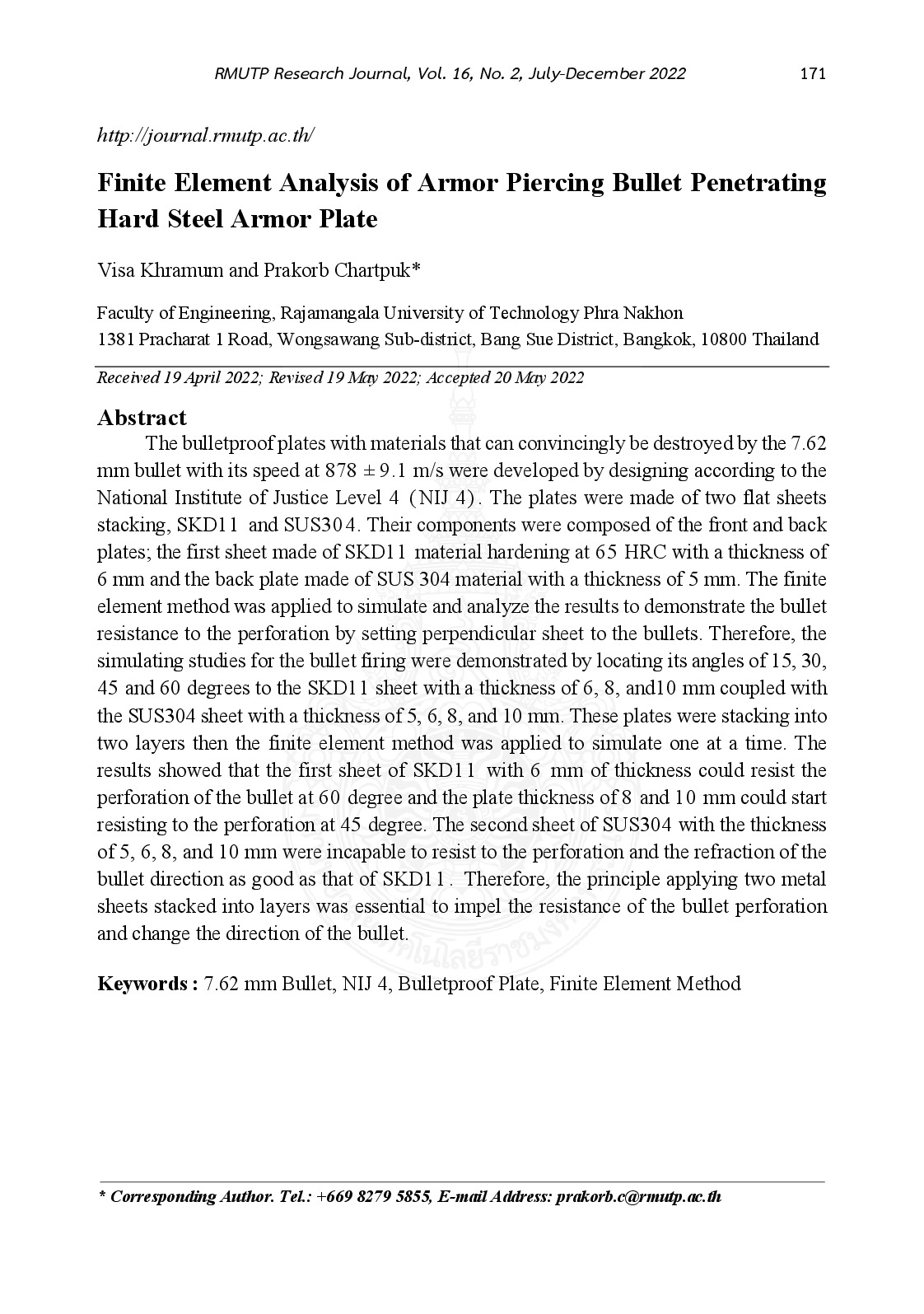
Finite element analysis of armor piercing bullet penetrating hard steel
The bulletproof plates with materials that can convincingly be destroyed by the 7.62 mm bullet with its speed at 878 ± 9.1 m/s were developed by designing according to the National Institute of Justice Level 4 (NIJ 4). The plates were made of two flat sheets stacking SKD11 and SUS304. Their components were composed of the front and back plates; the first sheet made of SKD11 material hardening at 65 HRC with a thickness of 6 mm and the back plate made of SUS 304 material with a thickness of 5 mm. The finite element method was applied to simulate and analyze the results to demonstrate the bullet resistance to the perforation by setting perpendicular sheet to the bullets. Therefore the simulating studies for the bullet firing were demonstrated by locating its angles of 15 30 45 and 60 degrees to the SKD11 sheet with a thickness of 6 8 and10 mm coupled with the SUS304 sheet with a thickness of 5 6 8 and 10 mm. These plates were stacking into two layers then the finite element method was applied to simulate one at a time. The results showed that the first sheet of SKD11 with 6 mm of thickness could resist the perforation of the bullet at 60 degree and the plate thickness of 8 and 10 mm could start resisting to the perforation at 45 degree. The second sheet of SUS304 with the thickness of 5 6 8 and 10 mm were incapable to resist to the perforation and the refraction of the bullet direction as good as that of SKD11. Therefore the principle applying two metal sheets stacked into layers was essential to impel the resistance of the bullet perforation and change the direction of the bullet.
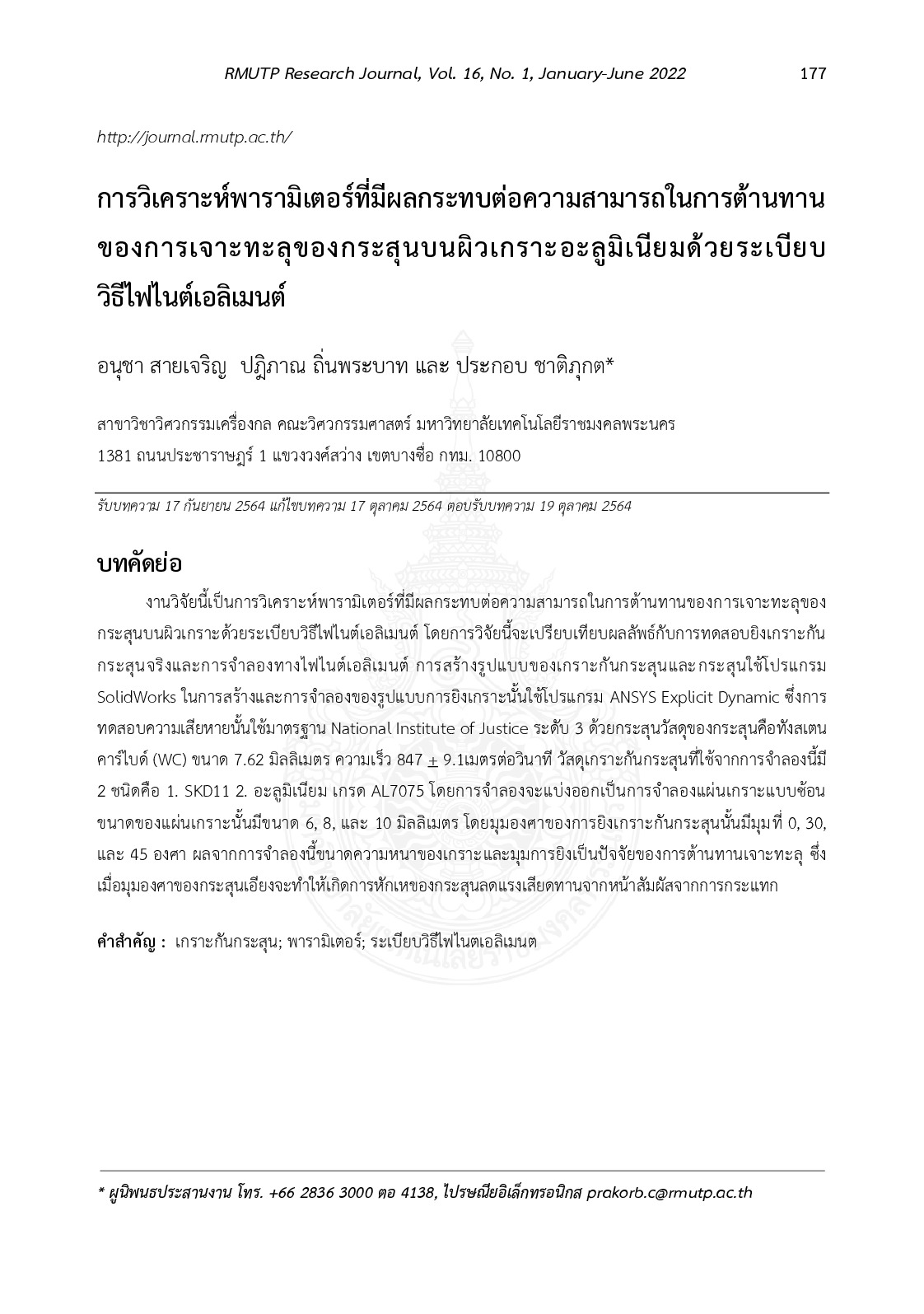
การวิเคราะห์พารามิเตอร์ที่มีผลกระทบต่อความสามารถในการต้านทานของการเจะทะลุของกระสุนบนผิวเกราะอะลูมิเนียมด้วยระเบียบวิธีไฟไนต์เอลิเมนต์
This research analyzes the parameters affecting the penetrating resistance of shells on the armor surface by the finite element method. In this study the results were compared with real bulletproof armor firing tests and finite element simulations. modeling of bulletproof armor using Solid Works program. Creating and simulating armor firing pattern using ANSYS Explicit Dynamic program. damage test is based on National Institute of Justice level 3 standards with material of the ammunition is 7.62 mm tungsten carbide (WC) and speed 847 + 9.1m/s. there are two types of bulletproof armor used in this simulation 1. SKD11 2. Aluminum AL7075. The simulations is into 1 category Simulation of stacked armor plates. The sizes of the armor plates are 6 8 and 10 mm and the angles of firing of bulletproof armor are 0 30 and 45 degrees. result of this simulation armor thickness and firing angle are factors of penetration resistance. when the angle of the projectile is tilted it will cause the projectile to deflect reducing the frictional contact from the impact.

ระบบควบคุมสภาพแวดล้อมการปลูกหัวไชเท้าด้วยเทคโนโลยีอินเทอร์เน็ตทุกสรรพสิ่ง
The purpose of the Environment Control System for radish with Internet of Things project is to control the environment of radish cultivation in a planting house. The working process of this project is separated into two parts. The first part hardware control is to control temperature moisture and illustrated the working status on LCD. The second part software control is collected data from all sensors and then published results on the website via MQTT protocol. The Environment Control System for radish with Internet of Things project is evaluated by measuring the value of temperature and soil moisture from the system compare with the value from reliable instruments. The test results show that the system can measure the temperature and soil moisture correctly. Moreover the software function of the system has fulfilled the requirements.
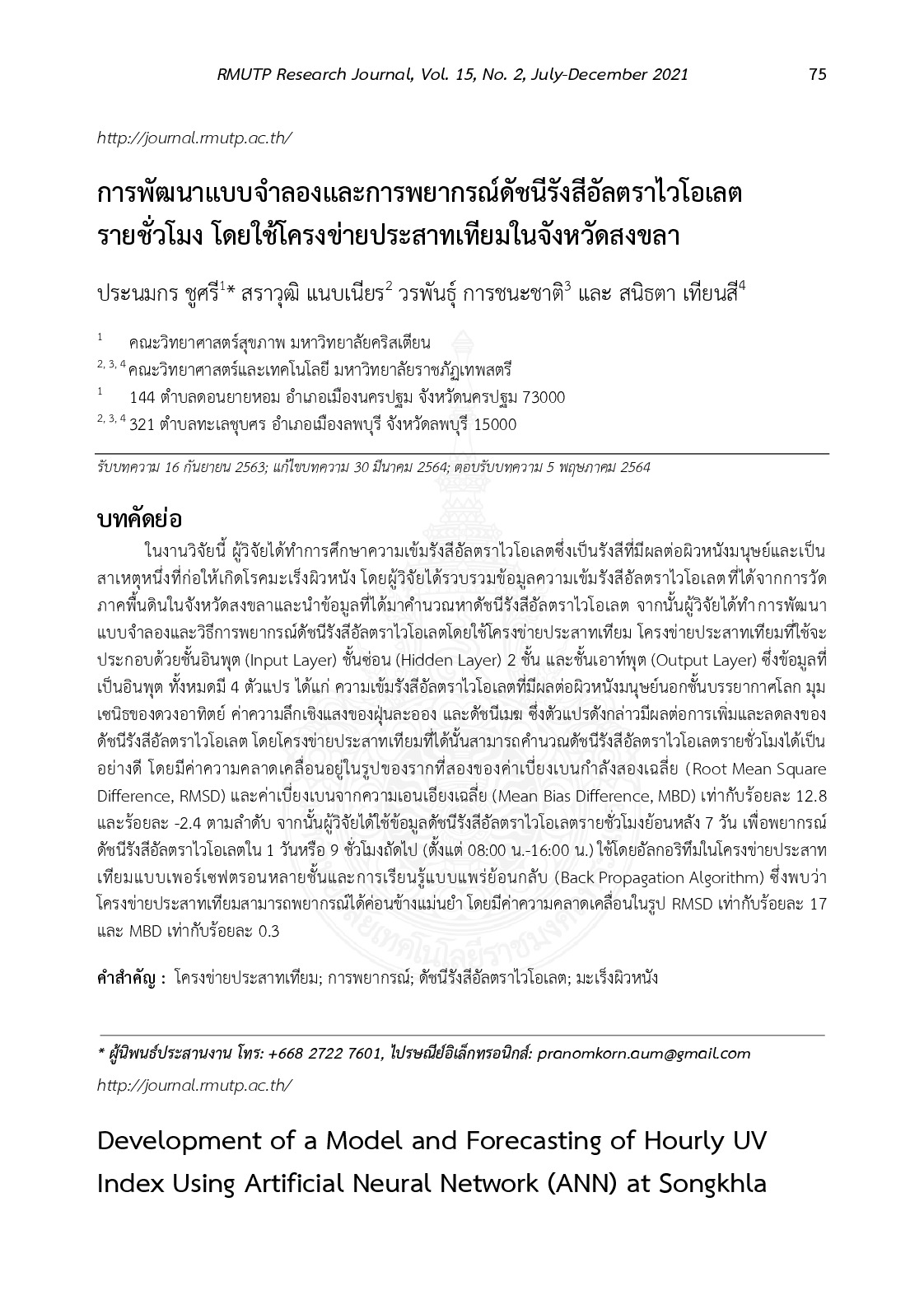
การพัฒนาแบบจำลองและการพยากรณ์ดัชนีรังสีอัลตราไวโอเลตรายชั่วโมง โดยใช้โครงข่ายประสาทเทียมในจังหวัดสงขลา
In this work solar erythemal ultraviolet radiation (EUV) which affects human skin and skin cancer was investigated at Songkhla province (7.2°N 100.6°E). EUV was converted to UV index then the data was used for model development and forecasting of hourly UV index using Artificial Neural Network (ANN). The ANN model has one input layer two hidden layers and one output layer. This input layer consists of extraterrestrial erythemal ultraviolet radiation solar zenith angle aerosol optical depth and cloud index which affect ultraviolet radiation and the output layer is hourly UV index. The results show that hourly UV index obtained from ANN and that from the measurement are in reasonable agreement with root mean square difference of 12.8% and mean bias difference of -2.4%. For forecasting of the hourly UV index the data for 7 days earlier was used for forecasting the next UV index for one day or nine-hour (08:00 am.-16:00 pm.). Multi-layer perceptron and back propagation algorithm were used in the model forecasting. The results show that the UV index from the model forecasting is reasonable agrees with UV index from measurement with root mean square difference of 17.0% and mean bias difference of 0.3%.
การวิเคราะห์พารามิเตอร์ที่มีผลกระทบต่อความสามารถในการต้านทาน ของการเจาะทะลุของกระสุนบนผิวเกราะอะลูมิเนียมด้วยระเบียบวิธีไฟไนต์เอลิเมนต์
This research analyzes the parameters affecting the penetrating resistance of shells on the armor surface by the finite element method. In this study the results were compared with real bulletproof armor firing tests and finite element simulations. modeling of bulletproof and bulletproof armor using Solid Works program. Creating and simulating armor firing pattern using ANSYS Explicit Dynamic program. damage test is based on National Institute of Justice (NIJ) level 3 standards with bullets the material of the ammunition is 7.62 mm tungsten carbide (WC). there are two types of bulletproof armor used in this simulation 1) SKD11 2) Aluminum AL7075. The simulations is into 1 category Simulation of stacked armor plates. The sizes of the armor plates are 6 8 and 10 mm and the angles of firing of bulletproof armor are 0 30 and 45 degrees. result of this simulation armor thickness and firing angle are factors of penetration resistance.