จำนวน Repository ( 8 )
สมบัติการดูดซับน้ำมันทอดอาหารของนอนวูฟเวนจากเส้นใยเซลลูโลสฟางข้าว
The objectives of this research were to study cellulose fiber extraction from rice straw with sodium hydroxide in various conditions (with 5 1 0 and 1 0 % of sodium hydroxide at room temperature 60ºC and 90 ºC for 0.5 1 2 and 3 hours) and to study rice straw nonwovens preparation by the wet-laid process. Oil wicking ability oil absorption ability air permeability morphology and physical properties of prepared nonwovens were investigated. It was found that the optimal condition for cellulose fiber extraction from rice straw was 5% of sodium hydroxide at 90 ºC for 2 hours. At this condition the cellulose fiber yield of 2 2% and the fiber length of 1 . 9 6 cm were obtained. The oil wicking ability and oil absorption ability of rice straw nonwovens increased when weight per unit area increased. Therefore oil absorbed into gaps between fibers of the nonwovens by capillary effect. Moreover the nonwovens could wick and absorb virgin palm oil better than fried palm oil because virgin palm oil has a lower viscosity than fried palm oil. The viscosity increased from derived lipid and other substances which dissolve and disperse increasing after frying food. The results indicated that the rice straw nonwovens had oil absorption ability.
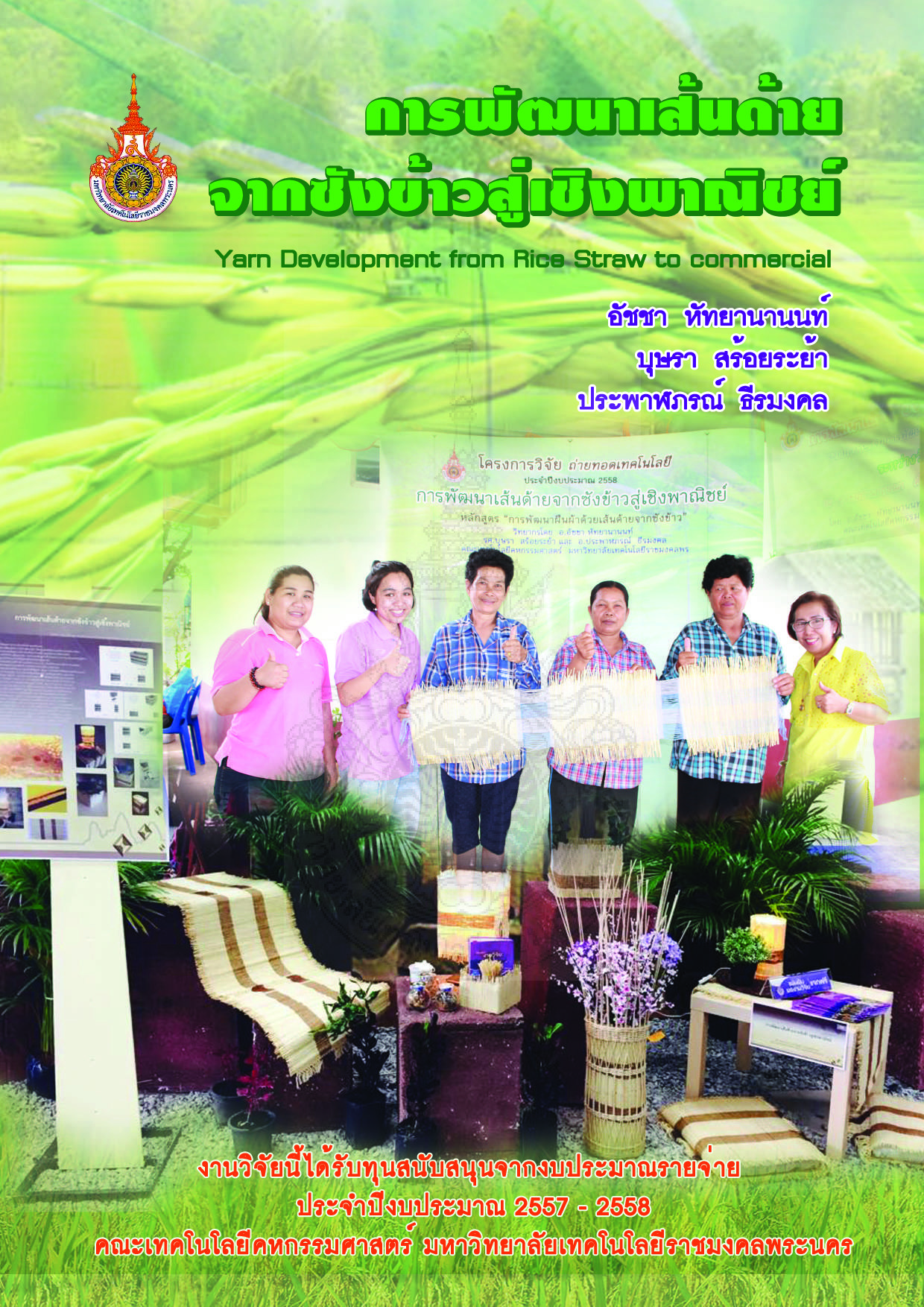
การพัฒนาเส้นด้ายจากซังข้าวสู่เชิงพาณิชย์
This research is Yarn Development from Rice straw to commercial. It aims to study the process of seperating fibers from rice straw. To study the physical properties of fibers from rice straw and to study the process of manufacturing yarn from rice straw fibers. The research material is rice straw fibers after that data was analyzed byphysical textile testing laboratory. The result of the first year’s research was the rice straw yarn has been developed as woven and develop into commercial products to promote. The process of separating fibers from rice straw which dried the sun for a few days. Selecting the rice straw fiber length at least 30 cm. to subtract the joints of the lower end of the stem by hand. peel off the rice straw fiber and place flat on a horizontal line. Then Rice straw fiber were tested in the physical laboratory was found that it is cellulose fibers tensile strength (Newton) at 28.18 elongation (percent) is at 2.01. The amounts of metals has plenty of CADMIUM at 0.1 mg/kg CHROMIUM (TOTAL) / (VI) at 0.5 mg/kg COPPER at 0.5 mg/kg and LEAD at 0.1 mg/kg which was not found to be risk for using. The fiber cross-section of rice straw fiber were found to be oval the middle is clearly. The fiber length is smooth and transparent when viewed from the side to see the clarity of the fiber. Rice straw fiber was weave in plain structure. Warp yarn uses a special brown cream and brown flat yarns. We use rice straw fiber with the same type of yarn. There are 2 warp yarn and using natural color without blench. Rice straw fabric was dyeing with dried hibiscus flowers (Kaa-Jeab herb) and mordant as ashes. The result is red light because of rice straw fiber surface is smooth and lustrous. Therefrom When woven as a fabric to develop be 4 products prototype : table lamps tablecloths in Japanese style potted plants and Accessories Box The result of the second year’s research there are focus group inquire for people it is interesting in this research and Date for transfer knowledge as: Ban-Krit-Sa- Na community Krit-Sa-Na sub-district bang-pra-ma district in Supanburi province. To plan the schedule and set the date place amount of participate and lectures 34 people The range of time to transfer as 3 days on 3 – 5 May 2015 and asking for consumer satisfaction of the curriculum and lecture for “transfer knowledge Yarn Development from Rice straw to commercial” by Questionnaire of participate satisfaction. Last the evaluation data was analyzed by using SPSS program in mean and percentage. The second year found that mostly participates were female aged under 21 years old finished the secondary school and also there are farmer. The participates are their income under 5000 baht and no income. For the participates questions relation to technology transfer of “Yarn Development from Rice straw to commercial” about course divided into 3 parts: The purpose The curriculum and The knowledge. The satisfaction of participates about project divided into 3 parts: Service process Lecturer and Facilities found that have been satisfied at maximum average and highest level of satisfaction in every parts of both satisfied participates questions. The participants are mainly used to provide benefits to themselves for one month to apply the gained after the training. Satisfaction with the benefits of technology transfer and utilization. Satisfaction at the highest level the participants used knowledge to apply with local and waste material. Moreover the participates make product as soon as finish course and they are planning to produce the table Hand Woven for weaving the Rice straw yarn fabric and push it to be OTOP products. The comments and suggestions of the participants found that they need for re-training again. They would like to have a longer period of training in order to gain more knowledge. All lecturer can transfer knowledge during the training as well.

The study and development of building construction material : wall construction material from para rubber and rice straw to reduce the internal e
This research is a studying and developing building constructing material that is reducing the usage of energy in a building and it is made from rubber and rice straw. This research aims to both improve the economic and raise the energy conservation idea. This research will find the proper building material that is heat resistance. From interviewing the expert the researcher came up with the best formula to produce this heat resistance board. The formula is to add water to the rubber (one part rubber and three parts water) and spay it on a flatted bed of rice straw. Then heat it for one hour in a temperature of one hundred degree Celsius. After that mix in borax to make this material heat and fire resistance. All theses testing; the heat resisting and water absorbing this material has past the standard to be used in an indoor building constructing (มยผ. 8101-51) Department of Public works and town planning Ministry of Interior 2008. From that point on the researchers designed a pattern on the material to add the look for home and building decorating. Therefore they are two sizes of the material; 0.60 x 0.60 x 0.10 meter and 0.60 x 1.20 x 0.10 meter.
Biogasification from rice straw
The research is to present the biogas production from rice straws with anaerobic digester. Firstly three digester tanks contain dry rice straw 3 kg slice with length 1-2 inch and water 60 lite. Digester A was a control sample. Digester B was designed for minimum performance (add the morass 2 lite) while the digester C was designed for Carbon/Nitrogen control (add urea 1 kg.). The biogas was operated for 30 days and measured which highest percent of Lower Explosive Limit was 93%. This studied show the simple methods to producing the biogas from the rice straw.
Education blade design for chopped digest material waste from rice straw
The main objective of the study is to design blades for chopping heart rice straw. This study is composed of three main testing parameters. The first parameter used is speeds at which the knife blades that will chop the straw. They will have 2 speeds one at 540 and the other at 720 rpm. The second parameter is the types of blades that will be used eclipse blades and smooth blades. The last parameter is the cutting edges. The eclipse and smooth types of the blades will have 4 5 and 6 cutting edges. For this test we use stubble sorted 50 heart rice straws. Placing the straw on the prepared steel and test with all three testing parameters repeating each testing parameter thrice and record the results. Based on the testing and evaluation the 6 edge eclipse blades with a speed of 720 rpm. Yielded the highes results for chopping heart rice straw at 66 percent. For the 6 edged smooth blades with a speed of 720 rpm the yield results for chopping heart rice straw was at 35.76%