จำนวน Repository ( 24 )
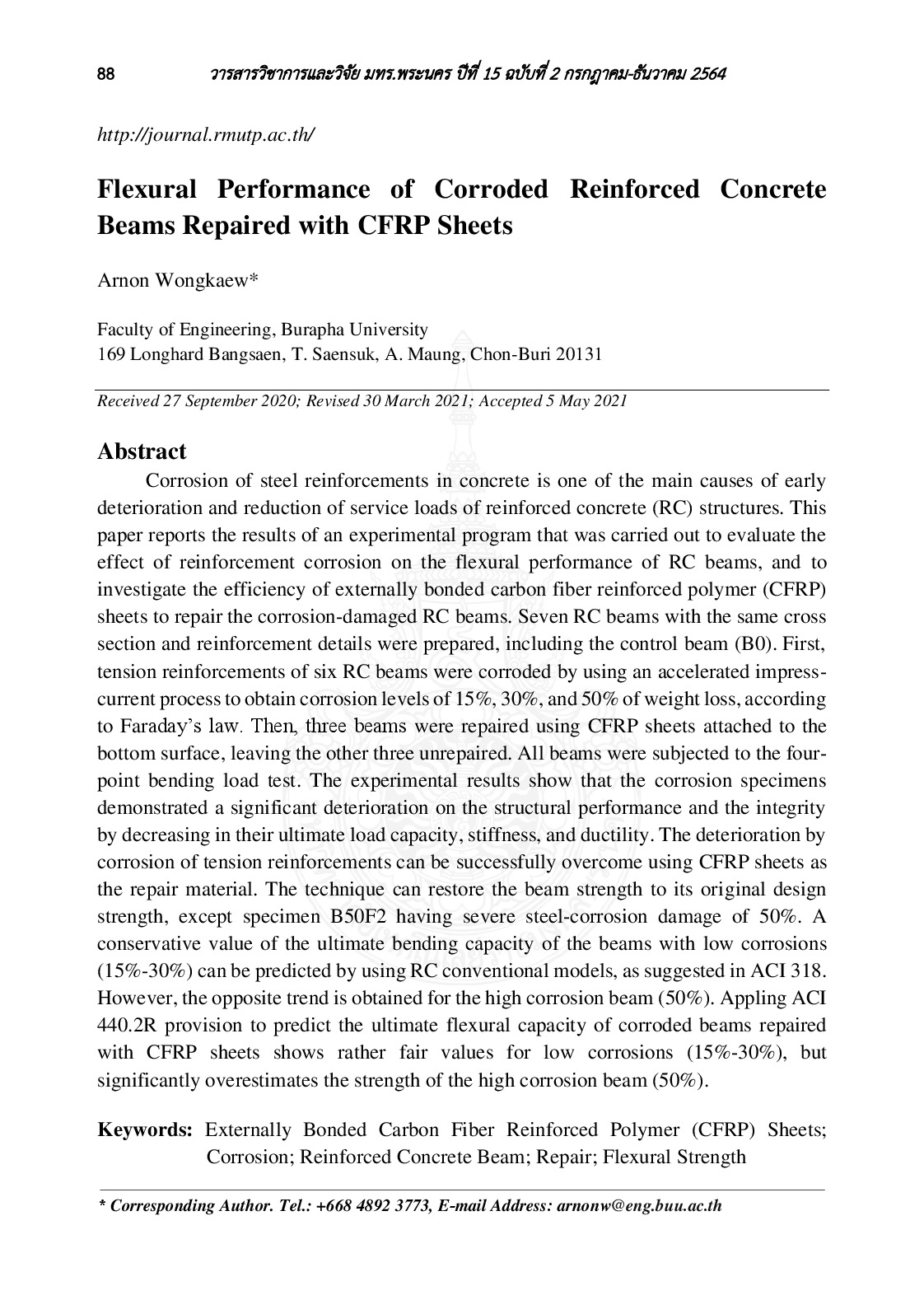
Flexural performance of corroded reinforced concrete beams repaired with CFRP sheets
Corrosion of steel reinforcements in concrete is one of the main causes of early deterioration and reduction of service loads of reinforced concrete (RC) structures. This paper reports the results of an experimental program that was carried out to evaluate the effect of reinforcement corrosion on the flexural performance of RC beams and to investigate the efficiency of externally bonded carbon fiber reinforced polymer (CFRP) sheets to repair the corrosion-damaged RC beams. Seven RC beams with the same cross section and reinforcement details were prepared including the control beam (B0). First tension reinforcements of six RC beams were corroded by using an accelerated impress-current process to obtain corrosion levels of 15% 30% and 50% of weight loss according to Faraday’s law. Then three beams were repaired using CFRP sheets attached to the bottom surface leaving the other three unrepaired. All beams were subjected to the four-point bending load test. The experimental results show that the corrosion specimens demonstrated a significant deterioration on the structural performance and the integrity by decreasing in their ultimate load capacity stiffness and ductility. The deterioration by corrosion of tension reinforcements can be successfully overcome using CFRP sheets as the repair material. The technique can restore the beam strength to its original design strength except specimen B50F2 having severe steel-corrosion damage of 50%. A conservative value of the ultimate bending capacity of the beams with low corrosions (15%-30%) can be predicted by using RC conventional models as suggested in ACI 318. However the opposite trend is obtained for the high corrosion beam (50%). Appling ACI 440.2R provision to predict the ultimate flexural capacity of corroded beams repaired with CFRP sheets shows rather fair values for low corrosions (15%-30%) but significantly overestimates the strength of the high corrosion beam (50%).
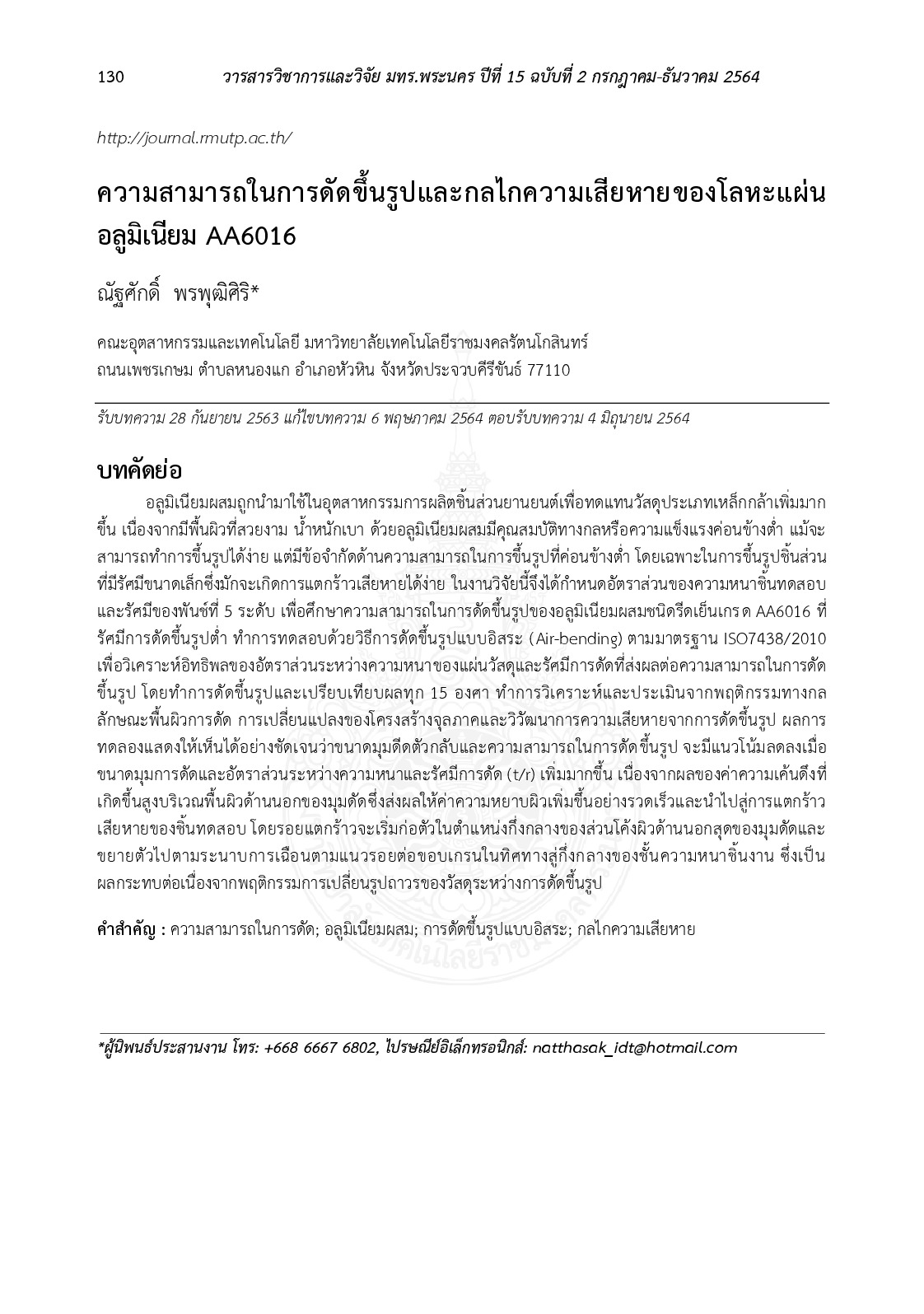
ความสามารถในการดัดขึ้นรูปและกลไกความเสียหายของโลหะแผ่นอลูมิเนียม AA6016
Aluminium alloys was used in the automotive parts industry increased for compensate steel parts material due to its lightweight and good surface. Since aluminium alloys are there relatively low mechanical properties although they can be deformed easily but the major limitation is their low formability. Especially the less bending radius which is often bending surface damaged easily. In the present work five-difference ratio of sheet thickness and bending radius for study to the bendability of cold rolled aluminum alloys AA6016 at low bending radius. The bending test by Air-bending method according to ISO 7438: 2010. To compare the results every 15 degrees. The mechanical behaviour surface roughness microstructure and damage evolution in the fillet region were analysed by experimental research. The experiment clearly showed that the Spring-back angle and bendability tend to decrease as the bending angle and material thickness increase. Due to the high tensile stress on the bending surface it effected to the surface roughness increases rapidly and led to the damage on the specimen bending surface. The initial cracks occur on the middle of the outer surface curvature and propagation in the shear plane pattern to the middle of the sheet thickness along the grain boundary. This is the consequence of plastic deformation by bending test.
การศึกษาระดับปัจจัยที่เหมาะสมสำหรับการปรับปรุงกระบวนการอบอ่อนเหล็กแผ่นม้วน
The objective of this research is to study the suitable factor level for the improvement of annealing furnace for rolled coils steel sheet. The experimenting has been performed to find suitable oxygen level by 5 annealing furnace experiment. The research has been started by collection the combustion. After that the burning adjustment by changing combustion technology with 5 levels of BGCV control valve open as 23% 40% 50% 75% and 100% has been implemented. The combustion adjustment data are recorded analyzed and compared with incomplete combustion value. The research result has been found that after improvement the combustion value. The percentage of oxygen level are improved to the better quality which standard at MV0-49% equal 2.5-4 O2% and MV50-100% equal 1.5-2.5 O2% conclusion 1 furnace as follows at the MV23.1% MV40% MV50% MV75% and MV100% level of oxygen as 2.5% 3% 3% 2% 1.5% and level of carbon monoxide as 0 ppm 2 ppm 2 ppm 2 ppm and 0 ppm respectively. Resulting of fuel energy consumption in the annealing process has been reduced around 225608 baht /year/furnace. Therefore it can depict that energy saving and annealing furnace efficiency improving are increased. The modified parameters will be applied to be the new standard reference values for the further engineer’s operational manual.
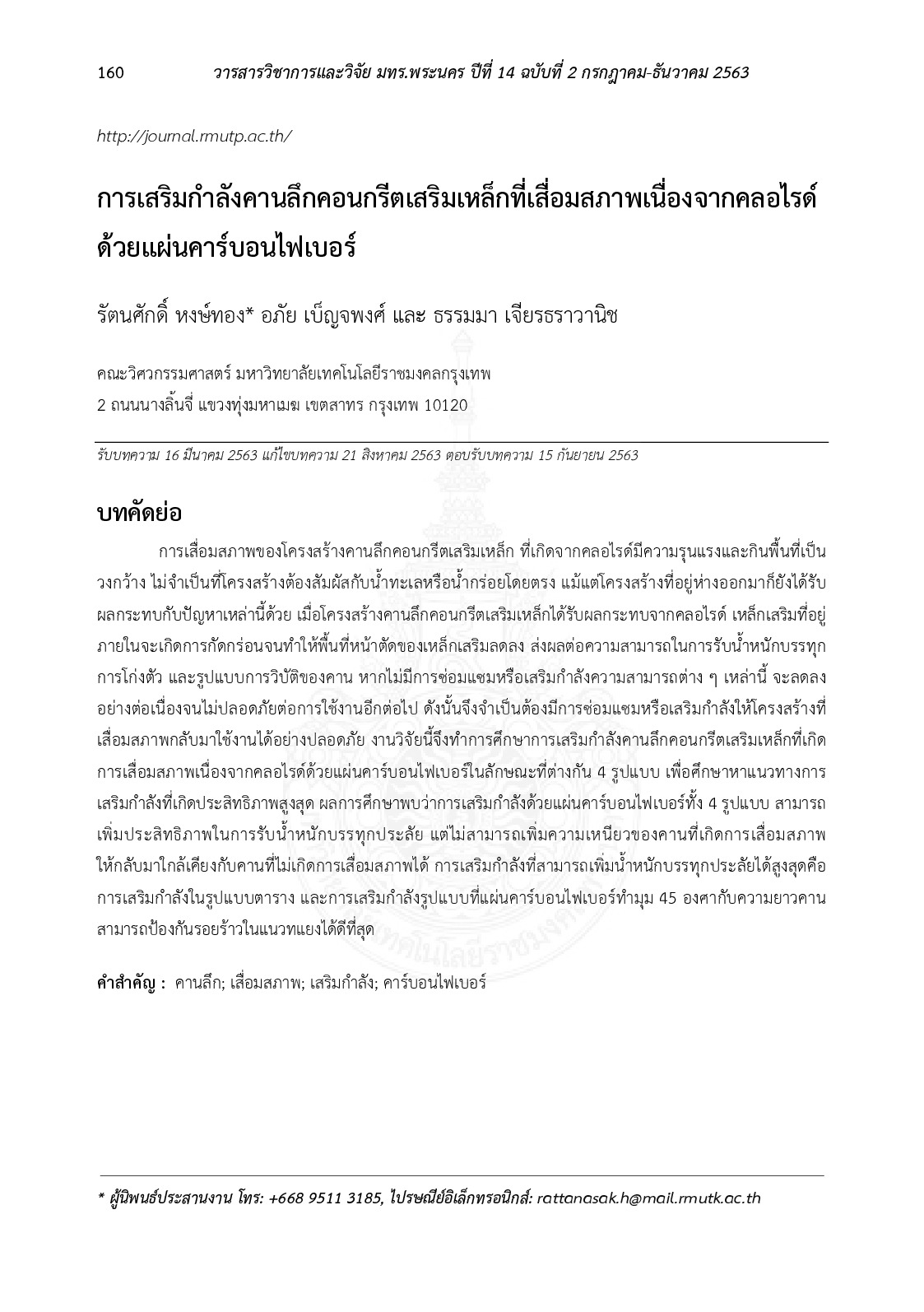
การเสริมกำลังคานลึกคอนกรีตเสริมเหล็กที่เสื่อมสภาพเนื่องจากคลอไรด์ด้วยแผ่นคาร์บอนไฟเบอร์
Deterioration of reinforced concrete deep beam structure caused by chloride is severe andtakes up wide area even though the structure is not exposed to sea water or brackish water. Even the structure which is far from sea water or brackish water is affected by this problem.When the reinforced concreate deep beam structure is affected by chloride steel reinforced inside the structure is corroded resulting in reducing the cross-sectional area of the reinforced steel affecting load capacity deflection and beam failure. If there is no repair or strengthening such capabilities are continuously reduced until it is no longer safe to use the beam. Therefore it is necessary to repair or strengthening the deteriorated structure to be safely used. This research investigated strengthening of deteriorated reinforced concrete deep beam caused by chloride with 4 formats of carbon Fiber sheets to seek guidelines for the most efficient strengthening. The resultshowed that the strengthening by the 4 format of carbon fiber sheet could increase ultimate loadcapability yet could not improve ductility of the deteriorated beam to become close to the beamthat is not deteriorated. The strengthening that could increase the maximum ultimate load capability was the table format strengthening. In addition the strengthening that the carbon fiber making 45 degrees with the length of the beam could best prevent diagonal cracks.

แผนฉนวนกันความร้อนจากใบสักเพื่อลดความร้อนให้กับอาคาร
This research aims to investigate and test the feasibility of the production of natural teak sheets and study the appropriate production methods. Study physical properties and mechanical properties to compare with industry standard insulation sheet. The ratio of tattoo and hyacinth. 5% 7% 9% of the material were dried at 400 600 800 kg / m3. The results showed that the modulus rupture. Elastic modulus And thickness swelling. It varies with the amount of glue. The nature of the tattoo causes absorption in the material if the density increases the water absorption will decrease. Compared to standard insulation products. The amount of adhesive is 7% of the weight of the material when dry. The density of 800 kg / m 2 is 25 kg / cm2. 140 degree Celsius ruptured modulus and elastic modulus But the thickness of the swelling has not met the criteria. In the next production should be mixed waterproofing in the work.