จำนวน Repository ( 156 )
การพัฒนาหลักสูตรระยะสั้นด้านการผลิตเคมีภัณฑ์ในครัวเรือน
The purpose of this research was to develop a short vocational training course on household chemical products and to develop a training course for shortterm vocational training in the production of household chemicals. Population groups Is a general public in Bangkok and metropolitan area by using the voluntary selection as follows. Trial of a short course on the production of household chemicals 10 participants. Evaluation of short courses in household chemical production 10 participants. Technology transfer the short-term training course on household chemical production 20 participants and five speakers. The tools used in the research are as follows: 1. Demand questionnaire 2. Short-term vocational training course 3. Satisfaction assessment. Data analysis using statistical software packages. The statistics used were mean ( X ) standard deviation (SD) and t-test. The research found that 1. Study and development of short courses in the production of household chemicals 1.1 selection of household chemicals that will lead to the creation of training courses based on components Where to buy Price per set Properties of components Safety and hazard Materials and equipment used for production storage use and distribution opportunities 1.2 Creating training courses training course components and training documents to have a sequence of steps that are easy and convenient for the learning of the general public 2. Trial of a short course on the production of household chemicals 2.1 Most trainees are satisfied with the short-term training program model as follows: Training procedures Training hours 1.30 hours per 1 course Short-term courses can be implemented and the curriculum can be used as a guideline for occupation at the highest level. As for the number of trainees four people per group per 1 course is at a high level. 2.2 Most of the trainees were satisfied with the speakers and short-term training. In explaining the various components of Household chemicals Explanation of the mixing process Household chemicals Integration of household chemical mixing techniques Explanation of caution In the mixing of household chemicals And explaining how to pack household chemicals at the highest level 3.Short-term evaluation of household chemical production 3.1 Most trainees are satisfied with the short-term training program model. The training process Training hours 1.30 hours per 1 course Short-term courses can be implemented and courses can be used as guidelines for their career at the highest level. As for the number of trainees four people per group per 1 course is at a high level. 3.2 Most of the trainees were satisfied with the speakers and short-term training. Explain the various components of household chemicals Explanation of the mixing process Household chemicals Integration of household chemical mixing techniques. Explanation of caution In the mixing of household chemicals And explaining how to pack household chemicals at the highest level 4.Technology transfer the short-term training course on household chemicalproduction 4.1 Most of the trainees were satisfied with the trainers for short-term training. Explain the various components of household chemicals Explanation of the mixing process Household chemicals Integration of household chemical mixing techniques Explanation of caution in the mixing of household chemicals and explaining how to pack household chemicals at the highest level 4.2 Most trainees were satisfied with the short-term training program model. Regarding the number of trainees four people per group Training procedures The number of training hours is 1.30 hours per course the highest level. Furthermore short courses can be implemented. As for the curriculum it can be used as a guideline for a career at a high level.
การผลิตและคุณลักษณะของแบคทีเรียลเซลลูโลสที่ผลิตด้วย Acetobacter xylinum TISTR 978 จากน้ำคั้นเปลือกสับปะรด
This research studies the production of bacterial cellulose from Acetobacter xylinum TISTR 975 with pineapple peel juice a low cost carbon source and coconut water as nutrient and carbon source. The factors influencing the production were studied including incubation time type of carbon sources and ratio of mixed carbon sources. In addition the characteristics of the produced bacterial cellulose were investigated using Fourier Transform Infrared Spectrophotometer (FTIR) Scanning Electron Microscope (SEM) Thermogravimetric Analyzer (TGA) Differential Scanning Colorimeter (DSC) and x-ray Diffractometer (xRD). It was found that the coconut water produced the amount of bacterial cellulose higher than the pineapple peel juice with 10 days of production. An addition of the coconut water into the pineapple peel juice increased the amount of bacterial cellulose. The characteristics of two bacterial celluloses from two different sources were nearly similar but the one from the pineapple peel juice had higher impurities. It can be concluded that the pineapple shell extract could be used as low cost carbon source for bacterial cellulose production.
เทคนิคการสกัดน้ำมันและการผลิตไบโอดีเซลจากน้ำมันเมล็ดกระบก
This paper presents the experimental results of the oil extraction process from wild almond seeds by mechanical and chemical methods. The optimum conditions for the biodiesel production from the extracted oil via transesterification reaction using methanol and potassium hydroxide (KOH) are reported. Chemical extraction was found to be an effective technique for wild almond oil extraction. Simple distillation was used as oil extraction unit applying 140 ml of n-hexane as solvent at 70ºC for 20 min. The oil yield was 43.11±0.98%. This extracted oil was used as raw material for biodiesel production with the maximum yield of 83.20±1.11%. The optimum conditions for biodiesel production were the catalyst loading of 0.5 wt% and 9:1 molar ratio of methanol to oil in a controlled reaction temperature of 70ºC for 60 min. Finally the properties of biodiesel were analyzed and most properties met the requirements of the department of energy business standard.
การห่อหุ้มเซลล์ยีสต์ที่ถูกตรึงบนชานอ้อยที่ผ่านการปรับสภาพและการประยุกต์ใช้เพื่อการผลิตเอทานอล
Most of ethanol production processes are limited by low ethanol production rate and recyclable problem of ethanologenic organisms. In the present study Saccharomyces cerevisiae TISTR 5339 entrapped in an aqueous mixture of alginate and pretreated-bagasse was used for ethanol production of immobilization parameter of yeast cells consisting of amount of bagasse and alginate concentration on ethanol production were investigated. The results showed that increase in alginate concentration and the amount of bagasse can increase structural strength and reduce deterioration of bead. The optimal condition of immobilization was 1.0% (w/v) bagasse and 2.5% alginate. Ethanol yield (Yp/s) ethanol production rate (Qp) and efficiency of fermentation (Ey) obtained from the bagasse-alginate immobilized yeast cell was 3.39±0.72 g/l0.14±0.03 g/l/h and 70.98±14.08% respectively. The ultrastructure obtained from SEM illustrated that S. cerevisiae TISTR 5339 was well incorporated within the bagasse-alginate matrix. Moreover the bagasse-alginate immobilized yeast cells were reusable at least 5 times with Ey higher than 50% of 1st round of fermentation. Therefore the pretreated bagasse-alginate immobilized yeast cells is an alternatively interesting techniques with effiiciency for ethanol production in the future.
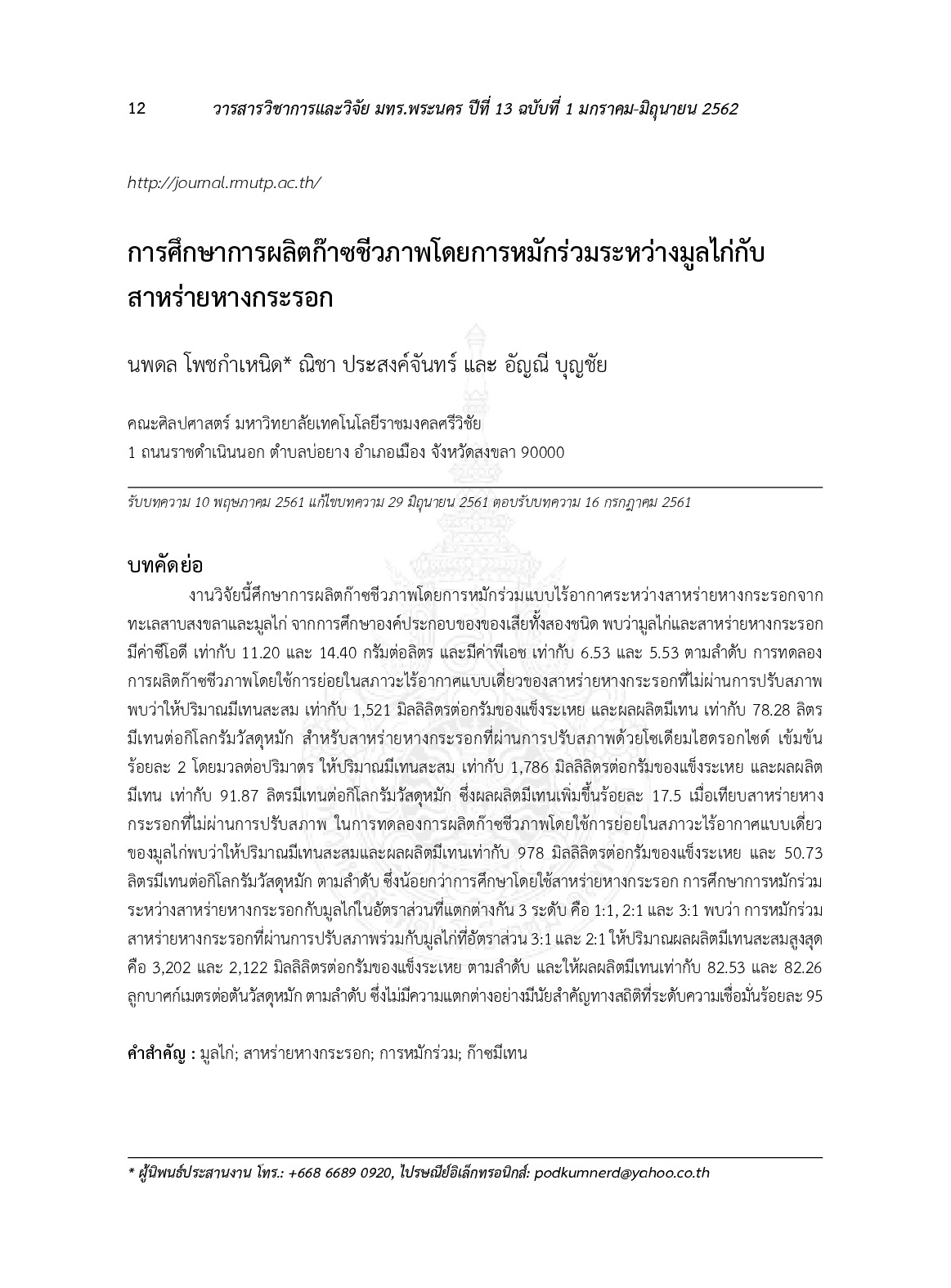
การศึกษาการผลิตก๊าซชีวภาพโดยการหมักร่วมระหว่างมูลไก่กับสาหร่ายหางกระรอก
This work presented the production of biogas using anaerobic co-digestion between hydrilla verticillata (HV) from Songkhla Lake Basin and chicken manure (CM). From the study of compositions of both wastes it was found that the COD of CM and HV were 11200 and 14400 mg/l and pH were 6.5 and 5.5 respectively. The biogas production using anaerobic single-digestion of untreated hydrilla verticillata (UHV) gave accumulative methane of 1251 ml-CH4/g-VS and methane production of 78.28 L-CH4/kg-substrate was obtained. For hydrilla treated with 2% w/v NaOH (THV) the accumulative methane was 1786 ml-CH4/g-VS and the obtained methane production was 91.87 L- CH4/kg-substrate which was 17.5 % increase when compared to the UHV. For the biogas production using anaerobic single-digestion of CM it was found that the accumulative methane and methane production were 978 ml-CH4/g-VS and 78.28 L- CH4/kgsubstrate respectively. These were lower than the studies using HV. The study of anaerobic co-digestion of HV and CM at three different ratios; 1:1 2:1 and 3:1 was studied. It was found that the anaerobic co-digestion using THV and CM at ratio 3:1 and 2:1 gave the highest potential for biogas production. The accumulate methane of 3202.20 and 2079.19 ml- CH4/g-VS were obtained respectively. The methane productions were 2.53 and 82.26 L-CH4/ton-substrate for ratio 3:1 and 2:1 respectively which is no significant different at 95 % confidence interval.