จำนวน Repository ( 207 )
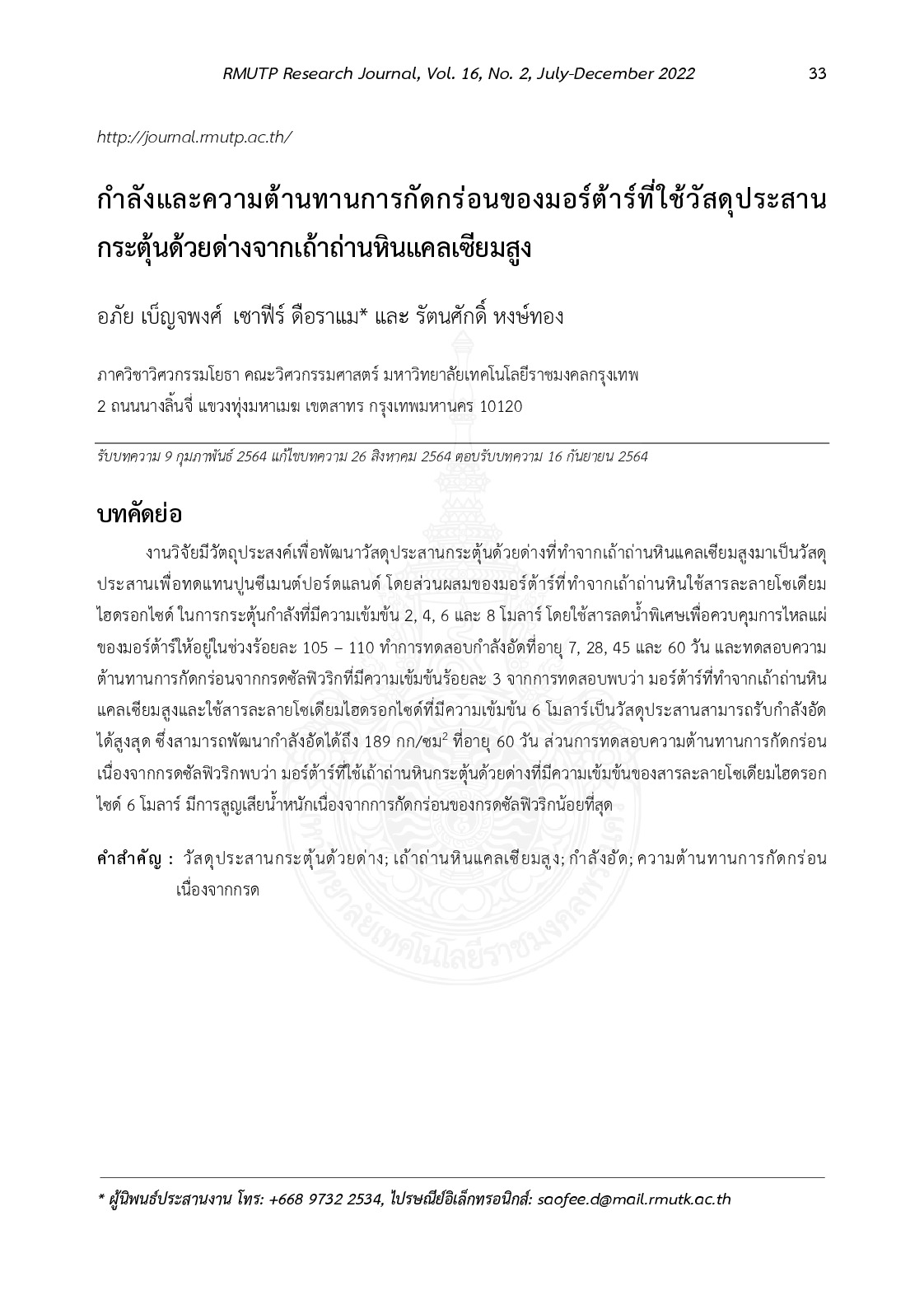
กำลังและความต้านทานการกัดกร่อนของมอร์ต้าร์ที่ใช้วัสดุประสานกระตุ้นด้วยด่างจากเถ้าถ่านหินแคลเซียมสูง
The aim of this study is developed of alkali activated high calcium fly ash to use as cementitious material to replace Portland cement. The mixture of mortar made from fly ash and sodium hydroxide solution (NaOH) was used to activate strength at concentrations of 2 4 6 and 8 molars. Superplasticizer was used to control the flow of mortar in the rage of 105 – 110. The compressive strength of mortar was determined at 7 28 45 and 60 days. The acid resistance of mortars due to sulfuric at a concentration of 3% were also investigated. The results showed the mortar made from high calcium fly ash with sodium hydroxide of 6 molar obtained the highest compressive strength which could be developed compressive strength up to 189 ksc at 60 days. For the acid resistance of mortar it was found that the of use 6 molar of NaOH activated high calcium fly ash binder had the least weight loss due to sulfuric acid attack.
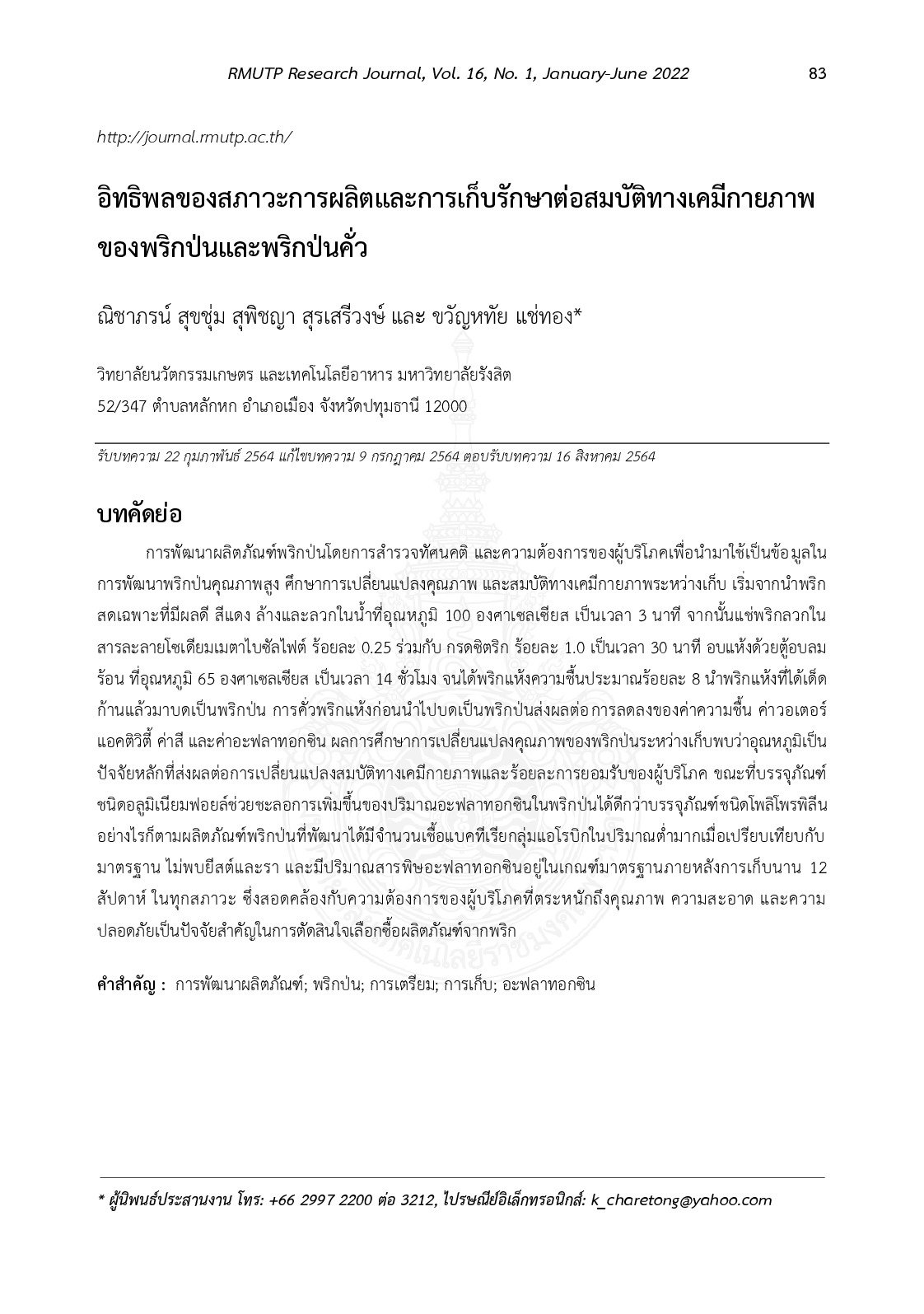
อิทธิพลของสภาวะการผลิตและการเก็บรักษาต่อสมบัติทางเคมีกายภาพของพริกป่นและพริกป่นคั่ว
Development of chili powder products through consumer survey to be used as the information for the development of high quality chili powder. The quality and physicochemical properties of chili powder during storage were investigated. The sound and red pods of fresh chili were washed and blanched at 100ºC for 3 min. Blanched chili pods were soaked in 0.25% sodium metabisulfite with 1.0% citric acid for 30 min prior to drying in a tray dryer at 65°C for 14 h to obtain dried chili with a final moisture content of approximately 8%. Dried chili pods without stem were ground to obtain chili powder. Roasting before grinding resulted in the reduction of moisture aw and color values. The results of study on the quality changes of chili powder during storage showed that storage temperature was the important factor affecting the changes in physicochemical properties and percentage of consumer acceptance. Meanwhile aluminum foil packaging slowed the increase of aflatoxin content in chili powder better than polypropylene. However aerobic bacterial count of the developed chili powder product is very low compared to the microbiological specifications while yeast and mold were not detected. The product contains a standard level of aflatoxin content after 12 weeks in all storage conditions which corresponds to the awareness of consumers in terms of quality cleanliness and safety are important factors in deciding to buy chili products.
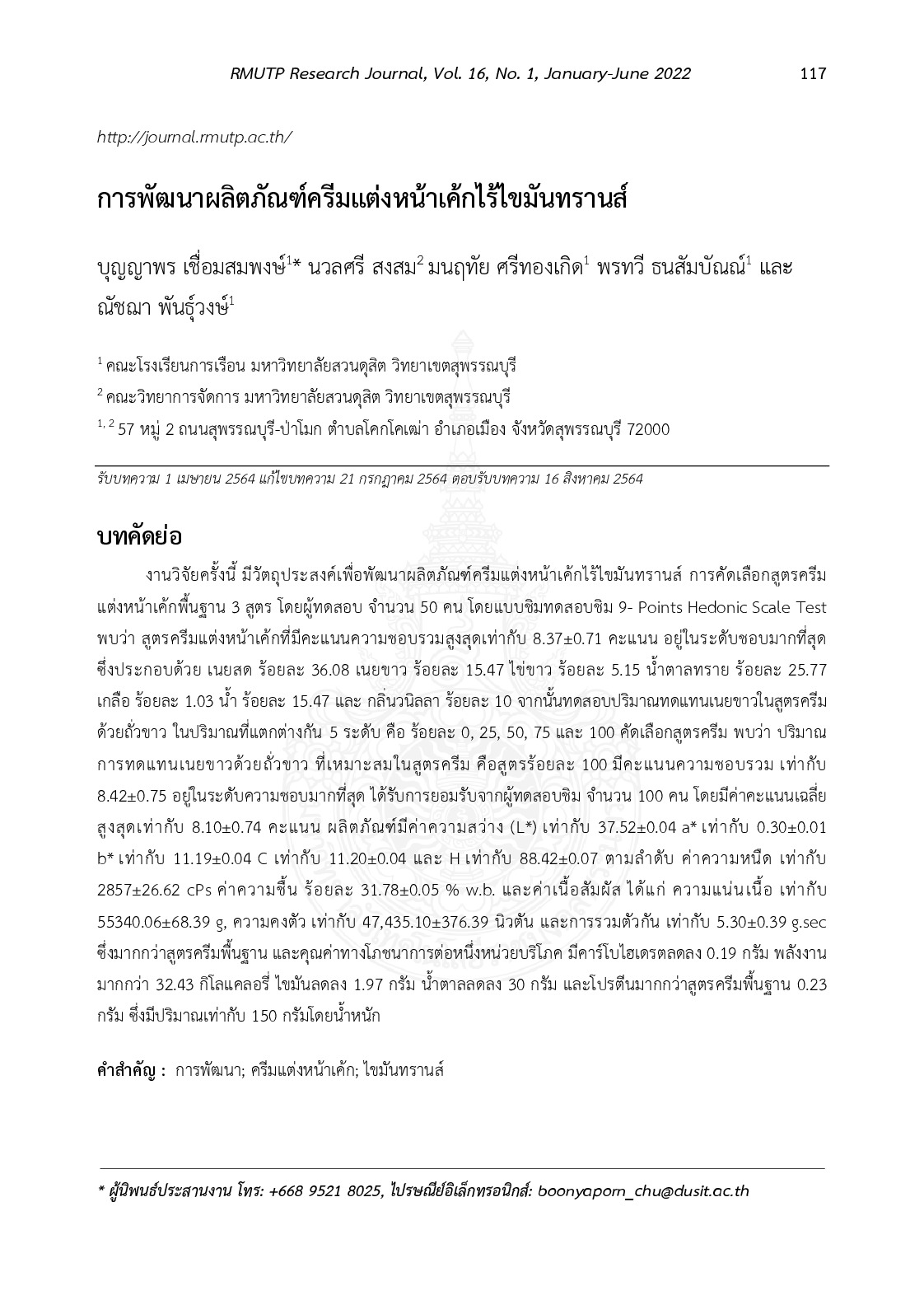
การพัฒนาผลิตภัณฑ์ครีมแต่งหน้าเค้กไร้ไขมันทรานส์
The objective of this research was to study the development of cake decorated cream without trans fat. selection of buttercream using as a standards recipe from 3 formulas 50 tasters by 9 Point Hedonic Scales Test. The formula using buttercream had 8.37±0.71 points at very like level was composed of butter 36.08 % shortening 15.47 % white egg 5.15 % sugar 25.77 % salt 1.03 % water 15.47 % and vanilla 10 %. Then substitute shortening with white kidney bean at 0 25 50 75 100 %. The 100% white kidney bean recipe was the highest acceptable 8.42±0.75 points at the very like level. The acceptance test with 100 consumers was 8.10±0.74 score at very like. The color of products showed L* a* b* C and H were 37.52±0.04 0.30±0.01 11.19±0.04 11.20±0.04 88.42±0.07 respectively The Viscosity was 2857±26.62 cPs Moisture was 31.78±0.05 w.b. Texture (Firmness) was 55340.06±68.39 g Consistency was 47435.10±376.39 N. and Cohesiveness was 5.30±0.39 g.sec which more than the standard recipe and nutritive values per one serving. Carbohydrates decrease at 0.19 gram Energy increase at 32.43 kilocalories Fat decrease at 1.97 gram Sugar decrease at 30 gram and more protein than the standard recipe with 0.23 gram. per serving at 150 g.
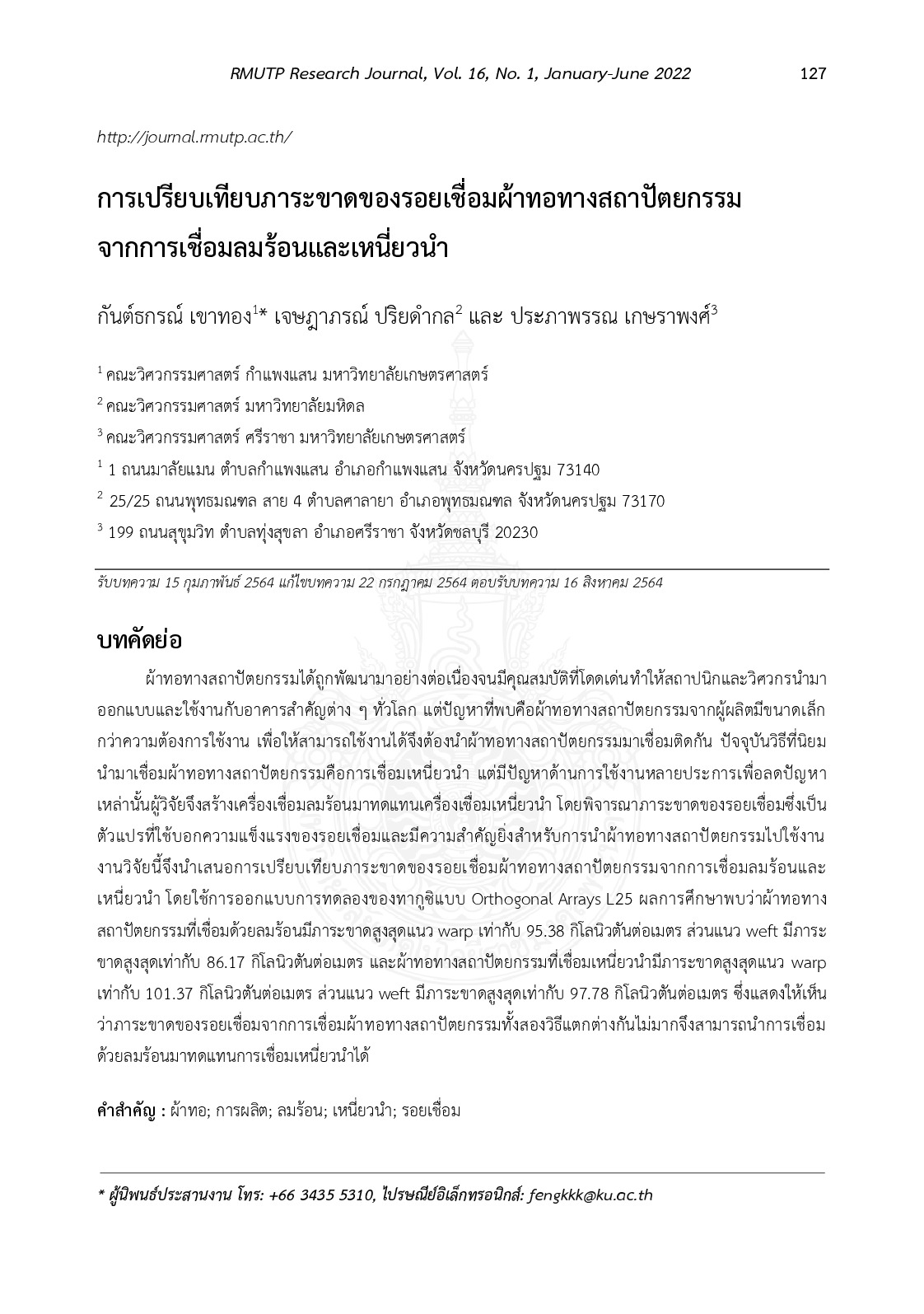
การเปรียบเทียบภาระขาดของรอยเชื่อมผ้าทอทางสถาปัตยกรรมจากการเชื่อมลมร้อนและเหนี่ยวนำ
Architectural fabrics were continuously developed on their unique performance. Architects and Engineers designed them for the application of important buildings around the world despite the symptom that Architectural fabric sizes from manufactures are smaller than the application sizes. Recently although the well-known method used to weld Architectural fabrics to enlarge their size is the high frequency welding there were some application issues. To mitigate those issues the researcher created the hot air welding to replace the high frequency welding in consideration on the failing loads of welded seams which are variable factors of the failing loads to indicate the weld strength and it is crucial for the Architectural fabric application. This research presents the comparison of failing load of weld seams between the hot air welding and high frequency welding by the test of Taguchis Orthogonal arrays L25 method. The test results demonstrated that Architectural fabrics welded by the hot air welding has the highest failing loads of wrap equal to 95.38 kN/m and the highest failing loads of weft at 86.17 kN/m. Conversely Architectural fabrics welded by the high frequency welding has the highest failing loads of wrap equal to 101.37 kN/m and the highest failing loads of weft at 97.78 kN/m. Based on a forementioned results there is no significant difference from both welding methods and thus concluded that the hot air welding could be used to replace the high frequency welding method.
การพัฒนาศักภาพและทักษะที่จำเป็นของกลุ่มคนทำงานภาคอุตสาหกรรมบริการ (การโรงแรมและการท่องเที่ยว) ในเขตกรุงเทพมหานคร
This research aims to analyze demand Necessary Skills and ways of collecting the credit to transfer into the education system of Service Industry Workers (Hospitality and Tourism) in Bangkok. The research results found 4 points that is; (1) career stability (2) knowledge (3) services (4) awareness and self-esteem value During the research process of training course curriculum found that there are three courses that is English training course for hospitality industry Excellent Services technique for customer impressive course using technology “Amadeus” system for booking and ticketing in tourism and hospitality industry. These courses become a set of learning handbook and trained to the target group service working to learn and have knowledge up-skilled and have a positive thinking to work in service industry. In term of earning credit from these courses into the education system in form of transfer credit by using knowledge and experiences the results from research seminar can be conclude into two ways (1) transfer credit from the course that has certificate or do not have any certificate still can transferred within the guarantee from institution (2)transfer credit from certified course should be specify with the exactly total houses studying or have a test and evaluate the learning outcomes from the courses.