จำนวน Repository ( 52 )

Comparison of PWM power rectifier between 6 pules and 12 pules converter topology
This paper presents a study of comparison of PWM power rectifier between 6 Pules and 12 Pules converter topology by small hydro turbine Generator (20kW) is power supply and Compare harmonics Current feed in the systems. Both converter connected Permanent Magnet Synchronous Generator (PMSG) and Voltage Regulator Control at 700 V. The control system by Decoupling Control and Conventional PI Control for control parameter PI value by Nicole-Ziegler method. Analysis for Performance of the system presented a mathematical model with Matlab/Simulink program. The result of simulation have value less than 5 percent of ripple voltage and Voltage Control continuously. Converter 12 pulse have harmonics Current value feed in the systems less than converter 6 pulse. This Case study can apply using PWM power rectifier control in future work
Graphical method and database development for computer programming to reinforced concrete slab analysis and design
This research was to apply graphical method as the input data combined with using database for developing reinforced concrete slab analysis and design. Visual Basic language was used for creating the GUI (graphic user interface) and coding and database file was used for storing data. The position of beam column and slab can define by drawing on GUI and this program will automatic translate to be the distances for using as data in process of analysis and slab design. Results from analysis and design were compared with manual calculation that they are a litter bit error because of rounding error. Moreover they can be more economically and more conveniently than results from VisStructure 4
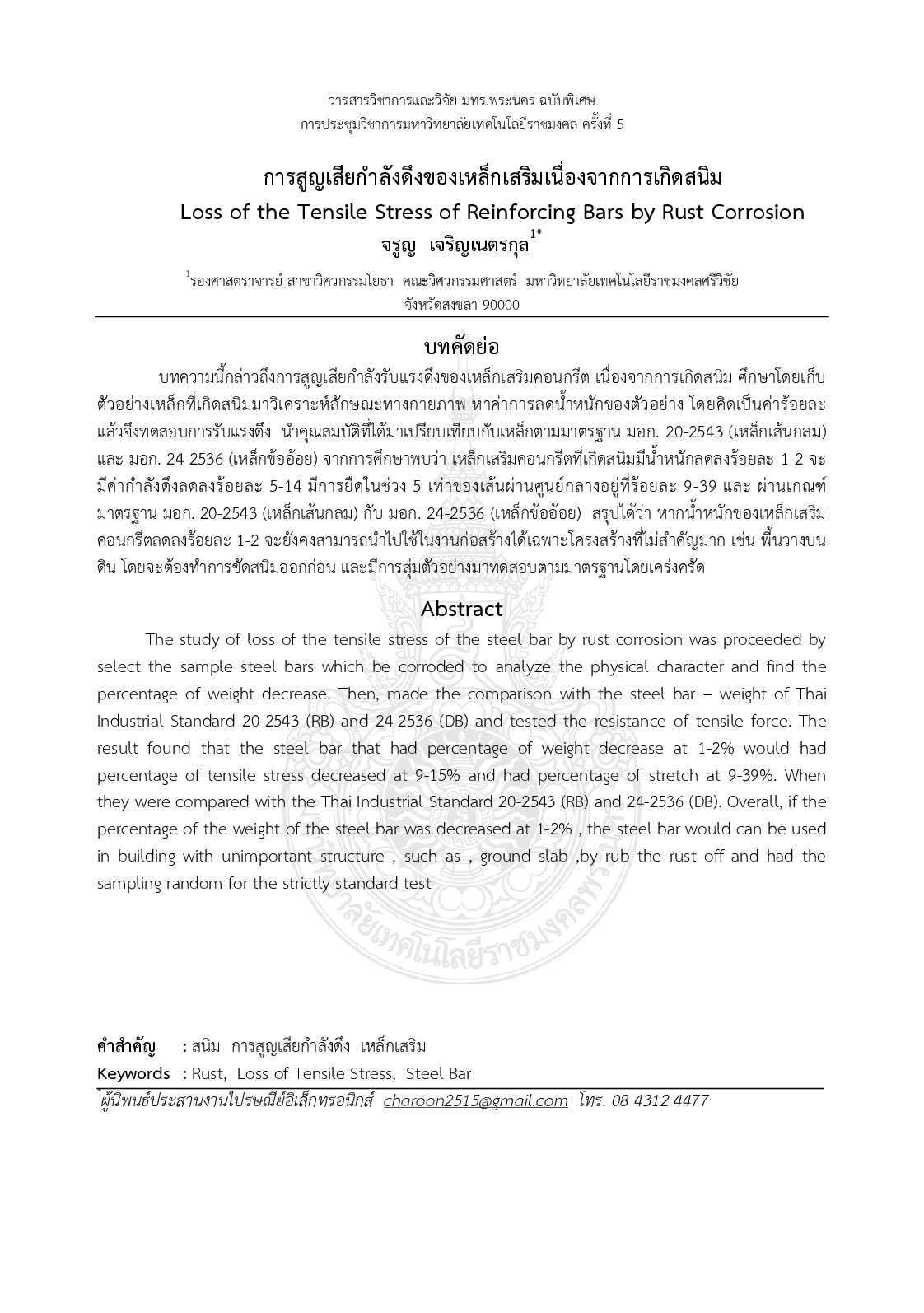
Loss of the tensile stress of reinforcing bars by rust corrosion
The study of loss of the tensile stress of the steel bar by rust corrosion was proceeded by select the sample steel bars which be corroded to analyze the physical character and find the percentage of weight decrease. Then made the comparison with the steel bar – weight of Thai Industrial Standard 20-2543 (RB) and 24-2536 (DB) and tested the resistance of tensile force. The result found that the steel bar that had percentage of weight decrease at 1-2% would had percentage of tensile stress decreased at 9-15% and had percentage of stretch at 9-39%. When they were compared with the Thai Industrial Standard 20-2543 (RB) and 24-2536 (DB). Overall if the percentage of the weight of the steel bar was decreased at 1-2% the steel bar would can be used in building with unimportant structure such as ground slab by rub the rust off and had the sampling random for the strictly standard test
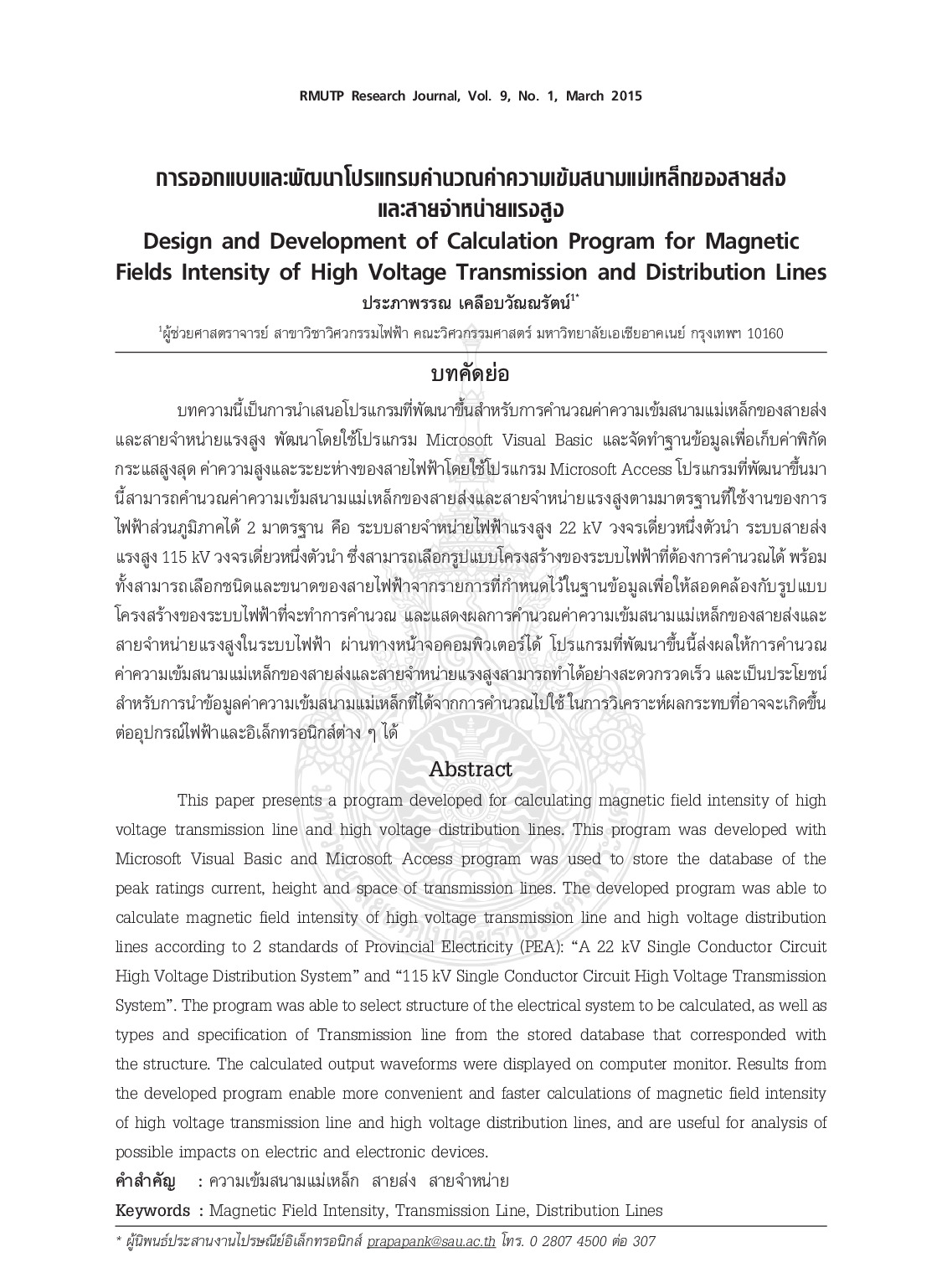
Design and development of calculation program for magnetic fields intensity of high voltage transmission and distribution lines
This paper presents a program developed for calculating magnetic field intensity of high voltage transmission line and high voltage distribution lines. This program was developed with Microsoft Visual Basic and Microsoft Access program was used to store the database of the peak ratings current height and space of transmission lines. The developed program was able to calculate magnetic field intensity of high voltage transmission line and high voltage distribution lines according to 2 standards of Provincial Electricity (PEA): “A 22 kV Single Conductor Circuit High Voltage Distribution System” and “115 kV Single Conductor Circuit High Voltage Transmission System”. The program was able to select structure of the electrical system to be calculated as well as types and specification of Transmission line from the stored database that corresponded with the structure. The calculated output waveforms were displayed on computer monitor. Results from the developed program enable more convenient and faster calculations of magnetic field intensity of high voltage transmission line and high voltage distribution lines and are useful for analysis of possible impacts on electric and electronic devices.
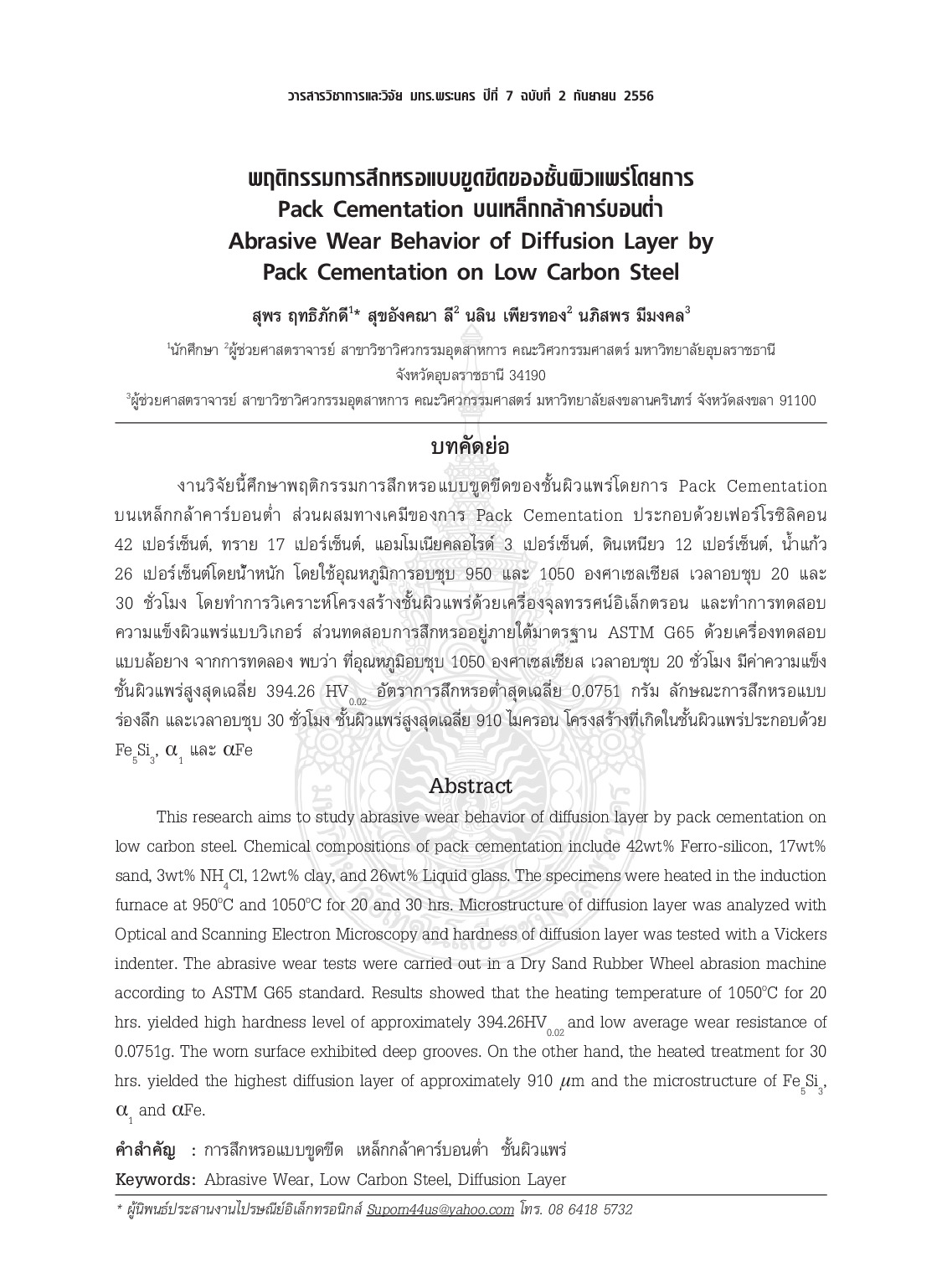
Abrasive wear behavior of diffusion layer by Pack Cementation on low carbon steel
This research aims to study abrasive wear behavior of diffusion layer by pack cementation on low carbon steel. Chemical compositions of pack cementation include 42wt% Ferro-silicon 17wt% sand 3wt% NH4Cl 12wt% clay and 26wt% Liquid glass. The specimens were heated in the induction furnace at 950?C and 1050?C for 20 and 30 hrs. Microstructure of diffusion layer was analyzed with Optical and Scanning Electron Microscopy and hardness of diffusion layer was tested with a Vickers indenter. The abrasive wear tests were carried out in a Dry Sand Rubber Wheel abrasion machine according to ASTM G65 standard. Results showed that the heating temperature of 1050?C for 20 hrs. yielded high hardness level of approximately 394.26HV0.02 and low average wear resistance of 0.0751g. The worn surface exhibited deep grooves. On the other hand the heated treatment for 30 hrs. yielded the highest diffusion layer of approximately 910?m and the microstructure of Fe5Si3 ?1 and ?Fe.