จำนวน Repository ( 97 )
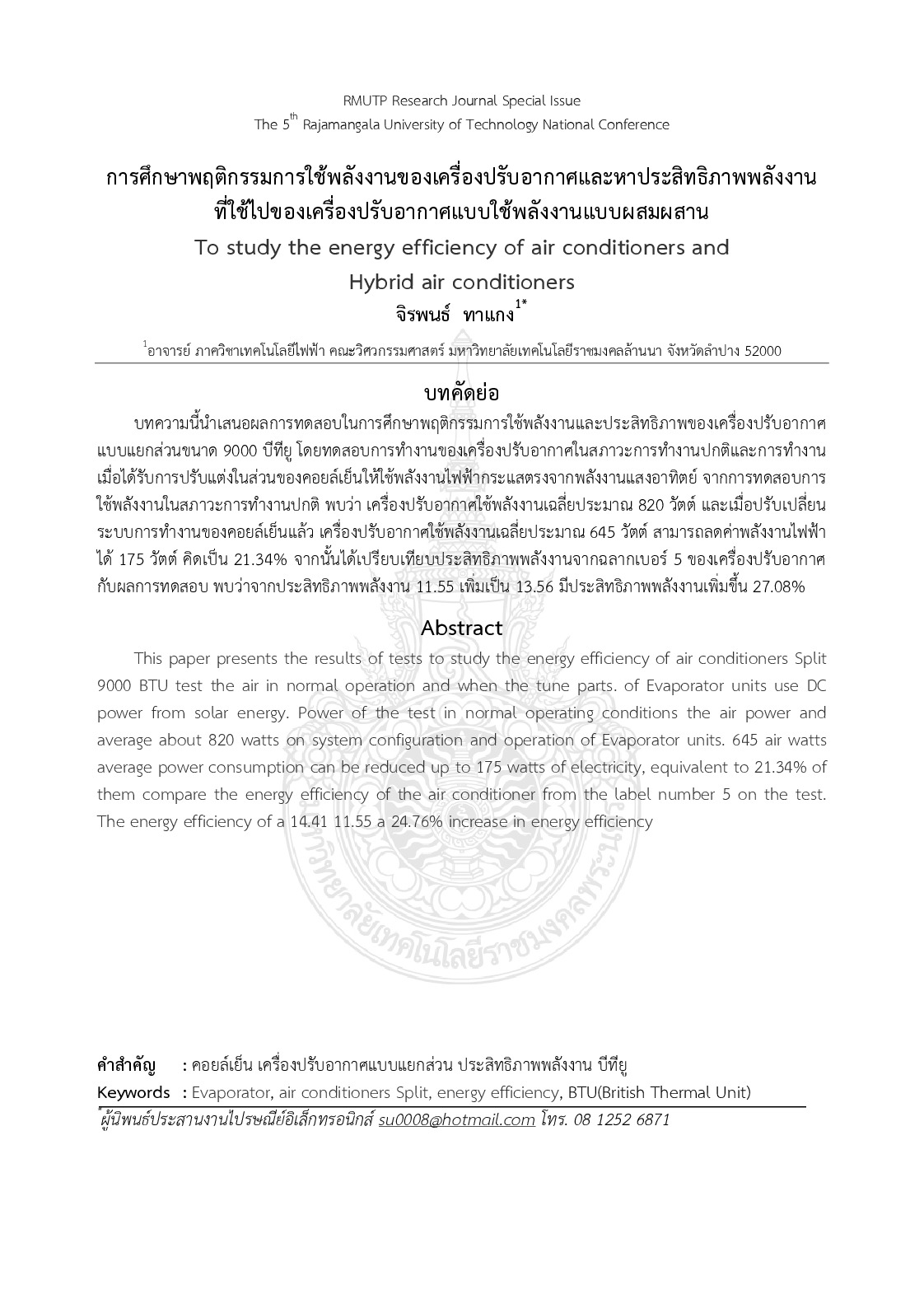
To study the energy efficiency of air conditioners and hybrid air conditioners
This paper presents the results of tests to study the energy efficiency of air conditioners Split 9000 BTU test the air in normal operation and when the tune parts. of Evaporator units use DC power from solar energy. Power of the test in normal operating conditions the air power and average about 820 watts on system configuration and operation of Evaporator units. 645 air watts average power consumption can be reduced up to 175 watts of electricity equivalent to 21.34% of them compare the energy efficiency of the air conditioner from the label number 5 on the test. The energy efficiency of a 14.41 11.55 a 24.76% increase in energy efficiency
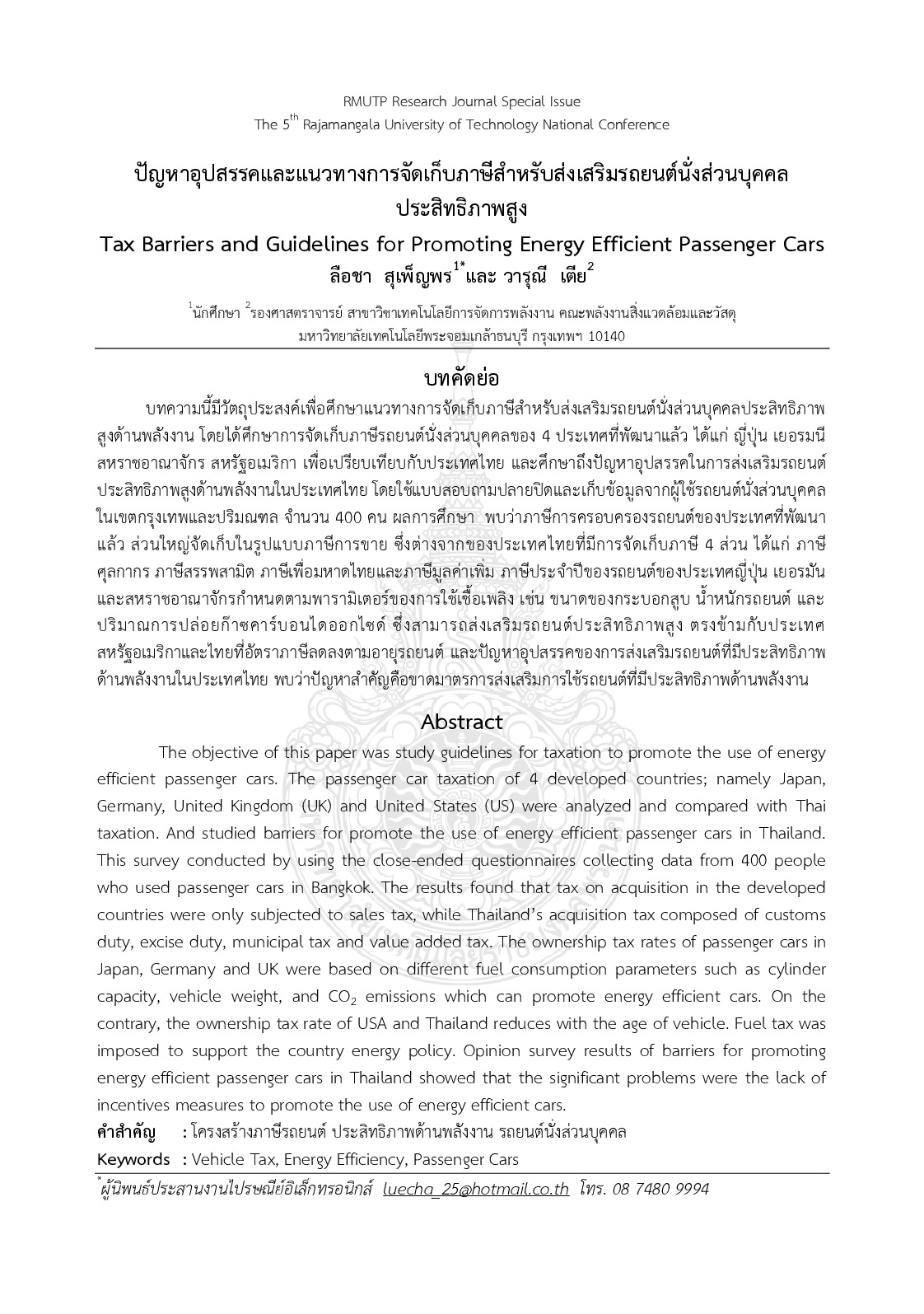
Tax barriers and guidelines for promoting energy efficient passenger cars
The objective of this paper was study guidelines for taxation to promote the use of energy efficient passenger cars. The passenger car taxation of 4 developed countries; namely Japan Germany United Kingdom (UK) and United States (US) were analyzed and compared with Thai taxation. And studied barriers for promote the use of energy efficient passenger cars in Thailand. This survey conducted by using the close-ended questionnaires collecting data from 400 people who used passenger cars in Bangkok. The results found that tax on acquisition in the developed countries were only subjected to sales tax while Thailand’s acquisition tax composed of customs duty excise duty municipal tax and value added tax. The ownership tax rates of passenger cars in Japan Germany and UK were based on different fuel consumption parameters such as cylinder capacity vehicle weight and CO2 emissions which can promote energy efficient cars. On the contrary the ownership tax rate of USA and Thailand reduces with the age of vehicle. Fuel tax was imposed to support the country energy policy. Opinion survey results of barriers for promoting energy efficient passenger cars in Thailand showed that the significant problems were the lack of incentives measures to promote the use of energy efficient cars.
การศึกษาและพัฒนาเครื่องอบกระดาษใบสับปะรดพลังงานแสงอาทิตย์ร่วมกับฮีตเตอร์
This research was aimed to investigate for pineapple leaf paper drying. In this study process of drying the paper as a final step after the other. Paper drying time takes in solar energy to dry naturally for at least 2-3 days or more without natural sunshine. Solar hybrid energy dryer was designed for drying faster than traditional drying. The development of solar hybrid energy dryer ability to operate continuously. The solar dryer receives the heat from sunshine by passing into the solar panel dimension 1 x 2.6 m2 . The panel was installed on the top of the oven which declined 15 degree from the ground. The dimension of the oven is 1 x 1.05 x 1.30 m3 and have added heat to paraphrase another 2 rooms and heater 4 kW with controller and have added heat to paraphrase another 2 rooms. The dryer installed heater 4 kW with temperature controller and blower 0.22 kW serves as the circulation of heat in the oven to constant flow of 0.138 m3 / s. Experiment research test 3 types ; the use of solar energy alone the use of solar heater with a temperature of 50 55 and 60 °C and the heater only at 50 55 and 60 °C with three temperature settings. The variables in the study such as temperature humidity in the dryer humidity and Solar energy affect the pineapple leaf paper drying time. Experimental results from solar heater hybrid with 60 °C temperature setting was dried in minimum period of 3 hours and half at an average initial moisture content 1043.70% db to the final moisture content of 9.12% db. Highest average temperature in the dryer was 64.33 °C with electrical energy consumption 10.5 kWh. The use of only solar drying was dried in maximum period of 5 hours at an average initial moisture content 1070.98% db to the final moisture content of 15.84% db. Highest average temperature in the dryer was 39.89 °C with minimum electrical energy consumption 10.5 kWh.

Potential energy of the fuel briquettes from mangosteen shell
The objective of this research is to use mangosteen shell that from household wastes for produce the fuel briquette. This fuel is used in terms of renewable energy which instead of firewood and charcoal from natural forest. We used the adhesive paste as a binder and briquette with hand pack filler. The results showed that the mangosteen shell can be burned to charcoal black and lightweight. By grinding mangosteen charcoal into small size these charcoals were mixing with the paste. We have to compress the mixing charcoal molded into fuel briquettes. These briquettes are performed the stable and non-broken products. After sun drying the results of potential energy testing showed that the calorific value 5920 cal/g combustion rate 11.8 g/min fixed carbon content 61.7% and ash content 7%. For the combustion efficiency testing our fuel briquette could be performed cooking as well non-explosion high combustible non-soot non-smoke and non-odors during used. These fuel briquettes are suitable for fuel products in household community or commercial production and industrial. Due to these advantages our briquettes are possibly to instead of firewood and charcoal from natural forest which can be reduced the global warming by another way.