จำนวน Repository ( 51 )

การวิเคราะห์โครงสร้างรถยนต์ไฟฟ้า ของมหาวิทยาลัยเทคโนโลยีราชมงคลพระนครด้วยวิธีการไฟไนต์เอลิเมนต์
The objective of research was to study and analysis the Electric vehicle structure of Rajamangala University of Technology Phra Nakhon. The Electric vehicle designed to save energy protect environment and cognitive development of student by used the computer software help in the design Material selection Finite Element Analysis Appropriability of the Electric Vehicle Structure and di s p l a c e m e n t of the vehicle structure by using the computer program help in the calculation for the Finite Element Method including to the development of engineering skill. The research must to create the Electric vehicle prototype to suitable and the structure have lightweight and strong for the electric vehicle and focuses on energy efficiency and the material of structure used steel pipe. This research can use to other working structure and future vehicle in sustainable. The vehicle has two seats Capable of running speed to 0-80 km/h the weight at the vehicle structure not over 1 0 0 kg. And the material of structure used steel pipe. This researching can use to other working structure and future vehicle in the sustainable.
การวิเคราะห์คุณลักษณะความเสียหายและผลที่ตามมาของความชำรุด ของสลักปากขอพ่วง ที่ใช้สาหรับรถบรรทุกสินค้าในการรถไฟแห่งประเทศไทย
Freight is major source of income of the State Railway of Thailand (SRT); which had revenues of one billion baht a year. The development of freight by rail system to be fart punctual and safe is important. Knuckle pin serves tension and shear stress in pulling Rolling Stock. Strength testing of Knuckle pin must be done by technical and engineering knowledge. SRT has 6000 Rolling Stocks; that means 6000 Knuckle Pin has been used and it is likely to increase due to the construction of the Double Track Project and the purchase of new Rolling Stocks. The efficient Knuckle Pin prolongs lifespan and SRT would have benefit on saving cost of maintenance and increase safety in the transportation of goods. This research is aimed at creating the understanding about the quality of the Knuckle Pin modeled Nat Mall. The pin would be test by Standard Test Methods for Tension Testing of Metallic Materialsand the Standard Test Method for Analysis of Carbon and Low-Alloy Steel by Spark Atomic Emission Spectrometry and Hardness Testing Machine and Microstructureto determine the cause of pin’s damage. This study will contribute the standardization of the quality of the Knuckle Pin which is used in Rolling Stocks of SRT.
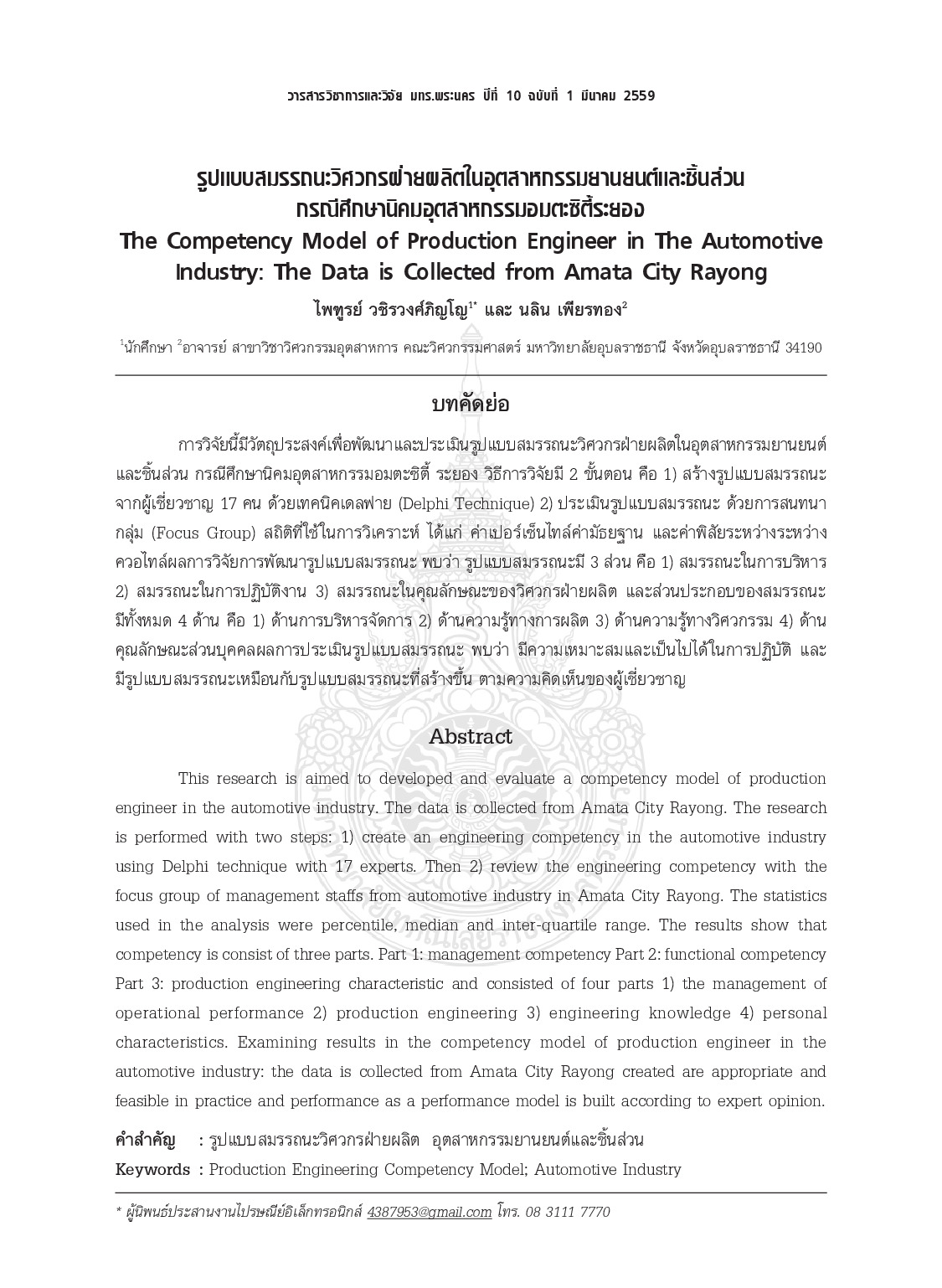
รูปแบบสมรรถนะวิศวกรฝ่ายผลิตในอุตสาหกรรมยานยนต์และชิ้นส่วน กรณีศึกษานิคมอุตสาหกรรมอมตะซิตี้ระยอง
This research is aimed to developed and evaluate a competency model of production engineer in the automotive industry. The data is collected from Amata City Rayong. The research is performed with two steps: 1) create an engineering competency in the automotive industry using Delphi technique with 17 experts. Then 2) review the engineering competency with the focus group of management staffs from automotive industry in Amata City Rayong. The statistics used in the analysis were percentile median and inter-quartile range. The results show that competency is consist of three parts. Part 1: management competency Part 2: functional competency Part 3: production engineering characteristic and consisted of four parts 1) the management of operational performance 2) production engineering 3) engineering knowledge 4) personal characteristics. Examining results in the competency model of production engineer in the automotive industry: the data is collected from Amata City Rayong created are appropriate and feasible in practice and performance as a performance model is built according to expert opinion.
การวิเคราห์ความน่าเชื่อถือได้ในการทำงานของเครื่องจักร และหาสาเหตุของเครื่องจักรเสีย: กรณีศึกษาโรงงานผลิตชิ้นส่วนรถยนต์
This research proposes reliability analysis in order to find the probability that a machine will work properly the failure rates of a machine and the factors related to the failure rates. The data were collected from 8 types of machines in an autoparts manufacturing factory. They consist of the times measured from the first day of the study until the machine produces defective product workers and production steps. The study duration is 90 days. The results show that the probability that the machine type 4 will work properly more than days is 0.40 machine type 5 more than 68 days is 0.32 machine type 6 more than 72 days is 0.31 machine type 8 more than 85 days is 0.26 machine type 9 more than 109 days is 0.80 machine type 10 at more than 52 days is 0.38 machine type 11 more than 71 days is 0.32 and the probability that the machine type 12 will work properly more than 85 days is 0.26. The failure rate of the machine type 4 at day 51 is 6.61 machine type 5 at day 68 is 1.61 machine type 6 at day 72 is 0.77 machine type 8 at day 85 is 1.26 machine type 9 at day 109 is 1.31 machine type 10 at day 52 is 0.92 machine type 11 at day 71 is 1.24 and the failure rate of the machine type 12 at day 85 is 2.15. The factors influencing on the failure rates are worker group 2 and production step 3 at the significance of 0.05.
Knowledge and management of software requirements
In software engineering requirements from customers users and stakeholder are initial information for software development process. The requirements elicited and gained are defined classified refined and stored systematically according to needs management principles. Therefore the requirements would be correct and ready to be used in the next step of development process. This process is called Software Requirements Engineering. If the gained software requirements are incorrect lack quality or are managed unsystematically they could lead to project failure and low-quality software product which cannot meet the needs of users and stakeholders. For these reasons this article proposed an overview of software requirements and an approach for software requirements management level of software requirements quality of software requirements and understanding of quality aspect common problems of requirements elicitation and awareness of impact and damage due to incorrect or low quality requirements. Success factors of software requirements management and 1-10-100 rules are also discussed. Finally the article addresses roles and goals of software requirements management team.