จำนวน Repository ( 96 )
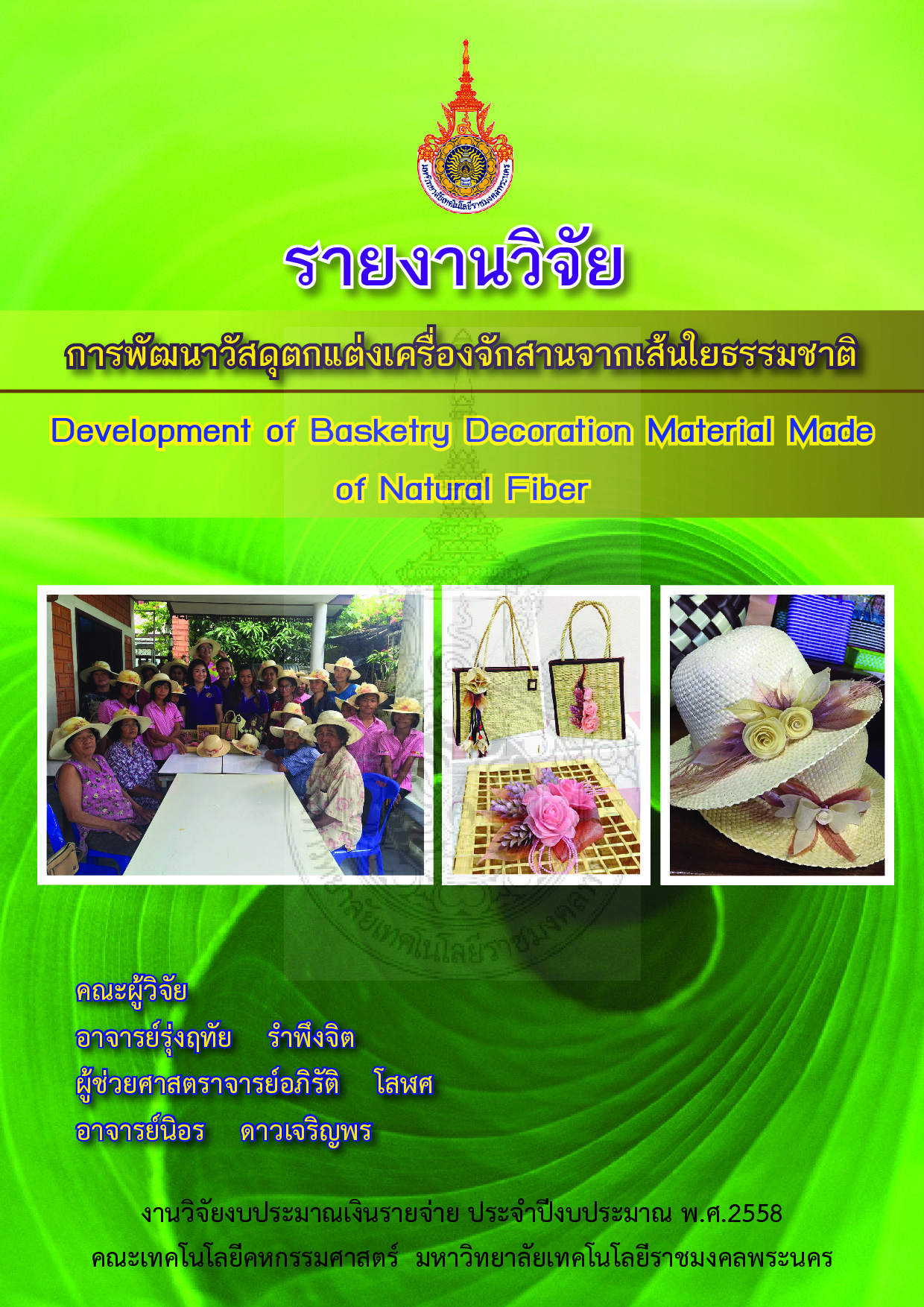
การพัฒนาวัสดุตกแต่งเครื่องจักสานจากเส้นใยธรรมชาติ
The study was aimed to investigate the production of banana fiber that was suitable for decorating handicraft basketry examine its effectiveness develop decorative handicraft materials for basketry from fibrous layer on the trunk of the banana tree and promote the obtained knowledge in the community of Plasticseeroong Baanmor Promburi District Singburi Province. The research result could be summarized that the most appropriate production process of dry fibrous layer on the trunk of the banana tree mixed with fibrous layer of paper mulberry was done through mechanical process. After bleaching the mixed fibrous layer was stirred by Hollander beater with the proportion of wet fibrous layer and water at 1:40; 10% of dry of paper mulberry was boiled for three hours in sodium hydroxide at 100 degree Celsius then bleached with 1.5% of hydrogen peroxide with 4% of the dry fibrous layer weight at 90 to 95 degree Celsius for two hours. The mixture of wet fibrous layer on the trunk of the banana tree with wet fibrous layer of paper mulberry was 70:30 which was considered appropriate for decorating handicraft basketry. Concerning the examination of mechanical properties of banana tree fibrous layer according to the standard of TAPPI T it was found that the folding endurance of paper value was 144 (N. m/g); the tensile strength value was 32.16 (N. m/g); the tear resistance value was 26.56 (mN.m2/g); and the bursting strength value was at 1.94 (KPa.m2/g). The fibrous layer obtained from on the trunk of the banana tree was fabricated into decorative basketry materials for example flowers palm leave hats flower key chains bags and paraffin coated flowers for bamboo boxed. The attendants’ satisfaction on the training of the production of decorative handicraft materials of basketry from fibrous layer on the trunk of the banana tree to 30 members of the community of Plasticseeroong Baanmor Promburi District Singburi Province concerning the training service speakers training procedures facilities and training benefits was at high level (90.67%) and at average level (9.33%).
เส้นใยสององค์ประกอบ : ชนิด การผลิต และการนำไปใช้
Bicomponent fiber is a specific type of synthetic fibers with two different properties of polymers joined together in the same filament during spinning process. Bicomponent fibers have distinctive properties from monocomponent fibers. The properties of fibers are outcomes of type of cross section properties of composed polymers fiber spinning process condition and after-treatment process. The primary applications of bicomponent fibers are self-crimping (or self-bulkiness) fibers thermal binder fibers microfibers and special property fibers which can be added into the shealth of fiber. The fiber processing types and applications of bicomponent fibers are summerised and stated in this paper.
การใช้ขุยมะพร้าวเพื่อเสริมความต้านทานแรงดึงของผลิตภัณฑ์แผ่นยางธรรมชาติ
This research aims to study the properties of natural rubber STR 20 at 100 phr with various contents of coir (e.g. 0 5 10 20 40 and 80 phr) and then mixed with chemical substance at constant ratio. After that the samples are ground by two-roll mill and formed by compression molding at 150 degree Celsius. This leads into the coir reinforcement natural rubber plate of dimension 30x30x0.5 cm. The properties of the natural rubber plates are tested under ASTM standard. From the results it is found that increasing in coir then the properties of resilience and density are improved at every mix ratio. However the tensile strength tear strength and wearing are increased at some certain value of coir. The samples give no water absorption at every mix ratio. The results from this research indicate that it can develop into the rubber floor tiles and rubber wall tiles for furnishing the buildings in natural style.
การพัฒนาวัสดุตกแต่งเครื่องจักสานจากเส้นใยธรรมชาติ
The purpose of this research was to investigate the development of basketry decoration material made of natural fiber by studying (1) the process of papermaking made of Typha Angustifolia fiber mixed with banana fiber (2) the development of the prototype of basketry decoration material made of natural fiber and (3) the target group’s comments on the prototype of basketry decoration material made of natural fiber. banana fiber the researchers (1) studied the process of paper making by handcraft method without using chemicals (2) used fiber preparation as the digestion of raw material with mechanical process by crushing the raw material into fiber and (3) studied the proper proportion of fibers for paper-making process which had 3 formulas. The researchers found out that the third formula suited best for making paper made of natural fiber in order to use in the production of basketry decoration material and also for making basketry decoration material made of natural fiber. The proportion of the third formula was (1) 20 grams of Typha Angustifolia leaves (2) 30 grams of banana tree (3) 20 grams of paper pulp and (4) 3 liters of waters. Then the researchers studied the comments of target group received from fifty people. 95% of the target group were satisfied with the beauty of basketry decoration material made of natural fiber 95% were satisfied with the usage of products as a sample for the production of other art forms 95 % were satisfied with the product’s weight which was suitable 95% were satisfied with the usage of Typha Angustifolia leaves and banana fiber in production 95% were satisfied with the property of product distribution. 90% were satisfied with the convenience of the product usage 90% were satisfied with the surface of the product and 80% were satisfied with the durability of product.

การพัฒนาแผ่นใยไม้อัดซีเมนต์จากาการประยุกต์ใช้เส้นใยธรรมชาติจากกากมะพร้าวและต้นข้าวโพด
This research aims to study the application of coconut meal and corncob fiber as high density cement-bonded fiberboard. The cement: fine sand: coconut meal and corncob fiber: water: cement setting accelerator (aluminium sulphate (Al2(SO4)3) calcium chloride (CaCl2) sodium silicate (Na2SiO3)) ratio is equal to 1: 0.2: 0.05: 0.3: 0.03 by weight. The fibers are taken from coconut meal: corncob that 5 ratios are used following: 0.0500: 0 (CN0) 0.0375: 0.0125 (CN25) 0.0250: 0.0250 (CN50) 0.0125: 0.0375 (CN75) and 0: 0.0500 (CN100) by weight. 12% of Sodium Hydroxide (NaOH) was used to modify the fibers by using 1: 10 of fiber: solution and boiling 100 degree of Celsius (1-3 hours). The fiberboard production use pressure casting in normal temperature (30 – 35 degree of Celsius) and 0.75 g/cm3 of density. Resulting the CN75 ratio is suitable ratio which pass TIS 878-2537 standard (cement bonded particle board: high density) and has good physical properties mechanical properties and thermal insulation. The most suitable cement setting accelerator is calcium chloride (CaCl2).