จำนวน Repository ( 171 )
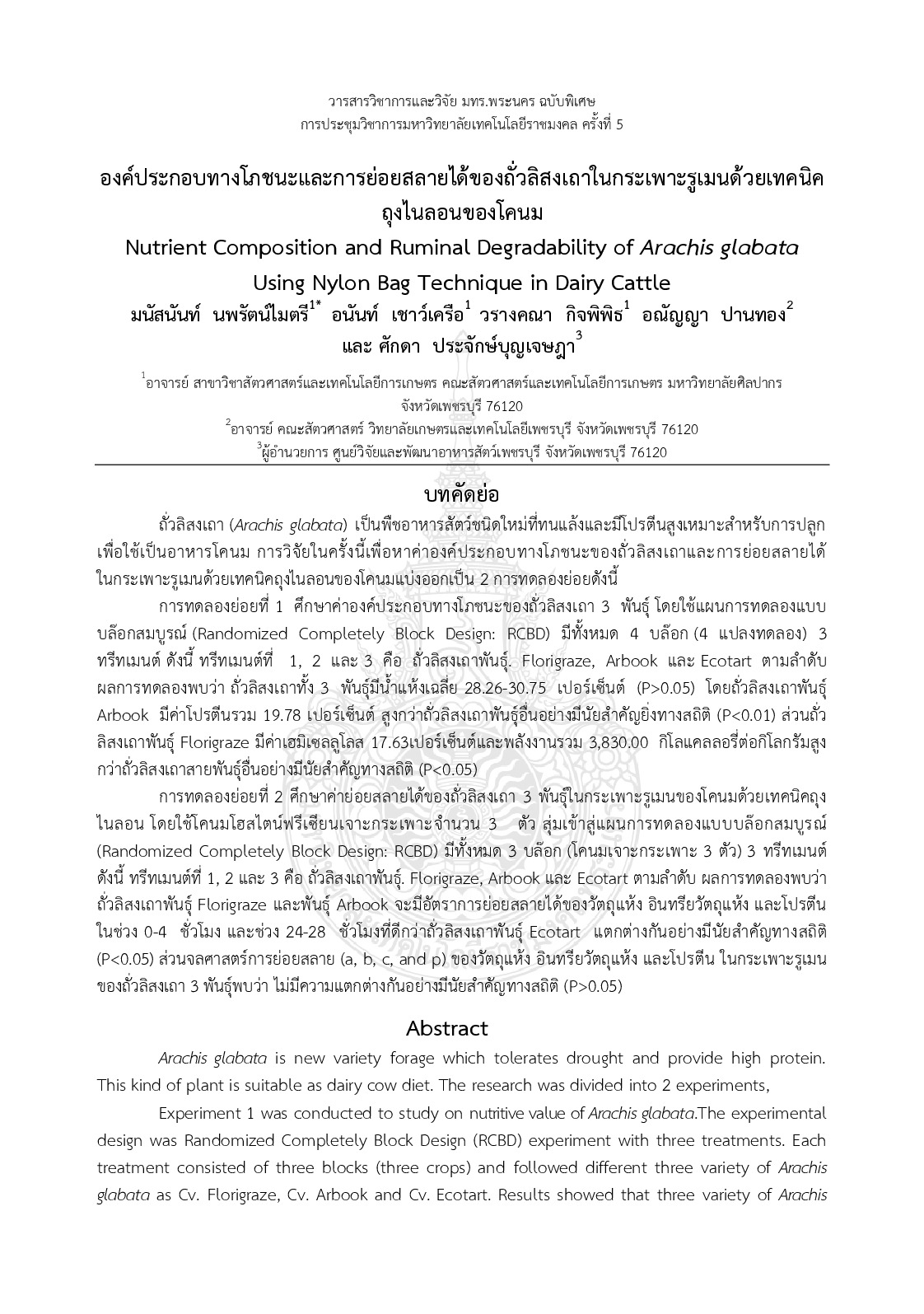
Nutrient composition and ruminal degradability of arachis glabata using nylon bag technique in dairy cattle
Arachis glabata is new variety forage which tolerates drought and provide high protein.This kind of plant is suitable as dairy cow diet. The research was divided into 2 experiments Experiment 1 was conducted to study on nutritive value of Arachis glabata.The experimental design was Randomized Completely Block Design (RCBD) experiment with three treatments. Each treatment consisted of three blocks (three crops) and followed different three variety of Arachis glabata as Cv. Florigraze Cv. Arbook and Cv. Ecotart. Results showed that three variety of Arachis glabata were 28.26-30.75 % of dry matter (P>0.05). In addition Arachis glabata Cv. Arbook was grater 19.78 % of protein than other group of Arachis glabata (P<0.01). Furthermore Arachis glabata Cv. Florigraze was grater 17.63 of hemicelluloses and 3830.00 kcal/kg of gross energy significant different among other group of Arachis glabata (P<0.05). Experiment 2 was conducted to study on ruminal degradability of Arachis glabata using In situ technique in dairy cattle. The experimental design was Randomized Completely Block Design (RCBD) experiment with three treatments. Each treatment consisted of three blocks (three ruminally fistulated dairy cattle) and followed different three variety of Arachis glabata as Cv. Florigraze Cv. Arbook and Cv. Ecotart. Results showed that Arachis glabata Cv. Florigraze and Arachis glabata Cv. Arbook was grater dry matter organic matter and protein degradability at 0-4 hour and 24-28 hour than Arachis glabata Cv Ecotart (P<0.05). In addition kinetic of degradation (a b c and p) of dry matter organic matter and protein were not significant different (P>0.05) among three variety of Arachis glabata.
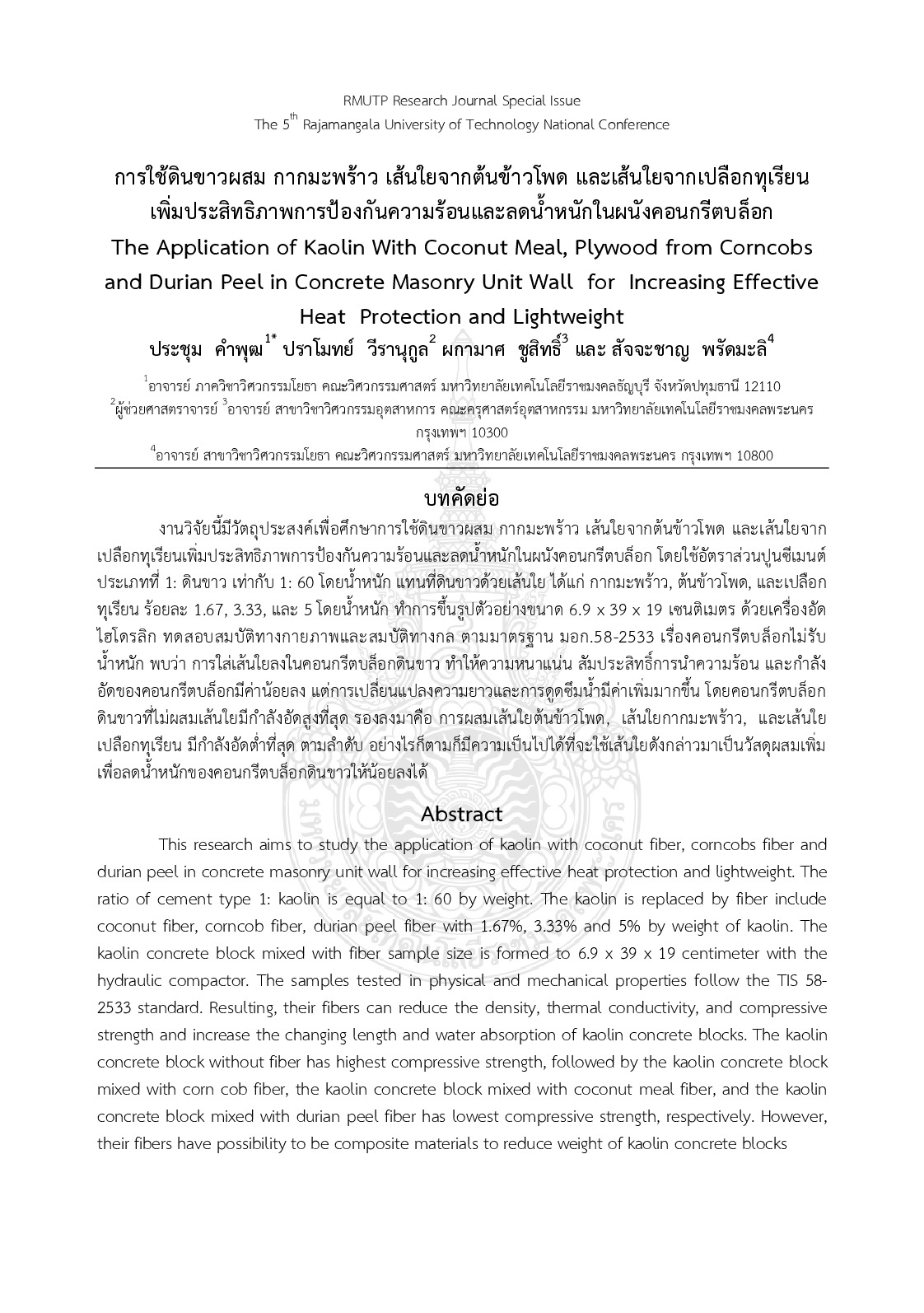
The application of kaolin with coconut meal, plywood from corncobs and durian peel in concrete masonry unit wall for increasing effective heat protection and lightweight
This research aims to study the application of kaolin with coconut fiber corncobs fiber and durian peel in concrete masonry unit wall for increasing effective heat protection and lightweight. The ratio of cement type 1: kaolin is equal to 1: 60 by weight. The kaolin is replaced by fiber include coconut fiber corncob fiber durian peel fiber with 1.67% 3.33% and 5% by weight of kaolin. The kaolin concrete block mixed with fiber sample size is formed to 6.9 x 39 x 19 centimeter with the hydraulic compactor. The samples tested in physical and mechanical properties follow the TIS 58-2533 standard. Resulting their fibers can reduce the density thermal conductivity and compressive strength and increase the changing length and water absorption of kaolin concrete blocks. The kaolin concrete block without fiber has highest compressive strength followed by the kaolin concrete block mixed with corn cob fiber the kaolin concrete block mixed with coconut meal fiber and the kaolin concrete block mixed with durian peel fiber has lowest compressive strength respectively. However their fibers have possibility to be composite materials to reduce weight of kaolin concrete blocks
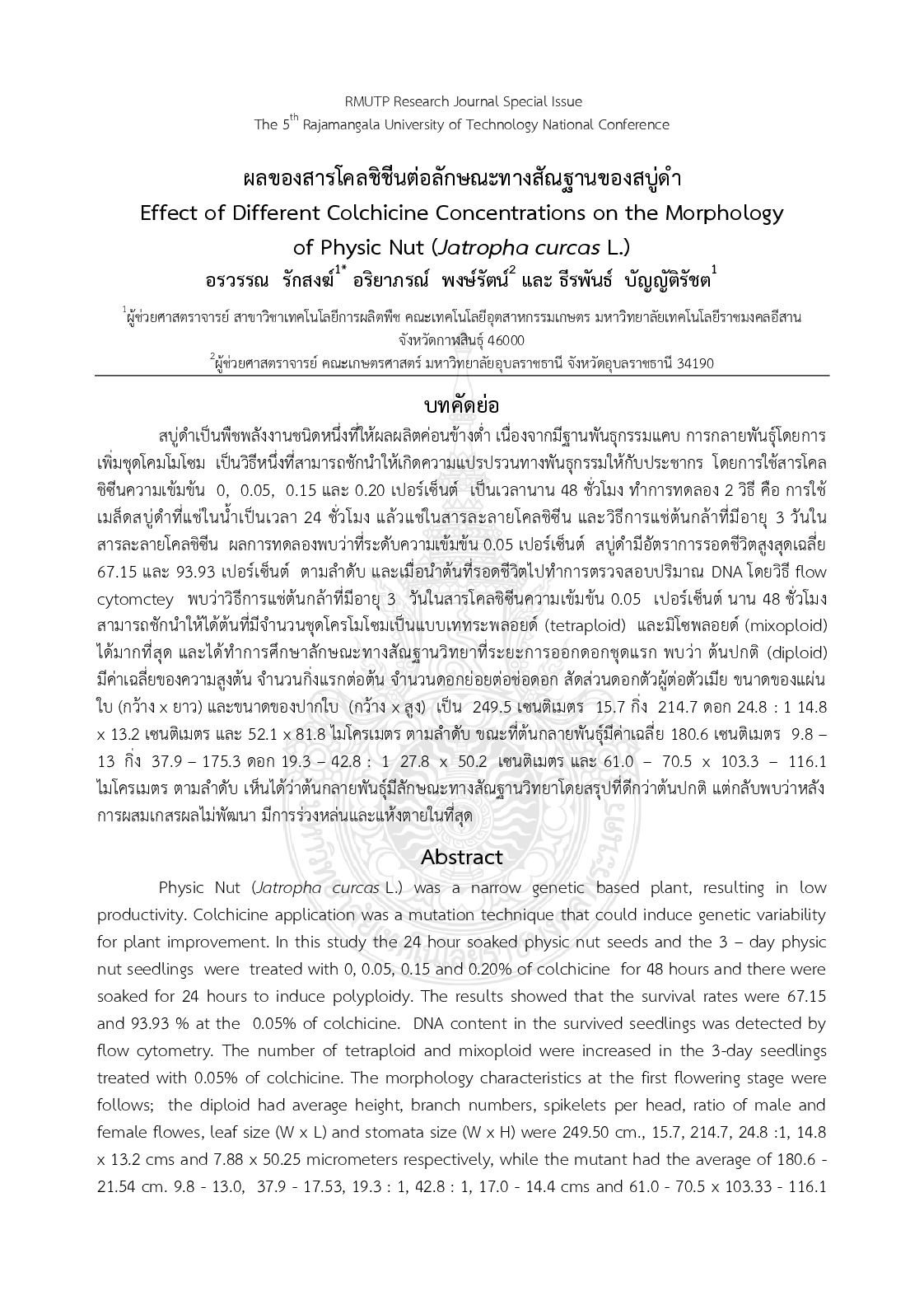
Effect of different colchicine concentrations on the morphology of physic nut (jatropha curcas l.)
Physic Nut (Jatropha curcas L.) was a narrow genetic based plant resulting in low productivity. Colchicine application was a mutation technique that could induce genetic variability for plant improvement. In this study the 24 hour soaked physic nut seeds and the 3 – day physic nut seedlings were treated with 0 0.05 0.15 and 0.20% of colchicine for 48 hours and there were soaked for 24 hours to induce polyploidy. The results showed that the survival rates were 67.15 and 93.93 % at the 0.05% of colchicine. DNA content in the survived seedlings was detected by flow cytometry. The number of tetraploid and mixoploid were increased in the 3-day seedlings treated with 0.05% of colchicine. The morphology characteristics at the first flowering stage were follows; the diploid had average height branch numbers spikelets per head ratio of male and female flowes leaf size (W x L) and stomata size (W x H) were 249.50 cm. 15.7 214.7 24.8 :1 14.8 x 13.2 cms and 7.88 x 50.25 micrometers respectively while the mutant had the average of 180.6 - 21.54 cm. 9.8 - 13.0 37.9 - 17.53 19.3 : 1 42.8 : 1 17.0 - 14.4 cms and 61.0 - 70.5 x 103.33 - 116.1 micrometers respectively. so The mutant had better characteristics but their fruits could not mature.
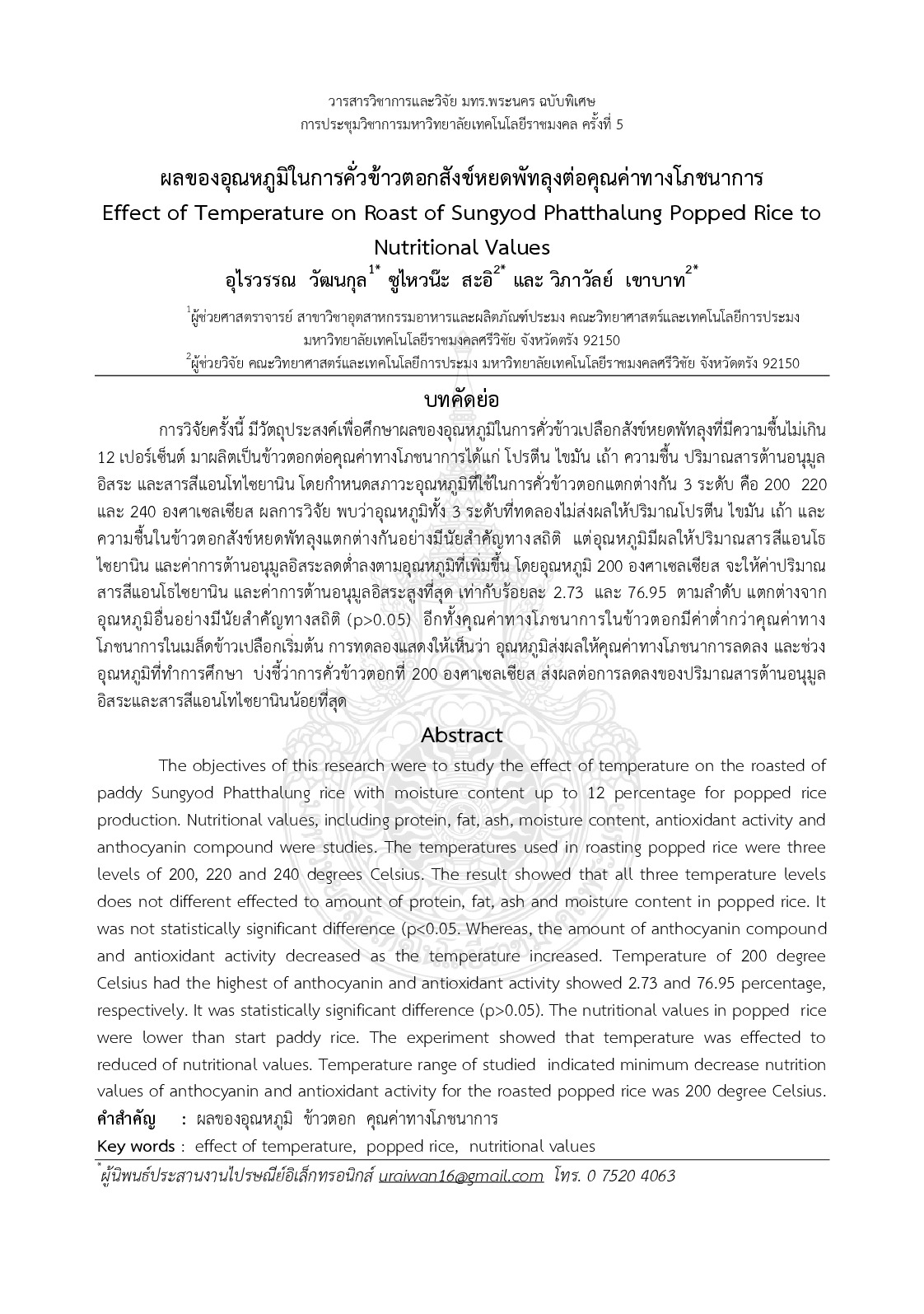
Effect of temperature on roast of sungyod phatthalung popped rice to nutritional values
The objectives of this research were to study the effect of temperature on the roasted of paddy Sungyod Phatthalung rice with moisture content up to 12 percentage for popped rice production. Nutritional values including protein fat ash moisture content antioxidant activity and anthocyanin compound were studies. The temperatures used in roasting popped rice were three levels of 200 220 and 240 degrees Celsius. The result showed that all three temperature levels does not different effected to amount of protein fat ash and moisture content in popped rice. It was not statistically significant difference (p<0.05. Whereas the amount of anthocyanin compound and antioxidant activity decreased as the temperature increased. Temperature of 200 degree Celsius had the highest of anthocyanin and antioxidant activity showed 2.73 and 76.95 percentage respectively. It was statistically significant difference (p>0.05). The nutritional values in popped rice were lower than start paddy rice. The experiment showed that temperature was effected to reduced of nutritional values. Temperature range of studied indicated minimum decrease nutrition values of anthocyanin and antioxidant activity for the roasted popped rice was 200 degree Celsius.
การพัฒนาผลิตภัณฑ์ขนมไทยจากกากมะพร้าวเหลือใช้
The purposes of the study regarding the development of Thai dessert products from used coconut residue are to study about appropriate amount of used coconut residue from oil extraction to study quality of Thai dessert products by using used coconut residue from oil extraction and to study acceptance of consumers towards Thai dessert products by using used coconut residue from oil extraction.