จำนวน Repository ( 82 )
การพัฒนาผลิตภัณฑ์ไอศกรีมโยเกิร์ตเสริมว่านหางจระเข้
Ice cream is a kind of sweets that is popular worldwide. For years ice cream has been continuously developed to meet various consumer satisfactions. Nowadays people are more concerning about health. Ice-cream is then added with some herb into ingredients to build more nutrition and to be healthy. Aloe Vera is a plant full of water containment. It also heals wound of fire hot water scalds persistent wound and appetite wound. Moreover Aloe Vera has its potential to instant product development in the forms of medicine food and cosmetics. The development purpose of yogurt ice cream with Aloe Vera added is to study the proper quantity of Aloe Vera in the yogurt ice cream along with the quality of Yogurt ice cream with Aloe Vera added product throughout the consumer’s satisfactions of the product as well. After the study of Aloe Vera chemical properties it indicates that each 100 grams of Aloe Vera has 3.20 kcal of energy 0.80 percent of carbohydrate less than 1.25 percent of protein 0.20 percent of ashes 99.0 percent of humidity and 0.64 percent of fiber. The study of production process indicates that the proper quantity of yogurt and Aloe Vera to add in the product of yoghurt ice cream with Aloe Vera added are yogurt at 60 percent and Aloe Vera at 50 percent. The study of physical side of quality indicates that the yogurt ice cream with Aloe Vera added has an increasing viscosity rate up to 1525 cps. color level at L* 91.98 a* -0.48 b* 14.28 infusible solid at 26.4 brix degrees. The melting rate of yoghurt ice cream with Aloe Vera added is at 67.90 and overrun rate is at 72.76. The study of chemical properties show that each 100 grams of yogurt ice cream with Aloe Vera added gives 147 kcal of energy 15.4 percent of carbohydrate 2.04 of protein 8.55 percent of fat 73.6 percent of humidity 0.42 percent of fiber and 0.46 percent of ashes. After proceeding yoghurt ice cream with Aloe Vera added to consumer test to research consumer’s satisfactions and to study marketing tendency for sale the target group is general amount of 200 persons. The study shows that the acceptance of consumer is in the level of high to highest.
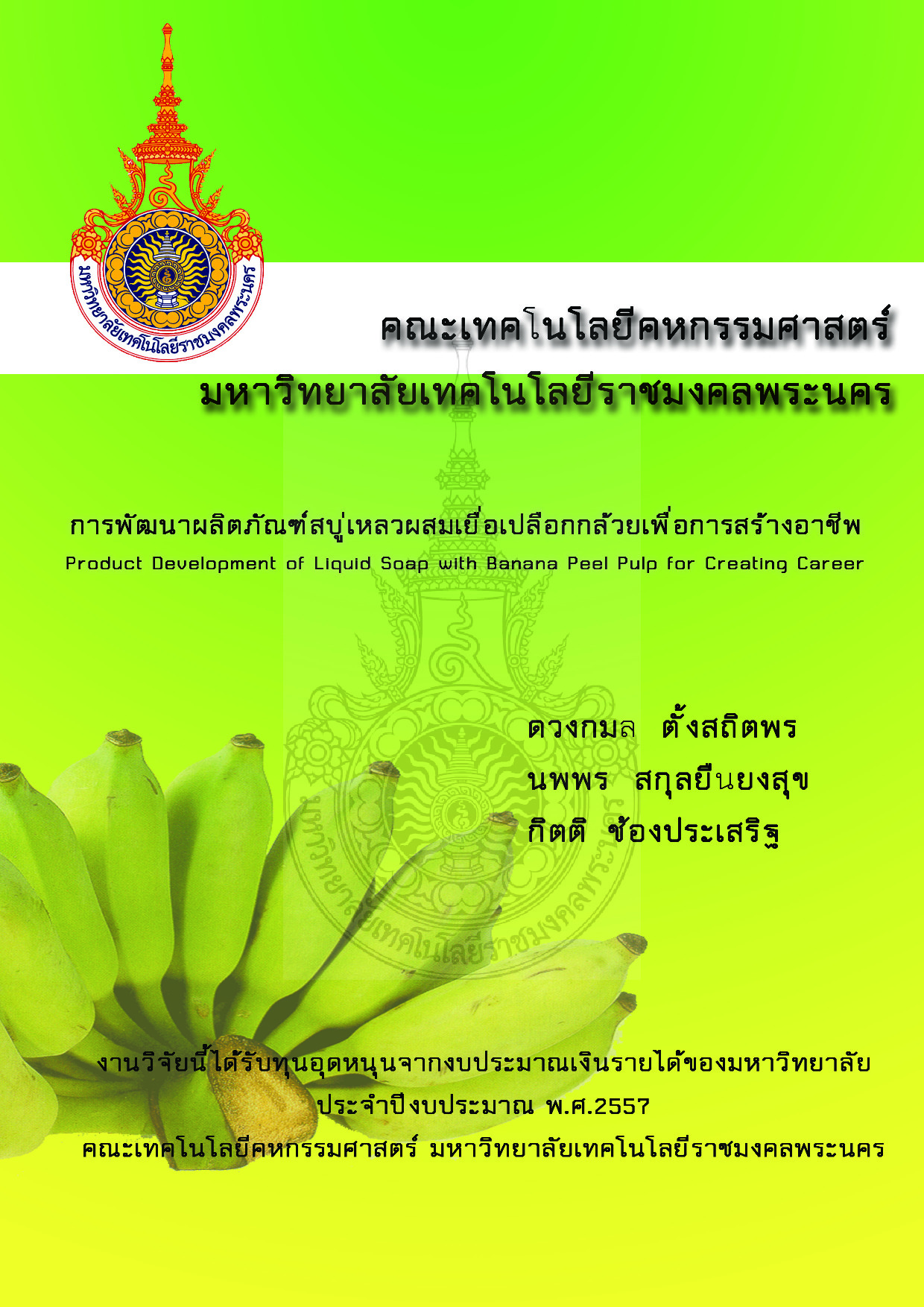
การพัฒนาผลิตภัณฑ์สบู่เหลวผสมเยื่อเปลือกกล้วยเพื่อการสร้างอาชีพ
Development of Liquid Soap with Banana Peel Pulp. We have studied the process of developing a recipe and product processing pulp peel bananas: banana peel and pulp of 3levels which take data from a survey of consumer behavior to suit the application. Andhave studied the sensory quality of the products liquid soap mixed pulp banana peel on 3 levels 5: 48.6 10 43.6 and 15 38.6% indicated that test scores give the formula 2 (20:10). in terms of color homogeneity. And texture (thick) overall. Levels like moderately to like verymuch. In terms of cleansing and smell no different at a statistically significant (p> 0.05) werethen tested for quality physical found that Liquid Soap with Banana Peel Pulp Formula 10:43.6% of the color. lightness (L *) was 59.6 ± 0.01 redness (a *) was -0.42 ± 0.01 andyellowness (b *) were 1.31 ± 0.01 which liquid soap is opaque. Because of the banana pulp is mixed in liquid viscosity in the 2584 Point Centrino bubble volume 370 ml and the water chemistry. The pH value of 6.52 ± 00.1 in the pH range 5-8 Thai Community Product Standard. Microbiological quality The shelf life of the product liquid membrane banana: banana peel and pulp. Store in a sealed jar per piece. Kept at room temperature The products were analyzed analyzed microbiological quality. Therefore the total plate count And yeast and mold By sampling every 1 week for a period of 8 weeks the total plate count<10 (CFU / g) Clostridium spp. Was not found Staphylococcus aureus None Streptococcusspp. Did not find Salmonella spp. Did not find Pseudomonas aeruginosa is found Coliform bacteria less. 3 MPN per gram Escherichai coli has been found safe for consumption. The resort complying with (TCPS. 95/2552) is to be a Thai Community Product Standard LiquidSoap of bacteria must be less than 1000 colonies per gram. Or cubic centimeters Meet ThaiCommunity Product Standard Liquid Soap education acceptable to the liquid membranebanana: banana peel and pulp were found to have a moderate satisfaction. Irritation andfeeling 100 percent.

Thai dessert product development form palmyra - plum powder
A research was aimed to investigate appropriate procedures of cabinet drying of flour made from Toddy palm at 60 65 and 70 degree Celsius and employed it as an ingredient in 3 Thai traditional desserts - Kanom-Chun Kanom Num-dok-mai and Kanom Puy-fai respectively. The investigation emphasized on these effects on color and odor of the products. Palm flours at the level of 0% 10% 20% and 30% was added then physical and chemical properties consumer’s acceptance were investigated and their shelf-life of the products packed in polyvinyl chloride and double layer of polyvinyl chloride and polyethylene at room temperature was inspected every day. Drying temperature of 60 ?C and 10% flour addition in the formulation found to be the optimal condition and also produces best quality of the products accepted by consumers as in such conditions overall score of acceptance was statistically significantly highest ( P>0.05) with 7.73 7.95 and 7.62 average scores for Chun Kanom Num-dok-mai and Kanom Puy-fai consecutively. Proximate analysis of these products in terms of moisture ash fat fiber protein and carbohydrate revealed that they were statistically different ( P>0.05). When 100 consumers were asked to taste and rank their acceptances Kanom Puy-fai Kanom Num-dok-mai and Kanom Puy-fai was acceptable by 66 28 and 6 panels successively. However these products should not store for more than a day due to the fact that microbiologically total viable count would be exceeds specified standard by a day.
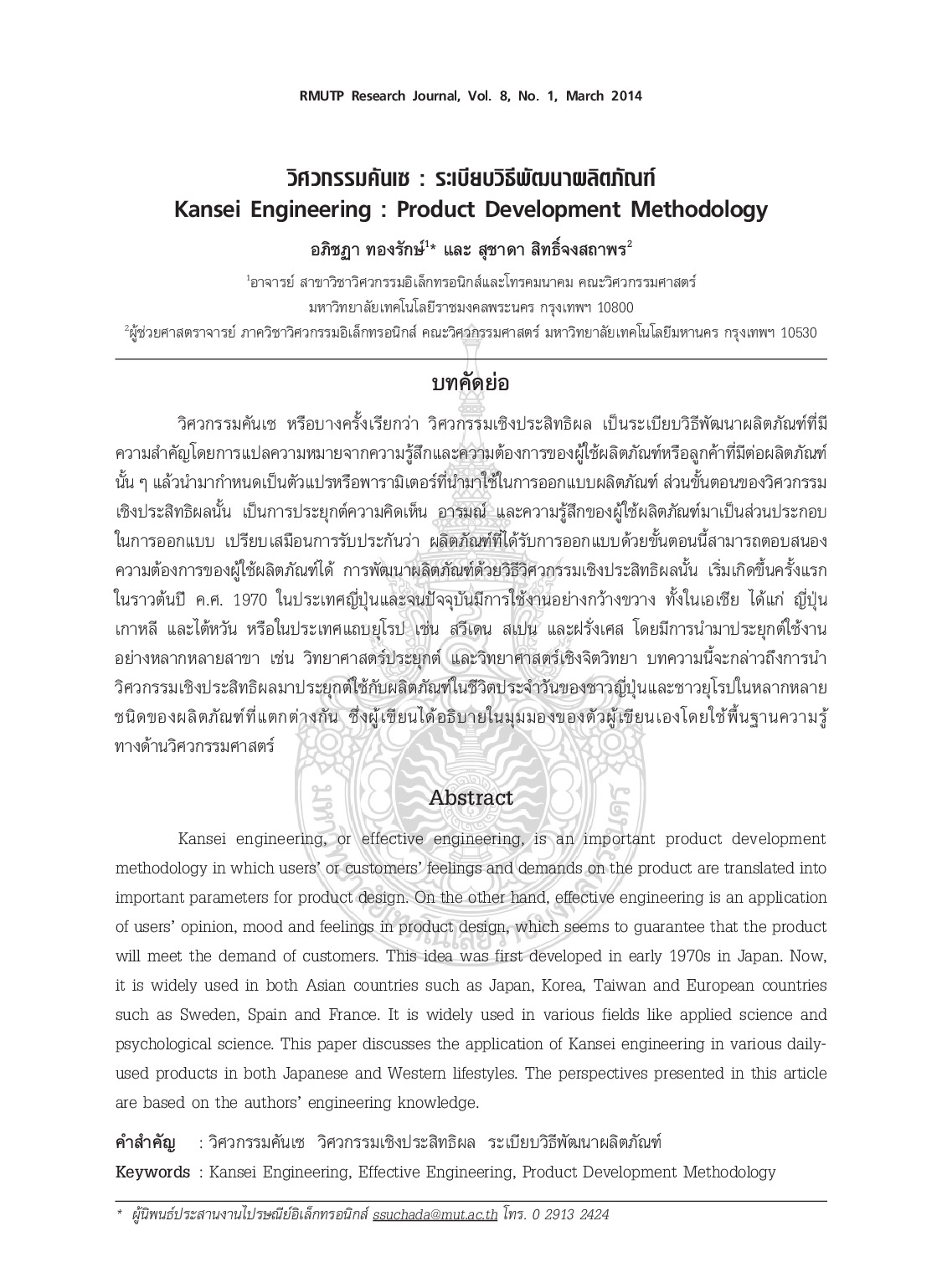
Kansei engineering: product development methodology
Kansei engineering or effective engineering is an important product development methodology in which users’ or customers’ feelings and demands on the product are translated into important parameters for product design. On the other hand effective engineering is an application of users’ opinion mood and feelings in product design which seems to guarantee that the product will meet the demand of customers. This idea was first developed in early 1970s in Japan. Now it is widely used in both Asian countries such as Japan Korea Taiwan and European countries such as Sweden Spain and France. It is widely used in various fields like applied science and psychological science. This paper discusses the application of Kansei engineering in various daily-used products in both Japanese and Western lifestyles. The perspectives presented in this article are based on the authors’ engineering knowledge.
The study and development of the wickerwork handicraft making for building the product development guideline for the sustainability of changwatang thong
This research. Study and Development of the Wickerwork Handicraft Making for Building the Product Development Guideline for the Sustainability of Changwat Ang Thong . The test concept is to develop handicraft can stand on the market of high competition in the state. It is a long time handicraft production process is a process that has been inherited wisdom within the family. But when the society changes. Consumers are increasingly demanding. Crafting an increasingly competitive. The creation of only one production order. The development of the craft did not creative enough. Community as a production base for the capitalist market to find the space to the community. Just profits.