จำนวน Repository ( 76 )
Approaches (PIA) forecasting motive with SEM by partial least squares (PLS) tchnique and product indicator approaches (PIA) technique
This research aimed to compare the techniques and method used to solve non-linear equations with SEM. By Partial Least Squares (PLS) technique and Product Indicator Approaches (PIA) technique. Were tested by the two methods of case studies is motive in the decision to study at Bachelor degree in Rajamangala University of Technology Suvarnabhumi Suphanburi campus Information Technology field. For sampling 221 found Partial Least Squares (PLS) technique to solve the problem of non-linear equation. However the same study Product Indicator Approaches (PIA) technique do not use this method as error indicators for the model with a negative value wrong predictions by SEM. Can not be predicted by the model to them.
Development of learning achievement by research – based in conjunction with technique SCAMPER
This pre experimental research was one group pretest-post test design. The research aimed to develop the students learning achievement to study learning process by research - base in conjunction with technique SCAMPER and to survey the treatment groupopinions about learning activities. The population consisted of a group of students enrolling in Research Methodology in the second semester in 2012. Before the experiment the learning styles of the treatment group were tested with Kolbs Learning Style Model and we found that the treatment group s learning style was Diverger. The data from testing styles of learning of the students was used to construct a set of activities by research - base in conjunction with technique SCAMPER. Then the students had to take a test with the achievement test constructed by the researcher before and after the experiment. The major research findings were that after the experiment the scores of the treatment group were significantly different at level 0.05 therefore; we concluded that the qualified set of the learning activities by research - base in conjunction with SCAMPER was able to develop the students learning achievement. In the part of learning process the technique SCAMPER was used to promote the students different views and ideas by asking questions which encouraged students to create their thinking systematically. In the students opinions about learning activities most of them strongly agreed with this technique which contributed to the thinking process and the systematic pursuit of knowledge.
Evaluation technique for northern corn leaf blight resistance and identification of resistance genes position in maize with dna markers
This study aims to develop a new evaluation technique for Northern Corn Leaf Blight (NCLB) resistance in maize under greenhouse condition. Ki48/Ki47 F2 (160 lines) and 2 commercial verities (Hi-Brix3 and Insee2) were evaluated. For this technique 10-14 day old seedlings (4-5 leaves) were sprayed with ACIL1 spore suspension (104spores/ml.) for infection. The results of this technique correlated with the results from the common technique under field condition which used 21-25 days old seedlings (6-7 leaves) (correlation value = 0.658). This evaluation technique was used to assist in QTL mapping of NCLB resistance. Population of Ki48/Ki47 F2 (160 lines) were analyzed for QTL mapping by using Simple Sequence Repeats (SSR) markers. It was found that major parental polymorphism located on chromosome 5 and chromosome 8. When Single QTL analysis was performed SSR marker UMC1365 could clearly indentified qualitative trait loci on chromosome 5 and SSR markers UMC1095 UMC1268 and UMC2356 could clearly indentified qualitative trait loci on chromosome 8.
The development of wbi on computer assisted instruction course using problem-based learning and demonstration techniques
This experimental research had five objectives: 1) to develop Web-Based Instruction (WBI) on Computer Assisted Instruction Course Using Problem-Based Learning and Demonstration Technique; 2) to evaluate the efficiency of the developed WBI according to Meguigans’s standard; 3) to compare the students’ learning achievements by pre-test and post-test; 4) to evaluate the students’ practical work and 5) to measure the students’ satisfaction towards the WBI. The samples in this research selected by purposive sampling consisted of 24 under graduate students in Academic Year 2/2012 of Department of Computer Education Faculty of Technical Education King Mongkut’s University of Technology North Bangkok. The research tools consisted of six units of the WBI a student’s learning achievement test administered before and after learning with the WBI video demonstration and problem based questions. The statistic employed in this research were the Meguigans’s standard t-test mean and Standard Deviation. Research results showed that; 1) the efficiency of the developed WBI was 1.22 according to Meguigans’s standard; 2) the students effectiveness after using the WBI was significantly higher than before using it at .05; 3) the average score of the practical work was 88.68 higher than 80; 4) the students’ satisfactory was at a good level. In conclusion the developed WBI can be used for the target group properly.
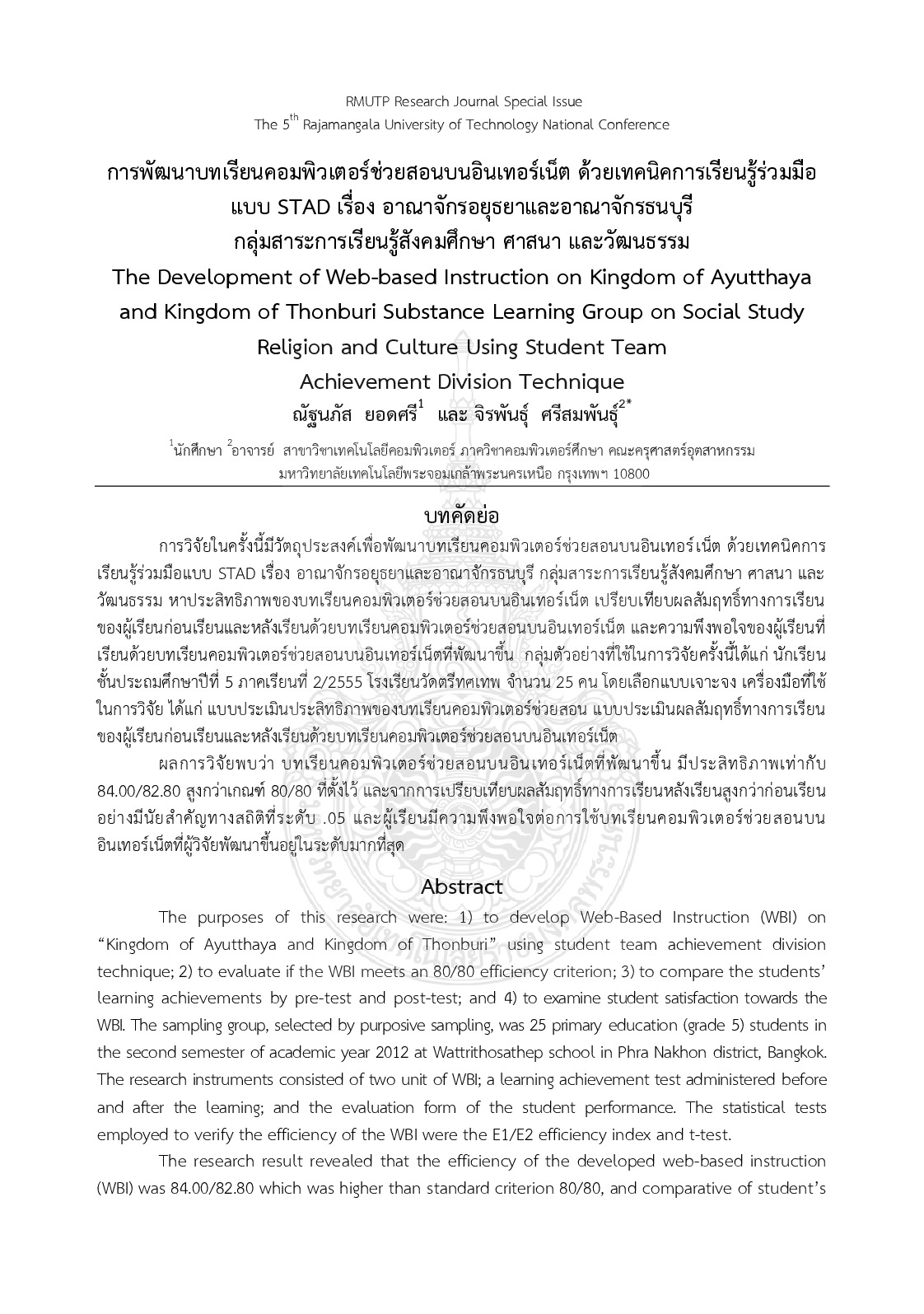
The development of web-based instruction on kingdom of ayutthaya and kingdom of thonburi substance learning group on social study religion and culture using student team achievement division technique
The purposes of this research were: 1) to develop Web-Based Instruction (WBI) on “Kingdom of Ayutthaya and Kingdom of Thonburi”กusing student team achievement division technique; 2) to evaluate if the WBI meets an 80/80 efficiency criterion; 3) to compare the students’ learning achievements by pre-test and post-test; and 4) to examine student satisfaction towards the WBI. The sampling group selected by purposive sampling was 25 primary education (grade 5) students in the second semester of academic year 2012 at Wattrithosathep school in Phra Nakhon district Bangkok. The research instruments consisted of two unit of WBI; a learning achievement test administered before and after the learning; and the evaluation form of the student performance. The statistical tests employed to verify the efficiency of the WBI were the E1/E2 efficiency index and t-test. The research result revealed that the efficiency of the developed web-based instruction (WBI) was 84.00/82.80 which was higher than standard criterion 80/80 and comparative of student’s achievement it was found that the student achieved learning progress significantly level of .05. Finally it was found that the learners opinion after using the developed web-based instruction (WBI) was very satisfactory.