จำนวน Repository ( 52 )
Analysis of steel industries in thailand : Case study of production planning and control by determination of time limited free back orders.
The objectives of this research were to find the distribution of food demand for laying hens and to find the optimum amount of that food production which had minimum cost. The data consisted of customer purchase orders for the food of laying hens price of food for laying hens cost per unit for the food inventory cost related to food of laying hens in which the food was out of stock such as fine overtime urgent purchase for material. They were collected in 2008-2009 form a factory in Nakhonratchasima province. The collected data were analized in order to explore the distribution of the monthly food demand for the laying hens and to see the rate of inventory per unit. The results were used in the stochastic linear programming model for aggregate planning in which the optimum production minimum cost could be obtained. Programming algorithm in MATLAB and tools in Linprog software were used to get the solution. The distribution of the food demand for laying hens and the random numbers were used in the model. The study found that the distribution of food demand for laying hens every month has normal distribution (January to December). The monthly average amount of production from January to December were 10936.94 12913.74 11898.12 13096 15443.26 14916.33 10322.64 10818.21 11393.11 11700.72 9706.05 and 11702.05 respectively. The minimum total cost average for 12months was Baht 62422386.98.

Cost of safety system in building construction
The goal of this study is to study the cost of safety system in building construction by studying multipurpose building with durable goods project. The cost of safety system in building construction is divided into two categories are the safety measure cost and the safety program cost in construction. From the study it is found out that the value of safety measure cost is approximately 1.85 % of a project cost and the value of safety program cost is approximately 0.98 % of a project cost. To sum up the cost of safety system in building construction is approximately 2.83 % of a project cost .Moreover the study found out that the safety measure cost is higher than the safety program cost about 1.88 as much. From the data of this study it can be used as the guideline in estimating the cost of safety system in building construction for the future project.
การวิเคราะห์ความอยู่รอด : การศึกษาการออกกลางคันของนักศึกษา ปวส.สายช่างอุตสาหกรรม มหาวิทยาลัยเทคโนโลยีราชมงคลพระนคร วิทยาเขตพระนครเหนือ
The objectives of the study were to fine the survival probabilities the haazard rates of dropping out of the tecnical diploma level students at Rajamangala University of Technology phra Nakhon North Bangkok Campus and the factors influencing on the university in 2005. The study foud tht the frist semester the survival probabilities of students in all divisions were high ranging from 0.9210 to 1.00 For the second semester the survival probabilities of students in all divisions ranged from 0/7820 to 0.8815 except Industrial Technology which had a maximum value of 0.9295 aned Metal Technology which had aminimum value of 0.6271. For the third and the fourth semester there were 6 division which had survival probabilities ranging from 0.7142 to 0.7971. They were Tool and Die Making Computer technology Eletrical Technology Electronics Auromatic Machine and production design. They 4 were Mechanical Tool Technology Business Computer Mechanical Power and Industrial Technolog. the hazard rates of dropping of students in all divising were low ranging for 0.00 to 0.0822. For the second semester the hazard rates of dropping of students in all divisions ranged from 0.1260 to 0.2458 except Industrial technology which had a minimum value of 0.0730 and Metal Technology which had a miximum value of 0.5221. For the third and the fourth semester the hazard rates of students in all division ranged from 0.1355 to 0.2962 excepy metal Technology which had the maximum value of 0.5932 and Tool and Die Making which had the value of 0.3364. The factors influencing on hazard rates of students drpout were place of previous school region of previos school and grade point average of previons school. The hazard rate of dropping of students graduation from school in the central region (not including Bankok Metropolitan Area) was 43% (0.562 times) less than the hazard rate of dropping of students graduation from schools in Bangkok metropolitan area. The hazard rate of dropping of students having grade aveage of 3.10-3.50 and 3.51-4.00 from previous school was 43.1% (0.569 times) and 63.7% (0.377 times) less than the hazard rate of students having grade point average of 2.00-2.50 respectively.

การพัฒนาแบบทดสอบบนเครือข่ายเพื่อวัดความสามารถด้านภาษาอังกฤษ ของนักศึกษามหาวิทยาลัยเทคโนโลยีราชมงคลพระนคร
The purposes of this research were to build and develop a standardized test used to measure English abilities compliant with the curriculum of the fourth-year students of rajamangala University of Tecnology phra nakhon. There were group of the students namelt the frist group which consisted of 57 students takung the electronic tests via the use of the electronic test and to and obtain a computer program prototype for measuring English abilities.
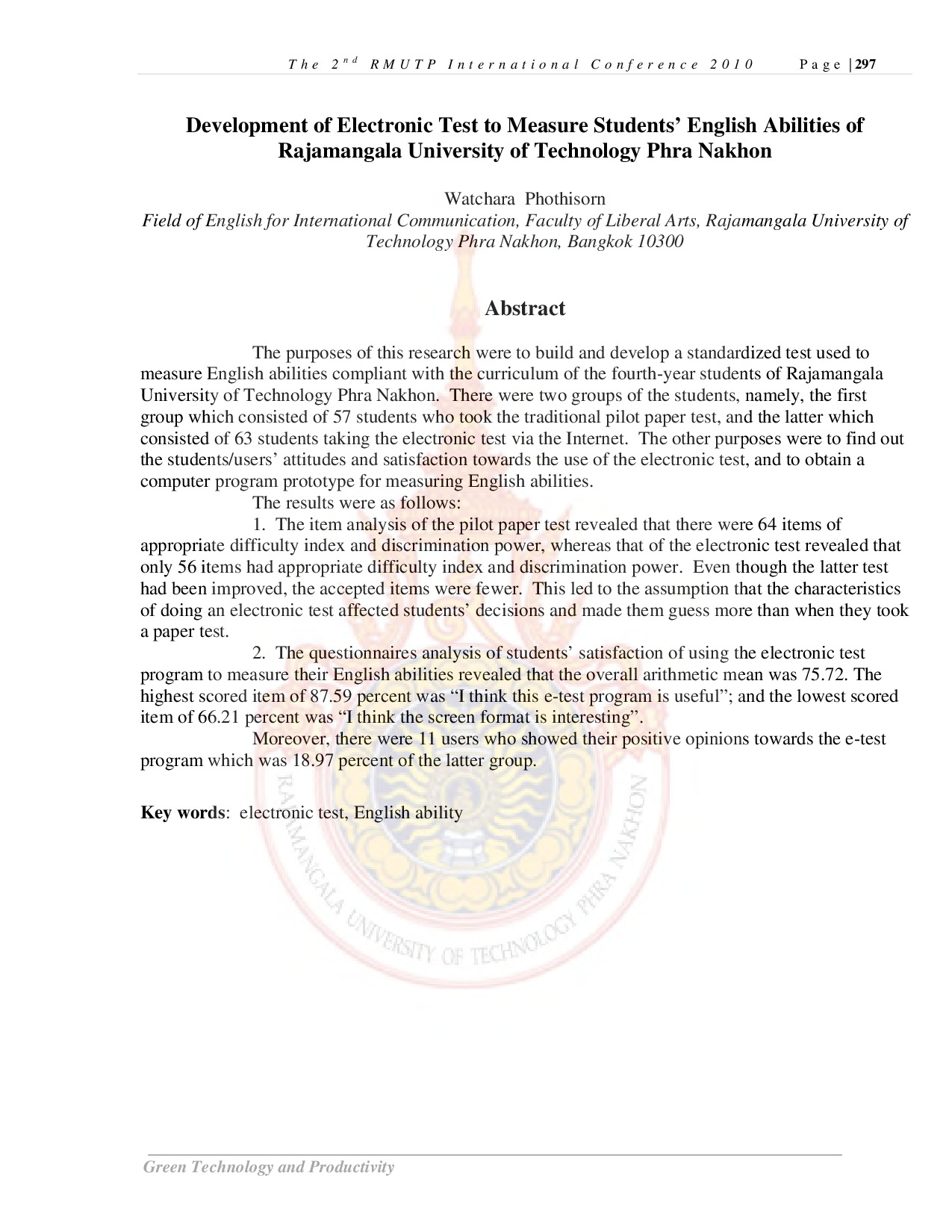
Development of Electronic Test to Measure Students’ English Abilities of Rajamangala University of Technology Phra Nakhon
The purposes of this research were to build and develop a standardized test used to measure English abilities compliant with the curriculum of the fourth-year students of Rajamangala University of Technology Phra Nakhon. There were two groups of the students namely the first group which consisted of 57 students who took the traditional pilot paper test and the latter which consisted of 63 students taking the electronic test via the Internet. The other purposes were to find out the students/users’ attitudes and satisfaction towards the use of the electronic test and to obtain a computer program prototype for measuring English abilities. The results were as follows: 1. The item analysis of the pilot paper test revealed that there were 64 items of appropriate difficulty index and discrimination power whereas that of the electronic test revealed that only 56 items had appropriate difficulty index and discrimination power. Even though the latter test had been improved the accepted items were fewer. This led to the assumption that the characteristics of doing an electronic test affected students’ decisions and made them guess more than when they took a paper test. 2. The questionnaires analysis of students’ satisfaction of using the electronic test program to measure their English abilities revealed that the overall arithmetic mean was 75.72. The highest scored item of 87.59 percent was “I think this e-test program is useful”; and the lowest scored item of 66.21 percent was “I think the screen format is interesting”. Moreover there were 11 users who showed their positive opinions towards the e-test program which was 18.97 percent of the latter group.