จำนวน Repository ( 3447 )
การศึกษาผลของกระแสฮาร์มอนิกส์ต่อค่าสูญเสียของหม้อแปลงไฟฟ้าเลื่อนเฟสและการทำให้เป็นจริงด้วยหม้อแปลงไฟฟ้าเลื่อนเฟส 15 องศา
The trend of energy savings has been widely interested and phase shift transformers (HMT) have been extensively used. This paper presents the investigation of the effect of harmonic currents on losses of the HMT. In this paper a 15-degree HMT with quad secondary winding is applied to find the relationship between harmonic currents and losses of the HMT. This relation can be met by testing the active power of primary and secondary sides while the HMT supplies for two and four non-linear loads at 25% 50% 75% and 100% rated currents respectively. The results reveal that harmonic currents affect winding eddy current losses significantly and the losses for loading the two secondaries 1 and 2 are the same as loading the two secondaries 1 and 3 while both %THDi are different. However for loading the secondaries 1 and 2 the %THDi is more than 15% so it is not met IEEE 519 Std. while the HMT is supplied with four loads the %THDi has met IEEE 519 Std. and the losses are less than 57% compared to one load. As a result of these if the HMT is applied to an adjustable speed drive system it is not only reduced the harmonics but also saved the energies.
การเพาะเลี้ยงเยื่อเพื่อการขยายพันธุ์และการชักนำเหง้าขนาดเล็กจากว่านชักมดลูกตัวเมีย Curcuma comosa roxb
This study was conducted to determine the effects of plant growth regulators on in vitro propagated plantlets and microrhizome inductions of Curcuma comosa Roxb. for an efficient development of plant regeneration. In vitro sprouted shoots (2 cm length) of C. comosa were incised in longitudinal section and subcultured on MS media supplemented with 3 mg/L BA for shoot multiplication and plant regeneration. Subsequently the regenerated plants were transferred to MS medium with various concentrations of plant growth regulators; BA (1 3 5 mg/L) kinetin (1 3 5 mg/L) and TDZ (0.5 1 1.5 mg/L). The result showed that MS medium supplemented with 3 mg/L BA was the most effective in shoot induction with the significantly maximum average number of 2.11 shoot buds per responding explant. Moreover MS medium supplemented with 1 mg/L BA produced the longest average of shoot bud explants (12.99 cm) while the basal MS medium induced the longest average of root multiplication (6.63 cm). Furthermore microrhizome induction was produced under in vitro conditions derived young shoot buds upon transfer to MS medium containing various combinations of 1 3 and 5 mg/L BA and 30 60 and 90 g/L sucrose concentrations. The optimum combination in the induction of significantly highest average length of both stem (18.32 cm) and root (7.52 cm) multiplication was obtained on MS basal medium supplemented with 1 mg/L BA and 30 g/L sucrose for 4 weeks. Although microrhizome formation was not produced by the different amount of BA and sucrose in induction medium starch accumulation was found at the base of the stem explants cultured on MS medium containing 60 and 90 g/L sucrose concentrations. Additionally in vitro propagated C. comosa plantlets through microrhizome induction were grown under greenhouse conditions for 4 weeks and further developed into normal plants resulting in successfully high survival rates of 66 – 100% in the cultivated C. comosa.
กำลังและความต้านทานการกัดกร่อนของมอร์ต้าร์ที่ใช้วัสดุประสานกระตุ้นด้วยด่างจากเถ้าถ่านหินแคลเซียมสูง
The aim of this study is developed of alkali activated high calcium fly ash to use as cementitious material to replace Portland cement. The mixture of mortar made from fly ash and sodium hydroxide solution (NaOH) was used to activate strength at concentrations of 2 4 6 and 8 molars. Superplasticizer was used to control the flow of mortar in the rage of 105 – 110. The compressive strength of mortar was determined at 7 28 45 and 60 days. The acid resistance of mortars due to sulfuric at a concentration of 3% were also investigated. The results showed the mortar made from high calcium fly ash with sodium hydroxide of 6 molar obtained the highest compressive strength which could be developed compressive strength up to 189 ksc at 60 days. For the acid resistance of mortar it was found that the of use 6 molar of NaOH activated high calcium fly ash binder had the least weight loss due to sulfuric acid attack.
ผลของสารสกัดหยาบด้วยเอทานอลจากสมุนไพร 7 ชนิดต่อการไล่มด
This research aims to study the ant repellent effects of the crude ethanolic extracts from 7 herbs; Piper nigrum Linn. Alpinia galanga (L.) Willd Ocimum basilicum L. Cymbopogon citratus Stapf Citrus aurantiifolia (Christm.) Swingle Citrus hystrix DC and Stemona collinsae Craib. Whatman filter paper was dipped with each concentration of the crude ethanolic extracts (0.625 1.25 2.5 and 5 % w/v) and placing the bait on a treated filter paper. The experiments were conducted in the natural. The numbers of weaver ants were recorded at 0 - 30 minutes. From the results the crude ethanolic extracts at 5% w/v of A. galanga was the most effective for repellent the ant (repellent rate; %R = 94.72 ± 2.39) followed with C. citratus (%R = 89.45 ± 3.85) S. collinsae (%R = 82.92 ± 4.47) and P.nigrum (%R = 81.20 ± 5.92). The repellent rates of those crude ethanolic extracts were significantly difference from distilled water which use for the negative control (P < 0.05). The crude ethanolic extract of A. galanga at concentration 5% w/v was prepared as spray cream chalk and powder. At 30 minutes of the observation the ethanolic extracts of A. galanga spray was the best ant repellent effect (%R = 100). The result from questionnaires reveals that a spray preparation was the more satisfaction for the using ant repellent products.
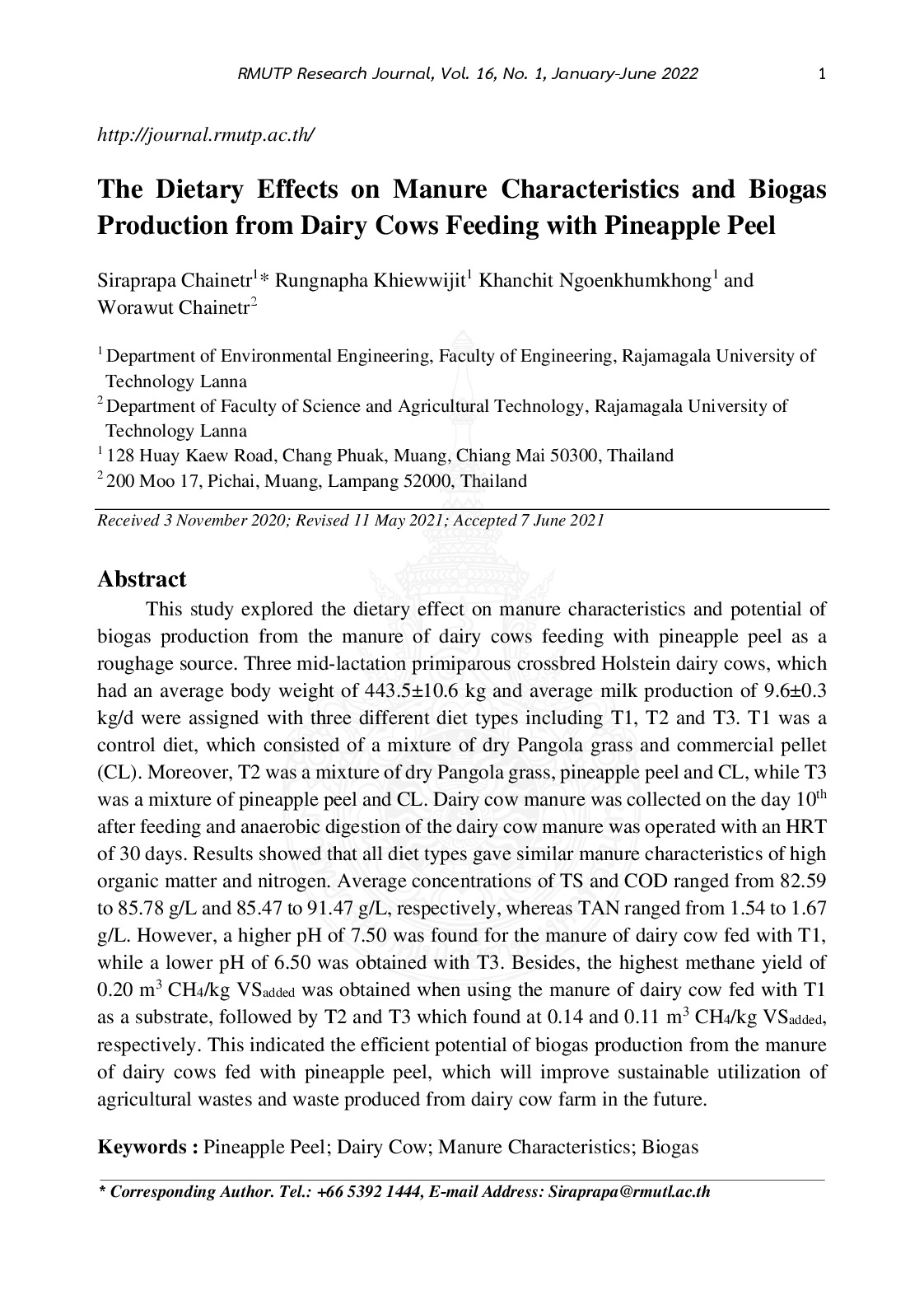
The Dietary effects on manure characteristics and biogas production from dairy cows feeding with pineapple peel
This study explored the dietary effect on manure characteristics and potential of biogas production from the manure of dairy cows feeding with pineapple peel as a roughage source. Three mid-lactation primiparous crossbred Holstein dairy cows which had an average body weight of 443.5±10.6 kg and average milk production of 9.6±0.3 kg/d were assigned with three different diet types including T1 T2 and T3. T1 was a control diet which consisted of a mixture of dry Pangola grass and commercial pellet (CL). Moreover T2 was a mixture of dry Pangola grass pineapple peel and CL while T3 was a mixture of pineapple peel and CL. Dairy cow manure was collected on the day 10th after feeding and anaerobic digestion of the dairy cow manure was operated with an HRT of 30 days. Results showed that all diet types gave similar manure characteristics of high organic matter and nitrogen. Average concentrations of TS and COD ranged from 82.59 to 85.78 g/L and 85.47 to 91.47 g/L respectively whereas TAN ranged from 1.54 to 1.67 g/L. However a higher pH of 7.50 was found for the manure of dairy cow fed with T1 while a lower pH of 6.50 was obtained with T3. Besides the highest methane yield of 0.20 m3 CH4/kg VSadded was obtained when using the manure of dairy cow fed with T1 as a substrate followed by T2 and T3 which found at 0.14 and 0.11 m3 CH4/kg VSadded respectively. This indicated the efficient potential of biogas production from the manure of dairy cows fed with pineapple peel which will improve sustainable utilization of agricultural wastes and waste produced from dairy cow farm in the future.