จำนวน Repository ( 592 )
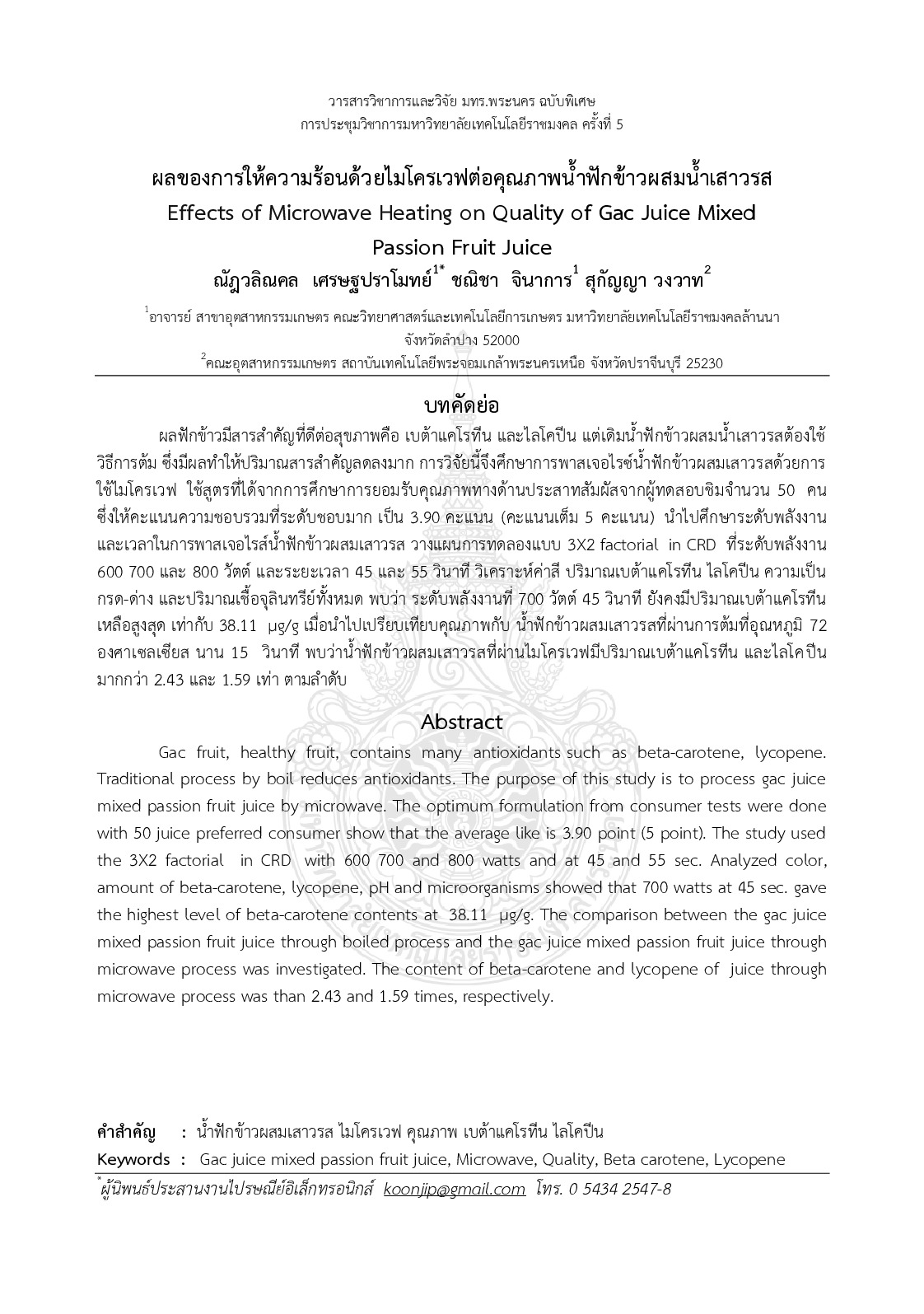
Effects of microwave heating on quality of gac juice mixed passion fruit juice
Gac fruit healthy fruit contains many antioxidants such as beta-carotene lycopene. Traditional process by boil reduces antioxidants. The purpose of this study is to process gac juice mixed passion fruit juice by microwave. The optimum formulation from consumer tests were done with 50 juice preferred consumer show that the average like is 3.90 point (5 point). The study used the 3X2 factorial in CRD with 600 700 and 800 watts and at 45 and 55 sec. Analyzed color amount of beta-carotene lycopene pH and microorganisms showed that 700 watts at 45 sec. gave the highest level of beta-carotene contents at 38.11 ?g/g. The comparison between the gac juice mixed passion fruit juice through boiled process and the gac juice mixed passion fruit juice through microwave process was investigated. The content of beta-carotene and lycopene of juice through microwave process was than 2.43 and 1.59 times respectively.
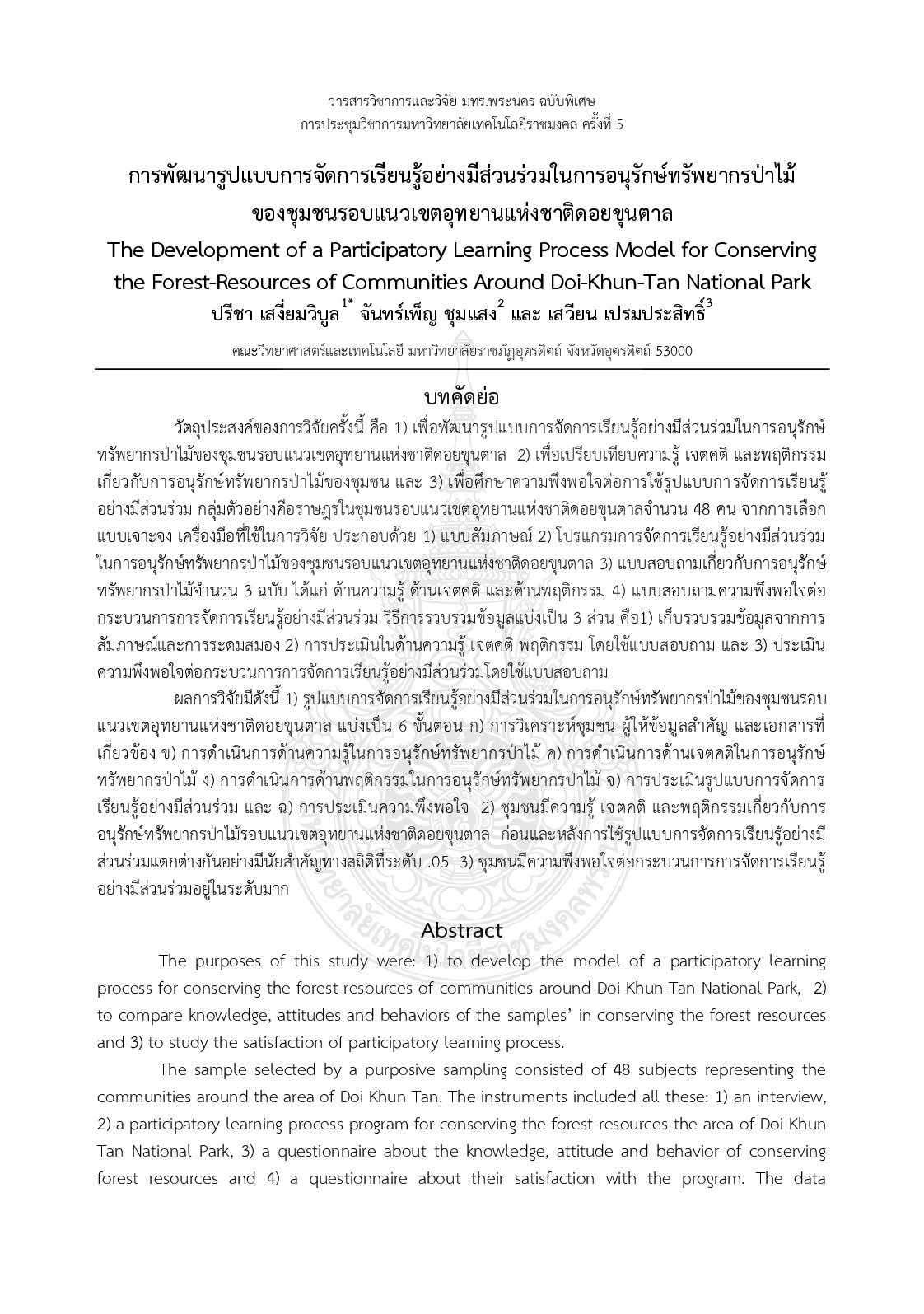
The development of a participatory learning process model for conserving the forest-resources of communities around doi-khun-tan national park
The purposes of this study were: 1) to develop the model of a participatory learning process for conserving the forest-resources of communities around Doi-Khun-Tan National Park 2) to compare knowledge attitudes and behaviors of the samples’ in conserving the forest resources and 3) to study the satisfaction of participatory learning process. The sample selected by a purposive sampling consisted of 48 subjects representing the communities around the area of Doi Khun Tan. The instruments included all these: 1) an interview 2) a participatory learning process program for conserving the forest-resources the area of Doi Khun Tan National Park 3) a questionnaire about the knowledge attitude and behavior of conserving forest resources and 4) a questionnaire about their satisfaction with the program. The data elicitation was drawn from three sources: 1) interviews and brainstorming 2) the assessment of the knowledge attitudes behaviors by the questionnaire and 3) the assessment of the satisfaction with the participatory learning process by the questionnaire. The study revealed these findings: 1) the participatory learning process of model fell into 6 steps consisting of a) the analysis of communities key informants and literature reviews b) the implementation of the knowledge to conserve the forest resources c) the implementation of the attitude towards conserving the forest resources d) the implementation of the behaviors of conserving the forest resources e) the assessment of the participatory learning process and f) the evaluation of satisfaction with the program; 2) the subjects’ knowledge attitudes and behaviors regarding forest conservation at the boundary of Doi Khun Tan before and after the participatory learning process are statistically different at the significance level of .05; and 3) the level of their satisfaction with the participatory learning process was high.
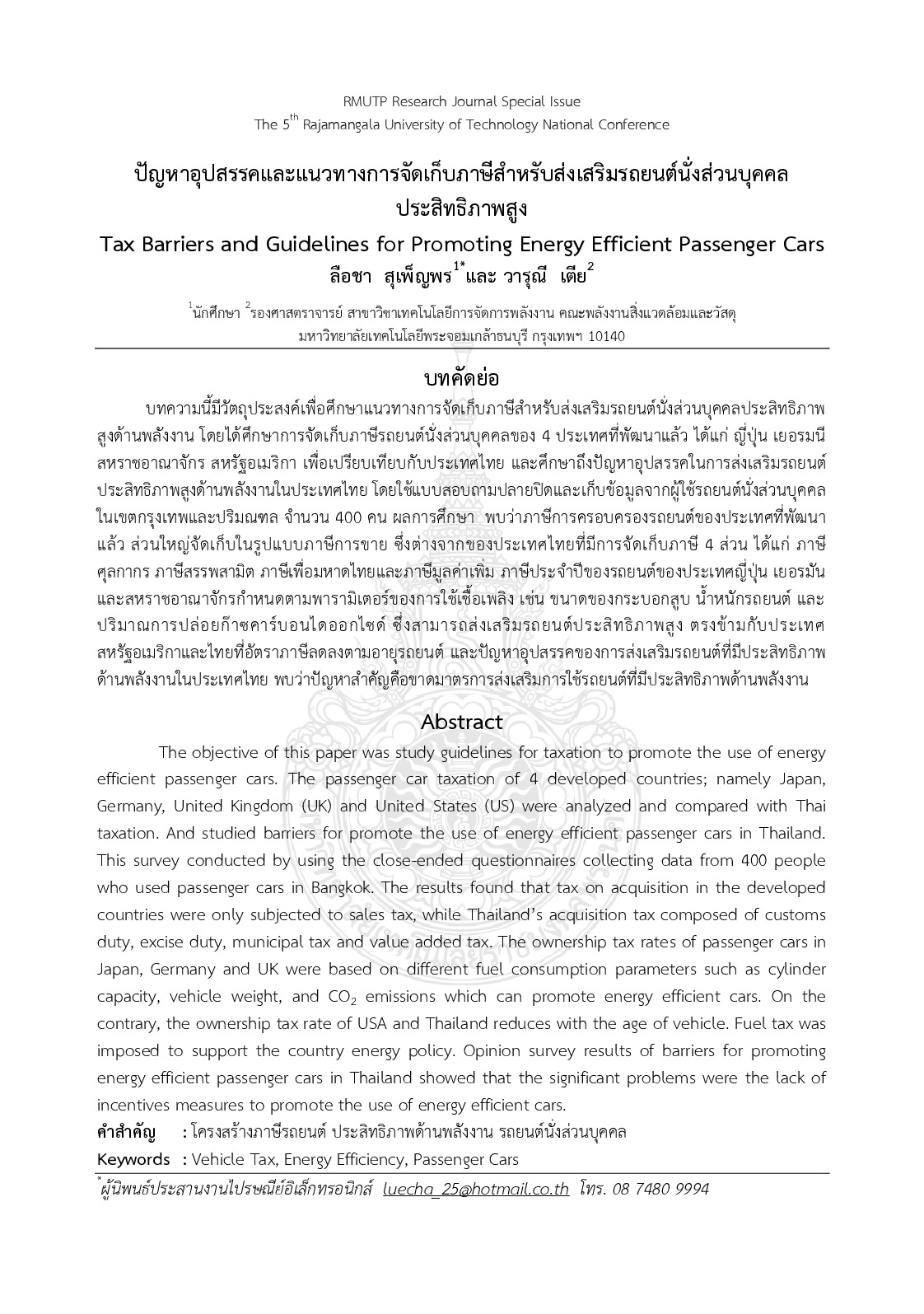
Tax barriers and guidelines for promoting energy efficient passenger cars
The objective of this paper was study guidelines for taxation to promote the use of energy efficient passenger cars. The passenger car taxation of 4 developed countries; namely Japan Germany United Kingdom (UK) and United States (US) were analyzed and compared with Thai taxation. And studied barriers for promote the use of energy efficient passenger cars in Thailand. This survey conducted by using the close-ended questionnaires collecting data from 400 people who used passenger cars in Bangkok. The results found that tax on acquisition in the developed countries were only subjected to sales tax while Thailand’s acquisition tax composed of customs duty excise duty municipal tax and value added tax. The ownership tax rates of passenger cars in Japan Germany and UK were based on different fuel consumption parameters such as cylinder capacity vehicle weight and CO2 emissions which can promote energy efficient cars. On the contrary the ownership tax rate of USA and Thailand reduces with the age of vehicle. Fuel tax was imposed to support the country energy policy. Opinion survey results of barriers for promoting energy efficient passenger cars in Thailand showed that the significant problems were the lack of incentives measures to promote the use of energy efficient cars.
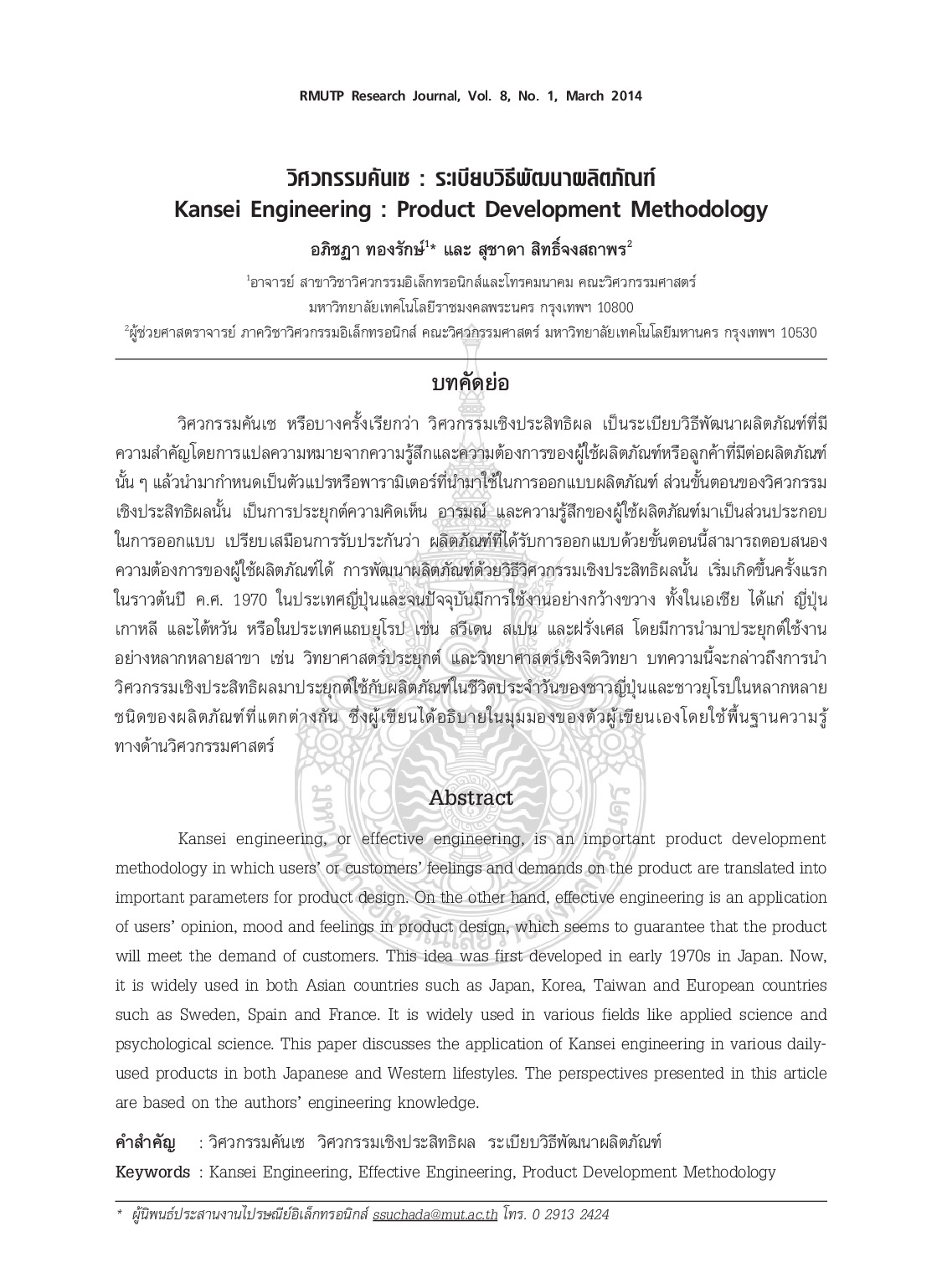
Kansei engineering: product development methodology
Kansei engineering or effective engineering is an important product development methodology in which users’ or customers’ feelings and demands on the product are translated into important parameters for product design. On the other hand effective engineering is an application of users’ opinion mood and feelings in product design which seems to guarantee that the product will meet the demand of customers. This idea was first developed in early 1970s in Japan. Now it is widely used in both Asian countries such as Japan Korea Taiwan and European countries such as Sweden Spain and France. It is widely used in various fields like applied science and psychological science. This paper discusses the application of Kansei engineering in various daily-used products in both Japanese and Western lifestyles. The perspectives presented in this article are based on the authors’ engineering knowledge.
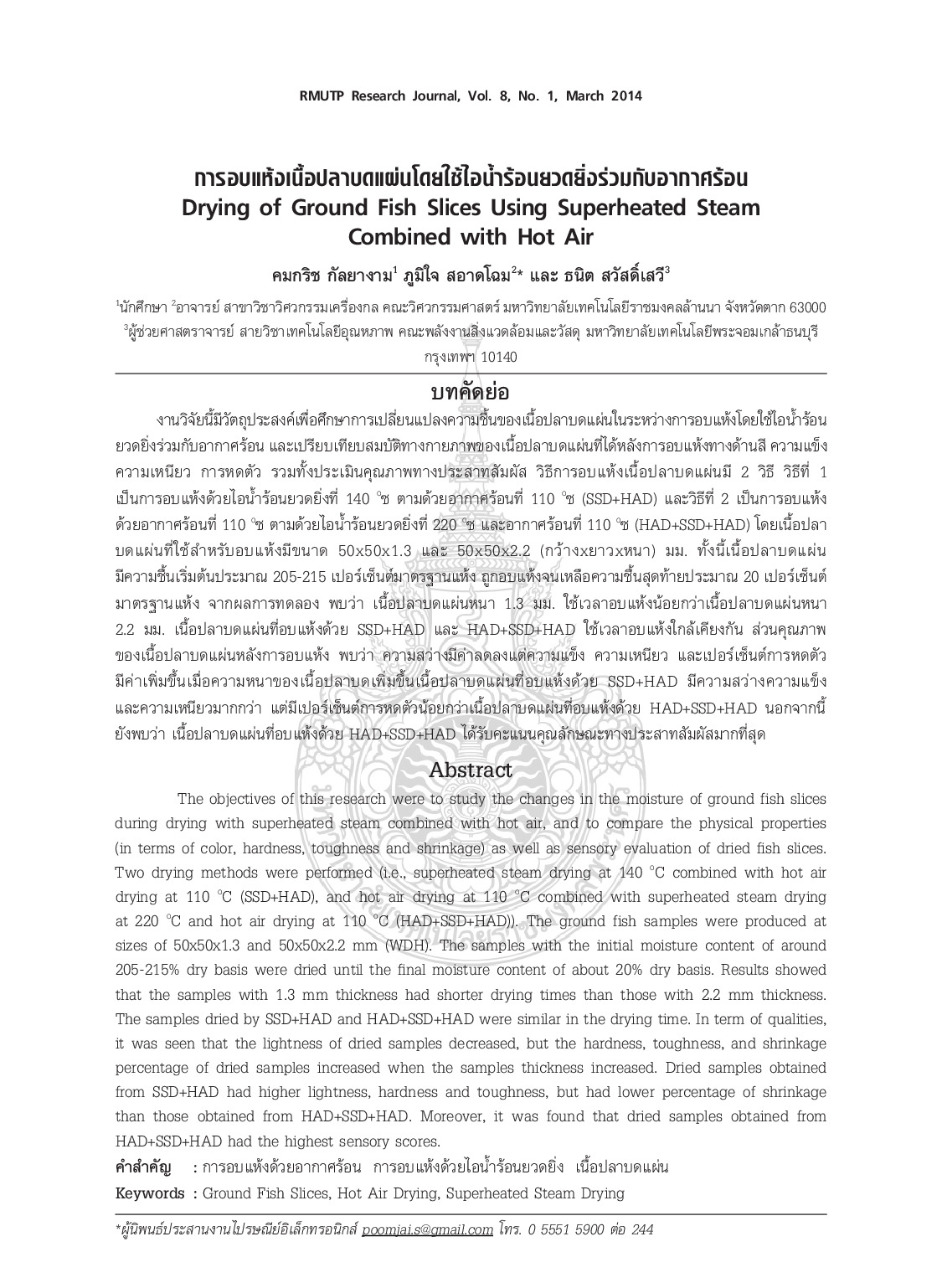
Drying of ground fish slices using superheated steam
Superheated steam drying has gained more attention due to its absence of oxidative reactions and high drying rate. This research involved drying of ground fish slices using superheated steam. The influences of superheated steam temperature (120 130 and 140 ?C) and thickness of ground fish slices (1.3 and 2.2 mm) on drying kinetics and quality attributes of dried fish slices were studied. Effective moisture diffusion coefficients (Deff) of the ground fish slices dried at different conditions were also investigated. From the experimental results it was seen that an increase in drying temperature and a decrease in thickness of ground fish slices led to faster moisture reduction. In terms of qualities it was found that the lightness value (L-value) decreased. However the redness value (a-value) percentage of shrinkage hardness and toughness values increased when the thickness of ground fish slices and superheated steam temperature increased. Moreover it was also found that the Deff of the ground fish slices increased with the increase of superheated steam temperature and thickness of ground fish slice.