จำนวน Repository ( 891 )
การพัฒนาผลิตภัณฑ์จากผลสับปะรดเพื่อส่งเสริมรายได้สาหรับนักเรียนมัธยมศึกษา อำเภอเมือง จังหวัดชัยภูมิ
The development of processed pineapple product for export to promote extra income of high school students in Muang district Chaiyaphum province. The purpose of this research is to develop the quality of processed pineapple products which has been tested by Randomized Complete Block Design (RCBD) method at 95% trusted evaluated by 9 point Hedonic scale sensual quality tasting by 70 people compared the means difference by Duncan’s New Multiple Range Test (DMRT) and analyzed the results by the statisticcomputer software. The processed pineapple products are pineapple filling cookies instant pasteurized pineapple juice and chocolate coating dried pickled pineapple. These products are subjected to simple preparation and advantageous for high school students to earn extra income from the production. The chemical quality analysis of pineapple filling cookies consists of 15.6 percent of humidity 4.21 percent of protein 15.6 percent of fat 0.99 percent of ash 1.98 percent of fiber and 67.6 percent of carbohydrate. The total energy is 428 kilocalorie total microbe (TPC) is microbe<10 CFU/g or less than 1x10³ colony per 1 gram of example. The storage lifetime extends up to 2 weeks from the production date. The instant pasteurized pineapple juice has total 57.6 kilocalories of energy 13.6 percent of carbohydrate 0.34 percent of protein 0.04 percent of fiber 0.39 percent of ash and 85.7 percent of humidity. The high level of humidity which contains individual liquid quantity in the product will increase the risk of spoilage from microbe. The total microbe (TPC) has microbe <10 CFU/g and specified the number of total microbe must be lessened than 1x10³ colony per 1 gram of example. Conclusion the instant pasteurized pineapple juice can be stored at 8-10 degree Celsius for 2 weeks from the production date. The study of dried pickled pineapple physical quality indicates that color components are as followings; brightness (L*) equals 49.79 which is in high level color balance (a*) equals 11.44 which means the dried pineapple has yellow color tasty represents in green section and color balance (b*) equals 33.50. The procession of the product by coating chocolate onto dried pickled pineapple has 16 percent humidity of total weight. The total microbe (TPC) has microbe <10 CFU/g and specified the number of total (3) microbe must be lessened than 1x10³ colony per 1 gram of example. Conclusion chocolate coating dried pickled pineapple can be stored at room temperature for 2 weeks from the production date. The research respondents have the most satisfaction for the study to apply the information to utilization in the mean of 4.80. Secondary the value compared to time and cost in the both mean of 4.50 which has the most total average mean in the high level of 4.33.
ความต้องการพัฒนาตนเองเพื่อรองรับการเข้าสู่ประชาคมอาเซียนของนักศึกษา คณะเทคโนโลยีคหกรรมศาสตร์ มหาวิทยาลัยเทคโนโลยีราชมงคลพระนคร
The survey research aimed to: 1) study the levels of self-development needs in preparation to enter AEC; 2) make a comparison of the students’ needs levels in aspects of personal data; and 3) propose appropriate forms of activities to be used in the development. The subject obtained through stratified random sampling consisted of 321 first-fourth year undergraduates of the Faculty of the Home Economic Technology Rajamangala University of Technology Phra Nakhon. The tool was a questionnaire. To analyse data the frequency percentage mean standard deviation t- test and ANOVA were used. The results were as follows: 1) The overall level of self-development needs was high ( X = 3.75). The needs for selfdevelopment in line with the Thai Qualifications Framework for Higher Education were high ( = 3.89). Moreover the level of needs conforming to Thai Graduate Preferable Qualifications for the ASEAN Community was moderate ( X = 3.46). 2) There was no statistically significant difference ( p<0.05) of the self-development needs level when genders educational levels or academic performances were considered 3) As for the activities it was rated best to use training for the development of cognitive skills numerical analysis communication and information technology skills domain of psychomotor skills and knowledge on ASEAN Community rules and regulations; lecturing for knowledge on ASEAN Community rules and regulations; study touring for knowledge development; camping for ethics and moral interpersonal skills responsibility and language skills; and student inter institutional exchanging for neighbouring countries knowledge development.
การพัฒนาผลิตภัณฑ์ซอสสำเร็จรูปจากเปลือกแตงโมที่เหลือใช้
This research had objectives to study the proper amount of adding of unused water melon peel in products of tomato sauce chili sauce pizza sauce and seafood sauce. This research studied the nutritional value of sauce products and studied the acceptance of consumers towards sauce products. The test found about the study about proper amount of unused water melon peel in four kinds of sauce products. The researcher tested about acceptance of forty examinees who are instructors in field of Food and Nutrition majoring Food and Nutritional science and majoring Food Service Industry by using 9-point hedonic scale by adding water melon peel into tomato sauce at levels of 5 10 and 15 per cent of all ingredients It is found that the examinees accepted chili sauce at level of 15 per cent that is in the much favor level (8). The chili sauce has been added with water melon peel at levels of 3 6 and 9 per cent of total ingredients. It was found that the examinees accepted it at level of 9 per cent that was from the level of moderate favor to much favor (7-8). The examinees accepted pizza sauce which has been added with water melon peel at level of 10 20 and 30 per cent of all ingredients. It was found that examinees accepted at level of 30 per cent which was in the level of much favor (8). The examinees accepted seafood sauce which has been added with water melon peel at level of 10 20 and 30 per cent of all ingredients. It was found that examinees accepted at level of 20 per cent which was in the level from moderate to very much favor (7-8). When the researcher studied the physical features of sauce product it was found that pH value at which was 25 degrees Celsius was in range of 3.90 3.49 3.83 and 2.73. The viscosity value was 4650cp 32639cp 37760cp and 612cp or centipoints respectively. Nutritional value of sauce product it was found that tomato sauce which has been added with water melon peel for 15 per cent has total calory for 70 per cent protein for less than 1.25 per cent fat for 0 per cent ash for 1.43 per cent carbohydrate for 17.5 per cent and moisture amount of 81.1 per cent. Chili sauce which is added with water melon peel for 9 per cent has total energy for 71.2 per cent; protein is less than 1.25 per cent fat is 0 per cent ash is 3.85 per cent; carbohydrate is 17.8 per cent and it has moisture amount of 78.4 per cent. Pizza sauce which is addedwith water melon peel for 30 per cent has total energy for 145 per cent; protein is less than 1.25 per cent fat is 3.49 per cent ash is 3.18 per cent; carbohydrate is 28.5 per cent and it has moisture amount of 64.8 per cent. Seafood sauce which is added with water melon peel for 20 per cent hashas total energy for 91.8 per cent; protein is 1.59 per cent fat is 0.20 per cent ash is 4.19 per cent; carbohydrate is 20.9 per cent and it has moisture amount of 73.1 per cent. However adding of water melon peel into four kinds of sauce products can be done but it should be realized about chemical components of starting components for example moisture amount and carbohydrate. These components may affect physical features for example smell flavor and texture. These features affect acceptance of products. From technology transfer of sauce products from water melon rind at 157/16 moo 9 Kao San housewife Group agricultural enterprise Bang Plee Bang Pla Samut Prakarn. 50 housewife Group agricultural there the level of satisfaction in every aspect.
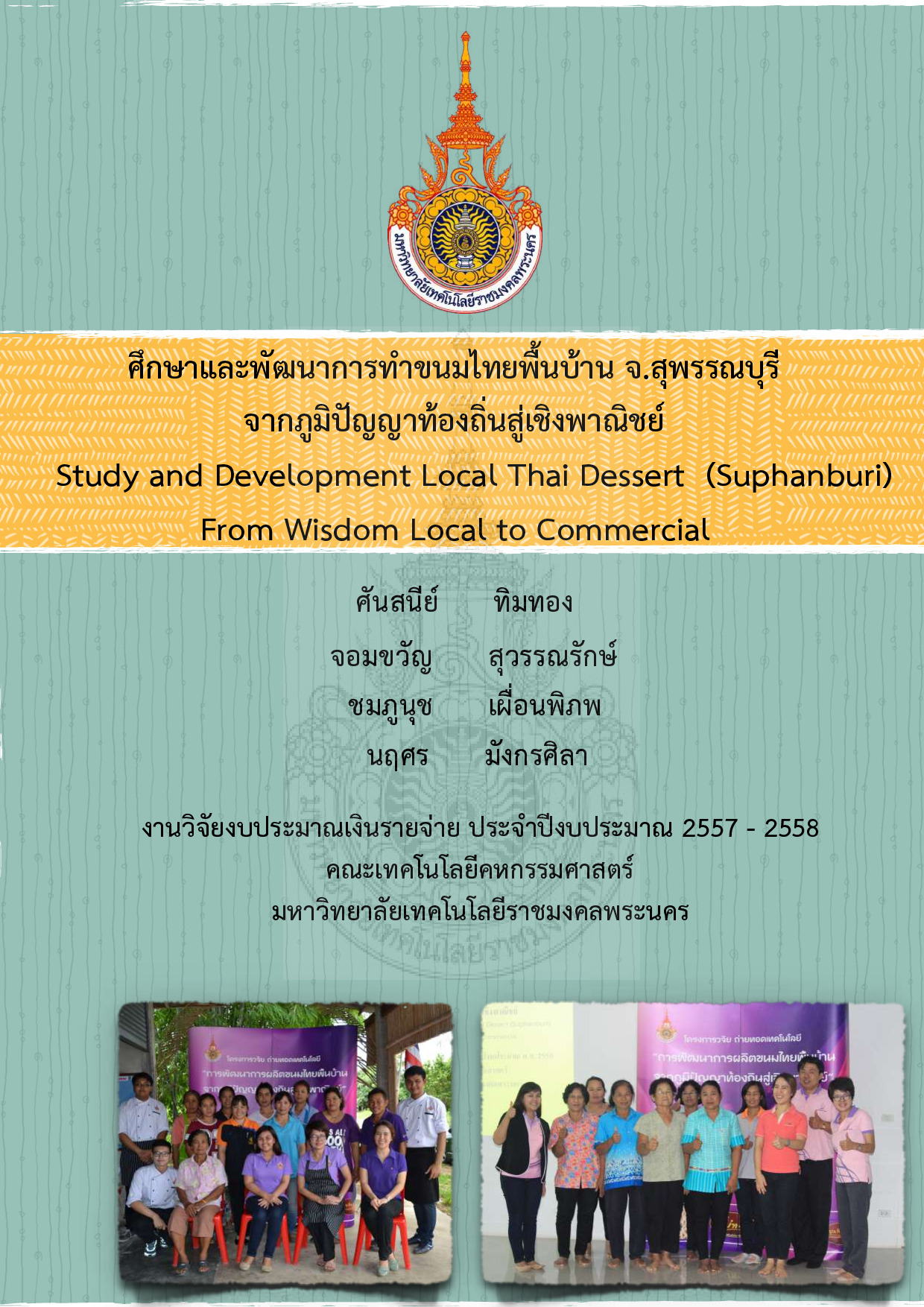
ศึกษาและพัฒนาการทำขนมไทยพื้นบ้าน จ.สุพรรณบุรี จากภูมิปัญญาท้องถิ่นสู่เชิงพาณิชย์
This research aims to gather the wisdom of the local confectionery. Suphanburi study based products to guide development toward commercialization. Transferring knowledge to To those related to benefits. Data were collected from five local groups five produce of wheel cake / fried beans sesame sheet / rice cracker with flossy pork / Chinese cake / fish eggs cake By interview Try making Bring samples Sensory evaluation and microbiological analysis found that wheel cake / fried beans sesame sheet / rice cracker with flossy pork and fish eggs cake. The average scores in all areas was good.The results determine the microbiological quality up to standard in the past. But Chinese Cake with yeast and mold beyond the standard set of standards Assistant. 115/2549 regarding Chinese Cake researchers to develop recipes Chinese Cake training and knowledge transfer processes. wheel cake / fried beans sesame sheet / rice cracker with flossy pork / Chinese cake / fish eggs cake. Education shelf wheel cake / fried beans sesame sheet / rice cracker with flossy pork / Chinese cake shredded and packed in a clear plastic bag PS (Polystyrene) and stored at room temperature. Sensory evaluation of appearance color aroma taste and texture every two days were shredded wheel cake and rice cracker with flossy pork as a second storage product to use in frying oil. Fried beans sesame sheet and Chinese cake plates five-day shelf life packaging foil bag metallic highlights. And a desiccant sachet You can help extend the life products. The present state of our knowledge as to the significance of the product that provide high energy can be details as ancient fried bean at 604 kilocalories rice cracker with flossy pork at 516 kilocalories wheel cake at 470 kilocalories Chinese cake at 427 kilocalories and fish eggs cake at 258 kilocalories respectively. Package design and branding while maintaining a modern Thailand with. The study of consumer behavior and consumer acceptance of products as a tourist in Thailand. Suphanburi Community food product purchase behavior found a place to buy a product that was also the most popular. Shop in the center of the deposit. Reasons to buy most products. To subsidized products from the community Factors buy Is packaging Test results emptied from local products developed into a commercial product both 5 rating in every type of consumer. At a high level Except for the ease of purchase. Because it is manufactured locally friendly. Stock trading is a friendly community. The agency also lacks support the market. Is the only product that consumers rated at a high level. Chinese cake to its consignment to the main tourist attractions. Suphanburi is also available on the website of One Tambon One Product. The five types of products and also to support local products. In most. After the development stage to commercial-oriented agency already has implemented. The transfer of knowledge and technology to manufacturers of theoretical knowledge and technologies. Local Thai Dessert And Packaging Workshop and to develop process to standards. The workshop on nutrition labeling packaging distribution channels overall satisfaction of participants in the highest level.
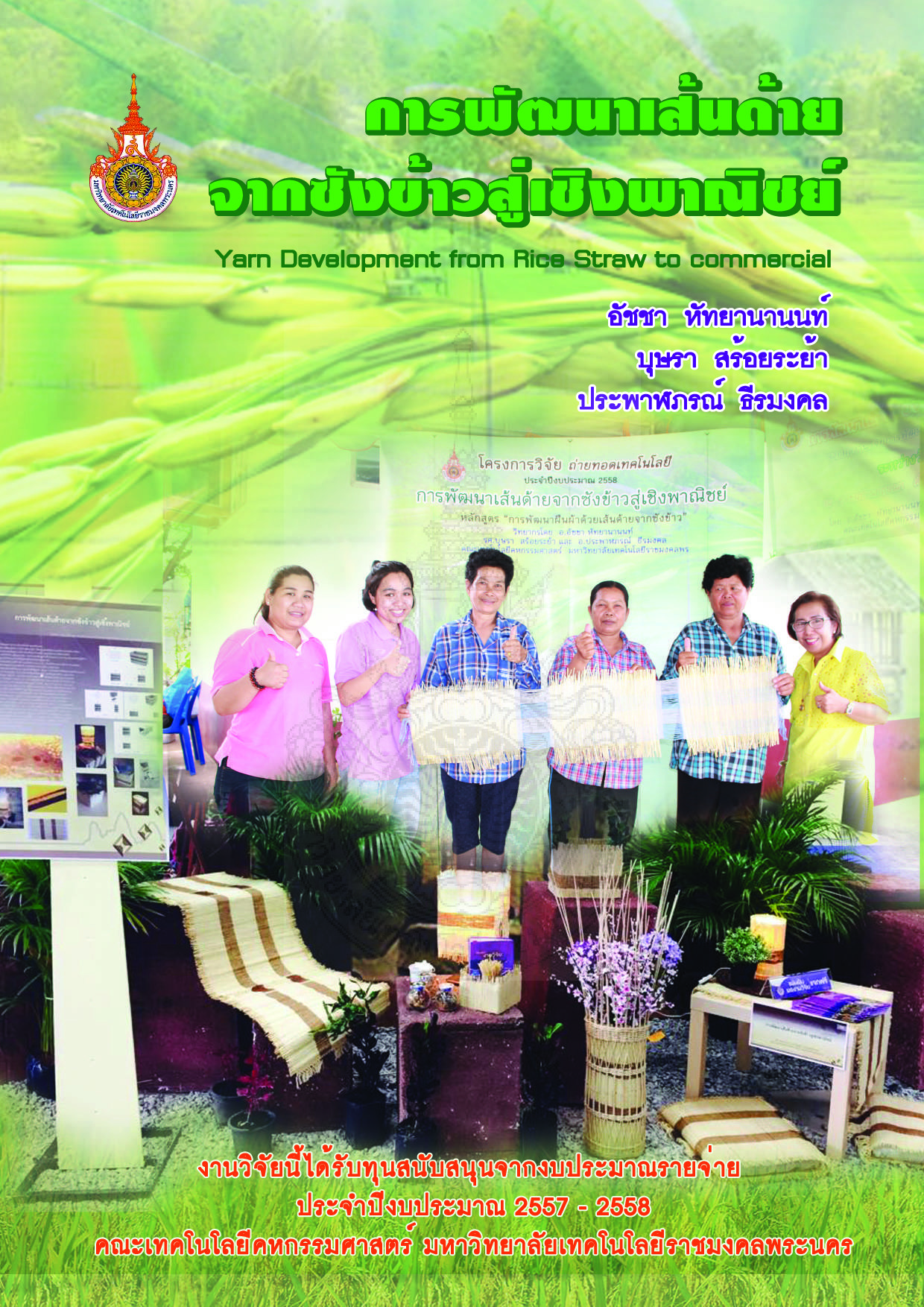
การพัฒนาเส้นด้ายจากซังข้าวสู่เชิงพาณิชย์
This research is Yarn Development from Rice straw to commercial. It aims to study the process of seperating fibers from rice straw. To study the physical properties of fibers from rice straw and to study the process of manufacturing yarn from rice straw fibers. The research material is rice straw fibers after that data was analyzed byphysical textile testing laboratory. The result of the first year’s research was the rice straw yarn has been developed as woven and develop into commercial products to promote. The process of separating fibers from rice straw which dried the sun for a few days. Selecting the rice straw fiber length at least 30 cm. to subtract the joints of the lower end of the stem by hand. peel off the rice straw fiber and place flat on a horizontal line. Then Rice straw fiber were tested in the physical laboratory was found that it is cellulose fibers tensile strength (Newton) at 28.18 elongation (percent) is at 2.01. The amounts of metals has plenty of CADMIUM at 0.1 mg/kg CHROMIUM (TOTAL) / (VI) at 0.5 mg/kg COPPER at 0.5 mg/kg and LEAD at 0.1 mg/kg which was not found to be risk for using. The fiber cross-section of rice straw fiber were found to be oval the middle is clearly. The fiber length is smooth and transparent when viewed from the side to see the clarity of the fiber. Rice straw fiber was weave in plain structure. Warp yarn uses a special brown cream and brown flat yarns. We use rice straw fiber with the same type of yarn. There are 2 warp yarn and using natural color without blench. Rice straw fabric was dyeing with dried hibiscus flowers (Kaa-Jeab herb) and mordant as ashes. The result is red light because of rice straw fiber surface is smooth and lustrous. Therefrom When woven as a fabric to develop be 4 products prototype : table lamps tablecloths in Japanese style potted plants and Accessories Box The result of the second year’s research there are focus group inquire for people it is interesting in this research and Date for transfer knowledge as: Ban-Krit-Sa- Na community Krit-Sa-Na sub-district bang-pra-ma district in Supanburi province. To plan the schedule and set the date place amount of participate and lectures 34 people The range of time to transfer as 3 days on 3 – 5 May 2015 and asking for consumer satisfaction of the curriculum and lecture for “transfer knowledge Yarn Development from Rice straw to commercial” by Questionnaire of participate satisfaction. Last the evaluation data was analyzed by using SPSS program in mean and percentage. The second year found that mostly participates were female aged under 21 years old finished the secondary school and also there are farmer. The participates are their income under 5000 baht and no income. For the participates questions relation to technology transfer of “Yarn Development from Rice straw to commercial” about course divided into 3 parts: The purpose The curriculum and The knowledge. The satisfaction of participates about project divided into 3 parts: Service process Lecturer and Facilities found that have been satisfied at maximum average and highest level of satisfaction in every parts of both satisfied participates questions. The participants are mainly used to provide benefits to themselves for one month to apply the gained after the training. Satisfaction with the benefits of technology transfer and utilization. Satisfaction at the highest level the participants used knowledge to apply with local and waste material. Moreover the participates make product as soon as finish course and they are planning to produce the table Hand Woven for weaving the Rice straw yarn fabric and push it to be OTOP products. The comments and suggestions of the participants found that they need for re-training again. They would like to have a longer period of training in order to gain more knowledge. All lecturer can transfer knowledge during the training as well.