จำนวน Repository ( 644 )

การพัฒนาเทคนิคการทำผ้าบาติกบนผ้าไหมด้วยสีธรรมชาติ
The aim of this reseach in to paint on silk fabric with batik technique using five natural dyes from neem tree bark lac mango leaves marigold and star gooseberry bark. The pre-mordant and after-mordant techniques were used in this work. There were 10 Mordants Aluminium Potassium Sulfate Copper Sulfate Sodium Dichromate Tannic Acid Tartaric Acid Tin (ll) Chloride and Calcium Acetate-Monohydrate were applied. The batik fabrics were characterized In color strength rubbing fastness washing fastness light fastness and stiffness. The result-indicated that silk Fabric painted with natural dye from neem tree bark could use all 10 mordants to improve color strength and gave various shade of color. The silk fabric painted with Natural dye from lac could not use all 10 mordants to improve color strength but it gave various shade. The silk fabric painted with natural dye from mango leaves marigold and star gooseberry bark showed that almost 10 mordants gave higher color strength and various shade. The mordanting technique would give good fastness and reduce the stiffness of batik fabric.
การพัฒนาเครื่องทอผักตบชวา
This research has been object to development weaving machine Equipment for weft. Design weave and Instruct technology give community. By make up weaving machine be able to ten The construct equipment for weft to tightness be equal to weft. Design weave and weave to consist Plan choose thread Heddle to tie and Move treadle. Instruct technology give community District Bangsai Amphur Provice Ayutthaya Which get instruct technology Make up weaving machine and design weave. Research result to invention make up Hyacinth weaving machine. Functional be durable Convenient to use in community. The construct equipment t thread Which consist litter move thread Bench to roll and bench t copy Functional be successful. Because of compare weft not pass process for weft at construct will cause thread tightness unequal have impact When divide weft for insert warp Divide weft unequal and Cause weft have tightness Impact when divide weft for insert warp divide weft unequal and break every. Section weft at pass process move weft thread be on as tightness unequal and will cause warp be convenient and not break. Have an effect on weave be convenient and marquisette high-quality. Design that in quantity at equal when design get efficacious change treadle be able to begin new design new design by not design. Instruct technology give community and community get technology and be able to design weave get efficacious. Evaluation from construct invention Design weave and instruct technology cause to know. Possibility that take research give community general and production to commercial continually.
การพัฒนารูปแบบความร่วมมือด้านการวิจัยทางวิทยาศาสตร์และเทคโนโลยีสำหรับสถาบันอุดมศึกษาของรัฐ
The objectives of this research were to study present problem and barrier factors and the development of science and technology research co-operation model for Thai Public Higher Education Institutions. The samples were 388 executives in 8 Thai Public Higher Education Institutions. The instruments were questionnaire survey executive interviews and query data. Data analysis were statistical and content analysis. It was found that Thai Public Higher Education Institution policy supported the research. These were co-researches co-devices and exchanged expert researcher in knowledge. The successful factors were capitals benefits shared goals quality development and increased researches based research system the expert persons research resources reward and motivation and draft model with 4 elements: structured cooperation research funding support standard and mechanical cooperation and types of unit administration. When the draft model was completed it was brought to Connoisseurship meeting for science and technology research co-operation model for Thai Public Higher Education Institutions.
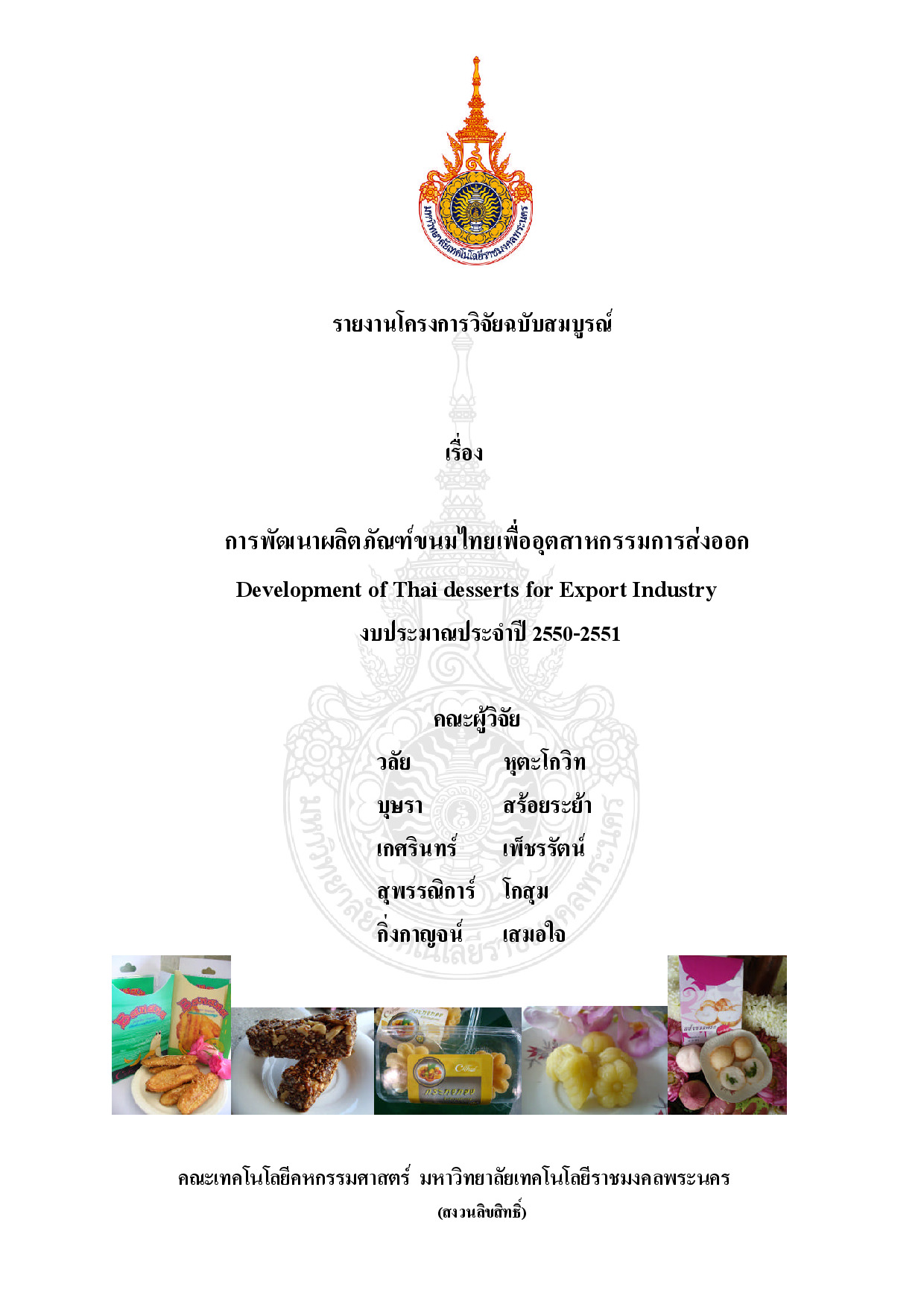
การพัฒนาผลิตภัณฑ์ขนมไทยเพื่ออุตสาหกรรมการส่งออก
Development Project of Thai dessert products for export industry aimed to develop 5 kinds of Thai dessert recipes and process which consisted of cereal bar instant peanut paste powder instant fried banana flour Kratong Thong (Golden Thai Pastry Cups) adapted for keeping longer and instant Kanom Krok flour (Coconut Rice Cake). The result was found that cereal bar from black sticky rice was developed by using 2 % high-fructose syrup and 12% glucose syrup and total soluble solid of syrup was at 90 Brix. The product tested was accepted moderately. Instant peanut paste powder recipe development made by Miss Suphannika Kosum was tested for sensory evaluation to compare with other peanut paste produced in marketplace. It was found that the product was accepted and there was statistically significant difference at p< 0.05. The five sensory overall liking attributes (colour smell taste texture and total impression) were 7.83 7.76 7.73 7.63 and 8.03 respectively. The product had high preference score. Instant fried banana flour recipe development was done by using rice flour to wheat flour ratio at 120:20 12.5% baking soda and 0.5% calcium chloride. Water requirement was 200 milliliter. The product was accepted at medium to high level. The second recipe of Kratong Thong (Golden Thai Pastry Cups) was the most accepted because it was golden yellow and smooth and stir frying for 1.3 minutes. The product was accepted at medium to high level. For instant Kanom Krok flour (Coconut Rice Cake) it was found that 3 recipes of them were significantly different for texture liking at p< 0.05. 100 and 90 gram of rice flour were studied for producing Kanom Krok it was found that there was no statistically significant difference for overall liking attributes (p> 0.05). Because of indifferent quantity of flour Kanom Krok was slightly different. However Kanom Krok made by 90 gram rice flour was less firming when compared to 100 gram rice flour and the product quantity obtained was also less. There was no statistically significant difference for overall liking attributes. The researcher transferred this knowledge and technology to the target private organization. The first time held on “Thai Dessert Products Course” in Lopburi province between 12-13 May 2008. The result of the technology transfer was found that 80 % of the participants’ satisfaction was accepted and after the course was finished the target groups applied this knowledge and technology for their careers to increase community’s income. It is regarded that this project was accomplished according to its success in the goal and objectives. Remark: 1Assistant Professor 2Lecturer of the Faculty of Home Economics Technology 3Lecturer of the Faculty of Architecture and Design
การพัฒนาผลิตภัณฑ์ป่านศรนารายณ์มัดย้อมสำหรับกลุ่มสหกรณ์การเกษตรหุบกะพง จำกัด
Research project of product development of hemp dying for Hub-Kra-Pong agricultural cooperatives limited. The purposes of this research were 1) Products development from hemp dying for Hub-Kra-Pong agricultural cooperatives limited. 2) To transfer technology of creativeproducts from hemp dying. 3) following the result of the project success. The research in the first year (Budget 2551) divided their operations into 3 phases. Phase 1) the experiment selected the appropriate characteristics of hemp fibers to the dying. Phase 2) the experiment was tie and dye method for appropriating characteristics of hemp fibers. Phase 3) design patterns in order to create product bags and hats design forms of 15 styles and chosen by the expert. The expert selected in each type 3 styles for making products to survey the product satisfaction. The research in the second year (Budget 2552) is a transfer technology products (bags and hats) prototype from hemp fiber that are made to Hub-Kra-Pong agricultural cooperatives limited. For the satisfaction of 30 participants trained to result as follows.