จำนวน Repository ( 771 )
พฤติกรรมการซื้อสินค้าในร้านสะดวกซื้อของผู้บริโภคในพื้นที่อำเภอหนองโดน จังหวัดสระบุรี
This research aims to study 1) personal characteristics that affect the purchasing behavior of consumers in convenience stores in Nong-Don District Saraburi province and 2) retail market factors that affect the purchasing behavior in convenience stores in Nong-Don District Saraburi province. The sample group used in the research consisted of 400 people in Nong Don District Saraburi province. The instrument used for data collection was a questionnaire. The statistics used for data analysis were percentage mean standard deviation a statistical significance test with a value of 0.05. The results of the research are that 1) most of the sample groups were female aged 21-25 years with status occupation student a monthly income less than or equal to 10000 Baht and an education level below bachelors degree. 2) Furthermore factors influenced the purchasing behavior in convenience stores. Overall the average score was at the highest level. The process had the highest average score followed by the product and distribution physical characteristics personnel and marketing communications. The aspect with the least average score was the price. 3) Shopping behavior in convenience stores was analyzed by hypothesis testing. It was found that different sexes had different purchasing behavior in convenience stores in Nong-Don District Saraburi province. It was significantly different at the 0.05 level and age marital status occupation monthly income educational backgrounds. The different is consumers purchasing behavior in convenience stores in Nong-Don District Saraburi province were significantly different at the 0.05 level. Retail market factors like products price distribution marketing promotion personnel process and physical appearance affect the purchasing behavior in convenience stores in Nong-Don District Saraburi province.
พฤติกรรมการเลือกซื้อน้ำมะพร้าวพร้อมดื่มของผู้บริโภคในเขตกรุงเทพมหานคร
The purposes of this research were 1) to study the purchasing behavior of readyto- drink coconut juice. 2) To study the marketing factors of ready-to-drink coconut juice of consumers. 3) To study the relationship between personal factors and behavior in purchasing ready-to-drink coconut juice and 4) to study the relationship between marketing factors and purchasing behavior of ready-to-drink coconut juice. This was a quantitative research using questionnaires as a tool to collect data from a sample of 400 people without gender who are 20 years of age or older and live in Bangkok. The statistics used in the data analysis consisted of percentage mean standard deviation and correlation was determined by chi-square statistical test. The results showed that 1) most consumers behaviors had a reason to choose ready-to-drink coconut juice as a healthy drink with a purchase frequency of 1-2 times per week. The amount of purchase per time is at 1 bottle / box / bag which the purchase cost per time is 51- 100 baht and most of them choose to buy products from convenience stores. 2) The overall marketing factors in purchasing ready-to-drink coconut juice of the sample group were at the highest level. When considering the factors by aspect they were found that almost all aspects had the highest level of opinion in terms of price products and distribution channels respectively. Except for marketing promotion it was found that the sample group had a high level of opinion. 3) The relationship between personal factors and behavior in purchasing ready-to-drink coconut juice found that gender was related to the purchase frequency and the cost of each purchase. The education level was related to the reason for the purchase purchase frequency and cost of each purchase. Age occupation and average monthly income were related to all aspects of purchasing behavior which were the reason for purchase frequency of purchase location of purchase quantity of each purchase and cost of each purchase were found to be (P ≤ 0.01) and 4) the relationship between marketing factors and purchasing behavior of ready-to-drink coconut juice found that the overall marketing factors were related to behavior in all aspects which were the reason for purchasing purchase frequency purchase location quantity of each purchase and each purchase cost were found to be statistically (P ≤ 0.05)
เครื่องกรองความถี่แบนด์พาสชนิดแอคทีฟที่ปรับตัวได้โดยใช้วงจรแทคโคมิเตอร์
This thesis presented the design and construction of an adaptive active band-pass filter by using a tachometer circuit. The main part was the multi voltage-mode filter circuit based on an operational transconductance amplifier which could automatically adjust the center frequency to adapt to the input signal frequency by the tachometer circuit. The frequency error value in the center frequency was set to be ≤ 3% of the input signal. Furthermore the proposed filter could support the input signal in the frequency range of 10 Hz - 10 kHz. From the simulation and experimental results of the proposed prototype filter it could respond to the frequency according to the theory of the band-pass filter and the error in choosing the center frequency which was 1.45 % and 2.6 % respectively (below the set error value of 3 %). Therefore the proposed filter could be used for real application. The working principles of the proposed prototype filter could also be applied to the noise attenuation circuit of an electrocardiogram machine. Moreover this research could be used as a guideline study for those who want to develop other types of adaptive active filters for higher efficiency.
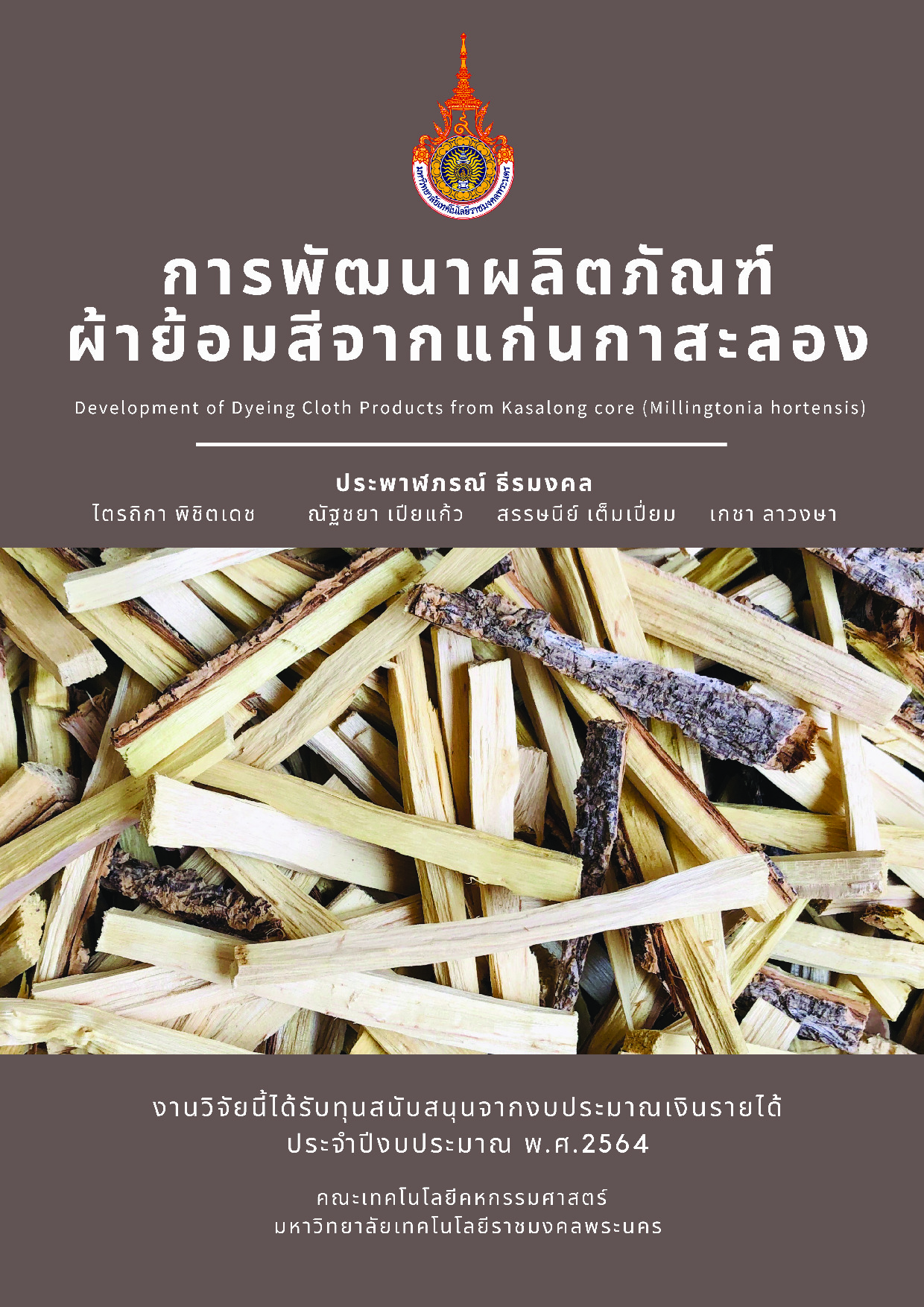
การพัฒนาผลิตภัณฑ์ผ้าย้อมสีจากแก่นกาสะลอง
Promotion of handicrafts in the field of natural dyes in the country. Increase the potential of the community and use the strengths of the cultural community. way of life and wisdom by finding ways to develop textile products by using creative textile innovations based on local wisdom in sustainable community areas To add added value to products in the ECO PRODUCT and ZERO WASTE product groups from the aforementioned concept To conserve plant genetics that exist throughout the country. The researcher therefore studied the process of dyeing fabrics by natural methods. By taking natural ingredients that are locally available and transforming them into environmentally friendly home products. This research is to study the natural dyeing of cotton fabric from Kasalong core. have a purpose Study on the effect of dyeing and the use of adjunctive agents in natural dyeing from Kasalong kernels. To develop dyed fabric products from Kasalong core and to pass on the knowledge and technology of developing dyed fabric products from Kasalong core for the general public. The result of dyeing cotton with natural dyes from Kasalong core. Four types of adhesives were used at a concentration of 20 percent as tamarind juice lime juice lime juice ash water and to test the washing fastness and sunlight resistance with the AATCC standard. The results can be summarized as follows. 1. The results of the study found that from the extraction of color from Kasalong kernels and then filtered with cloth. The color water extracted from Kasalong essence is brown. and when left for 24 hours the water color is dark brown and in this research using hot dyeing methods. 2. The result of dyeing cotton with natural dyes from Kasalong core without mordant using was found to yellow-brown but after washing the color intensity on the fabric fades slightly. 3. The result of dyeing cotton with natural color from Kasalong core. It was found that after washing the color intensity on the fabric was moderately fading. 4. The color measurement L* a* b* found that when the dye was measured in the CIELab system L* = 26.81 a* = 33.33 b* = 45.69 dL = 0.36 and dE*ab = 0.85 water. The resulting color from Kasalong will be reddish yellow. 5. Make the research prototypes as 10 of bag products. 6. Conducting technology transfer by organizing workshops dyeing course and sewing durating of the workshop for students and the general public was 1 day. Most of the participants had the highest level of satisfaction in all questions.
การพัฒนาต้นแบบการลงทุน เพื่อเตรียมความพร้อมเข้าสู่วัยสูงอายุของประชากรในเขตเมือง : กรณีศึกษา กรุงเทพมหานครและปริมณฑล
The study aims to develop the investment model for preparation for the new normal age. In-depth interviews and data collection 400 participants were obtained from a questionnaire which was reliable at 0.89. Descriptive statistics and inferential statistics were employed to analyze data e.g. Exploratory Factor Analysis (EFA). According to the interview the research findings revealed that the organization should encourage the employee in investment planning as well as having the notion of financial innovation. To do so diversification and up-to-date global knowledge attempt must be concerned. The results also presented that the respondents emphasized the financial innovation and creating factors of investment opportunity to prepare for the new normal age as none of the non-essential liability caused. Regarding organization procedures to develop the great aging society forming suitable elderly activities for the community was considered as providing widespread information as well as building different generations relationships. With these data genres of investment innovation not only were related to investment opportunity factors creation to the new normal aged but also related to organization procedures to develop the great aging society. Moreover investment opportunity factors creation to the new normal aged was associated with organization procedures to develop the great aging society. Using Empirical Variables Analysis (EVA) to prove the hypothesis in sum the findings showed that it was able to decrease factors related to empirical data from 20 to 9 factors. Nine (9) factors included (1) providing widespread information (2) being classified according to experiences status and readiness (3) having appropriate welfare (4) creating the project to support an obvious point (5) seeking for state measures (to support the project) (6) building different generations relationship (7) implementing new vacancy (8) considering available employment rate and welfare and (9) developing additional skills.