จำนวน Repository ( 534 )
เครื่องกะเทาะกะลาแมคคาเดเมียแบบหมุนเหวี่ยงเชิงมุม
This research aims to design and construct small-scale angular rotary macadamia nut cracker machine using angular rotary striking mechanism. The proposed machine can crack 3 sizes of macadamia nuts - 17-22 mm 23-28 mm and 29-34 mm diameter with no need for separation size before feeding into the machine. Results of the experiment showed that the proposed angular rotary macadamia nut cracker machine could be used exactly as designed. Its average efficiency in separating sizes before cracking was 83% with overall productivity of 7.75 kilograms per hours. With regard to cracking process it was found that weight of the cracked macadamia nut was 29.75% of the whole macadamia fruit. The other 70.25% was weight of the shell. Furthermore it was also found that regarding quality of the cracked macadamia nuts the whole-nut quality was 39% the half-nut quality was 44% and the broken- nut quality was 17% respectively.
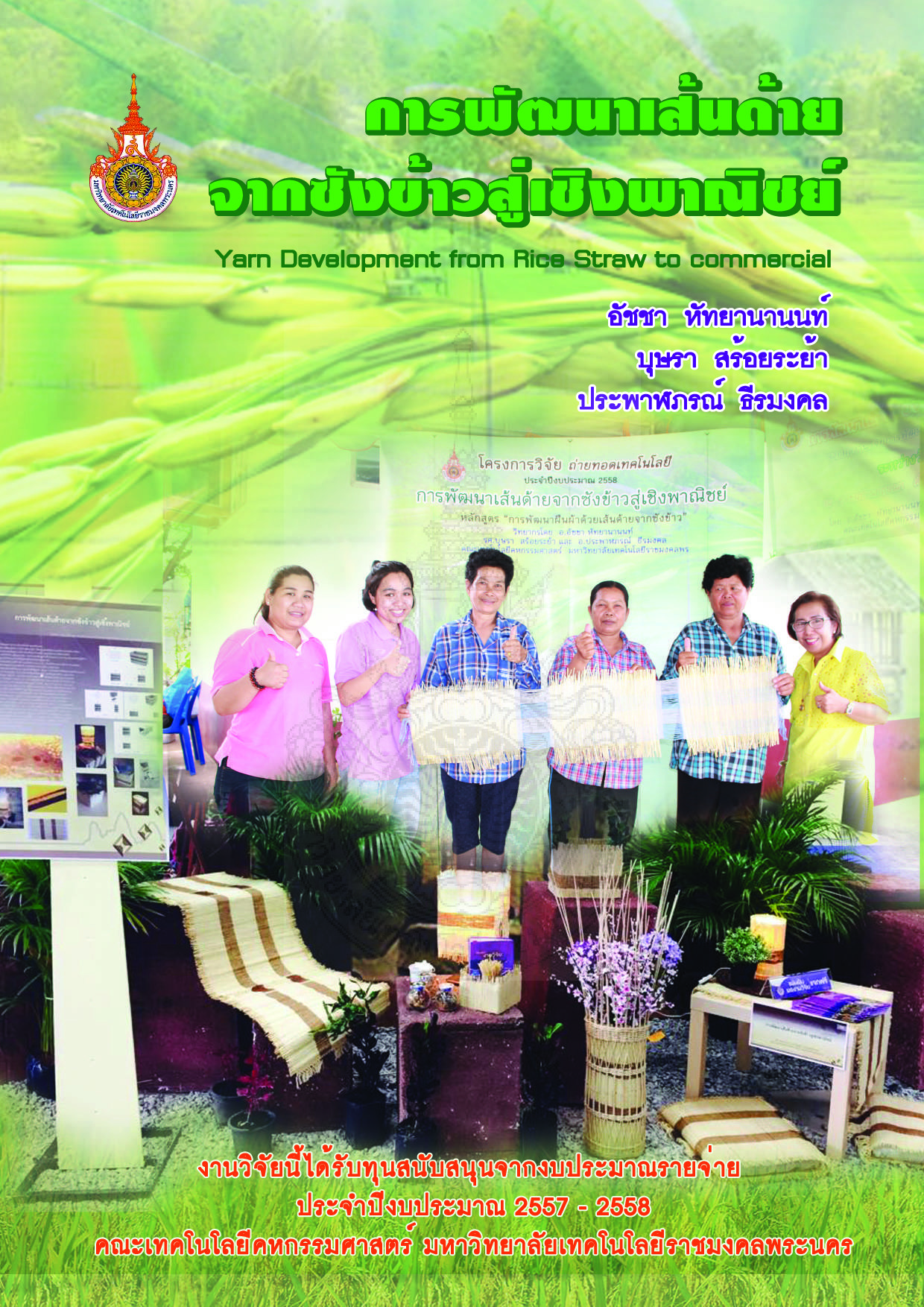
การพัฒนาเส้นด้ายจากซังข้าวสู่เชิงพาณิชย์
This research is Yarn Development from Rice straw to commercial. It aims to study the process of seperating fibers from rice straw. To study the physical properties of fibers from rice straw and to study the process of manufacturing yarn from rice straw fibers. The research material is rice straw fibers after that data was analyzed byphysical textile testing laboratory. The result of the first year’s research was the rice straw yarn has been developed as woven and develop into commercial products to promote. The process of separating fibers from rice straw which dried the sun for a few days. Selecting the rice straw fiber length at least 30 cm. to subtract the joints of the lower end of the stem by hand. peel off the rice straw fiber and place flat on a horizontal line. Then Rice straw fiber were tested in the physical laboratory was found that it is cellulose fibers tensile strength (Newton) at 28.18 elongation (percent) is at 2.01. The amounts of metals has plenty of CADMIUM at 0.1 mg/kg CHROMIUM (TOTAL) / (VI) at 0.5 mg/kg COPPER at 0.5 mg/kg and LEAD at 0.1 mg/kg which was not found to be risk for using. The fiber cross-section of rice straw fiber were found to be oval the middle is clearly. The fiber length is smooth and transparent when viewed from the side to see the clarity of the fiber. Rice straw fiber was weave in plain structure. Warp yarn uses a special brown cream and brown flat yarns. We use rice straw fiber with the same type of yarn. There are 2 warp yarn and using natural color without blench. Rice straw fabric was dyeing with dried hibiscus flowers (Kaa-Jeab herb) and mordant as ashes. The result is red light because of rice straw fiber surface is smooth and lustrous. Therefrom When woven as a fabric to develop be 4 products prototype : table lamps tablecloths in Japanese style potted plants and Accessories Box The result of the second year’s research there are focus group inquire for people it is interesting in this research and Date for transfer knowledge as: Ban-Krit-Sa- Na community Krit-Sa-Na sub-district bang-pra-ma district in Supanburi province. To plan the schedule and set the date place amount of participate and lectures 34 people The range of time to transfer as 3 days on 3 – 5 May 2015 and asking for consumer satisfaction of the curriculum and lecture for “transfer knowledge Yarn Development from Rice straw to commercial” by Questionnaire of participate satisfaction. Last the evaluation data was analyzed by using SPSS program in mean and percentage. The second year found that mostly participates were female aged under 21 years old finished the secondary school and also there are farmer. The participates are their income under 5000 baht and no income. For the participates questions relation to technology transfer of “Yarn Development from Rice straw to commercial” about course divided into 3 parts: The purpose The curriculum and The knowledge. The satisfaction of participates about project divided into 3 parts: Service process Lecturer and Facilities found that have been satisfied at maximum average and highest level of satisfaction in every parts of both satisfied participates questions. The participants are mainly used to provide benefits to themselves for one month to apply the gained after the training. Satisfaction with the benefits of technology transfer and utilization. Satisfaction at the highest level the participants used knowledge to apply with local and waste material. Moreover the participates make product as soon as finish course and they are planning to produce the table Hand Woven for weaving the Rice straw yarn fabric and push it to be OTOP products. The comments and suggestions of the participants found that they need for re-training again. They would like to have a longer period of training in order to gain more knowledge. All lecturer can transfer knowledge during the training as well.
การพัฒนาและวัดประสิทธิภาพระบบติดตามดวงตาต้นทุนต่ำ
Nowadays Eye Tracking Technology is one main challenge for developers of new human-computer interface. This technology provides a more natural way of interacting with a computer system by user’s eye. Now commercially available systems exist; however they are not widely used because of expensiveness. This paper describes a tutorial that shows step by step how to build a low-cost eye tracker using eyeglass setup. The glasses are designed to work with video-oculography technique (VOG) in the infrared spectrum. The key features of the eye is a center of the pupil. The gaze point of users are estimated based on order polynomial regression (linear quadratic and cubic). This research conducted an experiment with 30 participants tested eye-gaze calibration. Consequently the experimental results showed that eye-gaze can be estimated in real-time while the cubic function can be accurate eye-gaze position more than the other function.

Biogasification from rice straw
The research is to present the biogas production from rice straws with anaerobic digester. Firstly three digester tanks contain dry rice straw 3 kg slice with length 1-2 inch and water 60 lite. Digester A was a control sample. Digester B was designed for minimum performance (add the morass 2 lite) while the digester C was designed for Carbon/Nitrogen control (add urea 1 kg.). The biogas was operated for 30 days and measured which highest percent of Lower Explosive Limit was 93%. This studied show the simple methods to producing the biogas from the rice straw.
Development of bone replacement material via nanohydroxyapatite crystal growth on silk fibroin fiber
The objective of this research is to propose a new way to fabricate a composite material for future bone replacement development via growing apatite crystal on silk fibroin fiber. Apatite crystallization on silk fibroin fiber was prepared by precipitation reaction between Ca(NO3)2 solution and (NH4)2HPO4 solution adjusted pH by NH4OH solution. In this work Effect of solution concentration and initial pH values was investigated on apatite crystals. Chicken eggshells were used as calcium source by heating sufficiently powdered eggshells at 1300 °C for 4 h to acquire CaO powders made Ca(NO3)2 solution by dissolving in 65% HNO3 solution. Prepared Ca(NO3)2 solutions were adjusted concentration as 3 levels and were adjusted different pH values of 7 8 and 9 respectively. For processing of apatite crystallization silk fibroin fibers were immersed in Ca(NO3)2 solutions for 30 min. After that (NH4)2HPO4 solutions were added in silk fibroin fibers immersed in Ca(NO3)2 solutions. Reaction time was fixed about 1 min before cleaning to remove impurity precipitates on surface of silk fibroin fiber. Finally apatite crystallization on silk fibroin fibers occurred. The obtained result can conclude morphologies of apatite crystals on silk fibroin fibers was sheets sphere and flower. Solution concentrations and initial pH values directly influenced on Ca/P ratio of obtained apatite crystals by Ca/P ratio increases as increased solution concentrations or increased pH values. Finally research silk fibroin fibers were woven as two patterns of plain weave and twill weave and they were investigated Young’s modulus and tensile strength. The result indicates that Young’s modulus of silk fibroin fiber sheets woven as twill weave and as plain weave were about 616 MPa and 425 Mpa and tensile strengths of them weave were about 40 Mpa and 72 Mpa respectively. The optimum condition of growing apatite crystals on silk fibroin fibers was sample of CP19. Design of silk fibroin fiber with plain weave was an optimum pattern for future biomedical applicaions.