จำนวน Repository ( 795 )
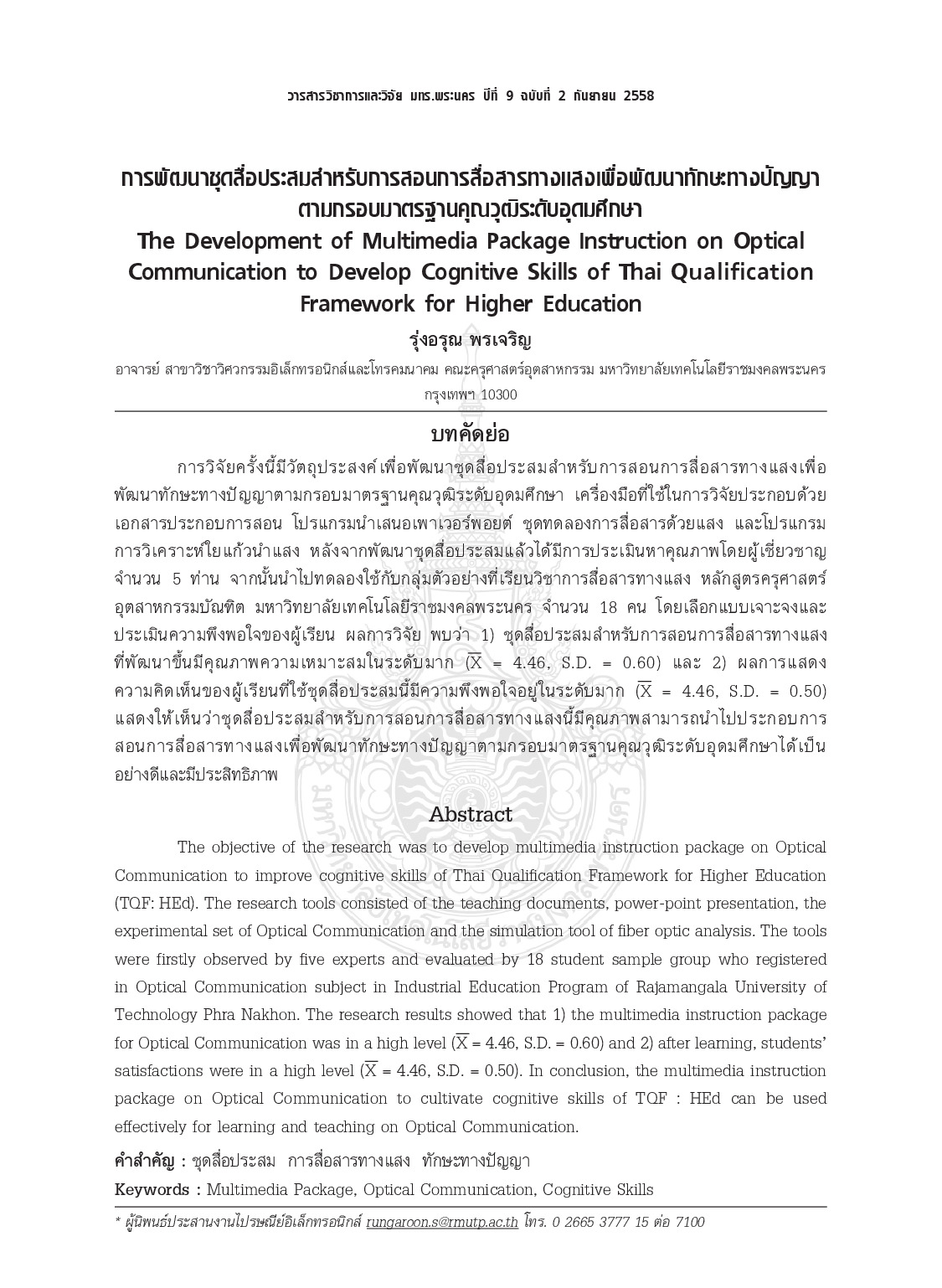
การพัฒนาชุดสื่อประสมสำหรับการสอนการสื่อสารทางแสงเพื่อพัฒนาทักษะทางปัญญาตามกรอบมาตรฐานคุณวุฒิระดับอุดมศึกษา
The objective of the research was to develop multimedia instruction package on Optical Communication to improve cognitive skills of Thai Qualification Framework for Higher Education (TQF: HEd). The research tools consisted of the teaching documents power-point presentation the experimental set of Optical Communication and the simulation tool of fiber optic analysis. The tools were firstly observed by five experts and evaluated by 18 student sample group who registered in Optical Communication subject in Industrial Education Program of Rajamangala University of Technology Phra Nakhon. The research results showed that 1) the multimedia instruction package for Optical Communication was in a high level (X ̅=4.46S.D.=0.60) and 2) after learning students’ satisfactions were in a high level (X ̅=4.46S.D.=0.50). In conclusion the multimedia instruction package on Optical Communication to cultivate cognitive skills of TQF: HEd can be used effectively for learning and teaching on Optical Communication.
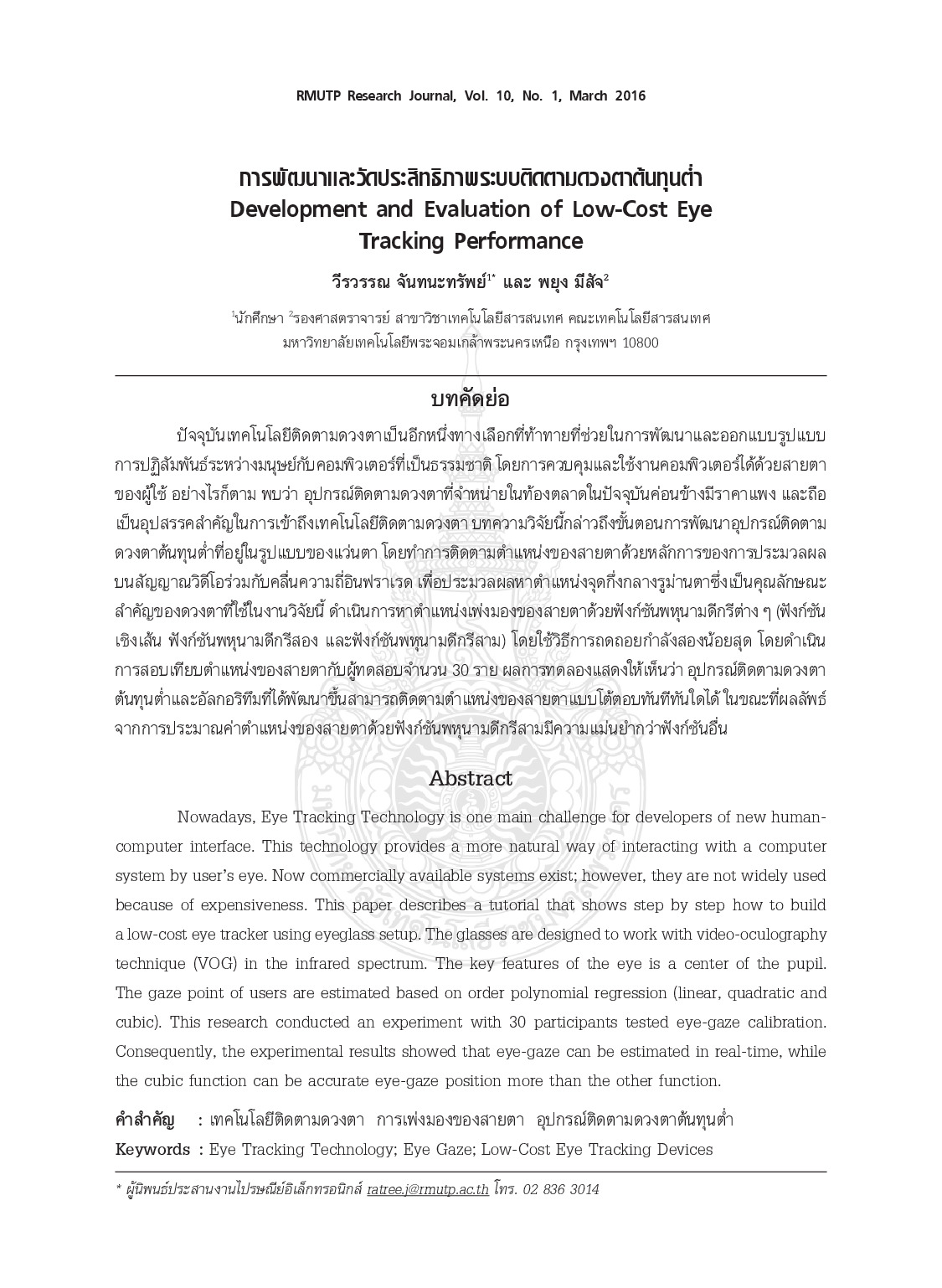
การพัฒนาและวัดประสิทธิภาพระบบติดตามดวงตาต้นทุนต่ำ
Nowadays Eye Tracking Technology is one main challenge for developers of new human-computer interface. This technology provides a more natural way of interacting with a computer system by user’s eye. Now commercially available systems exist; however they are not widely used because of expensiveness. This paper describes a tutorial that shows step by step how to build a low-cost eye tracker using eyeglass setup. The glasses are designed to work with video-oculography technique (VOG) in the infrared spectrum. The key features of the eye is a center of the pupil. The gaze point of users are estimated based on order polynomial regression (linear quadratic and cubic). This research conducted an experiment with 30 participants tested eye-gaze calibration. Consequently the experimental results showed that eye-gaze can be estimated in real-time while the cubic function can be accurate eye-gaze position more than the other function.
การพัฒนาแผ่นซีเมนต์บอร์ดด้วยกากกาแฟเพื่อการอนุรักษ์สิ่งแวดล้อม
The using of ground coffee wastes from industries to develop the cement board is an objective of this research that can solve the air pollution problems from smell and spreading of ground coffee wastes. The ratio of Portland cement type1: fine sand: tap water is equal to 1: 0.5: 0.416 by weight and the ratios of Portland cement type1: ground coffee wastes include 1: 0.05 1: 0.06 1: 0.07 1: 0.08 1:0.09 and 1: 0.10 by weight (6 ratios). The production of cement board uses the pressure casting in temperature 30 – 35 degree of Celsius and controls 0.75 g/cm3 of density. The testing of cement-bonded fiberboard properties follow the TIS 878-2537 standard (cement bonded particle board: high density). From the results 1: 0.05 is the most suitable quantity of cement: ground coffee wastes which mixed in cement board. This cement boards can reduce the ground coffee wastes by using as aggregate to produce the construction materials.
การพัฒนาแผ่นซีเมนต์บอร์ดจากเถ้ากะลามะพร้าว สำหรับการอนุรักษ์พลังงานและสิ่งแวดล้อม
This research aims to develop the cement board from coconut shell ash. The Portland cement type1: fine sand: tap water ratio is equal to 1: 0.4: 0.33 by weight. The 5 ratios of Portland cement type1: coconut shell ash include 1: 0.12 1: 0.13 1: 0.14 1: 0.15 and 1: 0.16 by weight. The cement board production uses the pressure casting in normal temperature (30 – 35 degree of Celsius) and controls the 0.75 g/cm3 of density then test the properties of cement-bonded fiberboard follow TIS 878-2537 standard (cement bonded particle board: high density). From the results 1: 0.12 is the most suitable ratio of cement board from coconut shell ash. This developed cement boards can reduce the quantity of coconut shell ash waste and have the good thermal insulation.
กลยุทธ์และกระบวนการพัฒนาเกมส์ทางการศึกษาสำหรับเด็กปฐมวัย
This research aims to study strategies required for developing educational game for preschool students and the development processes involved. The sampling groups used in this research included 3 content specialists whose responsibility is to verify the content of the games and 17 specialists on educational game. The sampling groups are selected particularly from the central region of Thailand. The research findings reveal the insights from the majority of specialists on development of educational games for preschool children as follow: games such as picture-matching domino object ordering object categorizing detail observing and number addition & subtraction games are popular for teaching. Moreover the principles for applying educational games with lessons should be incorporated in the development of game strategies. In addition the main objectives and the development process of games should focus primarily on their ability to draw attention from students as well as the fun of playing and allowing students to practice lessons and participate in class activities. The tools used for developing games are computers and devices created by teachers themselves. As for the future of educational game the trend is the more involvement of technology through the use of computer or mobile devices. Problems in game development include limited budget for purchasing hardware and devices. On top of that training on game development is much needed among teachers. The research results can be concluded with the following 5 strategies for preschool students: 1) enhance teachers’ knowledge and skills 2) study details of different kinds of games 3) develop games 4) determine time used for playing game 5) evaluate the process of game development in 4 areas including type of game devices used rules and playing instruction.