จำนวน Repository ( 558 )
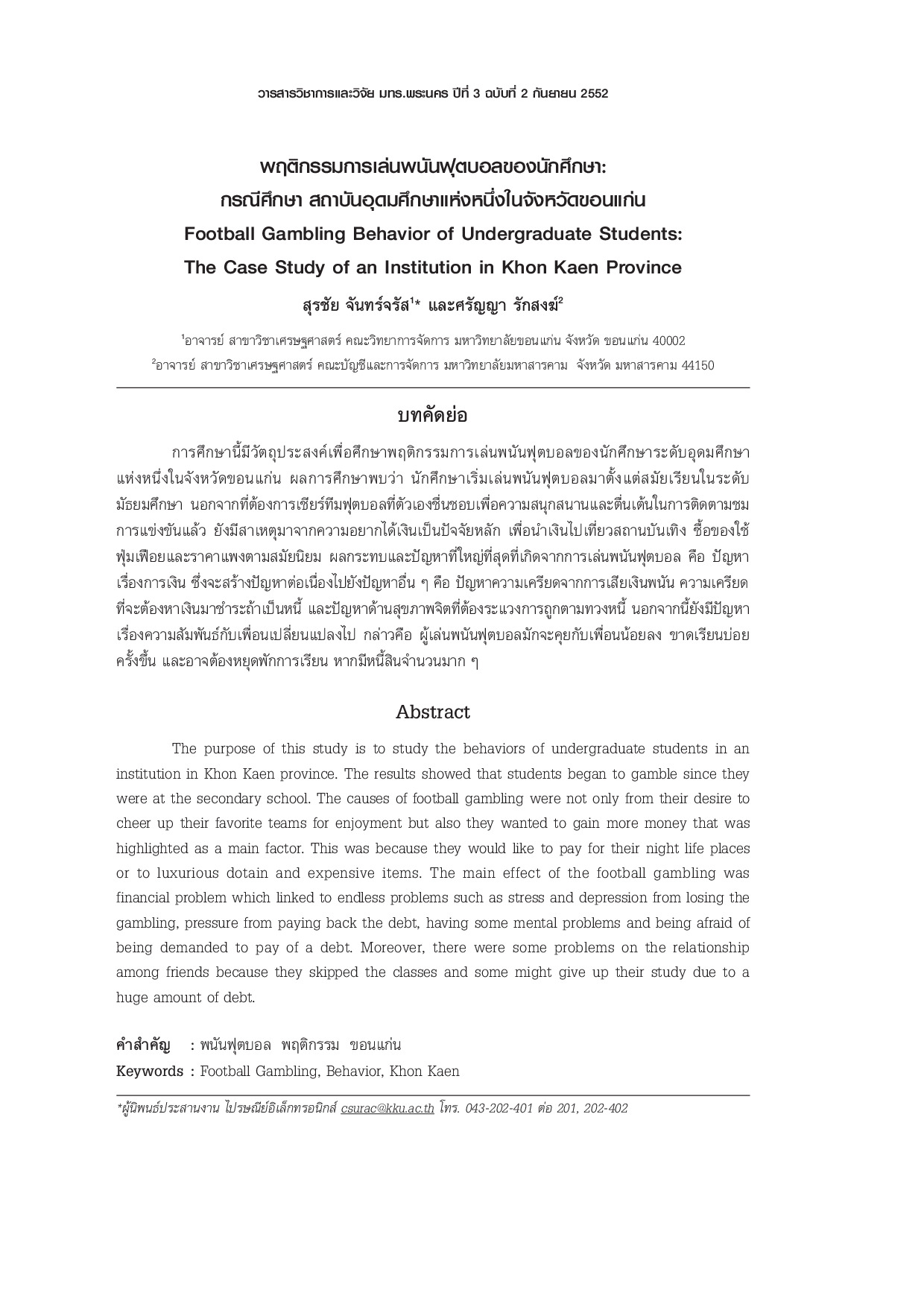
Football Gambling Behavior of Undergraduate Students: The Cass Study of an Institution in Khon Kaen Province
The purpose of this study is to study the behaviors of undergraduate students in an institution in Khon Kaen province. The results showed that students began to gamble since they were at the secondary school. The causes of football gambling were not only from their desire to cheer up their favorite teams for enjoyment but also they wanted to gain more money that was highlighted as a main factor. This was because they would like to pay for their night life places or to luxurious dotain and expensive items. The main effect of the football gambling was financial problem which linked to endless problems such as stress and depression from losing the gambling pressure from paying back the debt having some mental problems and being afraid of being demanded to pay of a debt. Moreover there were some problems on the relationship among friends because they skipped the classes and some might give up their study due to a huge amount of debt.
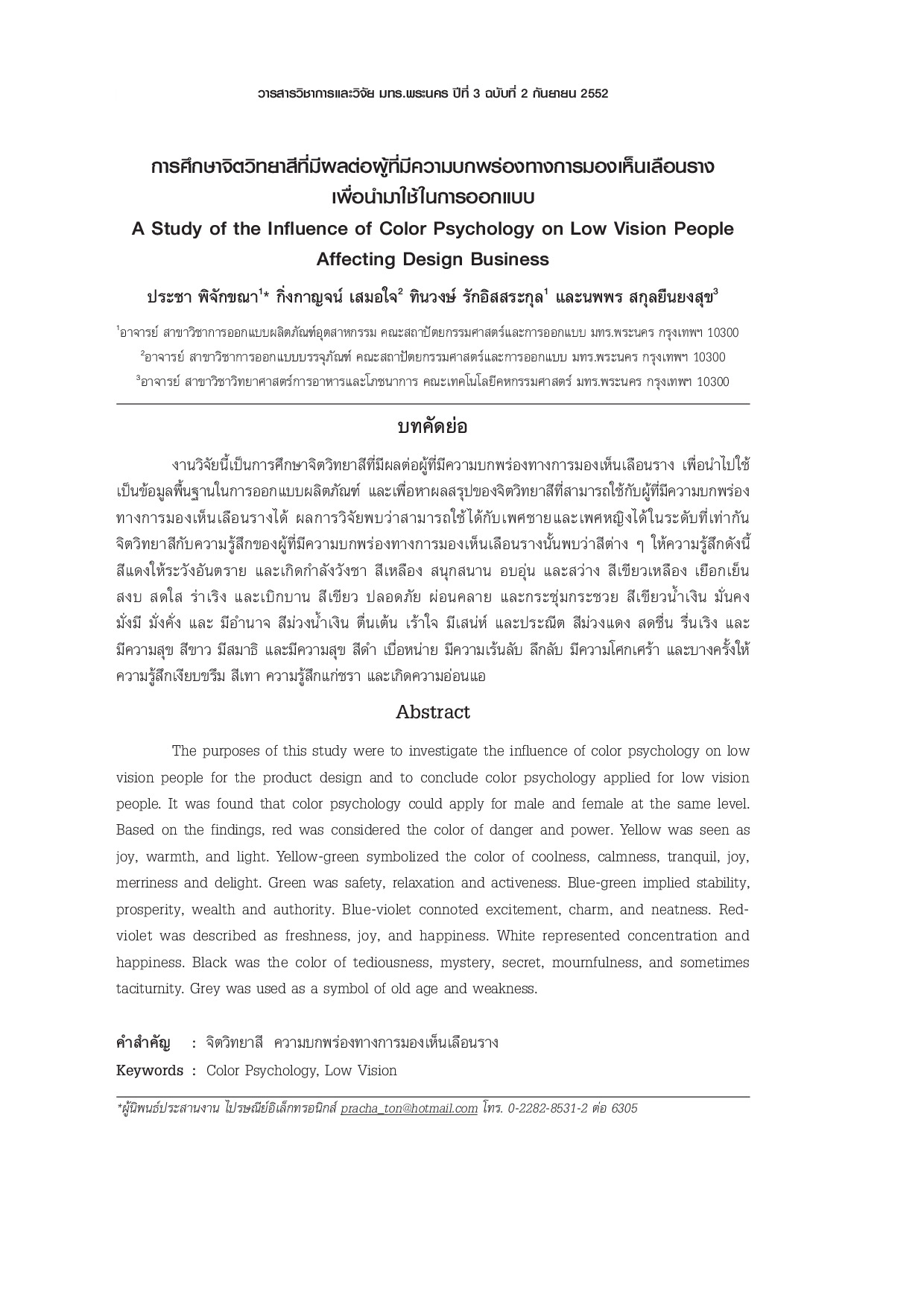
A Study of the Influence of Color Psychology on Low Vision People Affecting Design Business
This purposes of this study were to investigate the influence of color psychology on low vision people for the product design and to conclude color psychology applied for low vision people. It was found that color psychology could apply for male and female at the same level. Based on the findings red was considered the color of danger and power. Yellow was seen as joy warmth and light. Yellow-green symbolized the color of coolness calmness tranquil joy merriness and delight. Green was safety relaxation and activeness. Blue-green implied stability prosperity wealth and authority. Blue-violet connoted excitement charm and neatness. Red-violet was described as freshness joy and happiness. White represented concentration and happiness. Black was the color of tediousness mystery secret mournfulness and sometimes taciturnity. Grey was used as a symbol of old age and weakness.
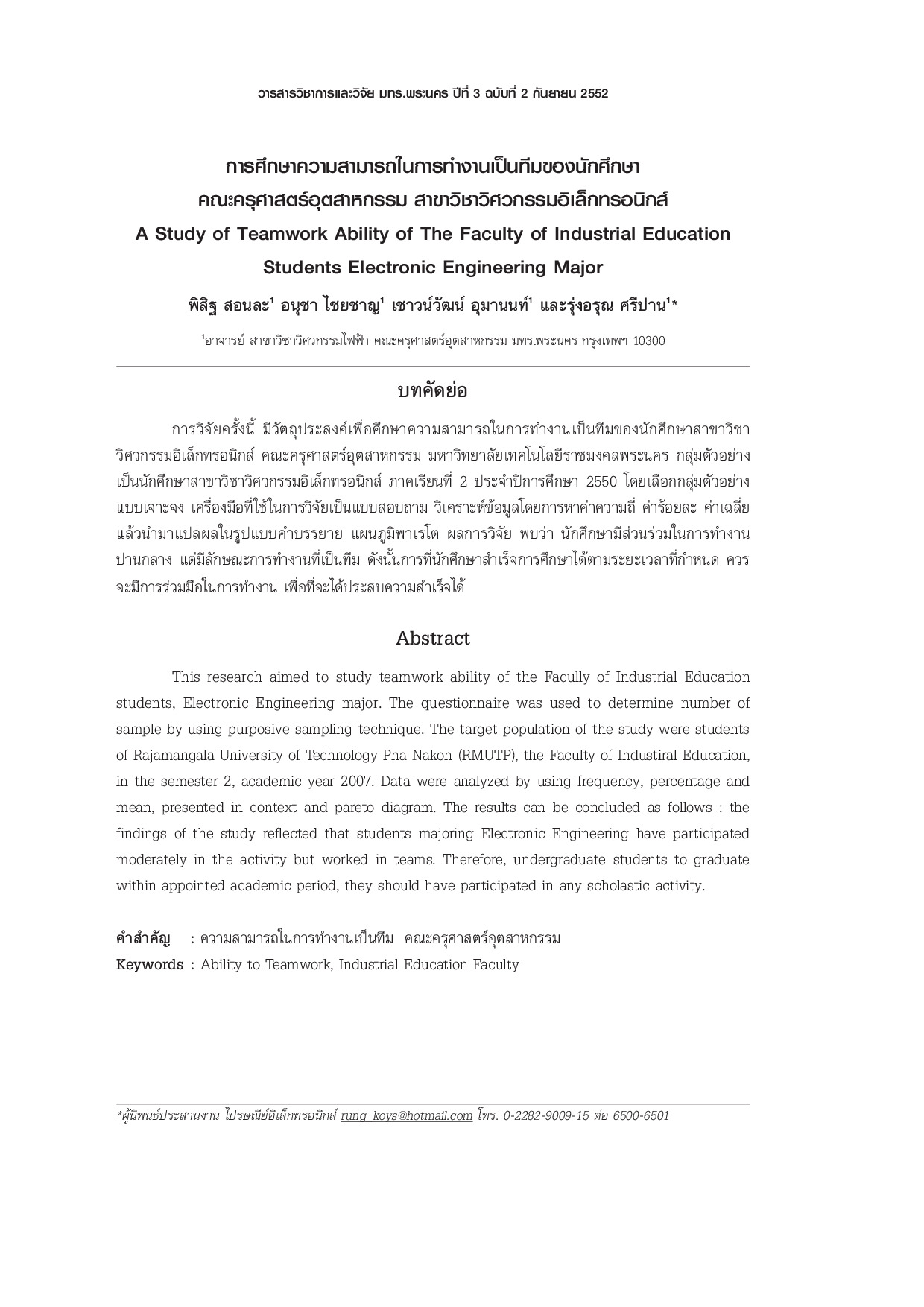
A Study of Teamwork Ability of The Faculty of Industrial Education Students Electronic Engineering Major
This research aimed to study teamwork ability of Facully of Industrial Education students Electronic Engineering major. The questionnaire was used to determine number of sample by using purposive sampling technique. The target population of the study were students of Rajamangala University of Technology Pha Nakon (RMUTP) the Faculty of Industiral Education in the semester 2 academic year 2007. Data were analyzed by using frequency percentage and mean presented in context and pareto diagram. The results can be concluded as follows: the findings of the study reflected that students majoring Electronic Engineering have participated moderately in the activity but worked in teams. Therefore undergraduate students to graduate within appointed academic period they should have participated in any scholastic activity.
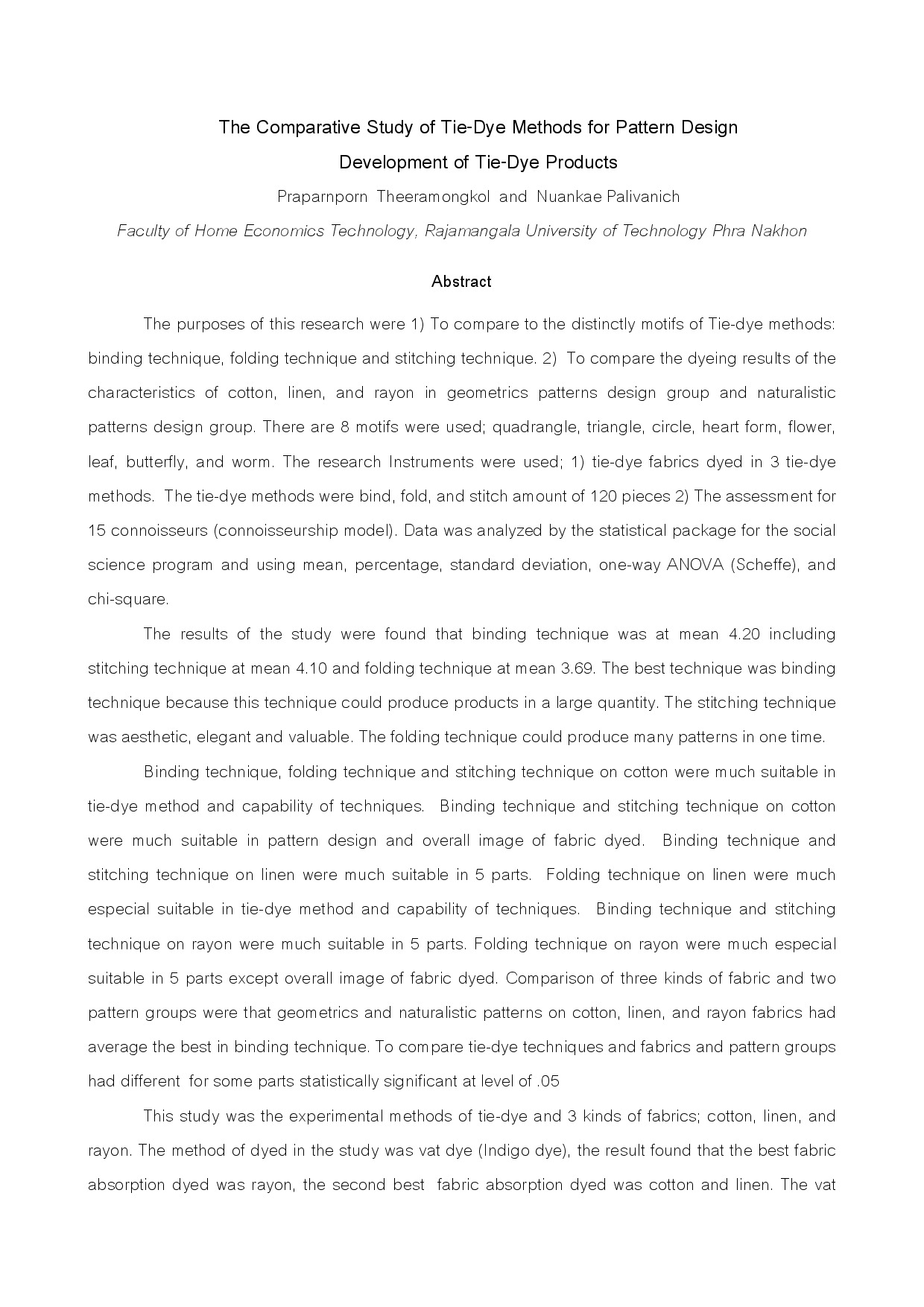
The Comparative Study of Tie-Dye Methods for Pattern Design Development of Tie-Dye Products
The purposes of this research were 1) To compare to the distinctly motifs of Tie-dye methods: binding technique folding technique and stitching technique. 2) To compare the dyeing results of the characteristics of cotton linen and rayon in geometrics patterns design group and naturalistic patterns design group. There are 8 motifs were used; quadrangle triangle circle heart form flower leaf butterfly and worm. The research Instruments were used; 1) tie-dye fabrics dyed in 3 tie-dye methods. The tie-dye methods were bind fold and stitch amount of 120 pieces 2) The assessment for 15 connoisseurs (connoisseurship model). Data was analyzed by the statistical package for the social science program and using mean percentage standard deviation one-way ANOVA (Scheffe) and chi-square. The results of the study were found that binding technique was at mean 4.20 including stitching technique at mean 4.10 and folding technique at mean 3.69. The best technique was binding technique because this technique could produce products in a large quantity. The stitching technique was aesthetic elegant and valuable. The folding technique could produce many patterns in one time. Binding technique folding technique and stitching technique on cotton were much suitable in tie-dye method and capability of techniques. Binding technique and stitching technique on cotton were much suitable in pattern design and overall image of fabric dyed. Binding technique and stitching technique on linen were much suitable in 5 parts. Folding technique on linen were much especial suitable in tie-dye method and capability of techniques. Binding technique and stitching technique on rayon were much suitable in 5 parts. Folding technique on rayon were much especial suitable in 5 parts except overall image of fabric dyed. Comparison of three kinds of fabric and two pattern groups were that geometrics and naturalistic patterns on cotton linen and rayon fabrics had average the best in binding technique. To compare tie-dye techniques and fabrics and pattern groups had different for some parts statistically significant at level of .05 This study was the experimental methods of tie-dye and 3 kinds of fabrics; cotton linen and rayon. The method of dyed in the study was vat dye (Indigo dye) the result found that the best fabric absorption dyed was rayon the second best fabric absorption dyed was cotton and linen. The vat dye in different kinds of fabric were dyed at the same quantity. They were dyed in the nearly different shade. Rayon was the best dye than another kind. Cotton and linen were dyed as the same shade.
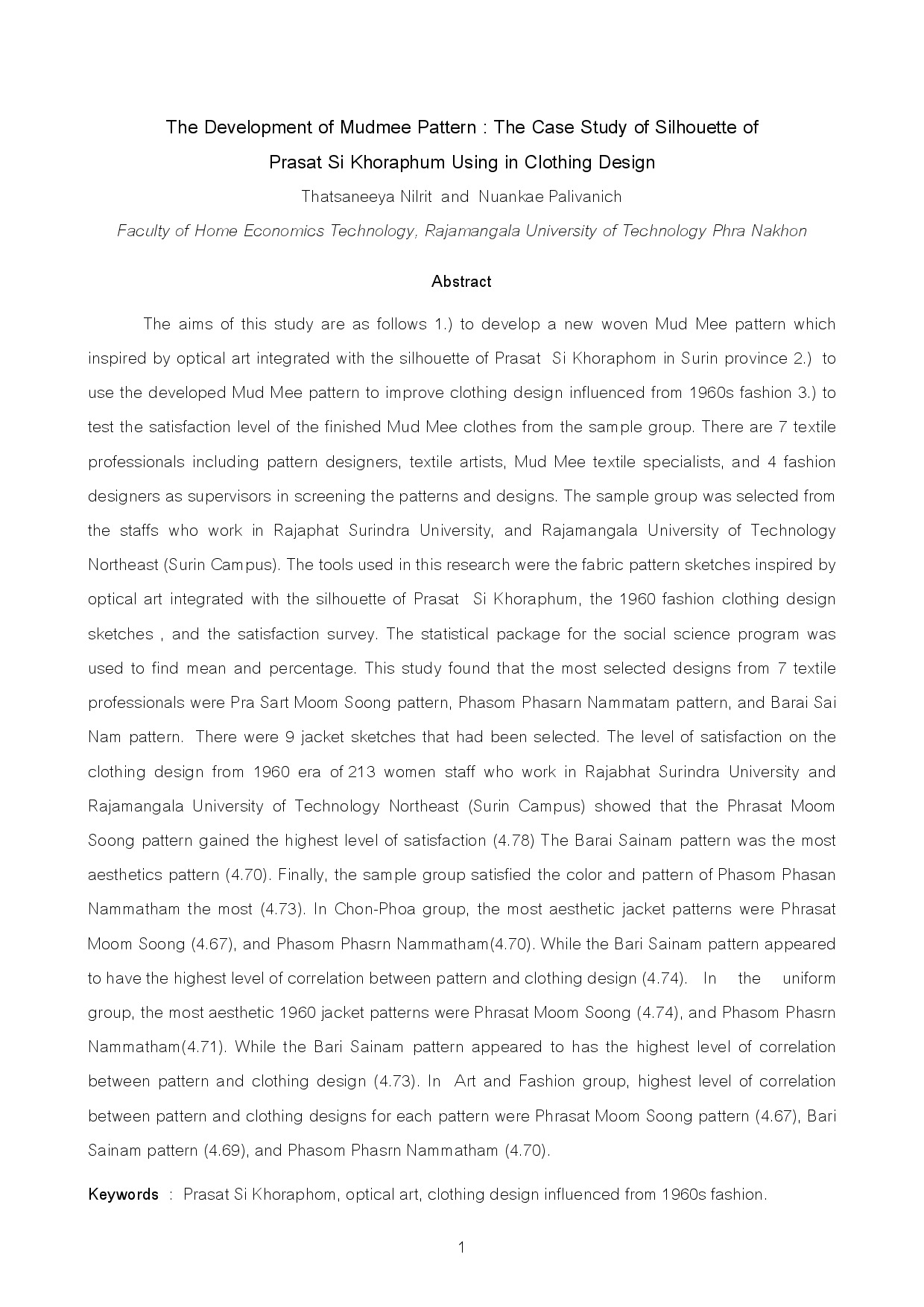
The Development of Mudmee Pattern : The Case Study of Silhouette of Prasat Si Khoraphum Using in Clothing Design
The aims of this study are as follows 1.) to develop a new woven Mud Mee pattern which inspired by optical art integrated with the silhouette of Prasat Si Khoraphom in Surin province 2.) to use the developed Mud Mee pattern to improve clothing design influenced from 1960s fashion 3.) to test the satisfaction level of the finished Mud Mee clothes from the sample group. There are 7 textile professionals including pattern designers textile artists Mud Mee textile specialists and 4 fashion designers as supervisors in screening the patterns and designs. The sample group was selected from the staffs who work in Rajaphat Surindra University and Rajamangala University of Technology Northeast (Surin Campus). The tools used in this research were the fabric pattern sketches inspired by optical art integrated with the silhouette of Prasat Si Khoraphum the 1960 fashion clothing design sketches and the satisfaction survey. The statistical package for the social science program was used to find mean and percentage. This study found that the most selected designs from 7 textile professionals were Pra Sart Moom Soong pattern Phasom Phasarn Nammatam pattern and Barai Sai Nam pattern. There were 9 jacket sketches that had been selected. The level of satisfaction on the clothing design from 1960 era of 213 women staff who work in Rajabhat Surindra University and Rajamangala University of Technology Northeast (Surin Campus) showed that the Phrasat Moom Soong pattern gained the highest level of satisfaction (4.78) The Barai Sainam pattern was the most aesthetics pattern (4.70). Finally the sample group satisfied the color and pattern of Phasom Phasan Nammatham the most (4.73). In Chon-Phoa group the most aesthetic jacket patterns were Phrasat Moom Soong (4.67) and Phasom Phasrn Nammatham(4.70). While the Bari Sainam pattern appeared to have the highest level of correlation between pattern and clothing design (4.74). In the uniform group the most aesthetic 1960 jacket patterns were Phrasat Moom Soong (4.74) and Phasom Phasrn Nammatham(4.71). While the Bari Sainam pattern appeared to has the highest level of correlation between pattern and clothing design (4.73). In Art and Fashion group highest level of correlation between pattern and clothing designs for each pattern were Phrasat Moom Soong pattern (4.67) Bari Sainam pattern (4.69) and Phasom Phasrn Nammatham (4.70).