จำนวน Repository ( 67 )
กลยุทธ์และกระบวนการพัฒนาเกมส์ทางการศึกษาสำหรับเด็กปฐมวัย
This research aims to study strategies required for developing educational game for preschool students and the development processes involved. The sampling groups used in this research included 3 content specialists whose responsibility is to verify the content of the games and 17 specialists on educational game. The sampling groups are selected particularly from the central region of Thailand. The research findings reveal the insights from the majority of specialists on development of educational games for preschool children as follow: games such as picture-matching domino object ordering object categorizing detail observing and number addition & subtraction games are popular for teaching. Moreover the principles for applying educational games with lessons should be incorporated in the development of game strategies. In addition the main objectives and the development process of games should focus primarily on their ability to draw attention from students as well as the fun of playing and allowing students to practice lessons and participate in class activities. The tools used for developing games are computers and devices created by teachers themselves. As for the future of educational game the trend is the more involvement of technology through the use of computer or mobile devices. Problems in game development include limited budget for purchasing hardware and devices. On top of that training on game development is much needed among teachers. The research results can be concluded with the following 5 strategies for preschool students: 1) enhance teachers’ knowledge and skills 2) study details of different kinds of games 3) develop games 4) determine time used for playing game 5) evaluate the process of game development in 4 areas including type of game devices used rules and playing instruction.

The effectiveness study of thai architecture learning record
This research aims to improve the learning performance of Thai architecture learning record. Study the learning of Thai architecture. And the attitudes of students from the learning program. Thai architecture sample interior architecture students in the second semester of an academic year of 2552 with 20 students at 15 weeks the students self-assess students with the knowledge of Thai architecture. The question is how to get 5 points. The acquired knowledge. The well received. The good is happening. Can occur. And suggestions. Analysis of quantitative data in percentage. Qualitative methods of synthesis. The results showed that Performance of the learning of Thai architecture. Accounted for 76.20 percent of the learning of Thai architecture. An average of 79.50 percent of the students and the learning of Thai architecture. A positive attitude. The attitude to the self to the friend attitude towards the teacher and attitude towards learning. Compliant with the learning curriculum of Bachelor of Architecture. The field of interior architecture completed in 5 areas: moral knowledge intellectual skills interpersonal skills and responsibilities numerical analysis skills and skills in communication and usage information technology.
The participatory learning process of leaung rice 11 production without toxic substance case study : khoklam village kamalasai district kalasin provice
This research aims to study participatory learning process to strengthen rural communities through Leaung Rice 11 production which promotes self-reliability and capability of the communities. This is a participatory action research (PAR) with farm experimental methods. It demonstrates a model to empower community which allows members to identify problems discuss find commitment and approve incoming development. Researchers here are therefore facilitators helping people in the community to achieve effective production of Yellow Rice 11. After providing sufficient information about Leaung Rice 11 production the main problems identified is a high production cost with chemical fertilizer being abundantly used causing health and environment problems to the community. This results in a solution of choosing organic Yellow Rice 11 production that is harmless and friendly to the environment. Despite co-operative learning and problems identification locals also get an opportunity to plant Leaung Rice 11 with organic fertilizer and Effective Microorganisms (EM) as a model to safe cost. It is obvious that rice production is also increased (737.69 Kilogram per Rai). Moreover production cost decreases to 1227.50 Baht per Rai per family. This research provides the community ability to analyze self-problems and potentiality under modern research methodology; problems identification solution identification experiment process co-operative learning data collection data discrimination data analysis and data application.
The Effects of learning orientation and knowledge management capability on innovation excellence and export performance of furniture exporting business in Thailand
The purpose of the research was to test the effects of learning orientation and knowledge management capability on innovation excellence and export performance of furniture exporting business in Thailand. The questionnaire was used as a research instrument to collect the data from 185 managing directors of business of furniture exporting business in Thailand. The statistics used for analyzing data were multiple correlation analysis and multiple regression analysis. The results of the research showed that learning orientation had a positive significant an effect on knowledge management capability but it does not a positive and effect on innovation excellence and export performance. In addition knowledge management capability had a positive significant an effect on innovation excellence but it does not a positive significant an effect on export performance. Also innovation excellence had a positive significant an effect on export performance.
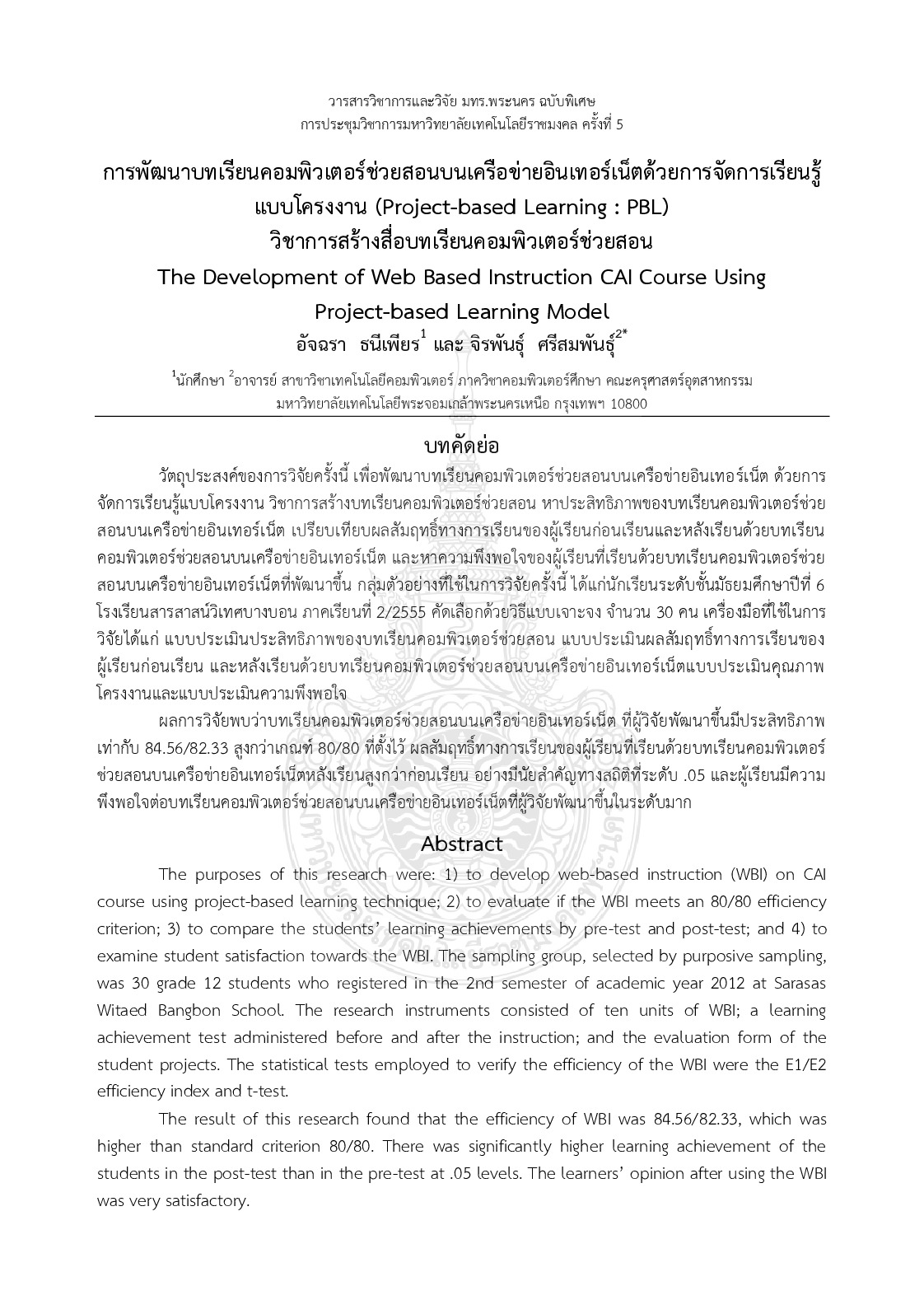
The development of web based instruction CAI course using project-based learning model
The purposes of this research were: 1) to develop web-based instruction (WBI) on CAI course using project-based learning technique; 2) to evaluate if the WBI meets an 80/80 efficiency criterion; 3) to compare the students’ learning achievements by pre-test and post-test; and 4) to examine student satisfaction towards the WBI. The sampling group selected by purposive sampling was 30 grade 12 students who registered in the 2nd semester of academic year 2012 at Sarasas Witaed Bangbon School. The research instruments consisted of ten units of WBI; a learning achievement test administered before and after the instruction; and the evaluation form of the student projects. The statistical tests employed to verify the efficiency of the WBI were the E1/E2 efficiency index and t-test. The result of this research found that the efficiency of WBI was 84.56/82.33 which was higher than standard criterion 80/80. There was significantly higher learning achievement of the students in the post-test than in the pre-test at .05 levels. The learners’ opinion after using the WBI was very satisfactory.